Although I didn’t come from what is generally understood to be “a musical family,” my mother still loved music. It just wasn’t what I would call my kind of music. Carole King, James Taylor, Barbra Streisand, Cher, Barry Manilow, Stevie Wonder, Chicago. It was all agreeable enough, but it didn’t grab me by the heart. But Mom was always supportive of my passions, and when the classical music thunderbolt struck, sparked by my discovery of the orchestra by way of John Williams, she did everything she could to feed the flame.
Needless to say, the world was a different place in the late ‘70s and early ‘80s. There was no internet, so it was possible to have a life and find happiness in the world most of the time. We lived in Easton, Pennsylvania, a quiet town, though classified as a city, about 90 minutes by car from New York and Philadelphia. Downtown Easton in the ‘70s was still pretty much as it had been for decades, though clearly in the twilight of its mid-century prime. The novelty of shopping malls caused the businesses to wither, but for the most part, the town you see in “Back to the Future,” that was it.
It was not a magnet for touring symphony orchestras, and for some reason that puzzles me, I never did see an orchestra play classical music until I left for college in 1984. But we got plenty of string quartets and pianists and opera companies that sang with piano accompaniment, mostly at the local colleges and at some of the churches. The Williams Center for the Performing Arts did not open at Lafayette College until 1983, and the Orpheus Chamber Orchestra didn’t commence its regular visits until 1987. I had already left for Temple University and the Philadelphia Orchestra in 1984, but it was easy enough to return home on a weekend, so I did manage to catch Orpheus there, at Lafayette, a number of times.
Until I discovered likeminded friends in my teens, my mom used to scope out the arts events in the local papers and, if I was interested (of course I was), she would usually attend concerts with me. The music would inspire flights of fancy and I was always jotting down ideas as they flitted through my head almost faster than I could capture them. These I would translate into stories and sometimes Super-8 films.
It was through records that I really got to know the orchestra (Beethoven was an early favorite), and there would always be a few LPs waiting for me under the tree at Christmas, and on one memorable occasion, after my Mom started taking a music appreciation course at Northampton County Community College, some Vivaldi records with my Easter basket. (She loved the Guitar Concerto in D.) In between, I would blow my allowance on discounted records at Listening Booth. Mom would build castles in the air for me, in the way that moms do, and encourage me, if it was something that I wanted, to work toward assembling a collection of my favorite composers. Little did she realize the seed that she planted!
It’s interesting to me to reflect back on my development. I was curious about opera. John Williams’ music for “Star Wars” was always being described as Wagnerian, so I went to the NCCC library and used my mom’s student I.D. to take out the multi-LP box of “Die Walküre.” This was such a strange new world to me. It was so… heavy. I just imagined these grim Norsemen in dark, sparsely-accoutered dwellings, the action, such that is, transpiring as in the sinewy illustrations of Arthur Rackham. But at that age, it was a little too much. I recognized “The Ride of the Valkyries,” of course, by what was all that wailing? Now, of course, I love Wagner and can totally get lost in it. But I remember a time in high school that even listening to Richard Strauss’ “Also sprach Zarathustra” made me feel physically unwell. I was a very sensitive kid.
Seeing Bergman’s film of “The Magic Flute” at Lafayette College was a breakthrough. That was a lot of fun. But the Metropolitan Opera broadcasts on Saturdays were still a slog. I remember those long afternoons, waiting for WFLN to get back to its regular programming. Again, it’s funny to think on it now, as I’ve long since broken the opera barrier. Certainly, by the time PBS broadcast the Met Ring Cycle in 1990, I was already well into it.
A notable exception to my early aversion had been the light operas of Gilbert & Sullivan, which I became totally hooked on as a teenager. (That’s right, G&S was my gateway drug!) My family went to see the Joseph Papp production of “The Pirates of Penzance” on Broadway – this would have been in 1982 – and after that my mom and I contrived to see every G&S performance we could get to. I also bought many of the operas on record, back when you could actually get them at the local mall. I still know all the lyrics to most of the most popular ones, having listened to them incessantly at such an impressionable age.
Again on PBS, I remember in the 1980s watching a series of G&S broadcasts featuring big stars in some of the principal roles (Vincent Price, Joel Grey, Robert Conrad, Peter Allen). The productions were a mixed bag, to be honest, but I enjoyed them (Clive Revill was always a treat), and my mom and I watched all of them while they lasted.
In the mid-‘80s, there was also a superb musical theater festival that was held at Muhlenberg College in Allentown in June that always included a first-rate Gilbert & Sullivan staging. For a time, we went every year, and we saw “Pirates” and “Patience” and “The Yeomen of the Guard” and “Ruddigore.” The latter was so much fun, I don’t know why it isn’t done more often. These were far superior to a touring production of “The Mikado” we caught around the same time at the State Theater in Easton.
One of the actors at Muhlenberg still stands out in my memory. As with the original D’Oyly Carte productions from back in the day, some of the Muhlenberg players were basically repertory. They returned year after year in roles suited to their “types.” I always delighted in John Hallman’s hammy performances and comic patter songs. In his bio, I learned he worked at one of the area hospitals, but clearly theater was in his blood. I wonder if he’s still around. Donald Spieth, who was music director of the now-defunct Lehigh Valley Chamber Orchestra, conducted the performances. There would also always be a standard musical, a show like “The King and I,” but that wasn’t quite my scene. I remember there was also a pretty good chamber music series.
I posted the other week about discovering some old programs in my parents’ attic, things that have sat there undisturbed for the past 40 years, and among them, I came across some Muhlenberg programs from the era.
Mom’s been gone 16 and ½ years now. The last concert we saw together was of Mozart’s last three symphonies, performed by the Chamber Orchestra of Philadelphia at the Kimmel Center in 2007. I can’t believe how cool my parents were about agreeing to see concerts with me when they came down to visit me in Philadelphia. My stepfather, in particular, was never a classical music guy and not one to sit still for long periods. He was a good sport to put up with us, in the upper levels of the old Academy of Music.
Mom and I had some great times together. She really made me what I am, or rather allowed me to become who I could be. She facilitated everything. Both my parents did, actually, she and my stepfather, but she was the one who was wholly simpatico. I am sorry to say, she was taken too soon. One of her greatest gifts to me is that she left me with no regrets, beyond the fact I could have had her in my life for perhaps another 30 years. Unsurprisingly, I am thinking of her, with gratitude, on Mother’s Day.
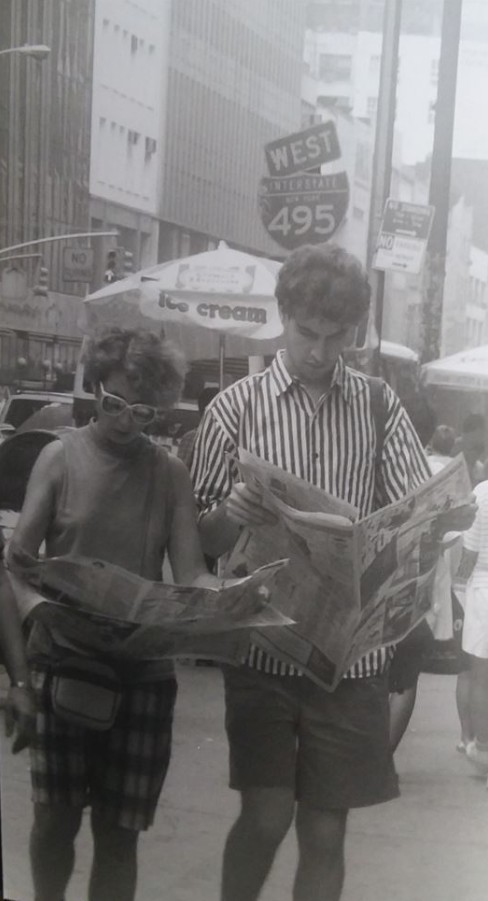
IMAGE: A little past our G&S heyday, but still a favorite photo