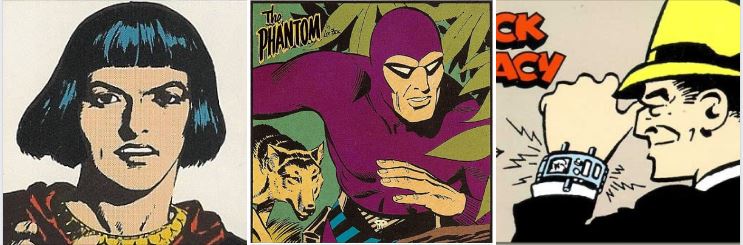
Get out your Silly Putty! There will be plenty of vibrant colors for you to enjoy this week on “Picture Perfect,” when the focus will be on comic adventurers – as in heroes from the funnies.
We’ll have music from movies inspired by the two-dimensional cliffhangers of newspaper favorites Prince Valiant, The Phantom, and Dick Tracy, as well as the longer-form, Golden Age adventures of Tintin.
“Prince Valiant” (1954) brings to life Hal Foster’s enduring Sunday strip about the exploits of a Viking prince at the court of King Arthur. Robert Wagner dons the signature page-boy haircut at the head of a hodge podge cast that also includes Janet Leigh, James Mason, Sterling Hayden, and Victor McLaglen (as Val’s Viking pal Boltar). The film also happens to feature one of Franz Waxman’s most rousing scores, clearly a prototype for the kind of music that later made John Williams a household name.
Then Billy Zane is “The Ghost Who Walks,” in a big screen adaptation of Lee Falk’s “The Phantom” (1996). Like Batman, The Phantom harnesses personal tragedy – in his case, the murder of his father – to a thirst for justice. He also happens to be part of an ancient lineage of Phantoms, who don the purple suit and fight crime from a secluded skull cave in a remote African country. The memorable, though somewhat monothematic, score is by David Newman, one of the sons of legendary Hollywood composer Alfred Newman.
Warren Beatty directs an amusing adaptation of Chester Gould’s “Dick Tracy” (1990), replete with primary color production design and meticulously applied prosthetic makeup, transforming some of the most respected actors of the day (including Al Pacino, Dustin Hoffman, and James Caan) into a live-action Rogue’s Gallery. Both design and makeup were recognized with Academy Awards, as was Stephen Sondheim, for his original song “Sooner or Later (I Always Get My Man),” sung in the film by Madonna. We won’t hear Sondheim’s song, but we will hear some of Danny Elfman’s underscore, which harkens back to Hollywood’s Golden Age.
Finally, we’ll turn from American newspaper strips to the comic albums of Belgian cartoonist Hergé, and his most famous creation, Tintin, an intrepid journalist whose stories seem always to embroil him in globetrotting adventures. Developed for the screen by Steven Spielberg and Peter Jackson, “The Adventures of Tintin” (2011) was shot as 3-D motion capture animation.
After 50 years in the business, during which he wrote music for all manner of films, in virtually every genre, John Williams finally got a crack at scoring an animated feature. The result was a double Academy Award nomination, as Williams had also written the music that year for Spielberg’s “War Horse.” Not bad for a then 79-year-old composer.
Unfortunately, “Tintin” never gained the kind of traction with the public that the filmmakers had hoped for, otherwise the score would certainly be much better known, as it is cut from the same cloth – and is of the same high quality – as those for the “Star Wars,” Indiana Jones, and Harry Potter series.
We’ll see you in the funny pages, this week on “Picture Perfect,” music for the movies, now in syndication on KWAX Classical Oregon!
——–
Clip and save the start times for all three of my recorded shows:
PICTURE PERFECT, the movie music show – Friday at 8:00 PM EST/5:00 PM PST
SWEETNESS AND LIGHT, the light music program – Saturday at 11:00 AM EST/8:00 AM PST
THE LOST CHORD, unusual and neglected rep – Saturday at 7:00 PM EST/4:00 PM PST
Stream them, wherever you are, at the link!
https://kwax.uoregon.edu/
Tag: John Williams
-

Destination Movie Magic? Due North
Where has the magic of the movies gone? Are there any composers or filmmakers working today that would be capable of creating anything as beguiling as the love theme from “Spartacus?”
Its creator, musical mage Alex North, was born in Chester, Pennsylvania (just outside of Philadelphia), on this date in 1910. His journey took him from a working-class background, to the Curtis Institute of Music, the Juilliard School, and the Moscow Conservatory. He also studied with Aaron Copland and Ernst Toch.
He became involved with the Federal Theatre Project. He worked in ballet, especially with Martha Graham and Anna Sokolow. He accompanied the latter to Mexico, where he had an opportunity to study with Silvestre Revueltas. Perhaps not coincidentally, his three North American teachers, Copland, Toch, and Revueltas, had all worked in film.
North wrote his first film score as far back as the 1930s, around the time he met up with director Elia Kazan. North was drafted during the war, and put his talent to use writing music for the Office of War Information documentaries.
With the cessation of hostilities, he returned to the theater. He also composed some concert pieces. It was his incidental music for plays such as “A Streetcar Named Desire” that earned him an invitation to Hollywood, where he wrote the score for Kazan’s classic film adaptation. It would be the first time jazz would be fully integrated into the drama, forming the basis for the film’s underscore, as opposed to being simply diegetic, or “source music,” played by a band or on a turntable in the background of a given scene. Its success opened the door to a new film score sensibility, paving the way for composers like Elmer Bernstein, Henry Mancini, and North’s beloved Duke Ellington.
In all, North wrote 50 film scores, racking up 15 Academy Award nominations, yet never taking home the prize. In 1986, he received lifetime achievement recognition from the Academy, the first composer to be so honored.
There were times, during the course of his career, when his music took on an independent life, distinct from the films for which it was written. He scored major hits with “Unchained Melody” (originally written for the film “Unchained” and recorded some 500 times) and the love theme from “Spartacus.” The original soundtrack to “A Streetcar Named Desire” also sold extremely well.
His acclaimed contribution to “Spartacus” didn’t keep the film’s director, Stanley Kubrick, from rejecting North’s score for “2001: A Space Odyssey” – without bothering to tell him. North found out only after the lights went down at the film’s premiere. Director John Huston was more appreciative. Later in his career, North became Huston’s composer of choice, for films like “The Misfits,” “Under the Volcano,” “Prizzi’s Honor,” and “The Dead.”
It’s especially poignant, in 2025, to view North’s acceptance speech for his honorary Oscar. (You’ll find a link to the clip below.) At around the 4:50 mark, he says: “I would like to make a humble plea to all of us involved in the movies, and that is to encourage and convey hope, humor, compassion, and adventure, and love… as opposed to despair, synthetic theatrics, and blatant, bloody violence. And sex, sex, sex, by all means, indeed… but with a bit of mystery, a touch of charm and elegance, and lots of imagination.”
Amen to that. It’s a shame that it’s a plea that’s been almost wholly ignored. We would be in a better place today, psychologically, as morale colors everything, were we not buffeted by an aggressively crass and downbeat popular culture. Had filmmakers only heeded his advice.
Happy birthday, Alex North.
———
The Righteous Brothers sing “Unchained Melody”In the movie “Ghost”
Love theme from “Spartacus”
Cover by Yusef Lateef
“A Streetcar Named Desire”
Rejected score for “2001: A Space Odyssey”
Honorary Academy Award, presented by Quincy Jones, with an intro by Robin Williams
John Williams talks North, reedited to include extended musical examples
-
John Williams Scores Spielberg UFO Film!
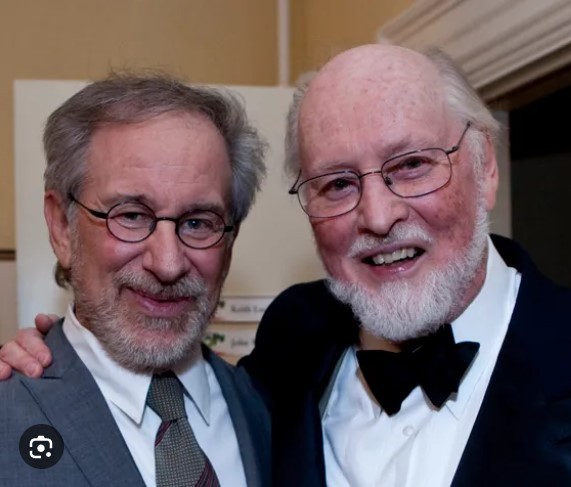
John Williams, who again teased his retirement from film scoring following the execrable “Indiana Jones and the Dial of Destiny,” has agreed to write the music for an upcoming Steven Spielberg UFO opus projected to open on June 12.
Not a lot is known about the project – not even the title – beyond the facts that regular Spielberg collaborator, David Koepp, wrote the screenplay (on an original story by Spielberg) and that the cast includes Colman Domingo, Emily Blunt, and Colin Firth. Maybe some of the other actors will be familiar to you, but I don’t recognize them, as I tend not to see a lot of newer movies.
Williams’ birthday is on February 8. He will likely be 94 years old at the time of the recording sessions. I have a ticket to hear his new piano concerto, with Emanuel Ax and the New York Philharmonic in March, so I expect the creative energy is still churning, if only he can hang on to his good health.
Spielberg’s had a history with this sort of thing (“Close Encounters of the Third Kind,” “E.T. The Extra-Terrestrial,” and “War of the Worlds,” along with a few TV series he executive produced that I wasn’t particularly interested in seeing). I don’t have high expectations for a return of the old Spielberg magic, since we are living in a post-Douglas Trumbull, Carlo Rambaldi age, but hopefully the CGI won’t be too contemptible.
A big plus is that Disney won’t be involved, which means the soundtrack might actually get wide distribution. For “Dial of Destiny,” the Mouse House pulled some kind of pre-order, limited edition bait-and-switch, meaning that millions of John Williams fans were shut out from obtaining the score on physical media and copies on the collectors’ market were priced in the hundreds. I finally managed to get a hold of a copy for $50 from Screen Archives Entertainment. Beyond “Helena’s Theme,” which is ravishing (and has no bearing whatsoever on the character in the film), the score is not top-drawer Williams.
I do wish he had said no to all these recent “Star Wars” and “Indiana Jones” films and poured his energies and creativity into more interesting projects. Let’s hope Spielberg’s film is not a retread and gives the composer something interesting to work with. It would also be nice if it’s not an alien invasion movie. There’s enough unpleasantness in the world right now. I know I’m hopelessly corny and old-fashioned, but I’m yearning for a little hope and uplift in my entertainment.
The film will mark Spielberg and Williams’ 30th collaboration. Their creative partnership dates all the way back to “The Sugarland Express” in 1974. Williams won three of his five Academy Awards writing for Spielberg films (“Jaws,” “E.T.,” and “Schindler’s List”). There’s no way he’ll win for this one, but it could bring him his 55th nomination. He is the most nominated person alive and the second most-nominated person in Oscar history, behind only Walt Disney (with 59).
At the very least, we can expect that the score will be “musical” and not simply a piece of electronically-manipulated sound design. That alone would be cause for celebration.
Best wishes to the Maestro on his latest screen endeavor. Whether or not it’s out of this world remains to be seen.
https://variety.com/2025/film/news/john-williams-steven-spielberg-ufo-movie-1236563896/
-

Yo-Yo Ma at 70 Celebrating His Film Music
It’s very hard to believe, but the eternally youthful Yo-Yo Ma turned 70 on Tuesday. This week on “Picture Perfect,” we honor one of the most famous classical musicians in the world with music from three of his film projects.
Ma played cello solos in two scores by John Williams – those for “Seven Years in Tibet” (1997) and “Memoirs of a Geisha” (2005). Of course, Williams being Williams, both scores were nominated for Academy Awards.
But it was Ma’s contribution to Tan Dun’s “Crouching Tiger, Hidden Dragon” (2000) that struck Oscar gold. Dun’s music contributed to what might be termed “The Year of the Dragon,” as Ang Lee’s film received 10 Academy Award nominations, including one for Best Picture. “Crouching Tiger” would slink away with awards for Best Foreign Language Film, Best Art Direction, Best Cinematography, and of course Best Original Score.
In addition, Ma recorded a very popular album in 2004 of arrangements for cello and orchestra of film music by Ennio Morricone, with the composer conducting. We’ll round out the hour with one of these, from Morricone’s beloved score to “The Mission” (1986).
I hope you’ll join me, as we salute Yo-Yo Ma at 70, on “Picture Perfect,” music for the movies, now in syndication on KWAX, the radio station of the University of Oregon!
Clip and save the start times for all three of my recorded shows:
PICTURE PERFECT, the movie music show – Friday at 8:00 PM EDT/5:00 PM PDT
SWEETNESS AND LIGHT, the light music program – Saturday at 11:00 AM EDT/8:00 AM PDT
THE LOST CHORD, unusual and neglected rep – Saturday at 7:00 PM EDT/4:00 PM PDT
Stream them, wherever you are, at the link!
BONUS: Ma and Williams on “The Tonight Show,” playing a selection from “Memoirs of a Geisha”
-

Yo-Yo Ma at 70 a Musical Legend
The years, they do fly by. How can Yo-Yo Ma be 70? It seems only yesterday we were celebrating his 60th birthday.
Arguably the most visible and charismatic cellist of his generation, Ma was born on October 7, 1955. He’s recorded more than 90 albums and been recognized with 19 Grammy Awards. In addition, among innumerable other honors, he has been the recipient of the National Medal of the Arts and the Presidential Medal of Freedom. As recently as 2020, he was included in Time Magazine’s “100 Most Influential People.”
Ma began playing cello at the age of 4. That’s when he “put away childish things” – that is to say, a juvenile pursuit of the violin, viola, and piano! At 5, he began performing in public, and at 7, played for Presidents Dwight D. Eisenhower and John F. Kennedy. At 8, he was introduced to American television audiences courtesy of Leonard Bernstein. The next year, Isaac Stern brought him along to “The Tonight Show with Johnny Carson.”
This was all before Ma attended Juilliard, where he studied with Leonard Rose. He dropped out of Columbia – only to attend Harvard. He spent four summers at the Marlboro Music Festival, where he played under the direction of legendary cellist and conductor Pablo Casals. He’s been friends with Emanuel Ax, a regular chamber music partner, since their student days.
Ma has long been acclaimed for his interpretations of the Bach Cello Suites, chamber music by Beethoven and Brahms, and most of the major concertos for cello and orchestra. However, his first commercial recording, believe it or not, was of the Cello Concerto by English composer Gerald Finzi. Ma recorded the piece while in his early 20s, with the Royal Philharmonic Orchestra conducted by Vernon Handley.
Later, having conquered the classical concert hall and established his mastery of the standard repertoire, Ma proved increasingly restless and exploratory, with forays into Baroque music on period instruments, American bluegrass, Argentinean tango, improvisatory duets with Bobby McFerrin, and several musical journeys along the Silk Road.
He’s also been active in film, contributing to the soundtracks of “Seven Years in Tibet” and “Memoirs of a Geisha” for John Williams and “Crouching Tiger, Hidden Dragon” (the recipient of an Academy Award for Best Original Score) for Tan Dun. And of course his album of arrangements of Ennio Morricone themes sold faster than a tray full of cannoli.
Ma’s friendship with Williams also yielded a cello concerto, which they first recorded together in 1994. My most recent Ma acquisition is his recording of the concerto in its revised version, released on Sony Classical in 2022, and of course it’s wonderful. However, the earlier release has an alluring bonus in Williams’ “Elegy,” reworked from material originally conceived for “Seven Years in Tibet” – six transporting minutes of unalloyed loveliness.
Ma is one of classical music’s last media celebrities, whether introducing kids to the cello on PBS’ “Arthur,” “Sesame Street,” or “Mr. Rogers’ Neighborhood,” or playing Bach in support of dancer Misty Copeland and sitting in with the band on “The Late Show with Stephen Colbert.”
I’ve been privileged to see him in concert several times. Last season, he was in Princeton at McCarter Theatre for a conversation with PBS NewsHour correspondent Jeffrey Brown. His love for music is such that it is not unusual for him to return after intermission, following a star turn in a big concerto, to modestly sit in with the rest of the cello section and play as a rank-and-file musician on the concert’s second half.
All in all, I suspect he’s a really good guy. In fact, I’m sure he is. Happy birthday, and thanks for everything, Yo-Yo Ma!
John Williams’ “Elegy”
On Colbert with Misty Copeland
At the age of 7, presented by Leonard Bernstein
“Crouching Tiger, Hidden Dragon”
Ma with saxophonist Joshua Redman, playing “Crazy Bus” on “Arthur”
On “Sesame Street”
Gerald Finzi’s Cello Concerto
Bach, Suite No. 1 for Unaccompanied Cello
Tag Cloud
Aaron Copland (94) Beethoven (95) Composer (114) Film Music (148) Film Score (143) Film Scores (255) Halloween (97) John Williams (196) KWAX (232) Leonard Bernstein (105) Marlboro Music Festival (125) Movie Music (163) Mozart (91) Opera (215) Philadelphia Orchestra (90) Picture Perfect (174) Princeton Symphony Orchestra (110) Radio (90) Ross Amico (244) Roy's Tie-Dye Sci-Fi Corner (290) The Classical Network (101) The Lost Chord (269) Vaughan Williams (107) WPRB (397) WWFM (881)