Tag: Marlboro Music Festival

  • Shostakovich’s Birthday Marlboro Music

    Shostakovich’s Birthday Marlboro Music

    Hey, Dmitri! Happy birthday!

    Oh, okay. Act like you don’t know me then. I understand. In Stalinest Russia, one can never be too careful.

    We’ll divine what we can from your String Quartet No. 4 on this week’s “Music from Marlboro.”

    While Shostakovich had an on-again, off-again history with the Soviet authorities that made him justifiably cautious, his fourth quartet grew out of a newfound confidence, the result of Stalin having personally selected him as a cultural ambassador to the West.

    But these things had to be navigated very carefully. A sign of favoritism from Papa Joe often had the effect of setting a recipient up for a very big fall.

    Still, Shostakovich was determined to leverage his new-found currency. He took the opportunity to persuade Stalin that if he were going to be sent out into the decadent West, then perhaps it would be a good idea to lift the ban on performances of his music at home. Otherwise, the situation might appear a little peculiar to outsiders. Stalin recognized the logic in this, and Shostakovich was rehabilitated.

    He was not by any measure a stupid man. Yet the artistic impulse was not to be denied. Shostakovich wasted no time in embarking on a new string quartet, which he loaded up with inscrutable subtexts, Jewish folk songs, and all sorts of things that had a history of angering the “wise leader and teacher.” Fortunately for the composer, his friends convinced him not to allow the work to be performed publicly, and he put it in a drawer for another day.

    That other day is now. We’ll hear it played at the 1983 Marlboro Music Festival by violinists Sylvie Gazeau and Yuzuko Horigome, violist Philipp Naegele, and cellist Robie Brown Dan.

    Anton Arensky was a pupil of that icon of Russian nationalism, Nikolai Rimsky-Korsakov. However, in his music, he tended to gravitate more toward the cosmopolitan approach of Rimsky’s rival, Peter Ilych Tchaikovsky. Arensky’s Piano Trio in D minor is full of good tunes, by turns melancholy, turbulent, reflective, and good humored, but unfailingly charming. It’s the kind of piece that will have you humming for the rest of the day.

    We’ll hear it performed by pianist Frederick Moyer, violinist Isodore Cohen, and cellist John Sharp, at Marlboro in 1982.

    It’s a cryptic birthday cake for Shostakovich, with a strong cup of open-hearted Arensky. The composer is gifted in more ways than one, on the next “Music from Marlboro,” this Wednesday evening at 6:00 EDT, on WWFM – The Classical Network and wwfm.org.


    Marlboro School of Music and Festival: Official Page
  • Beyond String Quartets: Marlboro’s Chamber Music Hour

    Beyond String Quartets: Marlboro’s Chamber Music Hour

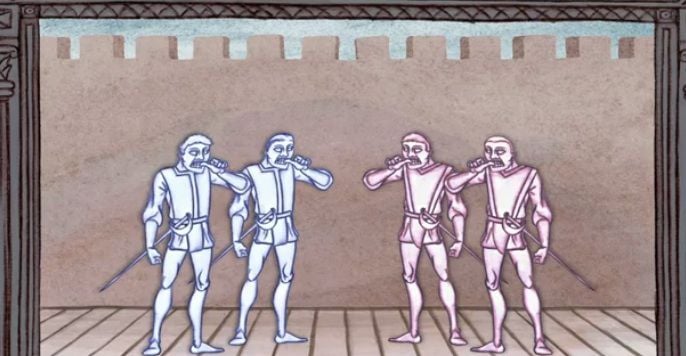
    String quartets, we bite our thumbs at thee!

    On this week’s “Music from Marlboro,” we smash the hegemony of chamber music’s most prevalent foursome to bring you an hour of contumely quartets.

    Wolfgang Amadeus Mozart spent five months in Mannheim in 1777, hoping to chase down a steady position there. He didn’t get the job, but he did receive a fistful of commissions from gentleman-flutist Willem van Britten Dejong. The 21 year-old composer was broke, in love, and, as usual, being badgered by his old man to make something of himself already. These external pressures may explain, in part, Mozart’s alleged aversion to the flute. He certainly responded to the new commissions as if they were more of a burden than a godsend. Still, he had too much integrity not to lend the works his usual polish.

    We’ll hear the Flute Quartet No. 1 in D major, K. 285, performed at the 1989 Marlboro Music Festival, by flutist Marina Piccinini, violinist Scott St. John, violist Christof Huebner, and cellist Peter Wiley.

    Bernard Garfield was longtime principal bassoonist of the Philadelphia Orchestra. He served with the orchestra for 43 years, from 1957 to 2000. Concurrently, he taught at Temple University and, for over three decades, at the Curtis Institute of Music. He also founded the New York Woodwind Quintet.

    It’s hardly surprising that a career bassoonist would write music for his own instrument. Garfield composed three bassoon quartets. We’ll hear the first of these, from 1950. It was performed at Marlboro in 2010 by bassoonist Natalya Rose Vrbsky, violinist David McCarroll, violist Dmitri Murrath, and cellist Judith Serkin.

    Finally, Carl Maria von Weber earned his place in the history books as one of the progenitors of German Romantic opera. With its lurid Wolf’s Glen sequence, “Der Freischutz” reverberated in its nightmarish extravagance, making it one of the most influential operas of the 19th century.

    Twelve years before “Freischutz,” in 1809, Weber, then 22, wrote a comparatively benign Piano Quartet in B flat major. His model was clearly Mozart, but already his head had grown too hot for his tricorn, as he also indulges in flights of post-Beethovenian temperament.

    We’ll hear Weber’s quartet, as played at Marlboro in 1989, by pianist Igor Ardašey, violinist Takumi Kubota, violist Ulrich Eichenauer, and cellist Siegfried Palm.

    Strike a blow against the tyranny of the string quartet! It’s an hour of revolting chamber music on the next “Music from Marlboro,” this Wednesday evening at 6:00 EDT, on WWFM – The Classical Network and wwfm.org.

    Marlboro School of Music and Festival: Official Page
  • Clara Schumann: Genius, Wife, and Forgotten Composer

    Clara Schumann: Genius, Wife, and Forgotten Composer

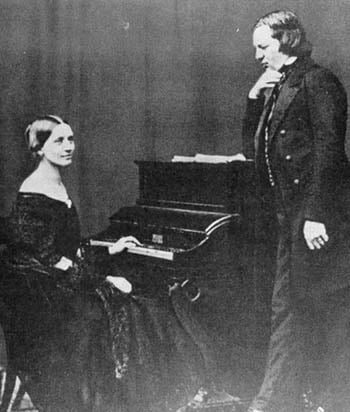
    Clara Schumann was a musician of impeccable taste. Her insights and opinions helped mold the artistic development of her husband and also to a great extent that of Johannes Brahms, who frequented the Schumann house from the age of 20 and became a life-long friend. She was also a pianist of genius. She performed publicly to great acclaim for over six decades. It was through concertizing that she supported her unstable husband and eight children. Later in life, she also became a revered teacher.

    Her acceptance as performer and pedagogue were highly unusual for a woman of her time. She was a child prodigy, the daughter of Friedrich Wieck, who also taught Robert Schumann. Under her father’s tutelage, she demonstrated a marked facility in composition. She was also a better pianist than Robert, who, according to some accounts, had managed to wreck one of his hands through the use of a finger-strengthening device (an assertion Clara denied.)

    Having enjoyed such a promising start, it’s heartbreaking, then, to read Clara’s comment, confided to her diary in 1839, at the age of 20, “I once believed that I possessed creative talent, but I have given up on this idea. A woman must not desire to compose – there never yet has been one able to do it. Should I expect to be the one?”

    It’s especially sad, since composing gave her such pleasure. “There is nothing that surpasses the joy of creation,” she wrote. “if only because through it one wins hours of self-forgetfulness, when one lives in a world of sound.”

    Fortunately for us, we have her Piano Trio in G minor, and on this week’s “Music from Marlboro,” we’ll have the pleasure of hearing it performed at the 2005 Marlboro Music Festival by pianist Ieva Jokubaviciute, violinist Julianne Lee, and cellist Judith Serkin.

    Clara would have been 26 at the time of her Trio’s composition. She passed the summer of 1846 on the isle of Norderney, where she accompanied her husband during his convalescence following an attack of neurasthenia. While there, compounding the Schumanns’ misfortunes, Clara suffered a miscarriage. The completion of her Trio must have seemed like an especially welcome escape. A year later, Robert composed his first piano trio, Op. 63, which bears some striking similarities to his wife’s creation.

    We’ll round out the hour with Robert Schumann’s “Andante and Variations,” from 1849. Though written soon after the back-to-back masterpieces of the Piano Quintet and Piano Quartet, both in the key of E flat major, Schumann was less pleased with his new work. Part of the problem was in its unusual instrumentation, which called for two pianos, two cellos, and horn. Early performances in the Schumann home were so loud, it may have contributed to the composer’s disgust with the piece.

    Schumann withdrew the work from his catalogue, later revising it for two pianos at the suggestion of Felix Mendelssohn. He also altered the structure of piece, which he ruthlessly cropped. It was Brahms and Clara Schumann who reappraised the value of his original thoughts and resurrected the work in the form he had initially intended, twelve years after the composer’s death, giving it its first public performance in 1868. It is in this version that the piece is now most often heard.

    We’ll hear it performed at the 1985 Marlboro Music Festival by husband-and-wife pianists Claude Frank and Lilian Kallir, cellists Melissa Meeli and Peter Stumpf, and hornist Julie Landsman.

    It’s an all-Schumann hour, in advance of the Clara Schumann bicentennial (which falls on Friday), on the next “Music from Marlboro,” this Wednesday evening at 6:00 EDT, on WWFM – The Classical Network and wwfm.org.

    Marlboro School of Music and Festival: Official Page

  • Dvořák’s Early Genius at Marlboro Music Festival

    Dvořák’s Early Genius at Marlboro Music Festival

    It was in the autumn of 1877 that a 36 year-old Antonin Dvořák included his “Moravian Duets” with his application for an Austrian State grant for “young, talented and poor artists.” Still little known outside of his native Bohemia, Dvořák caught the interest of Johannes Brahms, who sat on the board of adjudication. Recognizing the younger man’s talent, Brahms recommended Dvořák to his German publisher, Fritz Simrock.

    Simrock’s edition of Dvořák’s duets proved to be so popular that it went into a second printing. (Even so, he did not pay the composer!) When that sold out, he requested that Dvořák write something akin to Brahms’ wildly successful “Hungarian Dances.” The resultant “Slavonic Dances” cemented Dvořák’s international fame.

    On this week’s “Music from Marlboro,” Dvořák pays his dues, with two early works that reveal his genius in utero.

    The Piano Quartet No. 1 in D major, Op. 23, was composed over a span of just eighteen days during the summer of 1875. Dvořák was 33 and probably already at work on the “Moravian Duets.”

    Though a product of his early maturity, Dvořák’s quartet is already imbued with the composer’s soon-to-be familiar “Czech national sound.” Not nearly as well known as the “American” String Quintet or the Piano Quintet in A major, it is nevertheless unmistakably from the same pen, with no shortage of memorable melodies and brimming with his indelible charm. The work didn’t hit print until 1880 (around the time of the second run of the “Moravian Duets”). Tellingly, it was not published by Simrock, but rather by Schlesinger, a Berlin rival.

    We’ll hear it performed at the 1969 Marlboro Music Festival by pianist and Marlboro co-founder Rudolf Serkin, violinist Shmuel Ashkenasi, violist Martha Strongin Katz, and cellist Robert Sylvester.

    The “Moravian Duets” grew out of songs Dvořák wrote specifically for domestic performance by a wealthy merchant and his wife, who also happened to be amateur singers. At the merchant’s request, Dvořák began by arranging Moravian national songs, but quickly segued into providing wholly original music for the traditional folk texts.

    Delighted with the results, the merchant paid for the duets’ first printing in Prague, prior to Christmas 1876. Further songs followed. The complete cycle of 23, for two voices and piano accompaniment, appeared as three separate sets, assigned to different vocal ranges, between 1875 and 1881.

    We’ll round out the hour with the four songs of the first of these, collected under Op. 20, in its final form, performed in Czech by soprano Mary Burgess and tenor John Humphrey, with pianist Luis Batlle – a commercial recording made for Columbia Masterworks as an offshoot of the 1966 Marlboro Music Festival.

    One of the advantages of being a “provincial” composer is that Dvorak was already a master by the time he was discovered. Discover these works from his early maturity on the next “Music from Marlboro,” this Wednesday evening at 6:00 EDT, on WWFM – The Classical Network and wwfm.org.

    Marlboro School of Music and Festival: Official Page
  • Debussy, Ravel & Mallarmé at Marlboro

    Debussy, Ravel & Mallarmé at Marlboro

    It’s a Mallarmé marmalade, served up on French toast, on the next “Music from Marlboro.”

    While, for the most part, Claude Debussy and Maurice Ravel maintained a certain degree of respect for one another, both men were very possessive of Stéphane Mallarmé.

    Debussy had changed the course of music history with his dreamy translation into sound of Mallarmé’s poem, “L’après-midi d’un faune.” Musicians at the fin de siècle all sat up and took notice – aligning themselves into factions pro and con – but reportedly Mallarmé himself was not all that thrilled, believing the music inherent in his verse to be sufficient. Once he actually attended a performance of the work, however, you might say he changed his tune.

    It’s understandable, then, that Debussy would feel a certain sense of ownership when it came to setting Mallarmé to music.

    Debussy’s “Prélude à l’après-midi d’un faune” appeared in 1894. Mallarmé died in 1898. The first complete edition of Mallarmé’s poems did not appear until 1913. 1913, you’ll recall, was a revolutionary year in the arts, with controversies stirred by the Armory Show in New York City, Schoenberg’s Skandalkonzert in Vienna, and the premiere of “The Rite of Spring” in Paris.

    It was against this backdrop that the Debussy-Ravel rivalry would intensify. Ravel, proclaiming that Mallarmé was the greatest of all French poets, determined to secure the rights to set two of his poems, beating Debussy, who had applied for the same, to the punch. Though publicly Ravel remained good-humored about the coincidence, Stravinsky observed that the two composers did not speak to one another for a year.

    In the event, both set Mallarmé’s “Soupir” (“Sigh”) and “Placet futile” (“Futile Petition”). Opinion was divided as to their success. Stravinsky thought Ravel’s settings his favorites among all the composer’s works. (Of course, Ravel had dedicated the first of the songs to him.) Stravinsky even referenced “Placet futile” when he came to write “A Soldier’s Tale.” On the debit side, Charles Koechlin complained that if you didn’t already know Mallarmé’s poems, you couldn’t possibly understand the texts.

    The two songs had originally been planned as a balanced set, but then Ravel decided to add a third, “Surgi de la croupe et du bond” (“Rising from the Crupper and Leap”), which he described as the strangest and most hermetic. That, he dedicated to Erik Satie.

    Though Ravel had not heard Schoenberg’s “Pierrot Lunaire,” composed the previous year, there must have been something in the air. Ravel was eager to explore the coloristic possibilities of a chamber ensemble in supporting Mallarmé’s symbolist texts. For the final song, he would stretch his harmonic syntax beyond the bounds of tonality.

    Graciously, Debussy ended their estrangement by complimenting Ravel for possessing “the most refined [musical ear] there ever has been.”

    We’ll hear Ravel’s “Trois poèmes de Mallarmé,” performed by mezzo-soprano Mary Westbrook-Geha and an ensemble of eleven instrumentalists at the 1989 Marlboro Music Festival. Then we’ll give Debussy his due, with a performance of his revolutionary String Quartet in G minor, performed by violinists Joseph Lin and Judy Kang, violist Richard O’Neill, and cellist David Soyer, on tour at the Isabella Stewart Gardner Museum in Boston in 2002.

    I hope you’ll pardon my French, on this week’s “Music from Marlboro,” Wednesday evening at 6:00 EDT, on WWFM – The Classical Network and wwfm.org.

    Marlboro School of Music and Festival: Official Page


    PHOTOS: Gentlemen, choose your weapons!

Tag Cloud

Aaron Copland (92) Beethoven (95) Composer (114) Film Music (123) Film Score (143) Film Scores (255) Halloween (94) John Williams (187) KWAX (229) Leonard Bernstein (101) Marlboro Music Festival (125) Movie Music (138) Opera (202) Philadelphia Orchestra (89) Picture Perfect (174) Princeton Symphony Orchestra (106) Radio (87) Ralph Vaughan Williams (85) Ross Amico (244) Roy's Tie-Dye Sci-Fi Corner (290) The Classical Network (101) The Lost Chord (268) Vaughan Williams (103) WPRB (396) WWFM (881)

DON’T MISS A BEAT

Receive a weekly digest every Sunday at noon by signing up here


RECENT POSTS