Tag: Mozart

  • Mozart Anniversary Broadcast on WWFM

    Mozart Anniversary Broadcast on WWFM

    Mozart, take me away!

    I’m getting ready to hit the air waves with more Mozart – an assortment of symphonies, concertos, operas, orchestral, choral, vocal, chamber and instrumental music – in honor of the 264th anniversary of his birth.

    Along the way, we’ll hear selections performed by violinist Jaap Schröder and hornist Barry Tuckwell, both recently deceased, and a recording of Christopher Hogwood playing a clavichord that once actually belonged to the composer.

    If you enjoy the programming, please support it, with your contribution at 1-888-232-1212 or online at wwfm.org.

    As an added incentive, this time around we’re offering, among our thank you gifts, a 2-CD set, “Quiet Time: The Music of Mozart,” available for your donation of $60.

    At 7:30 tonight, I’ll be manning the board for a special broadcast of Westminster Choir’s Homecoming Concert, coming your way live from Princeton University’s Richardson Auditorium. David Osenberg will be your host for that. Then I’ll be back, following the concert, with more music until 10:00 EST.

    Forget your cares with Wolfgang. Grab your shades and join the Wolf Pack, on WWFM – The Classical Network and wwfm.org. Thank you for your support!

  • Mozart’s Humanity Celebrate His Birthday on WWFM

    Mozart’s Humanity Celebrate His Birthday on WWFM

    There’s a lot of art in Mozart. But also a lot of humanity.

    Join us today on The Classical Network, as we celebrate the 264th anniversary of the birth of Johannes Chrysostomus Wolfgangus Theophilus Mozart – better known as Wolfgang Amadeus Mozart.

    Current events got you down? Take the long view. This music from over two centuries ago still has the ability to touch our hearts, soothe our minds, and reach into our souls. Mozart’s music reflects what is best in Man.

    Tune in for a broad sampling of his extraordinary output, including symphonies, concertos, operas, orchestral, choral, vocal, chamber and instrumental music. If you enjoy it, please support it, with your contribution at wwfm.org.

    While you’re at it, pick up a thank you gift. Of course, we’ve a broad array of music-oriented loot. This time around, we’re adding a 2-CD set of Mozart adagios. This is the perfect collection to insulate yourself from the cares of the world.

    The saying goes that the best things in life are free, but it sure does cost money for us to bring you the music. We’ve been able to hang in there for 37 years, thanks to the generosity and perspicacity of listeners just like you.

    Please call us at 1-888-232-1212, or make your donation online at wwfm.org. Thank you for your continued support of WWFM – The Classical Network!


    FUN FACT: Mozart signed his name “Amadeus” only a few times in his life, when he was playing around in letters written in a kind of mock Latin. In fact, “Amadè,” “Amadé,” or simply “Amade” were his preference (“Amadeo” in Italy). He was fairly cavalier in the placement of the accent. It was only on his death certificate that the form “Amadeus” took root. His widow, Constanze, picked up on it and used it in her appeal to the Emperor for a pension (ultimately successful), citing Mozart’s contributions. As her late husband became increasingly venerated, “Amadeus” became the standard.

    Of course, we can be as pedantic as we like. But nothing changes the transcendent quality of the music and its enduring ability to elevate our mood.

    Find peace with Mozart on WWFM The Classical Network.

  • Tuckwell’s Mozart Horn Grooves

    Tuckwell’s Mozart Horn Grooves

    Barry Tuckwell’s grooviest Mozart?

  • Mozart at Marlboro: An Oasis of Musical Sanity

    Mozart at Marlboro: An Oasis of Musical Sanity

    With the world hurtling toward destruction, we’ll do our best to offer an oasis of sanity on the next “Music from Marlboro.”

    Find solace in Wolfgang’s Amadeus Mozart’s Piano Trio in B flat major, K. 502. The composer took evident pleasure in writing for the combination of violin, cello and piano. For one thing, these works provided him opportunities to connect with fellow musicians as a performer. He even regarded some as party pieces.

    K. 502 was written when Mozart was 30 years-old and at the peak of his powers. It was composed in 1786, the year of the premiere of “The Marriage of Figaro.” Like the opera, Mozart’s trio subverts a kind of class stratification, elevating the stringed instruments, formerly relegated to supporting roles, so that they attain equal footing with the piano. This egalitarian gesture allows for a kind of civilized discourse between friends.

    We’ll hear it performed at the Marlboro Music Festival in 1968, by violinist Jaime Laredo, cellist Madeline Foley, and pianist Rudolf Serkin.

    Then Mozart reaches for the stars, both figuratively and by association. It was probably nowhere in the composer’s thoughts that his Symphony No. 41, composed in 1788, would bear the subtitle “Jupiter.” Like most nicknames, the sobriquet was bestowed by others. That said, it could hardly be more appropriate, as this is one of Mozart’s most Olympian works. It turned out to be his final symphony – and what a way to go!

    The fugato passages of the finale, with the effortless interweaving of no less than five harmonious themes, is breathtaking in its ambition and scale. The spirit of indomitable optimism is just the thing we need right now.

    We’ll hear it performed by the Marlboro Festival Orchestra in 1967, conducted by a 90 year-old Pablo Casals.

    Music may not be a cure-all, but it sure does serve to remind us that there is still beauty in the world and something noble in humanity. Would that everyone could tap into that largeness of spirit and aspire to something greater.

    It’s Mozart for sanity, on the next “Music from Marlboro,” this Wednesday evening at 6:00 EST, on WWFM – The Classical Network and wwfm.org.

    Marlboro School of Music and Festival: Official Page

  • Mozart’s Death Krampus Connection?

    Mozart’s Death Krampus Connection?

    How is it that I never before drew the connection?

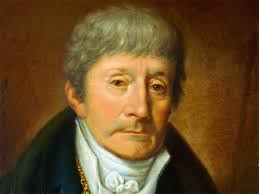
    You know, every once in a while, how someone comes up with a new theory about the identity of Jack the Ripper, or claims to have discovered the secret of Elgar’s “Enigma Variations?” Well, it only just occurred to me, I may have solved the mystery of Wolfgang Amadeus Mozart’s death. And it is far more sinister than any alleged poisoning by Antonio Salieri.

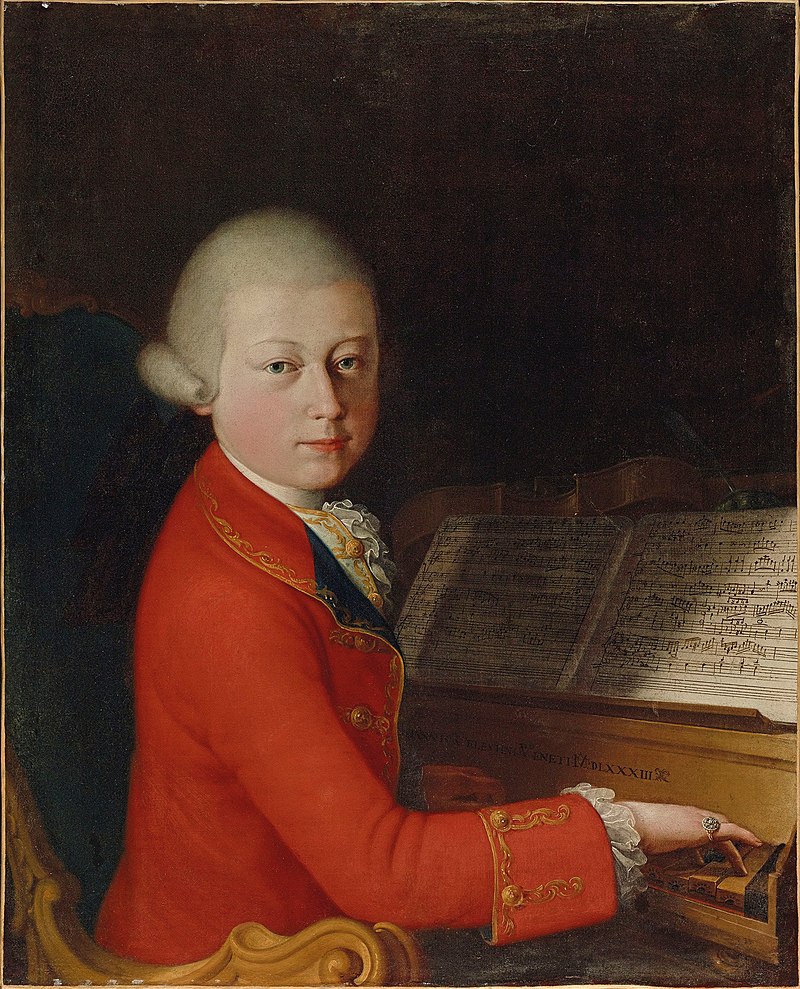
    Mozart gave up the ghost on this date in 1791. A prodigy at the keyboard and on the violin, and a composer from the age of five, alas, in death he was also ahead of the curve.

    Mozart was 35 at the time of his passing, yet there was always something childlike in his personality. At times, he seemed much younger than his years. There’s no question that he could be naughty. He was certainly disobedient to his father, autocrat though he was. He defied the Pope, was extravagant in his spending, was inappropriate in his speech, and could be perhaps a mite too arrogant for his own good.

    The cause of Mozart’s death was recorded as “severe military fever.” Even so, over the years, there have been dozens of theories put forth as to the true nature of his passing. Acute rheumatic fever. Streptococcal infection. Influenza. Mercury poisoning. A rare kidney ailment. Even a bad pork chop. Combined, of course, with overwork.

    Alas, we’ll never know for sure. Mozart was buried in a common grave – not a communal grave, or a pauper’s grave, as has been frequently stated, but one whose wooden marker has long since worn away.

    Here’s the thing. December 5, the date of Mozart’s passing, also happens to be Krampusnacht. As a former native of Salzburg and later Vienna, Mozart should have known better. Because, you see, Austria is the dark, beating heart of the Christmas devil.

    What exactly is Krampus? Why, he’s St. Nicholas’ austere helper. Horned, hairy, and egregiously long-tongued, Krampus emerges from his Alpine domain to assist the patron saint of children on the eve of his feast day. Saint Nick bestows small gifts to all the good girls and boys. The rest are handed over to Krampus.

    For milder offenses, there is the sting of the switch; for the especially ill-behaved, there are chains, a short ride in a wicker basket, and drowning in a stream or immolation by hellfire. When a recalcitrant child hears the dull clatter of approaching cow-bells on December 5, he knows it’s all over. With anxiety a thousand times worse than the anticipation of a bad report card, the wee sinner pulls the sweat-soaked blankets over his head and prays vociferously for a stocking full of coal.

    No doubt, Mozart was a chronic offender. Could he have withstood a sound thrashing in his weakened state?

    Confutatis maledictus, indeed.

Tag Cloud

Aaron Copland (92) Beethoven (95) Composer (114) Film Music (123) Film Score (143) Film Scores (255) Halloween (94) John Williams (187) KWAX (229) Leonard Bernstein (101) Marlboro Music Festival (125) Movie Music (138) Opera (202) Philadelphia Orchestra (89) Picture Perfect (174) Princeton Symphony Orchestra (106) Radio (87) Ralph Vaughan Williams (85) Ross Amico (244) Roy's Tie-Dye Sci-Fi Corner (290) The Classical Network (101) The Lost Chord (268) Vaughan Williams (103) WPRB (396) WWFM (881)

DON’T MISS A BEAT

Receive a weekly digest every Sunday at noon by signing up here


RECENT POSTS