When the 14 year-old Mozart perpetrated a daring theft from the most powerful institution in the world, there was no need to circumvent a laser grid by descending on cables from on high.
Mozart and his father attended a Holy Week service at the Vatican in 1770. There, they encountered for the first time Gregorio Allegri’s haunting “Miserere.”
Allegri composed his setting of Psalm 51 (50) in the 1630s. The piece was intended for exclusive performance in the Sistine Chapel, as part of the Tenebrae service of Holy Wednesday and Good Friday.
Its conception is a striking one, with two choirs: one intoning a simple chant, and the other, spatially separated, providing ornamentation. The effect of a stratospheric top C makes the “Miserere” one of the most enthralling works in the choral literature of the late Renaissance.
The Vatican, realizing it had a good thing, forbade performance of the piece or copies of the score to be circulated outside its walls, under pain of excommunication.
It was Mozart who blithely liberated the piece, copying it down from memory and handing it off to author and music historian Charles Burney, who published it without delay.
Mozart was summoned before the Pope, and rather than being excommunicated, he was showered with praise for his feat of musical genius. The ban on the “Miserere” was lifted.
Mission accomplished!
These portraits, of Allegri (left) and the teenage Mozart, will self-destruct in five seconds
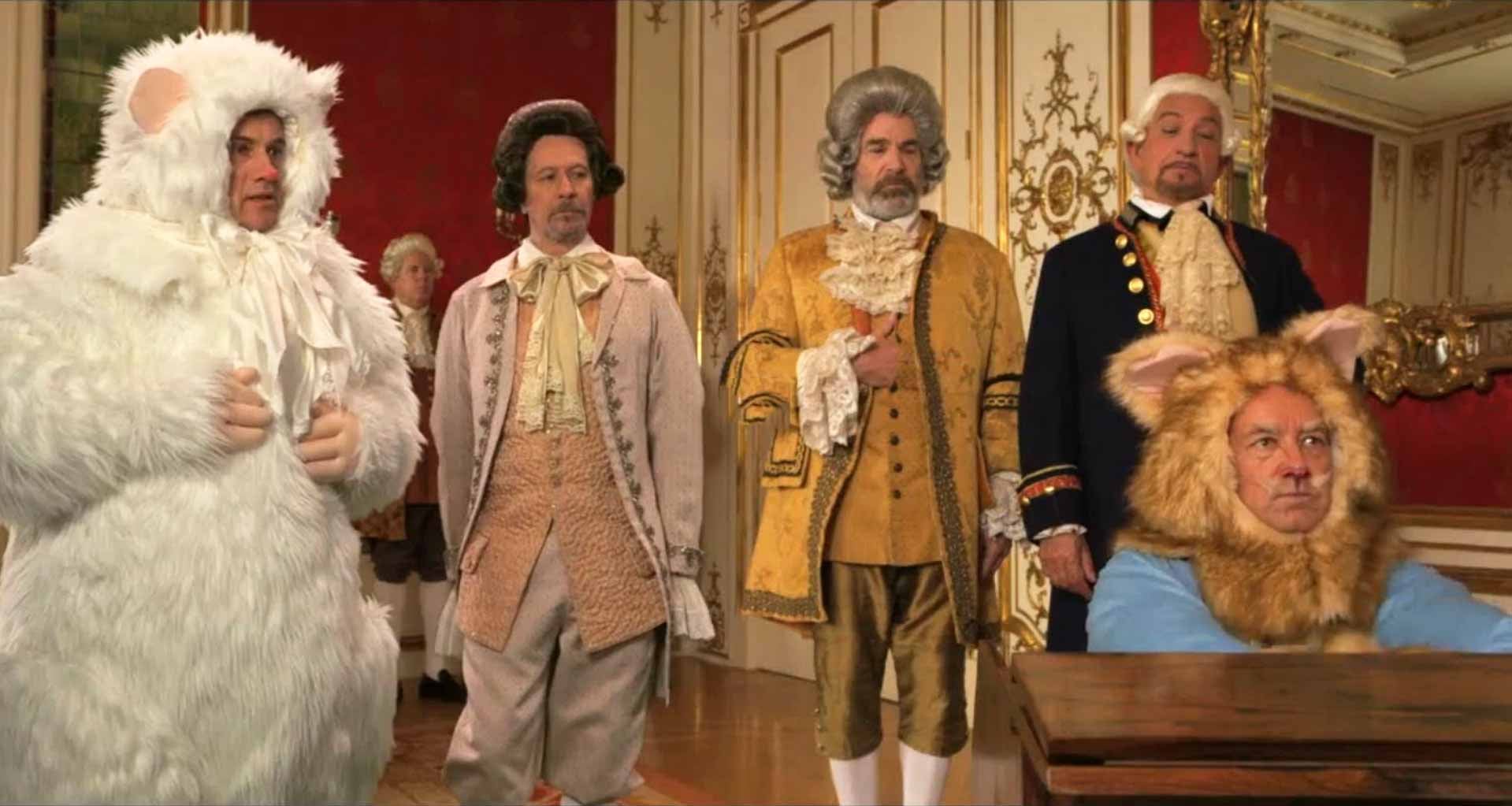
In the wake of yesterday’s marathon Mozart birthday celebration, revisit this star-studded Jimmy Kimmel mash-up of “Amadeus” and YouTube sensation Keyboard Cat.
What’s that, you say? You don’t remember Keyboard Cat?
As if that were not enough to demonstrate the decline of Western civilization over the past 230 years, behold – “Hamster on a Piano.”
By coincidence, I just happened to rewatch “Amadeus” (1984) earlier this week, for the first time in many years. Of course, I’d seen it a bunch of times before.
This was the theatrical cut. With all apologies to Miloš Forman, it has been my experience that directors’ cuts tend to be in most ways inferior, especially when recut so long after the fact. (Forman’s was issued in 2002.) Or maybe George Lucas has just made me skittish.
Unfortunately, once a director’s cut appears on home video, it tends to displace the original in all formats, including streaming.
Thankfully I’ve got my trusty old, double-sided DVD. Yeah, I have to flip it an hour and 50 minutes into the movie, but I grew up during the LP era, so I can take it.
All that aside, has there ever been a staged “Don Giovanni” as cool as this one?
What’s in name? Wolfgang Amadeus Mozart went by many in his lifetime.
He was baptized on January 28, 1756 (the day after his birth), as “Joannes Chrysostomus Wolfgangus Theophilus Mozart.”
Following the custom of the Catholic Church, the first two names represent his saint’s name (“Chrysostomus” meaning “golden mouth”). “Wolfgangus” is the Latin form of “Wolfgang” – “walks with wolves” – the name of Mozart’s maternal grandfather. “Theophilus” is from the Greek – “lover of God.” In German, this would be “Gottlieb,” and in Latin “Amadeus.”
Later in life, Mozart would refer to himself using the Italian (“Amadeo”) or the French equivalent, which is why you will sometimes encounter the pedantic “Amadè” in concert program notes.
Admittedly, after 1777, Mozart himself did seem to have a preference for “Amadè,” although he played a little fast and loose with the French accent (variously “Amadè,” “Amadé,” or just plain “Amade”).
He did use “Amadeus,” albeit facetiously, when signing some of his letters, in mock-Latin (“Wolfgangus Amadeus Mozartus”). But it was only after his death that this form really gained traction, employed even by the composer’s widow. This was taken up by biographers, critics, and musicians and became prevalent by the early 19th century.
In more recent times, Peter Shaffer’s play and its now-classic film adaptation have cemented “Amadeus” in the public consciousness.
But Mozart by any other name would smell as sweet. And with his scatological sense of humor, I’m sure he would have something to say about that!
Enjoy a bouquet of Mozart on his birthday, as WWFM – The Classical Network celebrates one of music’s greatest masters. It will be all-Mozart through 7 pm EST. Support classical music on the air waves and via internet streaming with your gift by calling today at 1-888-232-1212 or contributing online at wwfm.org. Thank you for your generous support!
Today is the birthday of Emmanuel Schikaneder (1751-1812). Schikaneder was the impresario who provided the libretto for Mozart’s “Die Zauberflöte,” or “The Magic Flute.” He was also the driving force behind the construction of the Theater an der Wien, the better to house his lavish spectacles. “The Magic Flute” received its first performance there in September 1791. Schikaneder created one of the opera’s lead roles, that of the fallible, if sympathetic birdcatcher Papageno. Mozart’s untimely death occurred only two months later. He was 35 years-old.
Schikaneder enjoyed life. During his leisure hours, he was also known to play at bölzlschiessen (dart-shooting) with the Mozarts. Projectiles were launched at paper targets hand-decorated with satirical images and verse about each of the game’s participants. Schikaneder was parodied for his fondness for the ladies.
Interestingly, “The Magic Flute” was not unique among Schikaneder’s productions, merely the apex of a vogue for allegorical fairy tale operas, frequently incorporating Masonic symbols. Some of these were collaborative efforts, with Mozart, only one in a veritable bullpen of Schikaneder composers, providing music for a few of the numbers. (“The Philosopher’s Stone,” recorded on the Telarc label, is a blast!)
In all, Schikaneder wrote 56 libretti and 45 spoken-language plays. Among the other composers he attempted to woo was Beethoven, even to the extent of providing him with free housing within the theater. Ultimately, Beethoven would reject the project, though by then he had already set the opening scene, which he later incorporated into his opera “Fidelio” (as the duet “O namenlose Freude”). Beethoven being Beethoven, he continued to live in the theater for as long as possible.
Although many of Schikaneder’s productions were popular successes, the sheer expense of realizing his fanciful visions eventually drove the company into debt. In the end, he wound up selling the theater to a consortium of nobles and fled Vienna for the provinces. He died insane and impoverished at the age of 61.
Schikaneder’s memory is preserved in statuary as part of the so-called Papagenotor, or Papageno Gate, immortalized in character, complete with feathers and panpipe, over a side portal of his former theater. He was also memorably played by Simon Callow in the film version of Peter Shaffer’s play, “Amadeus” (1984). Callow had created the role of Mozart, opposite Paul Scofield as Salieri, in the original London production in 1979.
Here’s a Schikaneder text that was set by Arnold Schoenberg, of all people. Schoenberg, the dour father of dodecaphony, wrote a number of cabaret songs. This one is called “Aria from ‘The Mirror of Arcadia.’” Schikaneder’s complete libretto was set in 1794 by Franz Xaver Süssmayr, as the opera “Der Spiegel von Arkadien.” Süssmayr is remembered primarily for having completed Mozart’s unfinished Requiem. Schoenberg’s setting dates from 1901.
The refrain of “Boom… boom… BOOM boom boom…” signifies the heartbeat of an ardent, if indiscriminate lover – more in line with a character like Cherubino than Papageno!
Since seeing so many women,
My heart beats so ardently,
It hums and buzzes here and there,
Just like a swarm of bees.
And if her ardour resembles mine,
And her eyes are lovely and limpid,
Then my heart, like a hammer,
Beats on and on.
Boom, boom, boom, etc.
I wish I could have a thousand women,
If it so pleased the gods,
I’d dance like a marmot
In every direction.
That would be a life worth living,
Then I’d have joy and fun,
I’d hop like a hare through the field,
And my heart would skip along.
Boom, boom, boom, etc.
A man who does not value women
Is neither cold nor warm,
And lies like a block of ice
In a young girl’s arms.
I’m a different sort of man,
I circle women in a dance;
My heart beats happily against hers,
Going boom, boom, boom, etc.
Schikaneder employs a similar gimmick in “The Magic Flute.” Allegedly, it was his suggestion, made during rehearsals, that Papageno stammer in excitement at his recognition of Papagena, during their famous duet, as seen here in the classic Bergman film.
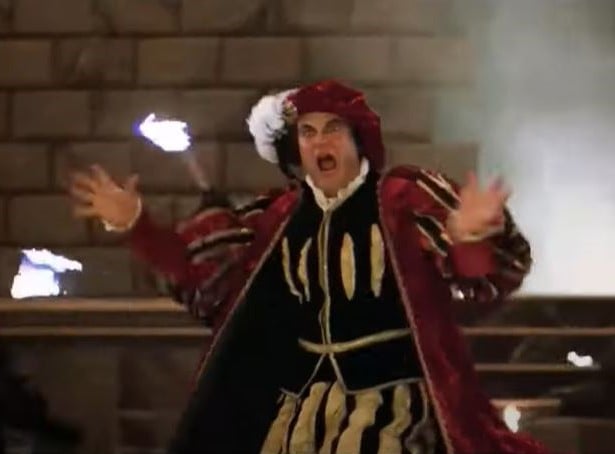
Papageno plays his bells in “Amadeus”
A precursor to “The Magic Flute”: “The Philosopher’s Stone” (1790), with musical contributions by Johann Baptist Henneberg, Benedikt Schack, Franz Xaver Gerl, Mozart, and Schikaneder himself