Because you asked for it: “Night of the Living Dead”… THE OPERA.
The composer is Todd Goodman and the librettist Stephen Catanzarite, adapting from the screenplay by John Russo and George A. Romero.
Act I
Act II
The opera is sung in English, but there are no subtitles. I don’t think there’s any mistaking the action or most of the words. Still, I’m not going to discourage you from refamiliarizing yourself with “the ‘Citizen Kane’ of zombie movies.” The film is in the public domain, so it’s available for free streaming everywhere. There’s a pretty good transfer of it on the “Night of the Living Dead” Wikipedia page.
Go ahead and gorge yourself on opera and offal. And don’t forget, Roy and I will discuss this undying classic on Roy’s Tie-Dye Sci-Fi Corner, when we livestream (or “Dead”-stream, as it were) on Facebook, Twitter, and YouTube, tonight at 7:30 EDT!
Today is the birthday of Giuseppe Verdi – Italian for “Joe Green.”
One of his most famous works, of course, is that grandest of grand operas, “Aida.” Its first staging in Cairo in 1871 included a dozen pachyderms and fifteen camels into the bargain. A dramatic spectacle of star-crossed love in Ancient Egypt, it created a sensation among the opening night audience of dignitaries, politicians, and critics.
Verdi himself did not attend the premiere and disliked the fact that the performance was not open to the general public. He was much happier when it was presented for the Italian people on his native soil.
Of course, anyone who’s ever dealt with the public understands that no success is unalloyed.
One day Verdi received a letter, by way of his publisher, from a dissatisfied customer by the name of Prospero Bertani. Bertani had traveled to Parma to attend a production of “Aida” in 1872.
Bertani confided to the composer, “I admired the scenery… I listened with pleasure to the excellent singers, and took pains to let nothing escape me. After it was over, I asked myself whether I was satisfied. The answer was ‘no’.”
In fact, he disliked “Aida” so much, he felt compelled to sit through it a second time, just to make sure he wasn’t missing something.
The letter continues, “The opera contains absolutely nothing thrilling or electrifying. If it were not for the magnificent scenery, the audience would not sit through it.”
Bertani went on to include the cost of admission, travel expenses, and the price of his meals, and demanded a full refund from the composer.
This amused Verdi. After a moment’s reflection, he instructed his publisher to reimburse Bertani, but not to pay for his meals. Verdi responded, “…To pay for his dinner too? No! He could very well have eaten at home!”
Happy birthday, Mean Joe Green.
No elephants in this “Aida,” but certainly plenty of spectacle
I just love the fact that the father of the modern zombie movie was inspired at the age 11 or 12 by Jacques Offenbach’s “The Tales of Hoffmann!”
George A. Romero, the animating force behind “Night of the Living Dead,” pays tribute to Powell-Pressburger’s bizarre masterpiece at the link. This is the same team that refined nightmare fuel with “The Red Shoes.”
Offenbach was a cello virtuoso who made his fortune as a hugely-successful composer of operetta. He wrote something like 100 of them, including “Orpheus in the Underworld,” which gave us this leggy earworm:
His only opera, “The Tales of Hoffmann,” is his magnum opus. Unfortunately, by the time it was accepted for performance at Paris’ Opéra-Comique, the composer was already in his grave. In fact, he died with the manuscript in his hand, only four months before the work’s premiere.
Debussy noted that the musical establishment of the day had difficulty coping with Offenbach’s sense of irony. Offenbach would no doubt have appreciated the fact that, like one of Romero’s zombies, he was, in a sense, reanimated after death. “The Tales of Hoffmann” has not been out of the repertoire since its premiere in 1881.
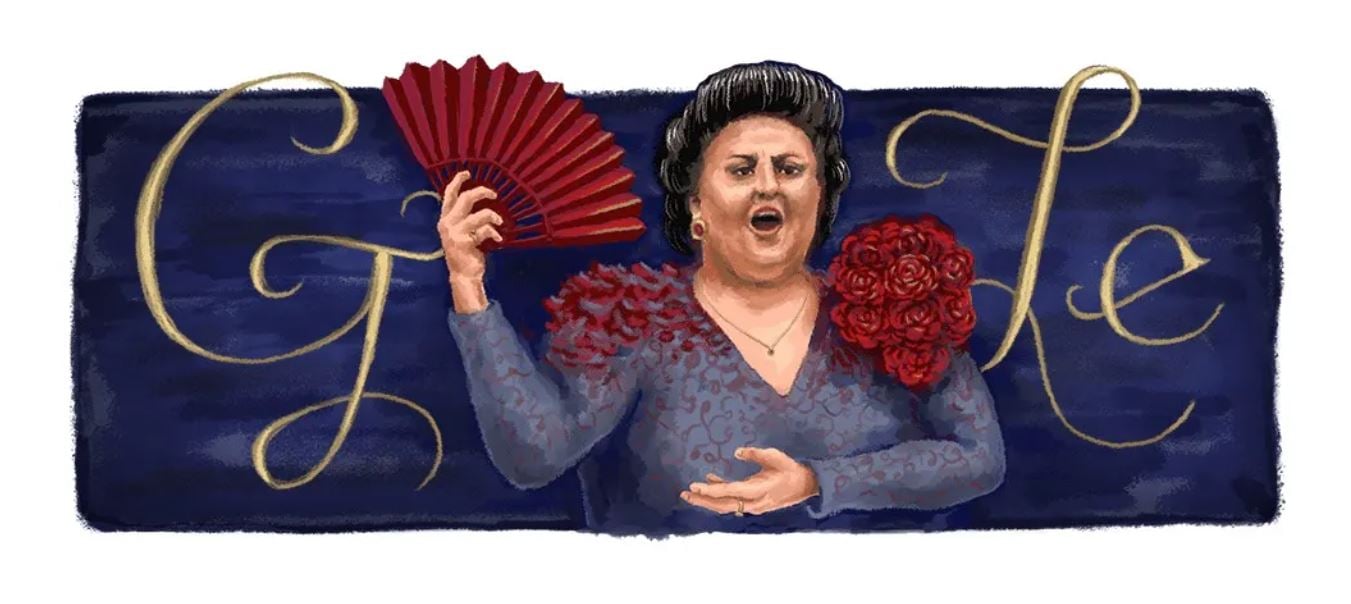
Montserrat Caballé gets a Google Doodle on what would have been her 89th birthday. Naturally in Google’s write-up, they emphasize her collaboration with Freddie Mercury, with imbedded video of “Barcelona.” Oh yeah, she also happened to be one of the greatest sopranos of her generation. I guess that’s why they called her “La Superba.”
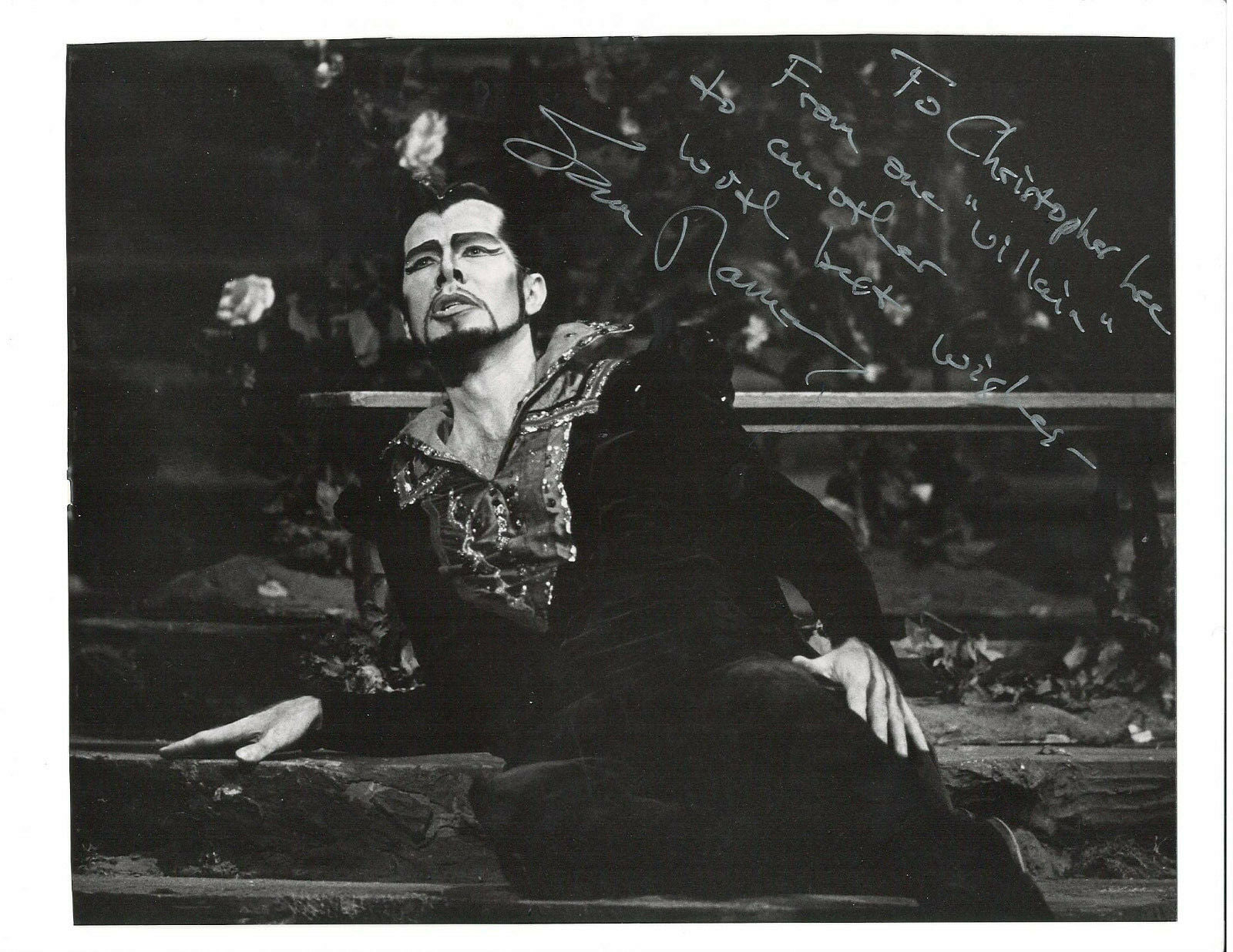
For decades, he reigned in Hell as opera’s greatest Mefistofele. I’ll be damned if Samuel Ramey isn’t 80 years-old today. Give the devil his due.
Gaze with envy into my cabinet of curiosities as I share this one-of-a-kind collectible: a photo inscribed by Ramey to actor Christopher Lee. Lee, who possessed quite the resonant bass-baritone himself, harbored a latent desire to become a professional opera singer. As a young man, he was overheard singing in a tavern in Stockholm and praised by none other than Jussi Björling, who offered to undertake his training. But it was at a time in Lee’s life before he could afford to live in Sweden.
Of course, both men – Ramey and Lee – were renowned for playing heavies.
Here’s Ramey as Verdi’s “Attila.” Listen to that audience, at around 3:20 and again at 7:04. The adoration is such that he finally launches into an encore.
Of course, his signature role will always be Boito’s Mefistofele.
Act I, “Son lo spirito che nega” (“I am the spirt that denies”)