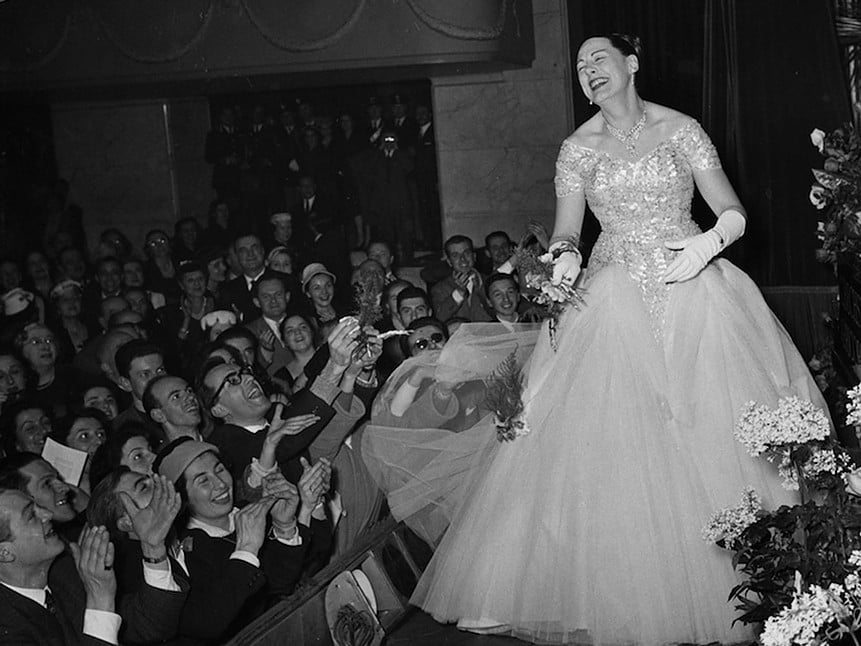
For years, the world of Italian opera was divided between two goddesses: Renata Tebaldi and Maria Callas. And from the evidence of YouTube, heated debate over their respective merits continues even to this day. So it was that the rivalry between post-war’s biggest divas drove a wedge between my barber and me.
It was at the old Symphonic-Operatic Barber Shop on South 20th Street in Philadelphia, a two-chair establishment, with black-and-white photos and homemade dioramas of the great singers in a large display window. In the waiting area, Playboy magazines were available for the clientele. Reading material was especially important in those days before the smart phone, and this was unquestionably a step-up from my hometown barber, who had always provided his kids’ hand-me-down horror comics. On the sound system, naturally, was continuous opera.
Unluckily for me, on this particular occasion, it happened to be a recording of Maria Callas. While I was aware of the cult of Callas and even understood on an abstract level the nature of her greatness, I had never quite been able to get around the timbre of her voice – the apple or whatever it was that was stuck in her throat.
During one particularly ambrosial passage, my barber paused, mid-cut, to express his awe at Callas’ talent. Unfortunately, he happened to phrase it as a question, and it would have been better for me had I taken it as rhetorical. Instead, I asserted that I’ve always been more of a Tebaldi man myself. A chill settled over the place, and when he was finished, he coolly collected his fee. If he could have gotten away with it, I’m sure he would have slashed my throat.
This all comes to mind on the occasion of the 100th anniversary of Tebaldi’s birth. At its peak, the flames of the Callas-Tebaldi rivalry were fanned by the media. Tebaldi was quoted as saying she had one thing Callas did not: a heart; and Time magazine reported that Callas quipped that comparing herself to Tebaldi was like comparing champagne to Coca-Cola. (She later assumed an air of innocence and claimed she had said cognac.)
There could be friction between the singers, certainly. Tebaldi never forgot the time Callas came to hear her sing Aida and made a ruckus in her box as she sang “O patria mia.” And Callas was furious when Tebaldi violated a no-encore agreement during a dual tour of South America. But Callas had endured much worse, earlier in her career, including hisses from the gallery and vegetables hurled from the audience.
“Opera is a battlefield,” she once remarked, “and it must be accepted.”
But the singers themselves also shared a mutual admiration. It’s said that any friction there may have existed between them was resolved when Callas went backstage to congratulate Tebaldi following a 1968 performance of “Adriana Lecouvreur” at the Met. Of course, by then, Callas was no longer active as an opera singer.
In regard to what distinguished them, Tebaldi observed that Callas always sang as the character, but she always sang as herself.
The world is too variegated a place to be organized into simple dichotomies. What is it that drives us to insist on absolutes? Black and white, light and dark, good and bad? And most perversely, winner and loser? This impulse of human nature tends to turn grown people into infantile sports fans. For Callas’ acolytes, it’s the compulsion to fill YouTube with side-by-side comparisons, in order to expose the alleged shortcomings of Tebaldi’s “flat” voice when juxtaposed with Callas’ volcanic intensity.
Whatever.
The “feud” hurt neither the box office, nor the record sales. When devotees’ passions flare, the cash register is almost always the winner.
Since the haircut debate/debacle, and with more exposure, I gradually got past what I perceived as Callas’ flaws to more fully appreciate her artistry. In fact, temperamentally, I think she and I are more alike.
But Tebaldi’s career went on much longer, and her voice was so beautiful. Callas developed vocal issues early and died comparatively young, at 53. The candle that burns twice as bright burns half as long.
Perhaps it was the composers themselves who did much of the heavy lifting. I was first exposed to Tebaldi through her gorgeous and moving Mimi in her classic 1959 recording of “La bohème.”
By coincidence, she, “Manon Lescaut,” and “Bohème” were all born on February 1st. “Manon Lescaut” was first performed on this date in 1893. “Bohème” received its debut on February 1, 1896 (with Arturo Toscanini on the podium).
Of course, it would be another half-century before Tebaldi appeared in either of these operas. But by then, she had already received Toscanini’s benediction, when he described hers as the “voice of an angel.”
Angelic it might have been, but it wasn’t the only ticket to operatic heaven.
Tebaldi and Callas. Can’t the two coexist? Can’t we all get along? Can’t I just get a haircut?
As someone with a wave in his hair, I have always had a hard time finding a satisfactory barber, and the problem only worsened in the ‘90s, when I allowed it, at the peak of its lushness, to grow generous and curly. The only analogy I could have drawn for an opera-loving Italian barber would have been Hector Berlioz. And I’m guessing Italian barbers are not terribly interested in Berlioz’s operas.
I turned forlornly from the door of the Operatic-Symphonic Barber Shop that day to continue my weary search, like a hirsute Flying Dutchman, for a permanent tonsorial roost.
I hasten to add, there appears still to be an “Opera Barber Shop” at this location, but it bears little resemblance to the Old Philadelphia establishment it replaced. No plastic Pavarottis. No cigars. And as far as I know, no Playboy.
If I had a time machine, I would go back and advise my younger self: never argue about any of the following – religion, politics, or opera!
Happy centenary, Renata Tebaldi.
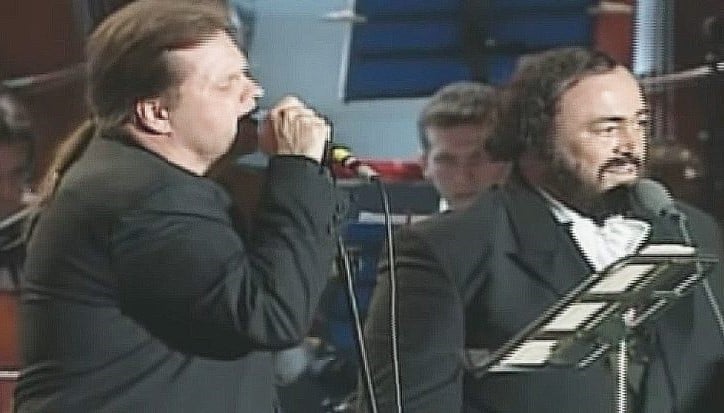
It’s said that Tebaldi had the kind of voice that was impossible to document on record, given the technology of the day. On her studio recordings, she was instructed to turn her head away from the microphones every time a climactic blast approached. In a sense, recordings have been kinder to Callas, capturing her personality, even as they shortchanged Tebaldi’s presence and technique. Here are some live performances preserved on television and film.
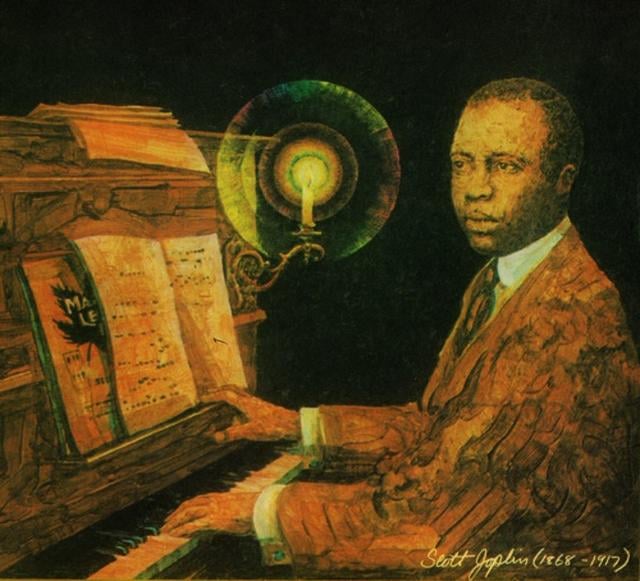
50 years ago today, the most ambitious work by America’s premier Ragtime composer received its belated first performance in Atlanta. Scott Joplin’s “Treemonisha” was presented by the Atlanta Symphony Orchestra and the Morehouse Glee Club, with Robert Shaw conducting. The chorus was prepared Wendell Whalum, and the direction and choreography were provided by Katherine Dunham.
In attendance was Eubie Blake, then a few weeks shy of his 85th birthday. Blake had known Joplin in Washington, D.C.
The plot of Joplin’s opera is set in a rural African American community near Texarkana, Arkansas, around 1884. The protagonist is 18 year-old Treemonisha, who was found under a sacred tree as a baby and raised as the daughter of Monisha and her husband Ned. As the community has no schools, her adoptive parents send her to away for her education. When she returns, she is the only member of her community who can read and write.
As the opera opens, Treemonisha foils the efforts of a conjurer, Zodzetrick, to sell a “bag of luck” to her mother. In retribution, conjurers kidnap Treemonisha and plan to toss her into a wasps’ nest. Happily, she is rescued by Remus, a townsman disguised as a scarecrow. The conjurers in turn are captured by field workers and taken into custody. However, at Treemonisha’s urging, they are forgiven and let go. Treemonisha is acknowledged as the community’s leader, and she and Monisha lead the people in a ragtime dance.
And so, in the contest between ignorance and education, superstition is overcome and grace attained through hard work, sound leadership, commitment to learning, and absolution. All well and good, but the opera also happens to be chock full of good tunes.
Joplin completed “Treemonisha” in 1910 and paid for the publication of a piano-vocal score. He sent a copy to the American Musician and Art Journal, which, in 1911, gave the work a glowing, full-page review. Presciently, the piece was lauded as an “entirely new phase of musical art and… a thoroughly American opera.”
Unfortunately, “Treemonisha” failed to gain traction. Joplin’s original orchestrations were completely lost (along with his first opera, “A Guest of Honor,” composed in 1903), and modern performances have required editing and orchestration by other hands, including T.J. Anderson (in Atlanta), Gunther Schuller (for Houston Grand Opera), and Rick Benjamin (for more intimate forces, akin to the theater pit orchestras Joplin would have known).
The work has often been characterized as a “Ragtime opera” – Joplin was, after all, the king of the rag – but “Treemonisha” encompasses a broader range of influences than such a description would suggest. The composer aspired to write a “serious” stage work in the European tradition, but one propelled by a uniquely New World vitality. As a unified artistic statement, it couldn’t have been written by anyone else. “Treemonisha” is engaging, tuneful, and very, very American.
Sadly, Joplin never lived to see his magnum opus fully staged. The work received its sole read-through in his lifetime in 1915 – two years before his untimely death at the age of 48 – at the Lincoln Theater in Harlem. Joplin himself was at the keyboard. The score then languished in obscurity for decades, until its rediscovery in 1970.
In 1971, selections were performed at the New York Public Library for the Performing Arts, with a group of singers supported by William Bolcom, Joshua Rifkin, and May Lou Williams. Following its Atlanta premiere, the complete work went on to be performed by companies all over the United States, making its Broadway debut in 1975.
In 1976, Joplin received a citation from the Pulitzer Prize committee “for his contributions to American music.” Of course, by then, he had already been dead for 59 years.
In this fascinating, poignant segment, we learn that Joplin’s orchestrations were probably trashed in 1962:
The historic Houston Grand Opera production – in English with Portuguese subtitles!
In Rick Benjamin’s orchestration for pit orchestra, with spoken introduction:
Eubie Blake plays his “Charleston Rag” in 1972 – a work he composed in 1899!
By coincidence, I just happened to rewatch “Amadeus” (1984) earlier this week, for the first time in many years. Of course, I’d seen it a bunch of times before.
This was the theatrical cut. With all apologies to Miloš Forman, it has been my experience that directors’ cuts tend to be in most ways inferior, especially when recut so long after the fact. (Forman’s was issued in 2002.) Or maybe George Lucas has just made me skittish.
Unfortunately, once a director’s cut appears on home video, it tends to displace the original in all formats, including streaming.
Thankfully I’ve got my trusty old, double-sided DVD. Yeah, I have to flip it an hour and 50 minutes into the movie, but I grew up during the LP era, so I can take it.
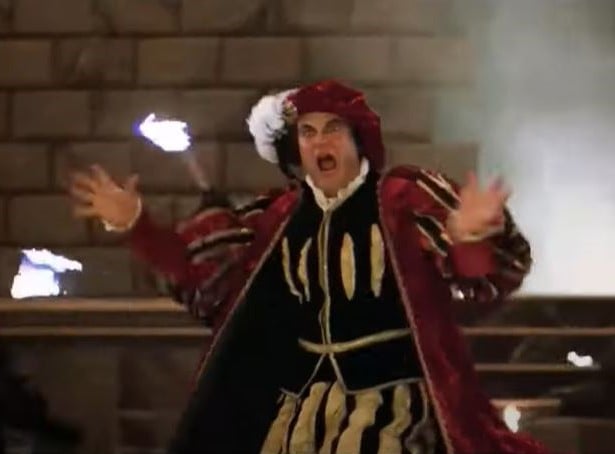
All that aside, has there ever been a staged “Don Giovanni” as cool as this one?