Today is the birthday of one of my favorite composers, Erich Wolfgang Korngold (1897-1957), in my heart since childhood, thanks to viewings of “The Adventures of Robin Hood. But guess what? I love his concert music and his operas too! Here’s a joyous discovery for a spring afternoon: Korngold at the piano, playing his own themes from opera and the movies, at the home of Ray Heindorf, who worked very closely with the composer as an orchestrator on a number of his classic film scores. By 1951, Korngold had already left Warner Brothers. He would work on only one more film, the Richard Wagner biopic “Magic Fire,” released by Republic Pictures in 1955. Hear Korngold sing (if you can distinguish him from Heindorf) and actually speak, especially during the final minutes, accompanied by some fascinating home movies.
Tag: Opera
-
Wagner Yannick and Tristan A Mixed Reaction
May 22. Richard Wagner’s birthday. Anyone else looking forward to this endurance test with the Philadelphia Orchestra? 4 and ½ blissful hours of blood clot-inducing “Tristan und Isolde.”
This tongue-in-cheek teaser has been receiving a mixed reaction. I happen to think it’s very funny, but on message boards, music chats, and social media, it’s been getting more than its share of vitriol. Evidently, there are some real Yannick haters out there. And I am sorry to have to admit, classical music still does have its stuffed shirts.
Thankfully, I spend as little time around them as I can. In fact, I’m not sure how close I am to any of them in real life. But you know how it is. These guys can come across as the most unassuming, mildest-mannered people, but give them the anonymity of the internet and they all turn into monsters.
It’s okay to have opinions – I’ve got plenty of them myself, and by no means am I satisfied with everything Yannick conducts, strictly from an interpretive standpoint – but lighten up. It’s just a teaser, and it’s supposed to be fun!
This “Tristan” is unlikely to be on a level of Wilhelm Furtwängler’s or Victor de Sabata’s, but it is an opportunity to hear one of the world’s great orchestras play Wagner’s hypnotic, narcotic, viscerally intense, revolutionary score without the distraction of the seemingly-inevitable, nihilistic Regietheater nonsense productions you’re likely to encounter these days at virtually any opera house that’s going to attempt a staging.
The Everest of “Tristan” is littered with the literal corpses of those who have attempted the climb. Not only have singers destroyed their voices, but conductors have actually died. Felix Mottl and Joseph Keilberth both dropped dead while conducting the second act. The very first Tristan, heldentenor Ludwig Schnorr von Carolsfeld, died suddenly at the age of 29, after only four performances.
In an interview given shortly before his death, Giuseppe Verdi said that he “stood in wonder and terror” before Wagner’s “Tristan.” Is it any wonder that Yannick is getting himself into shape?
-

NYCO: Will the Phoenix Rise Again?
Is it possible the phoenix is about to rise again?
For decades, New York City Opera was always the other, upstart opera company at Lincoln Center. From 1966 to 2010, it made its home at New York State Theater, across the plaza from the more venerated Metropolitan Opera.
While NYCO could not compete with the larger budgets and star-power of the Met, it was not unusual for it to excel its establishment neighbor – which could often be encumbered by its larger space and more ponderous productions – through creative artistic solutions and investment in unusual and neglected repertoire. Furthermore, NYCO provided a launchpad for many singers who went on to international careers and graduated to the Met itself, among them Placido Domingo, Samuel Ramey, José Carreras, Carol Vaness, and of course Beverly Sills. Sills served as NYCO’s director from 1979 to 1989.
Approximately one-third of NYCO’s repertoire was devoted to American opera. Among works to have received their first performances by the company include Aaron Copland’s “The Tender Land,” Robert Kurka’s “The Good Soldier Schweik,” Robert Ward’s “The Crucible” (recipient of a Pulitzer Prize in 1962), Jack Beeson’s “Lizzie Borden,” and Ned Rorem’s “Miss Julie.”
The company also presented a number classic musicals and served as a springboard into the opera house for Leonard Bernstein’s “Candide.”
Despite its decades of artistic success, in 2008, it was revealed the organization was struggling against serious financial difficulties. After 45 years, it would depart Lincoln Center to perform in a variety of New York venues, including the Brooklyn Academy of Music, until its seemingly inevitable bankruptcy in 2013. (Ironically, it was in 2008 that billionaire David H. Koch donated $100 million for the renovation of New York State Theater. The space has since borne his name.)
In 2016, the company was revived under new management, NYCO Renaissance Ltd. The new NYCO returned to Lincoln Center with a performance of “Tosca,” not at Koch Theater, but at Jazz at Lincoln Center. Since then, it has maintained something of an itinerant existence, in recent years maintaining its presence mainly through recitals and park performances. It has not given a staged performance since the world premiere of Ricky Ian Gordon’s “The Garden of the Finzi-Continis” in 2022.
Now the company seems poised to begin a new era. Conductor Constantine Orbelian, who had been the organization’s music director since 2021, was promoted to its executive director in September. The first concert under his administration will not be a staged opera, but rather an ambitious program to be presented at Carnegie Hall under the title “Music of Survival: A Celebration of Survival and Perseverance Told Through the Universal Language of Music.” The evening will include Mieczyslaw Weinberg’s Suite from “The Last Inch” and Fantasy for Cello and Orchestra, Erich Wolfgang Korngold’s rarely-heard Cello Concerto, conceived for the Bette Davis film “Deception,” and the U.S. premiere of Gennady Rovner’s “Metamorphosis” Symphony. The concert will take place on February 24 at 8 p.m.
This will serve as preamble to next season, which will highlight a fully-staged revival of William Grant Still’s opera “Trouble Island.” The work, with a libretto by Langston Hughes and Still’s wife, Verna Arvey, focuses on the rise and fall of Jean-Jacques Dessalines, leader of the Haitian Revolution, the only slave rebellion in history to successfully establish an independent nation.
“Troubled Island,” the first work by a Black American to be performed by a major company, in 1949 (after having been withdrawn twice in 1945 and 1948), was a great success with the opening night audience, receiving 22 curtain calls. Critical reaction was not as kind. Years later, Still’s daughter Judith claimed the work’s positive reception had been undermined by institutional racism. “Howard Taubman came to my father and said ‘Billy, because I’m your friend I think that I should tell you this – the critics have had a meeting to decide what to do about your opera. They think the colored boy has gone far enough and they have voted to pan your opera.’ And that was it. In those days, critics had that kind of influence.”
Still had already achieved unprecedented recognition in his field for a composer of color, having also been the first Black American to have had a symphony performed by a major orchestra, the first to have had a symphony performed widely, the first to have conducted a major orchestra, and much later – three years after his death, in fact – the first to have an opera (“A Bayou Legend”) broadcast on national television, as late as 1981. During his heyday, Still was widely hailed as the “Dean of Afro-American Composers.” But for some reason, a Black man in the opera house was evidently perceived by influential forces as an audacious step too far.
In 2006, Judith Still organized the heartbreaking story into a 600-page book she compiled from original documents, “Just Tell the Story: Troubled Island.” I ordered it in 2021, from William Grant Still Music, which is owned and operated by the composer’s family, but have yet to read it. I will do so before attending next season’s performance. Hopefully the planned revival will not be hampered or dismissed because of anti-DEI initiatives. While I agree that music and composers should rise or fall according to their individual merit, they should also be given the same opportunities as their peers. From what has been allowed to reach the public, Still has long proven himself an important voice in American music. Sadly, it’s only in the wake of George Floyd that many of our musical institutions are finally giving Still the platform he has so long deserved. I think he would be shocked to know his music is now being played by most of the country’s great orchestras.
NYCO was founded in 1943, offering affordable opera out of New York City Center, on West 55th Street, formerly a Masonic temple, converted into a performing arts center by New York Mayor Fiorello La Guardia and City Council President Newbold Morris. La Guardia dubbed it “the people’s opera.” As previously indicated, the company moved to Lincoln Center in 1966, the same year the Met opened at its new digs. (Since 1883, the Old Met had been located at 1411 Broadway.)
Unfortunately, I missed the glory days of Sills and her associates, but in the 1990s, I would travel in to New York with my best friend to catch NYCO performances of rarely-staged operas by Korngold, Sir Michael Tippett, Ferruccio Busoni, and Paul Hindemith. This would have been during Christopher Keene’s tenure. Keene had conducted at NYCO since 1970, and I am greatly indebted to him for some highly enjoyable and musically stimulating afternoons at the theater. Later, I learned of Keene’s personal demons, which made his energy and professionalism all the more remarkable. Sadly, he died of complications from AIDS in 1995 at the age of 48.
Buoyed by the excellence of these productions, I brought my parents, who were not “opera people,” but were curious, to see Arrigo Boito’s “Mefistofele.” Tito Copabianco’s classic production had propelled both Norman Treigle and Samuel Ramey to superstardom, but regrettably by 1994, it was looking a little threadbare and sad. At least it had an orgy and some horses (though not in the same scene).
Orbelian says he also plans to resurrect Pietro Mascagni’s “Isabeau.” You can read more about it here:
https://apnews.com/article/new-york-city-opera-constantine-orbelian-c4b9260c0ca4d5dbb8caf326de81a430
Music of Survival at Carnegie Hall on February 24
PHOTOS: William Grant Still and baritone Robert Weede, behind the scenes of “Troubled Island;” and New York City Opera’s Constantine Orbelian
-

Bidu Sayão Comic Brazil’s Opera Superhero
Who really cares about Batman or Wolverine? Since we’re all basically living in the tropics anymore anyway, here’s a comic book about Bidu Sayão. Thrill to the adventures of Brazil’s most famous operatic soprano!
You have to scroll down to the bottom of Bruce Duffie’s interview to see a more complete spread.
https://www.bruceduffie.com/sayao.html
Sayão was a great champion of the music of her compatriot, Heitor Villa-Lobos. Here she is, in Villa-Lobos’ “Bachianas Brasileiras No. 5,” with the composer conducting.
Later, she came out of retirement to sing Villa-Lobos’ “Forests of the Amazon.” You can hear some of it at the end of these selections from some of her signature roles (Manon, Juliette, and Mimi). There’s even a Brazilian folk song tossed into the mix.
She’s heavenly in Debussy’s “La Damoiselle élue,” after Dante Gabriel Rossetti’s “The Blessed Damozel,” recorded here with Eugene Ormandy and the Philadelphia Orchestra.
And “Si mes vers avaient des ailes” (“If my verses had wings,” text by Victor Hugo), by Venezuelan-born French composer Reynaldo Hahn.
Once she established herself at New York’s Metropolitan Opera, Sayão had the good sense to make her home in the cooler clime of Lincolnville, Maine.
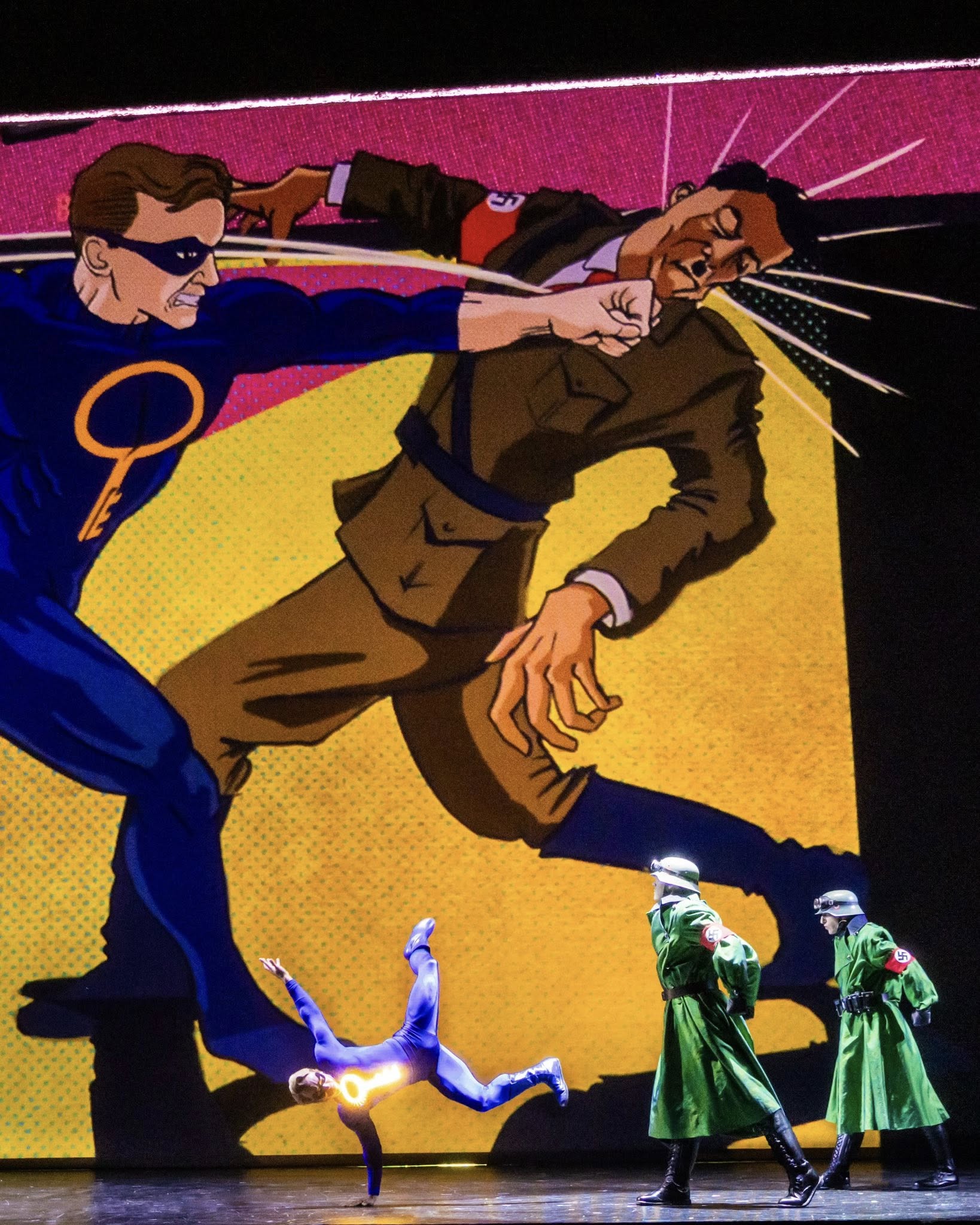
Her comic book dates from the 1940s. I’m hoping for a Jack Kirby-style cover, complete with Bidu punching out Hitler.
Tag Cloud
Aaron Copland (93) Beethoven (95) Composer (114) Film Music (129) Film Score (143) Film Scores (255) Halloween (94) John Williams (192) KWAX (229) Leonard Bernstein (103) Marlboro Music Festival (125) Movie Music (144) Mozart (88) Opera (206) Philadelphia Orchestra (89) Picture Perfect (174) Princeton Symphony Orchestra (108) Radio (88) Ross Amico (244) Roy's Tie-Dye Sci-Fi Corner (290) The Classical Network (101) The Lost Chord (268) Vaughan Williams (103) WPRB (396) WWFM (881)