Tag: Pablo Casals

  • Pablo Casals Bach Cello Suites Birthday

    Pablo Casals Bach Cello Suites Birthday

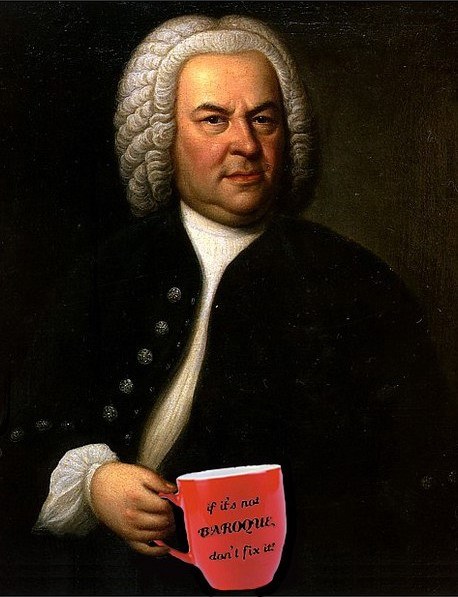
    It’s Pablo Casals’ birthday. Enjoy a beautiful Saturday morning with his pioneering traversal of the Bach cello suites, still sounding great after 80 years.

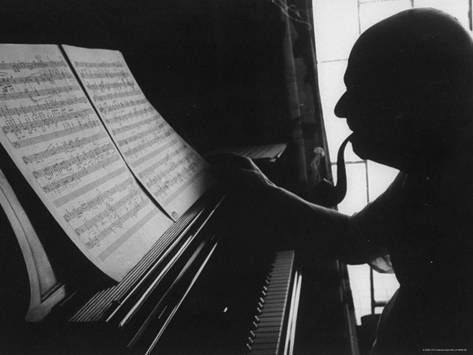
    It’s hard to believe that these cornerstones of the cello repertoire were once commonly regarded as little more than etudes. The truth is, before the 20th century they were not widely known, much less understood. It is Casals who is credited with having rehabilitated them, following his discovery of the music in a Catalan bookshop at the age of 13. He cherished the suites for the rest of his life, not only playing them in public but delving into them privately every morning after a walk and a smoke. There must have been something to it: Casals died in 1973, two months shy of his 97th birthday.

    He was the first cellist to record all six suites, already 60 by the time he first played Bach before a microphone.

  • A Brahms Christmas at Marlboro Music

    A Brahms Christmas at Marlboro Music

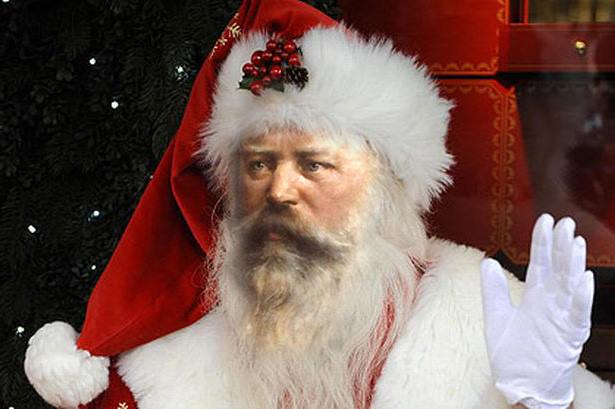
    Despite his remarkable resemblance to a certain Mr. Claus, Brahms is probably about the last composer you’d think of cozying up to on Christmas. This is the man who infamously left a party, after all, with one of the all-time great exit lines: “If there’s anyone here I’ve failed to insult, I apologize!”

    This week on “Music from Marlboro,” it’s a Brahms Christmas.

    Actually, Johannes Brahms had a very generous spirit. He did not shoot cats with a homemade bow-and-arrow and work the sounds of their pain into his music, as his enemies suggested. What he did enjoy was Christmas shopping! On one occasion he gifted the Schumann boys some rather pricey toy soldiers. On another, he surprised his housekeeper’s sons with a Christmas tree. Sure, Brahms could be a bit of a hard nut sometimes, but he retained a certain child-like demeanor at Christmas throughout his life.

    The second of his “Zwei Gesänge” (“Two Songs”) for voice, viola and piano, Op. 91, was written in 1863 for his friend, the violinist Joseph Joachim, and Joachim’s wife, Amalie. It had originally been intended as a wedding present, but Brahms resubmitted it the following year for the baptism of the couple’s son (who was named after him). Joseph was also well-versed on the viola, and Amalie was a contralto.

    The work, “Geistliches Wiegenlied” (“Sacred Lullaby”), after a text by Emanuel Geibel, is a cradle song sung by Mary, mother of Jesus, who addresses the holy angels, requesting that they silence the rustling palms because her Child is sleeping. The viola quotes the Christmas melody “Joseph, lieber Joseph mein,” a sly reference on the part of the composer, who incorporates the carol’s text in order to include Joachim’s given name.

    We’ll hear a performance from the 2011 Marlboro Music Festival, featuring mezzo-soprano Jennifer Johnson Cano, violist Hélène Clément, and, at the keyboard, Marlboro co-director Mitsuko Uchida.

    The adult Brahms had no family of his own. He divided Christmas Day between his favorite tavern and coffee shop, but Christmas Eve was another matter. In his later years, he greatly enjoyed passing the night with friends – once he was done shopping, that is – as part of a kind of extended family.

    Though he rarely spent Christmas with his longtime crush, Clara Schumann, Brahms thought of her every year, on at least one occasion writing her a nice Christmas letter in which he imagines sitting beside her at her breakfast table, conversing with her, and delighting in all of her last-minute holiday preparations.

    Clara joined Brahms for the first performance of his “Variations on a Theme by Haydn,” in its original version for two pianos, at a private gathering in Bonn, in August of 1873. The first performance of the orchestral version took place three months later, with the Vienna Philharmonic conducted by the composer.

    Brahms owed much of his interest in Haydn, who died 60 years earlier and whose music had pretty much fallen out of fashion, to his friend Karl Ferdinand Pohl, scholar-librarian of the Vienna Philharmonic. The theme that had so captivated Brahms is the famous “St. Anthony Chorale,” employed in the Wind Partita in B-flat, which at the time was attributed to Haydn.

    This evening, we’ll have an opportunity to compare both versions of Brahms’ celebrated variations. First, we’ll hear them performed in 1976 by pianists Stephanie Brown and Cynthia Raim; then the great Pablo Casals will conduct the Marlboro Festival Orchestra, from 1969.

    Of course, the theme is probably not by Haydn at all, but who are you going to believe, scholarship or Brahms? It is the Christmas season, after all. I’m willing to take it on faith. I hope you’ll join me for the next “Music from Marlboro,” this Wednesday evening at 6:00 EST, on WWFM – The Classical Network and wwfm.org.


    In the meantime, feel free to enjoy this profile of Pablo Casals by Marlboro’s Frank Salomon:

    https://mailchi.mp/marlboromusic/from-the-archives-pablo-casals?fbclid=IwAR1JlaAnoqYGZYZqzaUQtEjCU5NouYF_QzWw5-rDrIb9vWfryIt43xbYppE

    Marlboro School of Music and Festival: Official Page
  • Marlboro Festival: Hindemith & Beethoven Unleashed

    Marlboro Festival: Hindemith & Beethoven Unleashed

    A chamber music festival takes a break from chamber music this week, as musicians from Marlboro band together under two legendary artists.

    Paul Hindemith was evidently feeling his oats when he launched into his series of Kammermusiken, 20th century analogues to the Bach Brandenburg Concertos, only with a little more vinegar. Hindemith was about 26 when he wrote his exuberant Kammermusik No. 1 in 1922, the piece sounding like a post-modern mash-up of “Petrushka,” the Rondo-Burleske from Mahler’s Ninth Symphony, and hot jazz. Watch out for that siren! The performance, from 2016, will feature an ensemble of 12 Marlboro musicians under the direction of a figure better known as a pianist, Leon Fleisher.

    Then Pablo Casals will preside over a makeshift orchestra at the 1969 Marlboro Music Festival for a spiritually potent performance of Beethoven’s Symphony No. 7. Casals’ loving, humanistic interpretations of the orchestral works of Beethoven, Mozart, Schubert, Mendelssohn, Schumann, and of course Bach form a remarkable capstone to an enviable career. The legendary cellist was affiliated with Marlboro for the last 13 years of his life, from 1960 to 1973.

    Wagner characterized Beethoven’s Seventh as “the apotheosis of the dance,” but not even he could have foreseen Hindemith’s foxtrot. We’ll be dancing up a storm on the next “Music from Marlboro,” this Wednesday evening at 6:00 EST, on WWFM – The Classical Network and wwfm.org.

    Marlboro School of Music and Festival: Official Page
  • Bach at Marlboro: Casals, Serkin & More

    Bach at Marlboro: Casals, Serkin & More

    If, like me, you’re in the Northeast, hopefully you’re enjoying winter’s last gasp (on the second day of spring!) from someplace warm and comfortable, preferably with a mug of tomato soup and a toasted cheese sandwich at your side, and plenty of great music at the touch of a button or the click of a mouse.

    Although The Classical Network’s daylong celebration of Bach’s birthday has been postponed due to the inclement weather, nothing, not even Mother Nature, can impede an all-Bach “Music from Marlboro.” Join me for sublime music-making by the likes of Marlboro legends Pablo Casals, Felix Galimir, Mieczyslaw Horszowski, and Rudolf Serkin. Even the personnel of the Marlboro Festival Orchestra is stuffed with already-legendary and soon-to-be-legendary performers. It doesn’t get any better than this.

    Unfortunately, my original cut for the 58:30 show was an hour and four minutes! There was so much wonderful material, I couldn’t bring myself to delete any of the music, but I had to cut my text to the bone. So here is some of the background material that was left on the cutting room floor.

    About Pablo Casals: The legendary cellist was affiliated with the Marlboro Music Festival for the last 13 years of his life, from 1960 to 1973. It was Casals who, at the age of 13, rediscovered Bach’s cello suites in a thrift shop in Barcelona. His 1939 recordings established the works as cornerstones of the modern repertoire. Casals’ loving, humanistic interpretations of Bach’s orchestral works (as well as those of Mozart, Beethoven, Schubert, Mendelssohn, and Schumann) at Marlboro form a remarkable capstone to an enviable career. We’ll hear Casals in 1965, conducting Marlboro musicians, including trumpeter Robert Nagel, flutist Ornulf Gulbransen, oboist John Mack, and violinist Alexander Schneider, in Bach’s Brandenburg Concerto No. 2.

    About Mieczyslaw Horszowski: The great pianist died in 1993, just shy of his 101st birthday. He had one of the longest careers of any performing artist. Horszowski was a pupil of Theodor Leschetizky, who was a pupil of Carl Czerny, who in turn was a pupil of Beethoven. Horszowski played Beethoven’s Piano Concerto No. 1 in public for the first time in 1901! He joined the faculty of the Curtis Institute of Music in 1942. He remained there for over 50 years, giving his last lesson a week before his death. We’ll hear Horszowski in 1982, performing Bach’s Keyboard Concerto No. 7 in G minor, BWV 1058.

    About Felix Galimir: This marvelous musician had an amazing career. He was a violinist with the Vienna Philharmonic and the NBC Symphony (under Toscanini), formed the Galimir Quartet, and was in residence at Marlboro from 1954 until his death in 1999. Galimir will be on the podium, accompanying the venerable Horszowski in the aforementioned Bach concerto.

    About Rudolf Serkin: The visionary Serkin co-founded the Marlboro Music Festival in 1951, with Adolf and Herman Busch, and Marcel, Blanche, and Louis Moyse. In addition to being one of the most revered pianists of his generation, he managed to direct the festival for 40 years, until his death in 1991. We’ll listen to Serkin’s probing and intimate account, from 1976, of Bach’s 14 Canons, BWV 1087, on the first eight notes of the aria ground from the “Goldberg Variations.”

    Along the way, we’ll also hear a Trio Sonata in G major, BWV 1038, performed in 1974 by flutist Michel Debost, violinist Pina Carmirelli, cellist Ronald Leonard, and harpsichordist Mark Kroll!

    Not much talk from me, but lots of great music, as we celebrate Bach on “Music from Marlboro,” this Wednesday evening at 6:00 EST, on WWFM – The Classical Network. Please support us in advance of our belated Bach birthday celebration (which will take place tomorrow, hopefully, if we’re not under ten feet of snow) at wwfm.org. Thank you for your support, and Happy Birthday, Bach!

    Marlboro School of Music and Festival: Official Page
  • Gaspar Cassadó Rediscovered on The Classical Network

    Gaspar Cassadó Rediscovered on The Classical Network

    ¡Hola!

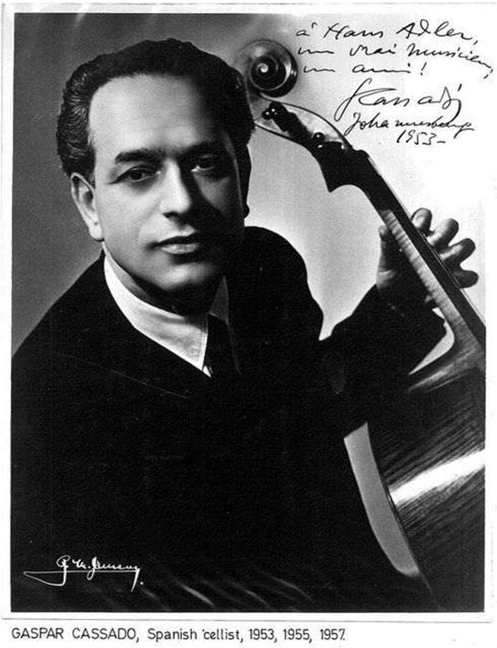
    The centerpiece of today’s Noontime Concert on The Classical Network will be a chamber music rarity by the great Spanish cellist Gaspar Cassadó (1897-1966). Cassadó had the advantage of having been born into a musical household in Barcelona. His father, a composer, organist, and piano salesman, shepherded his development and even moved the family to Paris so that he and his elder brother, Augustin, a violinist, could take advantage of the artistic climate there.

    At the age of nine, Cassadó was heard in recital by Pablo Casals, and though Casals was at the height of his career and very much in demand, he took the boy on as one of only three pupils. Needless to say, Casals’ influence made a deep impression on the young cellist. Cassadó also studied composition with Maurice Ravel and Manuel de Falla.

    Like the violinist Fritz Kreisler, Cassadó remained sheepish about some of his original miniatures in the styles of other composers and gained a degree of notoriety when it was discovered that many of the works he had been attributing to others, such as Frescobaldi, Boccherini, and Schubert, were in fact his own.

    Casals performed and conducted a number of Cassadó’s acknowledged works, and teacher and student often appeared together in concert. However, with the outbreak of the Spanish Civil War in 1936, Casals fled the country, effectively abandoning his career, while Cassadó chose to continue to perform extensively. Though Cassadó stayed out of Spain until after World War II and performed only once in fascist Germany, Casals publicly disavowed him in a letter to the New York Times. It’s thought that this irreparably damaged Cassadó’s career, though the two cellists later reconciled.

    Among Cassadó’s most frequently performed works are his “Rapsodia Catalana,” his Suite for Solo Cello, and “Requiebros,” which was championed by Casals.

    We will hear Cassadó’s Piano Trio in C major, performed by artists of the Lenape Chamber Ensemble, from a concert given at Delaware Valley University on July 22. Also on the program is Mozart’s Horn Quintet in E-flat major and Tchaikovsky’s string sextet, “Souvenir de Florence.”

    The Lenape Chamber Ensemble is made up of hornist David Jolley, violinists Nancy Bean and Cyrus Beroukhim, violists Catherine Beeson and Brett Deubner, cellist Arash Amini, and pianist Marcantonio Barone.

    The ensemble’s next concerts – featuring works by Haydn, Poulenc, and Schubert – will take place at 8:15 p.m. on March 2 at Upper Tinicum Lutheran Church, 188 Upper Tinicum Church Road, in Upper Black Eddy, PA, and at 3 p.m. on March 4 at Delaware Valley University’s Life Sciences Auditorium, 700 E. Butler Street and Route 611, in Doylestown. To learn more, visit lenapechamberensemble.org.

    For today, I hope you’ll join me for music by Mozart, Cassadó, and Tchaikovsky, at 12:00 EST, on WWFM – The Classical Network and wwfm.org.


    Casals performs Cassadó’s “Requiebros:”

Tag Cloud

Aaron Copland (92) Beethoven (95) Composer (114) Film Music (123) Film Score (143) Film Scores (255) Halloween (94) John Williams (187) KWAX (229) Leonard Bernstein (101) Marlboro Music Festival (125) Movie Music (138) Opera (202) Philadelphia Orchestra (89) Picture Perfect (174) Princeton Symphony Orchestra (106) Radio (87) Ralph Vaughan Williams (85) Ross Amico (244) Roy's Tie-Dye Sci-Fi Corner (290) The Classical Network (101) The Lost Chord (268) Vaughan Williams (103) WPRB (396) WWFM (881)

DON’T MISS A BEAT

Receive a weekly digest every Sunday at noon by signing up here


RECENT POSTS