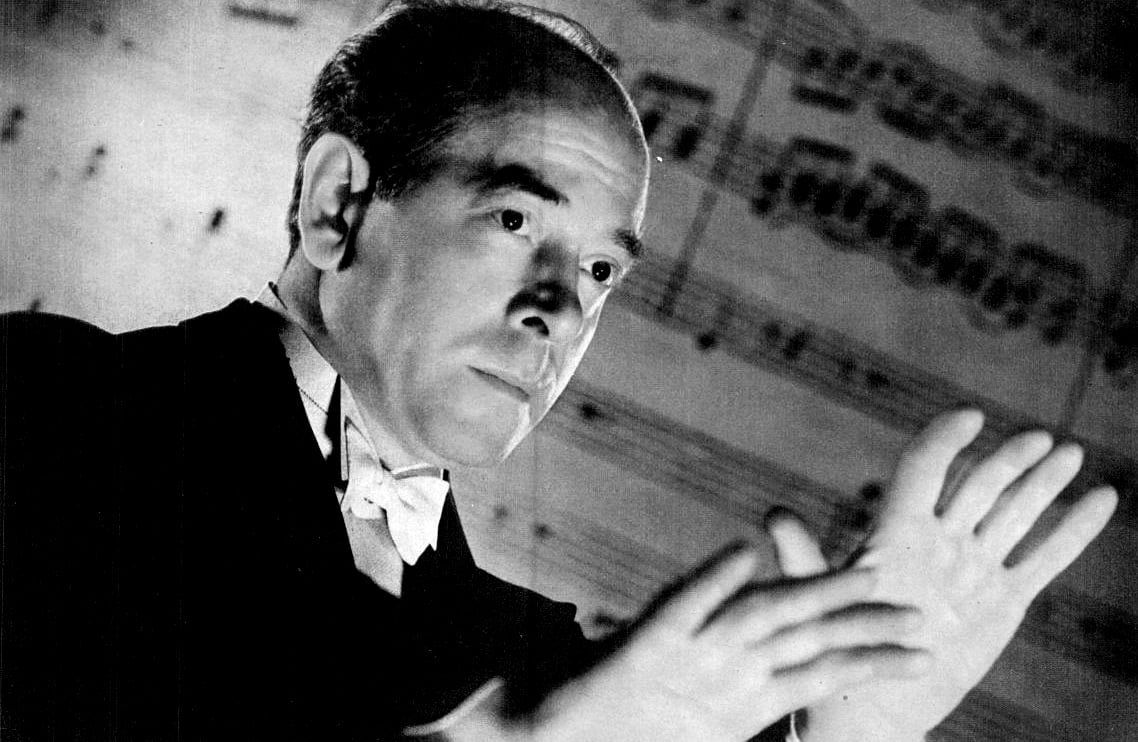
What’s the big deal about this guy, Jenő Blau? Well, you probably know him better by his adopted name, Eugene Ormandy.
Ormandy, a Hungarian-born violinist who studied with Jenő Hubay (for whom he was named), became a naturalized American citizen in 1927. Ultimately, he wound up directing The Philadelphia Orchestra for 44 years. In that capacity, he became one of the world’s most-recorded conductors.
However, in some respects, he remains a vastly underrated one.
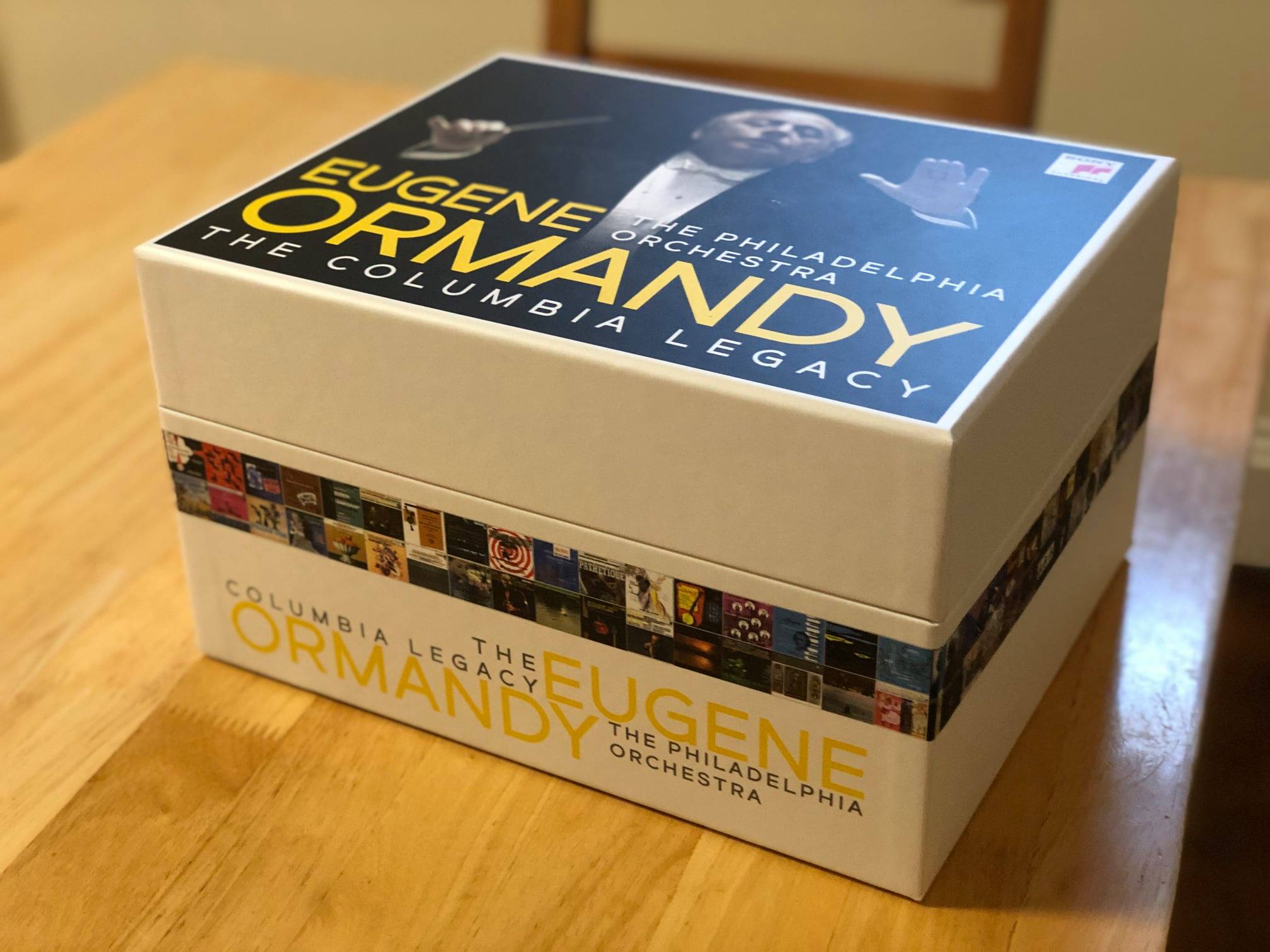
In May, I breathlessly announced my acquisition of “Eugene Ormandy: The Columbia Legacy,” a 13-pound box set of 120 compact discs, newly remastered from original analogue sources, recorded between 1944 and 1958. I am just over halfway through my first, attentive journey through its contents, and I have no hesitation in proclaiming it the release of the year.
At worst, there a handful of performances that never take flight as perhaps they should, and one or two interpretive misfires (I hasten to add, the execution is always impeccable), but by a staggering margin, the quality of the music-making documented in this set is both stunning and revelatory.
It astounds me that any of the old saws about Ormandy being “workman-like,” a mere custodian of Stokowski’s “Philadelphia sound,” and too commercially successful ever to be taken seriously have not been exploded, once and for all.
However, it remains obvious that, even with the evidence now freshly before their ears, some critics remain blinded by their preconceptions. How else to explain the blinkered, damning-with-faint-praise reception in the venerable British music magazine Gramophone and in The New York Times?
The box is a knockout. Yes, the recordings are in mono, but there’s a vitality to the music-making that lights up the room. I’d be first in line for a sequel, in the form of an authorized box of Ormandy’s Columbia stereo recordings.
But take your time, Sony Classical. There’s still plenty here for me to enjoy.
One of my favorite Ormandy records was also one of his later ones, this one made for EMI. Throughout his career Ormandy succeeded in selling Sibelius’ “Four Legends from the Kalevala,” a collection of tone poems inspired by the Finnish national epic the “Kalevala,” for the early masterpiece that it is.
The legendary Philadelphia strings in Vaughan Williams’ “Fantasia on a Theme by Thomas Tallis”
Hindemith, “Concert Music for Strings and Brass” (the movements uploaded individually into a playlist)
Ivan Davis joins Ormandy and the Philadelphians for Liszt’s “Hungarian Fantasy,” slightly abridged:
Bruckner “Te Deum” with Temple University Choir
World premiere performance of Samuel Barber’s Violin Concerto
Shostakovich Symphony No. 4
Reinhold Glière’s “Russian Sailor’s Dance”
Rachmaninoff Piano Concerto No. 2, with Eugene Istomin
Ormandy conducts “Scheherazade” (complete). This is the Philly Orchestra I remember from my college years.
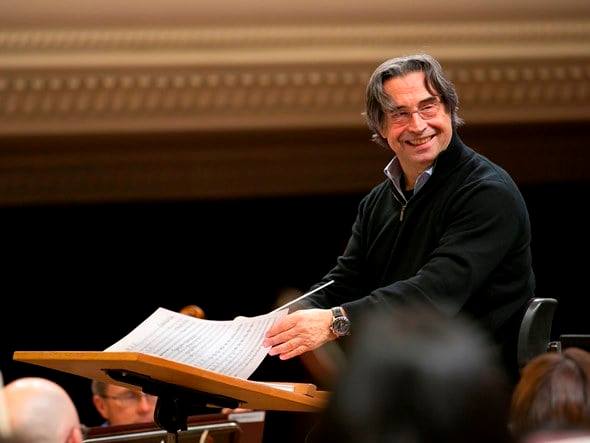
Aloof. Self-serious. Inordinately proud of his hair. In many ways, he’s like the anti-Yannick. You would never catch him in his workout clothes. Though, come to think of it, it would have been very interesting had Riccardo Muti been music director of the Metropolitan Opera while he held the reins of the Philadelphia Orchestra.
Like there’s not enough drama at the opera.
Muti served as music director at La Scala, one of the world’s most venerable opera houses, for 19 years (from 1986 to 2005). By the end of his tenure, the collective mood of the musicians and administration was as black and thick as a Milanese espresso. Following his departure, he would not set foot in the theater again for eleven years, tensions thawing only for the occasion of his 75th birthday. That was in 2016.
In May of this year, he returned – to lead the Vienna Philharmonic, no less, not the resident orchestra – to mark the 75th anniversary of La Scala’s reopening following World War II. But in-house conflict was still brewing.
When, after the performance, the opera’s current music director, Riccardo Chailly, came to congratulate Muti – to whom he’d lent his own dressing room for the occasion – Muti reacted by telling Chailly to get lost. (More specifically, to “get off my balls.”) At first, those present thought Muti had to be kidding. But he had already eviscerated a television crew, there to document the concert, mistaking them for intrusive journalists, and torn into La Scala’s press officer. Later, he claimed not to have recognized Chailly, because Chailly was wearing a mask.
Don’t ever change, Maestro.
Muti is 80 years old today. If he has mellowed, it is perhaps only in the voltage of his performances. His ego is intact, his temper is in good health, and his hair has lost none of its bounce. And I say this as a Muti “fan.”
This is not an artist without his flaws. There are those who contend that he dismantled the “Philadelphia sound,” cultivated for nearly seven decades by Leopold Stokowski and Eugene Ormandy. A more objective assessment would be that he brought the orchestra up to modern standards of adapting performance practice to suit the given repertoire, as opposed to applying the same overarching technique to, say, Mozart and Mahler.
He certainly didn’t make any friends by dressing down his audience. If someone applauded at the wrong time, he or she would be met with, at the very least, a withering gaze. But it was also not unheard of for him to literally stop a performance to deliver a stern reprimand. I shudder to think how he would have reacted had it been the era of cell phones.
Muti was never accessible or touchy-feely in the manner of Yannick, Philadelphia’s current music director, who has gone out of his way to be the people’s conductor. Dressed down and tattooed. Loquacious. A smile for everyone. Muti maintained the maestro mystique, with a fair amount of old school contempt perched coolly beneath a veneer of civility. There was always something of the aristocrat about him, a high priest ever-alert to the threat of profanation in his Temple of High Art.
Now, nearly four decades later, Muti is one of classical music’s old lions. And I find I can’t help but agree with him on some points regarding the state of the art, as expressed in his interviews. I confess I haven’t really followed his career in Chicago. They seem to love him there. He currently commands the highest salary of any conductor (at roughly $3.5 million per annum).
This has turned out to be a harder-edged post than I intended, certainly more so than the one I wrote a few years ago, on the occasion of Muti’s 76th birthday. I don’t want to give the impression that I am not forever grateful for all the thrilling performances I attended at Philadelphia’s Academy of Music, throughout the 1980s and into the ‘90s. In many ways, for me, these concerts have never been surpassed. Part of it must be attributable to the intimate nature of the hall, since abandoned for the cavernous Kimmel Center for the Performing Arts. At the Academy, Muti was like an uncaged lion in a miniature Coliseum.
Muti wanted his new hall, and it frustrated him no end that it was so long coming. It’s no secret that the delays contributed to his departure from Philadelphia. As with La Scala, there was always the sense that the break was not entirely amicable. If memory serves, he has returned to conduct in Philadelphia only once.
He has his vanities and shortcomings, to be sure, but it is evident he sincerely loves music. And he believes in the integrity of his art. He may not be the greatest conductor since Toscanini, whom he professes to emulate in his claimed deference to “the score.” But in concert, very few of Muti’s performances are museum pieces – or at least they weren’t, in Philadelphia. There was always plenty of passion roiling beneath the ermine cloak of “authenticity.”
For the countless hours of thrilling performances, I thank you, Maestro Muti. Happy 80th birthday.
Since I have painted him as such a horrible person, here’s a speech he delivered, in acceptance of the honor of Musician of the Year from Musical America. It shows that Muti is capable of exhibiting a sense of humor, if only on his own terms.
Muti having the time of his life rehearsing – and singing! – “Nabucco” at La Scala:
Muti demonstrates some of that Philadelphia electricity in this live performance of Elgar’s concert overture “In the South”
A Muti specialty and an old favorite – Martucci’s “Notturno.” Good to see the old crew again – Norman Carol, William de Pasquale, Luis Biava, Joseph de Pasquale, Richard Woodhams, Anthony Gigliotti. A great orchestra. Although I do hate it when local news personalities are brought in to host these telecasts. They never can seem to talk enough. Totally stomps the enchantment woven by the music.
At first, I was waiting for a slow news day – and one without a lot of major musical anniversaries – to share my elation, but then I kept finding myself cowed by the enormity of the undertaking. But if I’m going to do it, and it’s going to be relevant, I had better get on with it already. As the proverb says, a journey of a thousand miles begins with but a single step. So here goes!
sharp intake of breath
My “Eugene Ormandy: The Columbia Legacy” set has arrived!
Actually, it was delivered to my doorstep, finally, about two weeks ago.
Perversely, so intensely have I been looking forward to it, I couldn’t even bring myself to remove the shrink wrap for three or four days, lest I lose my grip on reality, forgoing the needs of daily existence to assimilate its contents and drift, with pinwheeling eyes, into fatal obsession. Last week, I finally broke the Seventh Seal.
An early birthday present to myself – months early – this set includes 120 compact discs, newly remastered from original analogue sources, discs and tapes recorded between 1944 and 1958. I want to stress that THESE ARE MONO RECORDINGS, not the frequently reissued stereo performances that have formed the core of Ormandy and the orchestra’s enduring reputation on record.
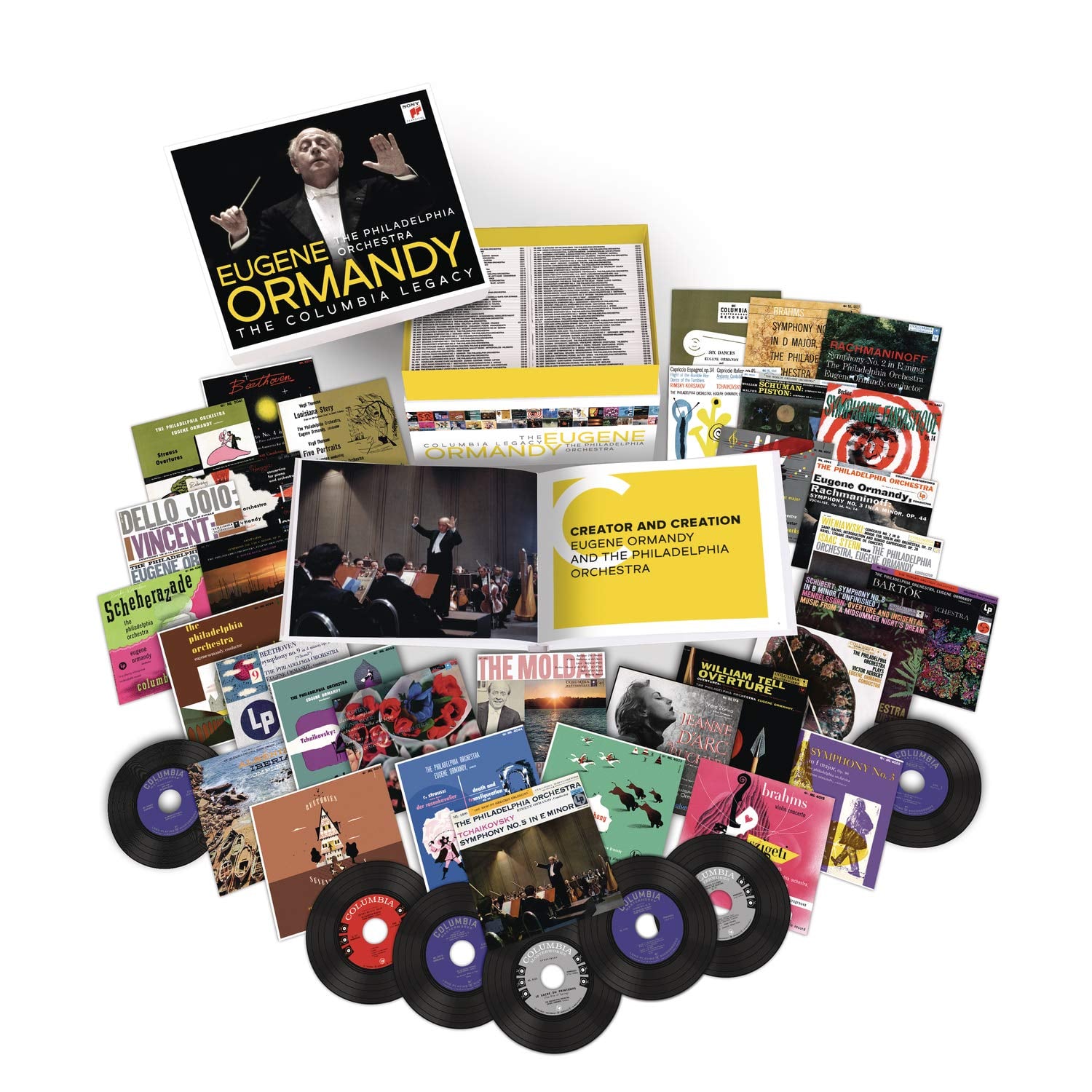
The CDs are filed in miniature facsimiles of the original album covers. These include the original cover designs and miniscule font for the liner notes. I can still read them, but if your eyes aren’t what they used to be, you may have to get yourself a magnifying glass.
A full 152 of these recordings are making their first-ever appearance on CD. 139 are receiving their first authorized releases. The list of world-class soloists is too long to catalogue here, but I will address them, along the way, as I offer future observations on the set.
This is, quite simply, a paragon of how this type of thing should be done. The box itself is so sturdy, it could serve as an elephant’s stool, if such a thing were still fashionable – a neck-and-shoulder interior, with a snow-white ribbon to lift a 208-page hardbound book from where it rests, atop a double row of enticing compact discs. The book contains an introductory essay in three languages (English, German, and French), reproductions of cover art, detailed recording information, an index of Ormandy’s Columbia mono recordings, facsimiles of session sheets, and some very nice photos.
The design is of a sort that is so rarely encountered these days, when it’s commonplace for record companies simply to toss everything into paper sleeves, put them in a utilitarian box with no notes, and just drop them on the market, as quickly and cheaply as possible. The Ormandy box is an object of beauty – which is a good thing, because it won’t fit on a standard CD shelf. The dimensions are 11 x 8 ½ x 6 ½”, so start thinking of a table on which you’d like to construct your shrine! The set itself weighs nearly 13 pounds.
Tantalizingly, the decision was made to retain the original couplings on some of the original records, which include performances by other conductors and orchestras (Szell, Walter, Mitropoulos, Beecham, Kostelanetz, etc.) This is one seriously impressive set! Only four volumes into it, and already I’ve been delighted again and again, with ample surprises from this “safe,” avuncular, underrated conductor. It turns out the young Ormandy knew a thing or two about turning on the juice and kicking up some genuine thrills.
The musicianship, too, is first-rate. This is not the luxuriantly upholstered Philadelphia Orchestra of legend. Don’t get me wrong, it still sounds great. Just different than you might expect, at least at the start. The sound is at least as good as other recordings from the period and often a good deal better. The Philadelphia Orchestra had a reputation for being at the cutting edge of developing technology. Just don’t go into it expecting crystalline digital. Make no mistake: these are vintage recordings.
Also, be forewarned, the set is not cheap (around 300 bucks U.S., give or take), but taken on a per-disc basis, it is an absolute steal. At any rate, you can’t really put a monetary value on the contents – the music, the performers, and the promise of years of enjoyment are all priceless.
If you are interested in the box, I would move on it sooner than later. These kinds of sets tend to have fairly brief distribution, and this one is the best I’ve ever seen. Grab it soon, before it winds up on the collectibles market, with dealers charging double or even triple the price.
I anticipated that one of the great joys of the set would be the excuse it presents to get reacquainted with a lot of the standard repertoire in, at the very least, extraordinarily well-played performances. As someone who gravitates toward unusual and neglected music, almost the only time I listen to top-40 classical is if I’m in the car and it happens to come on the radio, or if I’m attending a live concert. This, despite the fact that I can’t even tell you at this point how many performances I have of all of these pieces in a record collection that encompasses perhaps 10,000 CDs.
Since I’ve been out of the studio for over a year, and not attending concerts, thanks to COVID – and since the broadcast of complete performances of major works seems to be becoming more and more a thing of the past – finding an excuse to revisit the oldies again is actually a big treat.
(Please note: this set also contains many surprises! Almost right from the start, Disc 2 is an all-American program, and none of the composers are the usual suspects.)
No doubt the box will keep me busy for a long time. Here’s hoping one day, in the not-too-distant future, that a “Eugene Ormandy: The Columbia Stereo Legacy” set will also appear, consisting of the 200+ albums that comprise the balance of Sony’s archive of Ormandy’s work in Philadelphia.
For now, I’ve been easing my way, slowly, very slowly, through each of the CDs in sequence, savoring each one, so I am still not very far along. I deliberately avoided the set entirely during my illness last week, not wanting to associate any aspect of it with fever or nausea.
Who should acquire this box?
Philadelphia Orchestra maniacs
Eugene Ormandy advocates
Collectors with shelves full of dusty old records from the 1940s that will never sound as clean as this
Anyone interested in totally reassessing a conductor, often damned with faint praise, at a time when he really sounds as if he has something to prove
Who should pass?
The casual listener seeking performances in wide-dynamic, digital clarity
Those who can’t lift 13 pounds
I don’t know who else
So as to keep this post manageable, I’ll offer further observations, and more hard information, as I wade deeper into Elysium and find I can no longer keep its delights to myself.
The first disc, after all, does contain Alexander Borodin’s “Polovtsian Dances” – which, as we all know, from the ubiquitous 1970s television commercial, was the basis for “Stranger in Paradise.”
THANK YOU, Sony Classical!
Take a closer look, with members of the orchestra here:
With the possible exception of his own transcriptions of the music of Johann Sebastian Bach, Leopold Stokowski recorded more Wagner with the Philadelphia Orchestra than any other composer.
This Sunday night on “The Lost Chord,” on Stoky’s birthday, we’ll revisit some of his early recordings, originally issued on 78s, including the controversial “Liebesnacht,” the original version of his symphonic synthesis after “Tristan und Isolde” – an arrangement that infuriated listeners, with its inconclusive ending – and the “Liebestod,” which he subsequently undertook, by popular demand, in order to provide a more satisfactory conclusion.
We’ll also hear a superb performance of “Wotan’s Farewell and Magic Fire Music,” from “Die Walküre,” with baritone Lawrence Tibbett, in a role he never sang on stage. And, as an added bonus, Stokowski himself will supply a spoken summary of the “Ring Cycle,” done for CBS radio in 1932, complete with faux middle-European accent. (Stoky was a second-generation Londoner, his father of Polish extraction and his mother Irish.)
I hope you’ll join me for “Magic Fire” – Leopold Stokowski’s early Wagner recordings with the Philadelphia Orchestra – this Sunday night at 10:00 EDT, on WWFM – The Classical Network and wwfm.org.
Every year on Richard Yardumian’s birthday, I reflect on my days in community radio. I remember well playing his music from vinyl during my apprentice years, and I wonder at how those recordings – by the Philadelphia Orchestra, no less – have somehow dropped off the face of the planet.
Yardumian served as the orchestra’s composer-in-residence from 1949 to 1964. During that period, Philly gave first performances of no less than ten of his works, beginning with “Desolate City” in 1945. Eugene Ormandy recorded six of them. The music is attractive, well-crafted, and often deeply felt, with insights into the composer’s spiritual convictions and Armenian heritage.
Okay, maybe there was no financial incentive for Sony to reissue recordings of a dimly-recollected “niche” composer, when Ormandy’s “Scheherazade” continues to rake it in no matter how many times it is re-released. Then why not license the Yardumian recordings to another label?
In the 1990s, Albany Records briefly revived some of Ormandy’s lesser-known American classics – among them, works by the equally neglected Louis Gesensway and John Vincent – so my hopes were high that I would finally be able to acquire Yardumian on CD. Alas, the series petered out after only three volumes.
Well, after nearly 35 years in radio, it appears my thinly-worn patience is finally about to be rewarded, as I only just learned of an impending box set on Sony Classical (the modern incarnation of Columbia Records) that is to comprise the orchestra’s complete mono recordings made under Ormandy from 1944 to 1958.
This will include all the staples, of course – Tchaikovsky, Rimsky-Korsakov, Rachmaninoff, and Sibelius – but also much American music, including everything on the Albany series, but also recordings of Norman Dello Joio, Roy Harris, Leon Kirchner, William Schuman, and another composer closely associated with the orchestra, Harl McDonald. None of these have ever before been officially reissued.
Interestingly, Virgil Thomson’s “Five Blake Songs” is also listed, which would suggest the set will include even the long-suppressed “The Little Black Boy.”
In all, 152 of the recordings are said never to have appeared on compact disc. Philadelphia was responsible for some of the works’ first U.S. performances. Some of them were world premieres. There are simply too many highlights and curios to itemize. The list of vocal and instrumental soloists is also self-recommending.
On the one hand, it makes me happy to know I will finally be able to access so many of these recordings easily in pristine copies. On the other, I realize that the value of my LP collection continues to plummet.
The set, EUGENE ORMANDY/THE PHILADELPHIA ORCHESTRA: THE COLUMBIA LEGACY, runs to 120 CDs and will be issued on April 9!
You can find the press release, with more information, here: