For whatever reason (i.e. I sent in the wrong show), my New Year’s program aired on “Sweetness and Light” a few weeks ago. Aside from having eggnog on my face, no harm done, I suppose, although I’m sure listeners were wondering why I was going all Guy Lombardo three weeks before Christmas.
Since it’s already recorded, and because it’s the holidays, and because I’m lazy, I’m putting the kettle on to boil some more water for a festive tea party. The playlist will include Dmitri Shostakovich’s charming arrangement of “Tea for Two,” Samuel Barber’s “Souvenirs,” his musical evocation of the elegant Palm Court of the Plaza Hotel in days of yore, and Richard Strauss’ hallucinatory dancing tea leaves from the high-calorie ballet “Schlagobers,” or “Whipped Cream.”
The show will achieve its nutty apotheosis when sugar and caffeine intersect with the hypnotic patter of the 1953 novelty song “The Little Red Monkey,” which tells of a simmering simian’s reactions to violin, euphonium, and tea.
Your eyes will pinwheel, your brain will hum, and your heart will go pitter-pat when you join me for a bottomless cuppa on “Sweetness and Light,” this Saturday morning at 11:00 EST/8:00 PST, exclusively on KWAX Classical Oregon!
Stream it wherever you are at the link:
https://kwax.uoregon.edu/
Tag: Richard Strauss
-

Take 2 Holiday Tea Party on “Sweetness and Light”
-
Strauss’ “Guntram”: A First-Class Second-Rate Opera?
Few have done more to rehabilitate neglected Strauss, especially neglected Strauss opera, than Leon Botstein. But after all, rehabilitating the neglected is what Botstein does. He’s made a career of it, on record, in concert, and as part of the mission of the Bard Music Festival, a kind of music mecca that attracts the curious to Bard College every summer for total immersion in a composer’s work and world. (This year’s festival, which will take place largely over two weekends, August 8-10 and 14-17, will be devoted to the sleeping giant of Czech music, Bohuslav Martinů.) Botstein is the festival’s founder and co-artistic director. In that capacity he conducts the operas and most of the orchestral programs, serves on panels, writes illuminating essays, and delivers pre-concert lectures. At 78, he’s still an intellectual dynamo. His lumbering gait and considered speech belie a seemingly inexhaustible well of energy. Botstein has served as Bard’s president since 1975. Yes, you read that correctly. He assumed the office at the age of 29.
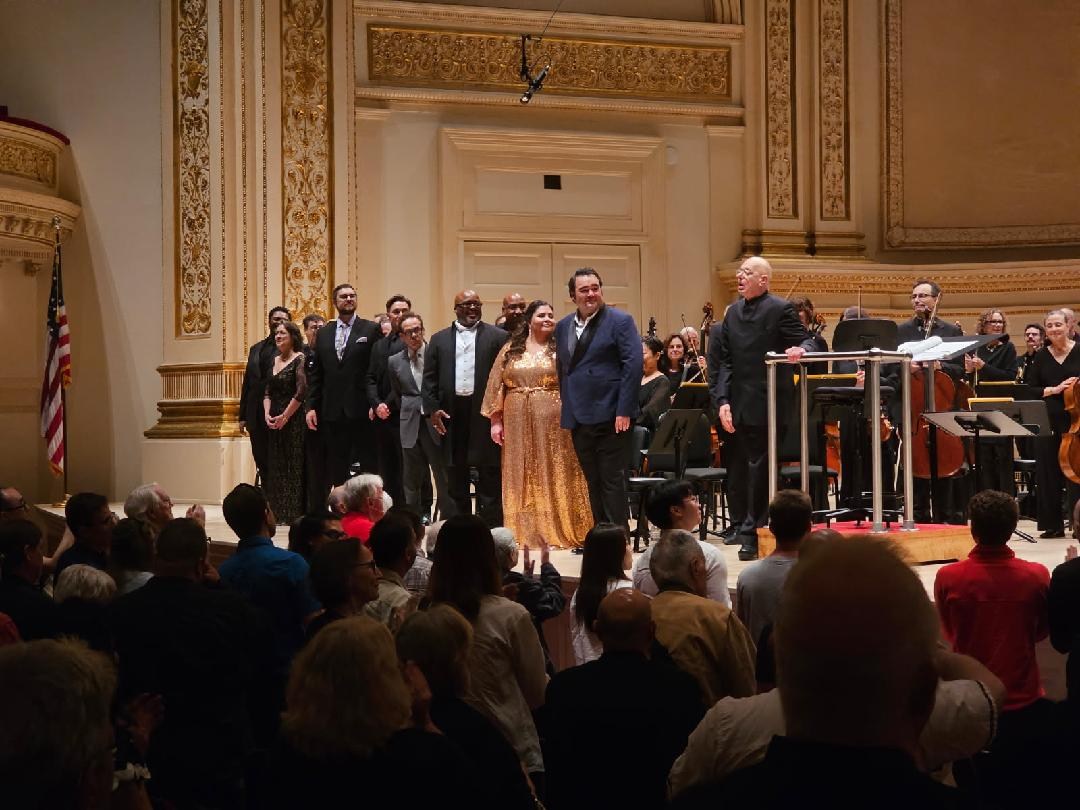
On Friday, Botstein took the stage of Carnegie Hall to guide the American Symphony Orchestra (a group he has directed since 1992) through the resurrection, in concert, of Strauss’ first opera, the problem child “Guntram.” The work was tepidly received at its premiere in Weimar in May 1894. Basically, everyone thought it was fine, if not particularly special. Pauline de Ahna sang the role of Freihild. Four months later she would become Strauss’ wife. (He announced their engagement on the day of “Guntram’s” premiere.)
In November, Strauss brought the work to his hometown of Munich, where he was serving as music director. Its reception there might be charitably characterized as brutal. So poorly did its single performance go down that the orchestra walked out on strike under the direction of its concertmaster (Strauss’ cousin). The two leads refused to reprise their roles, and a third singer was adamant about not returning until a better pension was negotiated. Ouch!
By then, Strauss had already tasted success with his tone poems “Don Juan” and “Death and Transfiguration.” “Till Eulenspiegel’s Merry Pranks,” “Also sprach Zarathustra,” “Don Quixote,” and “Ein Heldenleben” were yet to come. He was a decade away from “Salome,” the work that would change his operatic fortunes forever. (But first, he would have his revenge on conservative Munich with his scandalous opera “Feuersnot.”) He would go on to become perhaps the most successful opera composer of the 20th century.
Still, you know how it is. One never forgets the sting of rejection. Strauss just couldn’t get over “Guntram’s” failure. He tried to put it behind him with a humorous gesture, figuratively burying the pain with a symbolic gravestone erected on his property that bore the inscription:
“Here lies the venerable, virtuous young Guntram—
Minnesinger, who was gruesomely slain by the symphony orchestra of his own father
May he rest in peace!”Strauss would enjoy wealth and celebrity, but that early humiliation stayed with him. In 1940, when he was in his mid-70s, at the other end of a very fruitful career, he revised “Guntram,” making some cuts and hoping its merits would finally be recognized. But its fortunes did not improve.
“Guntram,” then, is right in Botstein’s wheelhouse. “Salome,” “Elektra,” and “Der Rosenkavalier” don’t need his help. Rather, he’s been working his way through Strauss’ lesser-known efforts, including the aforementioned “Feuersnot,” “Die ägyptische Helena,” “Die schweigsame Frau,” “Friedenstag,” “Daphne,” and “Der Liebe der Danae.” He and the ASO recorded “Die ägyptische Helene” and “Der Liebe der Danae” at Avery Fisher Hall in 2001 and 2003, respectively, for Telarc Records.
Before I forget: it is essential that you get there early for any Leon Botstein performance. I guarantee his insightful pre-concert talks will enrich your experience of the music. On this occasion, had I missed his remarks, it would have gone right over my head that this was no mere Wagner knockoff, but rather a sly subversion of the Wagnerian aesthetic it would seem to embrace. I would have missed out on the entire social and historical context that allowed me to take vicarious pleasure in knowing that “Guntram” pissed off Strauss’ contemporaries. Of course, the music itself also happens to contain passages of great beauty, especially when heard live.
Botstein conducted “Guntram” from that 1940 revision of the work, the only performance edition. While the opera may not be a world-beater, we’re far enough along from the prejudices and animosities that pummeled it in the 1890s to at least give it a fair and objective hearing.
Strauss wrote his own libretto, which is full of the turgid Teutonic iconography familiar from so many German Romantic operas. A corrupt ruler, high-minded minnesingers, civil unrest, a saintly woman, thwarted love, and heavy swords that in my opinion never get enough use. Strauss further emulates Wagner through the employment of leitmotifs – musical snippets associated with certain characters or ideas that undergo transformation as they recur throughout the opera. Guntram’s is insistently memorable, helped no doubt by the fact that it’s basically the first three notes of the Enterprise fanfare from the original “Star Trek” television series. A leitmotif associated with Freihild’s love anticipates a similar one in Strauss’ “Die Frau ohne Schatten.”
Certainly, “Guntram” has got its share of castles and pageantry and lofty-minded singing societies – in this case, a pacifist rebel alliance united against a tyrannical duke. Too bad Guntram kills him. If it were Wagner, you would expect the hero, or any rate the self-sacrifice of the heroine, to change the world. But there is no redemption in “Guntram.” Instead, the protagonist retires, like Strauss’ vision of the Hero at the end of his epic tone poem “Ein Heldenleben” – which actually quotes “Guntram” in the section celebrating “The Hero’s Works of Peace.” The climactic moments of the opera also put one very much in the mind of “The Hero’s Retirement from this World and Completion.”
There are intimations of other Strauss works, as well. “Death and Transfiguration,” already written, finds its way in. There’s no question as to the identity of the composer. Strauss was already a master orchestrator, and his thumbprints are easily detectable without a magnifying glass. But the ghost of Wagner is forever lurking behind a column. One thing I forgot to mention is a dance that Strauss includes twice, which to my ears is a Romantic gloss on the same Tielman Susato dance Peter Warlock used as the basis for the last movement of his “Capriol Suite.” Can that be possible? How well known would Susato have been in the 19th century? Perhaps the similarity is just a coincidence? A chorus of monks also gets to intone some faux Gregorian chant. Great fun!
Despite all the music’s feints at “Tristan und Isolde,” especially in the third act, “Guntram” is an opera without any sense of Wagnerian transcendence or redemption. It’s more like there’s the POSSIBILITY of redemption, perhaps, someday, I’ll have to get back to you, as Guntram wanders off into a life of renunciation, reflection, and seclusion; but before he goes, he exhorts Freihild, who clearly reciprocates his attraction, to devote herself to charitable works. What a guy.
According to Botstein, this subversion of Wagnerian ideals would have been seen as heretical by his contemporaries. Read Alex Ross’ “Wagnerism: Art and Politics in the Shadow of Music” for a better understanding of just how pervasive Wagner’s influence was. No exaggeration, it permeated just about every aspect of human existence and thought – philosophy, fashion, architecture, politics, and of course the arts – apparently so much so that Strauss’ teacher, Alexander Ritter, an ardent Wagnerian, totally cooled on their friendship in the wake of “Guntram.” (On the other hand, Strauss’ rival, Gustav Mahler, respected its merits enough to include two of its preludes on a concert – at Carnegie Hall, as a matter of fact.) To mess with Wagner would have been to rock the pillars of the earth.
A frequent criticism leveled against Botstein, a prolific scholar who has published in multiple disciplines (in multiple languages, for that matter) and is the head of a liberal arts college, is that as a conductor he conducts like a hell of an academic. It’s his curiosity that drives the performances as opposed to penetrative insight. I can’t say that has always been my experience, and in fact more often than not, I have attended Botstein concerts that have left me juiced – often in both senses, as in electrified AND drained, as those Bard concerts can attain epic dimensions. On the other hand, an Ives’ Second Symphony I heard Botstein conduct at Carnegie last season lacked any suggestion, in its execution, of a work that can live and breathe in a unique, vital, and even transcendent way. Under Botstein’s direction, it was just there. Like John Knowles Paine on a bad day. That’s the risk you take, with the vagaries of live performance.
On Friday, I can attest, Botstein was like a surfer harnessing the energy of one bitching wave. I had been totally ignorant of John Matthew Myers, but he had a ringing heldentenor that rang effortlessly over the orchestra and carried out to every corner of the hall, gliding on Carnegie’s legendary acoustics. In fact, the acoustic flattered practically everyone. There was a lot of very good and attractive singing from a diverse cast. Katharine Goeldner sang with passion and commitment in the supporting role of the Old Woman. I was amused to recall Rodell Rosel, who sang the Duke’s Fool, as the Jester in Botstein and the ASO’s performance last season of Schoenberg’s “Gurre-Lieder.” When in need of motley antics, they must have him on speed dial. To keep it short, I could pretty much dole out praise across the board. Myers was the revelation, but for as stunning as he was, in the end anyone present would have had to concede the laurels should be cast at the feet of Angela Meade, who stunned especially at the end of Act II, when her character, Freihilde, the kind wife of the evil duke, was finally given something more to do than swoon. When she belts, “Ich liebe dich!,” that’s pretty much that. All you can do is go to intermission.
Strauss famously characterized himself as “a first-class second-rate composer.” You can practically detect the twinkle in his eye when he said it. The performance of “Guntram” on Friday night certainly bore out his assessment. In all, I found the opera worked marvelously well in concert – I found it rewarding and even revelatory – although I can imagine the challenges for anyone attempting an actual staging. For one thing, all three acts are hampered by dramatically-stagnant monologues (three for Guntram and one for Freihild), making it a textbook park-and-bark. Any staging is bound to come off seeming like a series of tableaux, with the other singers waiting around for long stretches, holding poses, or doing their best to look natural. But with voices like these, who cares? Sometimes all you need are big voices and a powerful orchestra. Anyway, I happen to groove on ersatz Wagner.
I must say, it was instructive, if perhaps a little foolhardy, to listen to this on the same weekend as the Philadelphia Orchestra’s performance of Wagner’s “Tristan und Isolde.”
Thank you, Leon Botstein, the American Symphony Orchestra, and the men of the Bard Festival Chorus. It was a wonderful evening!
Strauss was the focus of the Bard Music Festival in 1992. In 2011, Bard offered a series of staged performances of “Die Liebe der Danae” (“The Love of Danae”). In 2022, the opera was “Die Schweigsame Frau” (“The Silent Woman”). These can be viewed, with a number of other Bard opera productions, on YouTube.
“Die Schweigsame Frau”
“Die Liebe der Danae”
Bard Music Festival 2025: Martinů and His World
Fisher Center at Bard
HAPPY BIRTHDAY, RICHARD STRAUSS!
Photo by H. Paul Moon (who was also very kind to supply my ticket)
-
Holiday Tea Party Music on “Sweetness and Light”
This week on “Sweetness and Light,” I invite you to a holiday tea party. That’s right, the music will all in some way be related to tea.
We’ll get the kettle roiling with Dmitri Shostakovich’s charming arrangement of “Tea for Two,” recollect the elegant Palm Court of the Plaza Hotel in days of yore with Samuel Barber’s “Souvenirs,” and experience sugar-induced hallucinations of dancing tea leaves in Richard Strauss’ high-calorie ballet “Schlagobers,” or “Whipped Cream.”
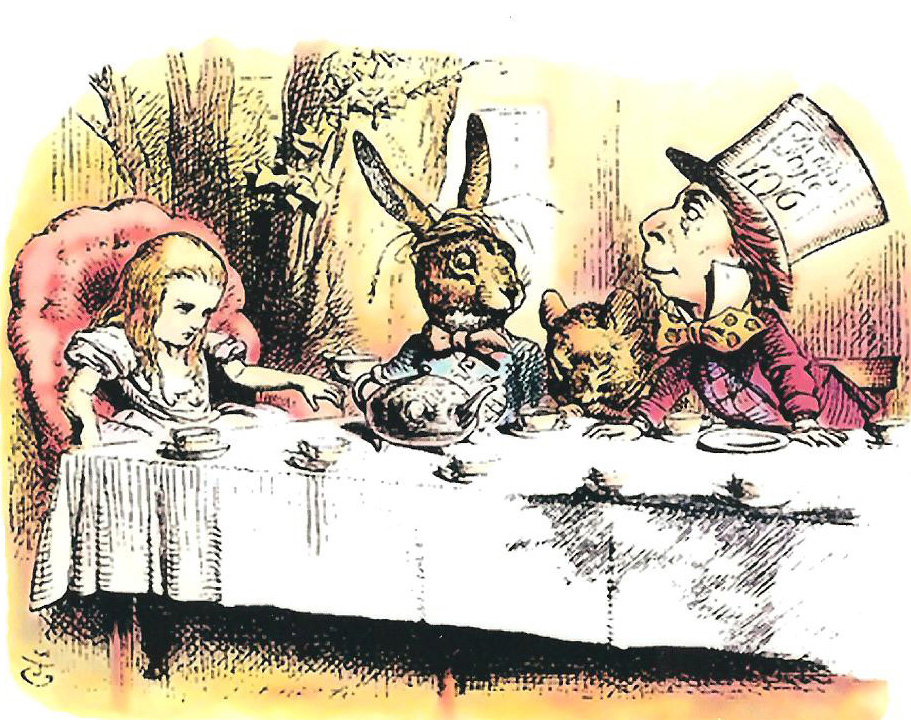
Lewis Carroll’s Hatter may have been mad, but even he would think twice before imperiling an “unbirthday” with a fidgety monkey. The maddening patter of the 1953 novelty song “The Little Red Monkey” relates a simmering simian’s reactions to violin, euphonium, and tea.
Your eyes will be pinwheeling and your brain will be humming from an overindulgence of caffeine and cake when you join me for “Sweetness and Light,” this Saturday morning at 11:00 EST/8:00 PST, exclusively on KWAX, the radio station of the University of Oregon!
Stream it wherever you are at the link:
For as disturbing as “The Little Red Monkey” is, Sheridan Le Fanu’s novella, “Green Tea,” is the ultimate cautionary tale about tea and monkeys:
https://www.gutenberg.org/cache/epub/11635/pg11635-images.html
-

Strauss, de Lancie, and Oboe
I’ve said it before, and I’ll say it again: often on significant musical anniversaries, I’ll do a search of my Facebook posts from past years, and I’ll find that I am actually intimidated by my own work. I realize it may come across as a rather conceited observation, but I offer it in all modesty. Against those times when the muse was so clearly with me, how can I possibly compete?
Such is the case on the anniversary of the birth of Richard Strauss. Just look at what I wrote in 2021.
https://www.facebook.com/photo/?fbid=1904954623005152&set=a.279006378933326
And it’s not the only fine post I’ve written about this composer.
What’s an aging classical music fanatic to do? As the tiny demon inside me compels me to write, I offer this, as a sequel of sorts.
In his late 70s and in variable health, Strauss retreated to his vacation villa in Garmisch, in the Bavarian Alps, to wait out the remainder of the war. Garmisch, recognized for the excellence of its skiing conditions, had been the site of the 1936 Winter Olympics, which preceded by five months the notorious Summer Games mentioned in my post at the link above.
On May 1, 1945, the day after American troops occupied the town, and only a week before VE Day, jeeps rolled into Strauss’ driveway. As the largest house in town, his residence had been singled out as the optimal location for a makeshift command center. When an officer entered the house to deliver the news, the 81 year-old occupant is said to have come down the stairs and introduced himself, “I am Richard Strauss, the composer of ‘Rosenkavalier’ and ‘Salome.’”
The officer, Lt. Milton Weiss, happened to be a musician and decided to find another house.
A few hours later, a second contingent arrived. This time the squad was led by Maj. John Kramers of the 103rd Infantry Division’s military-government branch. He told the Strausses they had 15 minutes to pack up their things. A short while later, Strauss walked down the drive to Kramers’ jeep carrying two documents. One was a paper that certified Strauss as an honorary citizen of Morgantown, West Virginia. The other was the manuscript of “Der Rosenkavalier.” Strauss said, “I am Richard Strauss, the composer.”
Kramers, a Strauss fan, was stunned. After shaking the composer’s hand, he had a sign installed on the front lawn stating that the house was off limits. The Strauss house was spared, and the composer enjoyed a special status with the occupying troops.
One of these was a 24 year-old intelligence office named John de Lancie, who heard about what had transpired at the Strauss villa and determined to become a regular visitor of the composer. Before the war, de Lancie had been principal oboist with the Pittsburgh Symphony under Fritz Reiner. After the war, he would join the Philadelphia Orchestra (in 1946). Later, he became director of the Curtis Institute of Music (1977-1985). It was on one of his visits that de Lancie asked Strauss if he had ever considered writing an oboe concerto. Out of hand, the composer said no.
Six months later, after the war, de Lancie was surprised to learn Strauss had published an oboe concerto. The autograph score bore the inscription: “Oboe Concerto/1945/suggested by an American soldier.”
That Strauss had seen to it to assign him the rights of the first U.S. performance had to have been bittersweet for the oboist. Although de Lancie would one day assume the position of principal in Philadelphia, at the time, he was just a rank and file section oboist. Under orchestra protocol, he would be unable to perform as soloist, as Marcel Tabuteau (who happened to be de Lancie’s teacher) had seniority as the current principal. De Lancie therefore passed the rights on to a young oboist friend at the CBS Symphony, Mitch Miller – later of “Sing Along with Mitch” fame – who gave the concerto its American debut.
De Lancie would be promoted to principal oboist in Philadelphia in 1954 and held the position until 1977. His only public performance of the piece was when the orchestra played it for the first time, on August 30, 1964, at Michigan’s Interlochen Center for the Arts. De Lancie didn’t get around to recording it until 1987, with Max Wilcox the conductor. By then, the oboist was 65 years-old. It had been over four decades since he had planted the seed for one of Strauss’ late masterpieces.
Listen to de Lancie perform Strauss’ Oboe Concerto here:
Strauss died in Garmisch at the age of 85. And yes, de Lancie’s son, who also bore his name, appeared in many incarnations of “Star Trek.”
At 83, Strauss quipped, with humorous self-deprecation, “I may not be a first-rate composer, but I am a first-class second-rate composer.”
Along those lines, I offer, “I may not be a first-rate writer, but I am a first-class Facebook poster.”
Happy birthday, Richard Strauss.
At the link, see footage of Strauss conducting “Der Rosenkavalier” at 85, with commentary by Sir Georg Solti and narration by Sir John Gielgud. Solti conducted the work’s valedictory trio at the composer’s funeral. He recalls, “Marianne Schech sang the part of the Marschallin, Maud Cunitz was Octavian, and Gerda Sommerschuh was Sophie. One after the other, each singer broke down in tears and dropped out of the ensemble, but they recovered themselves and we all ended together.”
https://www.youtube.com/watch?v=x1o6D1pTJqc
PHOTOS: The octogenarian Strauss at Grimasch, including photo taken by John de Lancie (top).
-

Time’s Echo: Music as Living History
Whenever I’m ambling around a bookstore, especially one that deals exclusively in new books (as opposed to used bookshops, which are always my preference), I’ll come to the music section and be reminded of the impoverished state of our culture, as I stare into a wall full of glossy flip-books about vapid pop stars. If I’m lucky, there will be perhaps one shelf devoted to classical music, and on that shelf perhaps one or two volumes worth my while, and I’ve usually already read them.
Thankfully, and I don’t know how, the tradition of writing and publishing thoughtful, carefully researched music books persists, even if they are seldom stocked or displayed at the local sausage factory. In fairness, I did see a copy of Jeremy Eichler’s “Time’s Echo” at the area Barnes & Noble. But I had already received it as a surprise Christmas gift after having first encountered it at the local independent shop, Labyrinth Books Princeton.
When I first read the subtitle, “The Second World War, the Holocaust, and the Music of Remembrance,” I totally expected it to be a book about music written in the concentration camps or by composers who were interned there. But I was way off the mark.
Opening it at random and simply dipping into a passage about Mendelssohn’s standing in the hearts of the German public, even after a commemorative statue was melted down for munitions by the Nazis in accordance with their racial laws – Mendelssohn, raised without religion, was descended from the Jewish philosopher Moses Mendelssohn, though he himself was baptized into the Reformed Christian church – was enough to make me realize the broader scope of Eichler’s intent. (The statue, it turns out, returns in the book’s epilogue.)
Among other things, the book traces the idealistic history of “Bildung,” in which we learn, during a century or so of liberalization, Jews were permitted to leave the ghettos to assimilate, flourish, and enrich German society and culture in a spirit of universal brotherhood. According to Eichler, “‘Bildung’ signifies the ideal of personal ennoblement through humanistic education, a faith in the ability of literature, music, philosophy, and poetry to renovate the self, to shape one’s moral sensibilities, and to guide one toward a life of aesthetic grace. …The life of dignity implicitly promised by ‘Bildung’ was open to all, regardless of one’s origins (that is, of course, as long as one was male).” Progress comes incrementally. But that’s the thing. Society claws its way slowly, slowly toward the light, and then come the hammer blows of war and hatred and fascism to knock it all down. The quashing of hope is heartbreaking.
The narrative begins with the indelible image of “Goethe’s Oak,” the tree under which tradition holds the great German poet once gazed out over a lush valley of promise and declared, “Here a person feels great and free… the way he should always be.” Ironically, a little over a century later, the oak is the only living thing to have been spared in clearing a forest to make way for the Buchenwald concentration camp.
In a later chapter, Eichler relates the chilling history of Babi Yar, the site of a former ravine in Kyiv used as an execution site and mass grave by the Nazis. 30,000 Jews were killed there, the body count swollen to 100,000, when the remains of murdered Jews and other undesirables were transported from other parts of the Soviet Union – the site then obliterated by the Soviet authorities, whose policy it was to obfuscate, distort, and deny history. In the end, they could change the landscape, but they couldn’t kill the memory.
However, as Eichler reminds us, with the passage of time, atrocities like Babi Yar and the wider suffering of two World Wars will no longer be the stuff of lived experience. The sense of immediacy will inevitably fade into the past, distilled into so many dates and statistics on a dry page. Even memoirs are experienced at a remove. We can read about the horrors and the misery, and we may empathize, but necessarily it will always be at a distance.
“Time’s Echo” discusses four composers who actually lived through the era and specific examples from their work that stand as enduringly vibrant monuments to those dark times. Eichler argues that close listening to these musical memorials can provide an aural and emotional record of the horrors of war and the Holocaust, with an immediacy that allows the listener a greater comprehension of the enormity of the world’s turmoil and its emotional toll.
I hasten to add, in case I give the impression that the book dwells in darkness, there is also plenty of hope and humanity on display.
Eichler writes of the touching friendship between Dmitri Shostakovich and Benjamin Britten, separated by some 1700 miles, and an Iron Curtain, but who bonded over music – Shostakovich declaring Britten’s “War Requiem” the greatest work of the 20th century and Britten returning Shostakovich’s admiration, most recently for the latter’s Symphony No. 13 (subtitled “Babi Yar”).
Shostakovich composed “Babi Yar” on texts of Yevgeny Yevtushenko, who dared to speak truth to power – for a time, anyway; the poems were soon toned down, but Shostakovich held fast to the originals. The work stirred great controversy with the authorities (by then under Krushchev), who tried to intimidate everyone involved with the work’s first performance. There are plenty of anecdotes in the book to illustrate the constant terror artists experienced living in the Soviet Union, especially under Stalin. Shostakovich dedicated his next symphony, the Symphony No. 14, another work for vocal soloists and orchestra, to Britten, who conducted the work’s UK premiere.
Shostakovich, who was not Jewish, nevertheless possessed a vast well of empathy for the oppressed. As one who was frequently targeted himself, he knew a thing or two about terror and suffering. He closely identified with the Jewish people, had many Jewish friends and associates, and stuck out his neck time and again in advocating for them in his music, both implicitly and explicitly, assimilating Jewish folk tunes and poems into his works. He also did what he could to shield composer Mieczyslaw Weinberg from official persecution. Weinberg’s father-in-law, actor Solomon Mikhoels, who was enlisted to help disseminate the truth about Babi Yar, was lured into an alley and assassinated; his death was ruled a traffic accident.
It’s easy to see how Britten, as a pacifist and a homosexual – either “offense” which could have landed him in jail – would have found further sympathy with Shostakovich. Both men were outsiders and both had to be very careful in their dealings with the system. Conversely, both connected profoundly with the wider public. It’s hard to imagine any composer’s death today inspiring the kind of turnout or displays of respect both received at their funerals. (Shostakovich died in 1975 and Britten died in 1976.) Britten, who was granted conscientious objector status in 1943, gained first-hand experience of the camps when he insisted on accompanying violinist Yehudi Menuhin as pianist in a recital for displaced survivors at the liberated Bergen-Belsen. It was an experience that would stay with him for the rest of his life.
You will also emerge from the book with a greater affection for Arnold Schoenberg. The dour high priest of dodecaphonic music was actually a real mensch, a passionate humanitarian, even if touchingly blinkered by his idealism. His cantata “A Survivor of Warsaw” proved so disturbing in 1947, with its uncompromising text relating the barbarity of a concentration camp, complete with beatings and gas chambers, that nobody knew what to do with it. More disturbing was a willful silence surrounding many of the atrocities committed against Jews, in particular, that was upheld seemingly everywhere. Incredibly, the work was first performed by a company of cowboys and farmhands, who mastered not only the twelve-tone idiom but Hebrew for its first performance – in Albuquerque, New Mexico! – in 1948. It’s a great story, and a welcome human interlude, well-related in the book.
Schoenberg was the polar opposite of Richard Strauss, who could be calculated and cynical, but nonetheless loved the arts and believed in tradition, to the extent that he thought he could uphold and preserve Germany’s proud cultural history by tacitly playing ball with the Nazis. All too soon, he realized he was in over his head. Strauss was no Nazi himself, but in convincing himself he was above politics and that the current regime would surely pass, he made unfortunate decisions that left him morally compromised. He was also politically compromised, as he quietly continued to collaborate with Jewish librettist Stefan Zweig, and he did not suffer fools quietly. His intercepted correspondence, full of acid remarks about the idiots in charge, put him on the outs with Hitler, even as he was held up to the world as a paragon of German superiority. In the end, it was all he could do to keep his Jewish daughter-in-law and grandchildren out of the camps. He could not save the rest of his daughter-in-law’s family. (He tried; he went so far as to visit the camp himself, but was turned away.)
“Metamorphosen,” composed in 1945, has long been understood as Strauss’ elegy to bombed out Munich, its opera house, a symbol of German art, the site of so many formative cultural experiences and later personal successes, now in ruins. Eichler delves into the work’s deeper significance and enigmas, even as he runs up against resistance from an uncooperative Strauss estate.
The book is built on a foundation of scholarship (with ample pages of notes and attributions listed in an appendix), but is by no means a dry, academic treatise. It is not crammed with impenetrable jargon. This is a book written with the general reader in mind. It’s an engrossing piece of history rendered in absorbing prose. If you are familiar with and enjoy the books of Alex Ross, you will find this at least as rewarding. (Ross is the music critic for the New Yorker; Eichler is chief classical music critic for the Boston Globe.)
The book is certainly thought-provoking, even if a lot of the philosophical meditations the author inspires have been churning around my head at least since the time I became conscious of having an intellect. That’s not to say Eichler doesn’t provide fresh perspectives. Nor is it to say I agree with all of his conclusions. I do believe it’s possible to listen to music composed before the horrors of the 20th century and to be able to meet it on its own terms, and that in so doing a work such as Beethoven’s 9th Symphony is still more than simply “freedom kitsch.” Music from the past still has plenty to offer us in the considerable enrichment of our lives, and from many perspectives.
But I also believe that not only do great works of art “change” over the course of the life of anyone who experiences them (how could we not view the world differently as we learn more and continue to evolve as people?), I agree with Eichler that they can also be viewed differently as a result of their continued and inexorable progress through the creep of history.
Eichler is at his best when he characterizes music as aural history, with the experiences and emotions of an artist and an era frozen in amber, and demonstrates how careful listening allows us to experience these sensations anew. While the author scores point after point, he feeds us no pat answers. He provokes thought and inspires conversation, right up to the sense of ambiguity he leaves us with as he encounters the reconstituted Mendelssohn statue at the end of the book.
“Time’s Echo” is highly recommended for anyone who’s bothered to wade through this post to this point – especially so if you happen to be interested in four masters of 20th century music, WWII history, the Holocaust, how the past continues to inform the present, and how music parallels and supplements the written word as a vessel of history and persists as a living document of the human experience. Read it now, and thank me later.
[Published by Alfred A. Knopf, Fall 2023]
Tag Cloud
Aaron Copland (94) Beethoven (95) Composer (114) Film Music (148) Film Score (143) Film Scores (255) Halloween (97) John Williams (196) KWAX (232) Leonard Bernstein (105) Marlboro Music Festival (125) Movie Music (163) Mozart (91) Opera (215) Philadelphia Orchestra (90) Picture Perfect (174) Princeton Symphony Orchestra (110) Radio (90) Ross Amico (244) Roy's Tie-Dye Sci-Fi Corner (290) The Classical Network (101) The Lost Chord (269) Vaughan Williams (107) WPRB (397) WWFM (881)