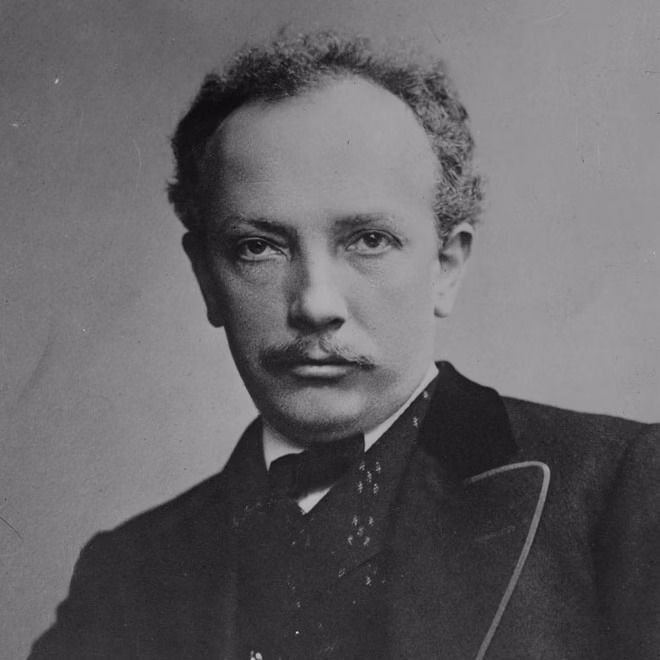
Tag: Richard Strauss

  • Strauss’ Whipped Cream Ballet A Sweet Birthday Treat

    Strauss’ Whipped Cream Ballet A Sweet Birthday Treat

    On Richard Strauss’ birthday, enjoy a coffee break with his frothy ballet “Schlagobers” (“Whipped Cream”).

    Blog reflections on “Schlagobers”

    IT’S SCHLAGOBERS!!

    Caffeine-induced teaser for an American Ballet Theatre production

    Not to be confused with…

  • Fritz Reiner Birthday The Tyrant Conductor

    Fritz Reiner Birthday The Tyrant Conductor

    December 5th is when Krampus, the Christmas demon, descends from his Alpine lair to flog fearful girls and boys. And December 19th is the birthday of Fritz Reiner.

    From a musician’s standpoint, Reiner was one of the most dreaded conductors, in an era when tyrants of the podium still very much roamed the earth. With a glower that could make Bela Lugosi quake – and sporting quite the similar hairline – Reiner was forged in Hungary at the twilight of the Austro-Hungarian Empire. Hungary at the time had quite the reputation for churning out great conductors. George Szell, Eugene Ormandy, Antal Doráti, Ferenc Fricsay, Sir Georg Solti, and István Kertész all achieved considerable international success.

    Among Reiner’s own teachers was Béla Bartók, with whom he studied piano. Reiner would later repay the favor with what many consider to be the benchmark recording of Bartók’s “Concerto for Orchestra.” He also worked closely with Richard Strauss in Dresden, and his recordings of Strauss’ works are equally revered. All in all, the Chicago Symphony under Fritz Reiner was a surefire choice to give the ol’ hi-fi a good workout in the early days of stereo.

    In 1928, Reiner became a naturalized American citizen. He began to teach conducting at the Curtis Institute of Music in Philadelphia, where among his pupils was Leonard Bernstein. His first American post was as principal conductor of the Cincinnati Symphony. He took over the Pittsburgh Symphony for a decade, beginning in 1938. Then he spent several years at the Met. But it was as music director of the Chicago Symphony that he attained legendary status.

    For a master interpreter of some of the largest and most challenging works in the repertoire, his baton technique was notable for its precision and economy. Much of what he achieved, unfortunately, was through the brutality he exuded in rehearsals. Reiner emerged from an Old World steeped in aristocratic privilege. At the top of their profession, conductors then were regarded as gods-on-earth. When drive and ego were bolstered by absolute power, working conditions could become downright perilous. Before strong musicians’ unions, conductors exercised the authority to fire anyone on a whim. So when musicians played for Reiner, they played as if their lives depended on it – or at the very least their livelihoods.

    Did it make for better musicmaking? You can’t argue with the excellence of Reiner’s Chicago Symphony.

    Read this account of the day Reiner finally gave his “perfect concert.”

    https://csosoundsandstories.org/125-moments-101-fritz-reiners-perfect-concert/?fbclid=IwAR1XCI9gDY-L5-Z-wSxZyYMlWjDU2IbhvhlVSgZ17SA0ekYHWECHuQw4L3A

    Even autocrats have their soft side. Happy birthday, Fritz Reiner.


    Reiner conducts Beethoven

    Big band Bach

    Benchmark Bartók

    Strauss’ “Salome”

    And, to keep it seasonal, “Waltz of the Flowers” from “The Nutcracker”

    https://www.youtube.com/watch?v=mgaS9CZ7KsQ

  • Time Magazine’s Composer Covers

    Time Magazine’s Composer Covers

    Due to my hectic weekend in Ticonderoga, I was unable to honor Dmitri Shostakovich and George Gershwin on their birthdays. It did occur to me that both were featured on the cover of Time Magazine, which gave me the idea to compile ten Time covers of famous composers (which I am only just getting around to posting). Happy belated birthdays, boys!

    Shostakovich, born September 25, 1906 (died August 9, 1975)
    Gershwin, born September 26, 1898 (died July 11, 1937)

    Interestingly, both appeared on the cover on July 20, seventeen years apart!

    It’s sobering to be reminded of a time when classical music was still accepted as a part of our broader culture. I wonder who the last living composer was to be featured on the cover of Time?

    Andrew Lloyd Webber got a cover in 1988. No John Williams?


    Clockwise from left: Gershwin (July 20, 1925), Shostakovich (July 20, 1942), Richard Strauss (January 24, 1927), and Richard Strauss (July 25, 1938). More in the gallery.

  • Richard Strauss: Nazi Puppet or Pragmatist?

    Richard Strauss: Nazi Puppet or Pragmatist?

    When Richard Strauss wrote and conducted his “Olympic Hymn” for the 1936 Berlin Games, his seeming willingness to act as a puppet for the Third Reich earned him international criticism. But Strauss was no Nazi.

    In 1933, Strauss was named president of the newly instituted Reichsmusikkammer. He was not consulted on the appointment and accepted it as what he saw as a preventative measure, hoping to head-off reorganization of German musical life by “amateurs and ignorant place-seekers.”

    Professionally, he did what he could to preserve musical culture, extending copyrights, conducting works by banned composers (like Mendelssohn and Mahler), and continuing to collaborate with Jewish artists (like Stefan Zweig). In fact, he became such a thorn in the side to the Nazi regime that Goebbels wrote in his diary, “Unfortunately we still need him, but one day we shall have our own music and then we shall have no further need of this decadent neurotic.” For his part, Strauss referred to Goebbels as a “pipsqueak.”

    Unfortunately, the composer’s subversive correspondence was intercepted by the Gestapo and forwarded to Hitler himself. Strauss was quietly demoted (on the grounds of “ill health”), dismissed from his position in the Reichsmusikkammer, and trotted out thereafter only for propaganda purposes, most notably at the 1936 Games. His music was appropriated by filmmaker Leni Reifenstahl for her paean to German athletic prowess, “Olympia.”

    Part of Strauss’ motivation in playing along was to protect those closest to him, including his daughter-in-law, Alice Grab Strauss (née von Hermannswörth), and his grandchildren, all Jewish. Late in the war, Alice was arrested, and Strauss was barely able to secure her release. Thereafter, everyone was kept under house arrest. Strauss could do nothing to save to her relations. 32 members of Alice’s family died in concentration camps.

    Strauss never joined the Nazi Party and refused to give the Nazi salute. He may have been naïve to think he could do anything to stem the regime’s calamitous torrent, but he wasn’t stupid. With the rise of Hitler, he believed, or rather hoped, that he could keep his head down and quietly accomplish what good he was able until the storm had passed.

    In 1948, at the age of 84, he was cleared of any wrongdoing by a denazification tribunal. Still, for many, a pall hung over his reputation. The demonstratively anti-fascist Toscanini, who resigned his position as director of the Bayreuth Festival in 1933 (to be replaced by Strauss), is said to have told Strauss to his face, “For Strauss the composer, I take my hat off. For the Strauss the man, I put it on again.”

    It was in the final months of World War II that Strauss composed his “Metamorphosen,” a lament for strings spanning nearly half an hour. In the work, he ruminates on the funeral march from Beethoven’s “Eroica” Symphony. At the bottom of the score is inscribed “In Memoriam.”

    Though Strauss never commented on the inspiration for the piece, it’s generally been interpreted as an elegy for German civilization, as symbolized by the opera house in Munich, city of his birth, laid waste by bombs. Strauss had a deep personal connection to the theater. He had attended performances there since boyhood and enjoyed many successful productions of his own works. His father played first horn in the orchestra for 39 years. Further, the destruction of the Vienna State Opera took place on the very eve of Strauss putting pen to paper.

    It may have been Allied bombs that brought physical devastation to the structures of Munich and Vienna, but Strauss harbored no illusions as to what was truly responsible for the ruination of all he loved.

    The composer confided in his diary, “The most terrible period in human history is at an end, the twelve year reign of bestiality, ignorance and anti-culture under the greatest criminals, during which Germany’s 2,000 years of cultural evolution met its doom.”


    Strauss’ “Olympic Hymn”

    “Metamorphosen”

  • Richard Strauss The Conducting Secrets

    Richard Strauss The Conducting Secrets

    Richard Strauss will probably always be remembered, first, as the composer of Dionysian tone poems, employing opulent, even hedonistic orchestration, and for the turbulent, angst-ridden operas “Salome” and “Elektra.”

    But when it came to conducting, he took a decidedly Apollonian stance. His technique might best be described as no-nonsense. Some have even remarked on his looking bored. George Szell suggested Strauss often just wanted to get a performance over with, so that he could get out and go to a card game.

    (Szell, by the way, wound up conducting the first half of the premiere recording of Strauss’ “Don Juan” in 1917, on account of the composer oversleeping.)

    Here are Strauss’ “Ten Golden Rules for the Album of a Young Conductor,” set down in 1927:

    1. Remember that you are making music not to amuse yourself, but to delight your audience.

    2. You should not perspire when conducting. Only the audience should get warm.

    3. Conduct “Salome” and “Elektra” as if they were by Mendelssohn: fairy music.

    4. Never look encouragingly at the brass, except with a brief glance to give an important cue.

    5. But never let the horns and woodwinds out of your sight. If you can hear them at all, they are still too strong.

    6. If you think that the brass is now blowing hard enough, tone it down another shade or two.

    7. It is not enough that you yourself should hear every word the soloist sings. You should know it by heart anyway. The audience must be able to follow without effort. If they do not understand the words, they will go to sleep.

    8. Always accompany the singer in such a way that he can sing without effort.

    9. When you think you have reached the limits of prestissimo, double the pace.

    10. If you follow these rules carefully, you will, with your fine gifts and your great accomplishments, always be the darling of your listeners.

    In 1948, Strauss wrote of Number 9, “Today I should like to amend this: take the tempo half as fast.”

    Some of his suggestions may seem as if they’re tongue-in-cheek, but the idea to lighten the textures makes a whole lot of sense when you consider just how overblown these works can be, and how impossible to hear the singers.

    Strauss recorded most of his orchestral works over the last two decades of his life. A few of these were captured on film.

    See for yourself if Strauss follows his own advice, or, if as Szell, suggests, all he’s really thinking about is playing cards.

    “Till Eulenspiegel’s Merry Pranks”:

    With commentary by Szell, his one-time assistant:

    “Allerseelen” (“All Souls’ Day”), with a glimpse of lederhosen!

    Happy birthday, Richard Strauss.

Tag Cloud

Aaron Copland (92) Beethoven (95) Composer (114) Film Music (123) Film Score (143) Film Scores (255) Halloween (94) John Williams (187) KWAX (229) Leonard Bernstein (101) Marlboro Music Festival (125) Movie Music (138) Opera (202) Philadelphia Orchestra (89) Picture Perfect (174) Princeton Symphony Orchestra (106) Radio (87) Ralph Vaughan Williams (85) Ross Amico (244) Roy's Tie-Dye Sci-Fi Corner (290) The Classical Network (101) The Lost Chord (268) Vaughan Williams (103) WPRB (396) WWFM (881)

DON’T MISS A BEAT

Receive a weekly digest every Sunday at noon by signing up here


RECENT POSTS