
Happy birthday, Richard Strauss! Fans of the composer will enjoy this two-hour documentary I found on YouTube, featuring commentary by prominent musicians, interviews with people who actually KNEW him, narration by Sir John Gielgud, and, not least of all, footage of Strauss himself. Strauss described himself as “a first-rate second-class composer.” He certainly lived a remarkable life.
Tag: Richard Strauss
-

Strauss’ “Love of Danae” Rare Opera Online
On Richard Strauss’ birthday, enjoy this production of the rarely-heard opera “Die Liebe der Danae” (“The Love of Danae”), a comedy after Hugo von Hofmannsthal (libretto by Joseph Gregor), steeped in Greek mythology.
The powerful god Jupiter and the lowly donkey driver Midas compete for the love of the beautiful Danae. According to the promotional material, “The story is a Mozartean blend of comedy, romance, and drama on the themes of transformation and the acceptance of life’s changes, all brilliantly illuminated by Strauss’s orchestral mastery.” The production is a collaboration of stage director Kevin Newbury and architect Rafael Viñoly.
True to the mission of Bard SummerScape, this is the first time the opera has ever been staged in New York. The performance took place at Bard College in 2011. The American Symphony Orchestra is conducted by Leon Botstein:
Some background and a brief synopsis of the opera:
https://en.wikipedia.org/wiki/Die_Liebe_der_Danae
Unfortunately, because of the COVID-19 pandemic, this year’s Bard Music Festival, which was to have focused on Nadia Boulanger and her world, has been postponed until the summer of 2021.
You’ll find more information at the website of Fisher Center at Bard, https://fishercenter.bard.edu/summerscape/.
-

Strauss’ Lawsuit The “Funiculì, Funiculà” Story
When he came to work it into the finale of his grand symphonic fantasy “Aus Italien” (“From Italy”) in 1886, the 22 year-old Richard Strauss assumed “Funiculì, Funiculà” was a traditional Neapolitan folk song.
Imagine his chagrin when he learned that the song was actually composed in 1880, by one Luigi Denza, to lyrics by Peppino Turco.
The subject is a funicular cable car that used to service passengers to Mount Vesuvius, before it was predictably destroyed in an eruption in 1944. The song became a huge international success and sold over a million copies.
This meant that Strauss found himself embroiled in a lawsuit, which resulted in his having to pay a royalty fee every time “Aus Italien” was performed.
This would be irksome to any composer, but Strauss especially has often been singled out for his love of money. Stravinsky used to spell his name using dollar signs in place of the esses.
Fate seems to have been in on the joke. Strauss’ fortune was twice obliterated, by both world wars, and – also because of war – he was never paid for his opulent ballet “Josephs-Legende.”
Strauss was not the only composer to step wrong in regard to “Funiculì, Funiculà.” Rimsky-Korsakov used it as the basis for his “Neapolitan Song,” and Arnold Schoenberg transcribed it for string quartet. Whether Denza ever tried to sue Rimsky-Korsakov is unknown. Schoenberg clearly credited the original composer. Maybe he was just too scary to sue.
Join me this afternoon, when Luigi Denza (now in the public domain) will be among my birthday honorees, from 4 to 7 p.m. EST, on WWFM – The Classical Network and wwfm.org.
-
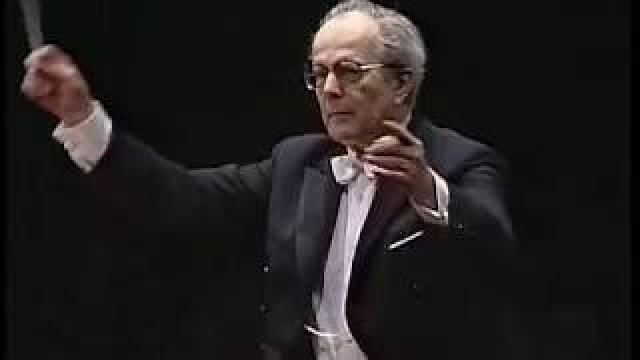
Remembering Wolfgang Sawallisch & Philadelphia
I remember being told by a friend over coffee, back in the early ‘90s – still a few years away from the brushfire circulation of news on the internet – that Wolfgang Sawallisch was to be the next music director of the Philadelphia Orchestra.
Sawallisch?!!
It was a name I associated with Old World integrity and classic (mono) recordings of Richard Strauss. Also, a fabulous, underrated recording of “Ma Vlast” I had discovered while doing college radio, with the Suisse Romande Orchestra, of all things.
Had he ever even been to the United States? How old was he? I guess at the time he must have been around 70. In the event, he died in 2013, only six months shy of his 90th birthday. Philadelphia would prove to be the high-profile capstone of a very respectable, indeed enviable, if not exactly glamorous career.
Still, after the intensity and flash of Riccardo Muti, it would be a nice corrective. And I offer that as a Muti fan. This was Philadelphia, after all, where Ormandy roosted for 40 years.
While Sawallisch was not the most thrilling music director (the word
“kapellmeister” was bandied a lot), he provided solid leadership and proved on more than one occasion that on a good day he could still surprise.I remember a concert on which he programmed works by Kodály and Miklós Rózsa (the rarely-heard Viola Concerto), which were interspersed with performances by a traditional Hungarian band, complete with cimbalom. He may have to some degree drained Einojuhani Rautavaara’s Symphony No. 8 of some of its Finnishness, but at least he secured its premiere. When a severe snowstorm meant the orchestra couldn’t make it in for a scheduled concert of scenes from Wagner’s “Tannhäuser” and “Die Walküre” (including all of Act I), he made the impromptu decision to throw open the doors of the Academy of Music and play the accompaniment himself at the keyboard, with Deborah Voigt, Heikki Suikola, and chorus, for the enjoyment of anyone who cared to show up.
He was generally all about Beethoven and Bruckner and, yes, Strauss – a concert performance of “Ariadne auf Naxos” was a highlight of his tenure (with Werner Klemperer, Colonel Klink, as the Majordomo!) – but he could also turn around and play the tar out of something like Bohuslav Martinu’s Symphony No. 4. All in all, not a bad legacy.
I hope you’ll join me – once again over coffee – as I remember Wolfgang Sawallisch, with a selection of his recordings, as conductor and pianist. They’ll be among my featured highlights on this, his birthday, this afternoon from 4 to 7 p.m. EDT, on WWFM – The Classical Network and wwfm.org.
-

Strauss, Busch & Marlboro’s Divergent Paths
On the next “Music from Marlboro,” we’ll have works by two German composers who traveled widely divergent paths.
As the aging elder statesman of Romantic opulence, Richard Strauss was in his late 60s when the Nazis seized control of Germany in 1933. He was 75 at the outbreak of World War II. Controversially, he remained at home, hoping to preserve and promote German music (including his own) and to shield his Jewish daughter-in-law and grandchildren. While comprehending Strauss’ importance as a propaganda tool, Goebels wasn’t actually fond of his music, referring to him privately as a “decadent neurotic.”
All that was still decades in the future at the time Strauss wrote his Piano Quartet in C minor, in 1883-84, at the tender age of 20. Interestingly, for a composer who became celebrated for the apotheosis of the lavish tone poem, Strauss here channels his admiration for Johannes Brahms, and in a genre not generally associated with a follower of the post-Wagnerian “New Music School.” Brahms was at the height of his fame while the young Strauss was living in Berlin. In fact, Strauss attended the premiere of Brahms’ Fourth Symphony, following his appointment as music director in Meiningen at 21.
We’ll hear Strauss’ quartet, performed at the 1972 Marlboro Music Festival, with Walter Klien at the keyboard, in his early 40s and at the peak of his pianistic powers. The string players will include violinist Edith Peinemann, violist Philipp Naegele, and cellist Miklós Perènyi.
Violinist Adolf Busch lived with his family – and friend, future son-in-law Rudolf Serkin – in Berlin in the 1920s, as Serkin established himself as one of Europe’s outstanding young pianists. The musicians remained in Germany until 1927. The much-respected Busch, who was not Jewish, vehemently opposed the National Socialists. He was one of the first prominent non-Jews to do so. With the rise of Hitler, Serkin and the Busches relocated to Switzerland. Busch repudiated Germany entirely in 1933.
He and Serkin arrived in the United States, with the rest of Busch’s family, in 1938, with Europe on the brink of war. They settled in Vermont in the 1940s. There, alongside flutist Marcel Moyse, they founded the Marlboro Music School and Festival in 1951, having successfully eluded the horrors that had claimed so many others to create something of lasting beauty – a chamber music retreat in what must have seemed like a bucolic paradise.
In addition to being one of the great violinists, Busch was also a talented composer. We’ll hear his “Divertimento for 13 Solo Instruments,” from 1925, in a 1982 recording featuring Marlboro musicians: Isidore Cohen and Irene Serkin, violins; Caroline Levine, viola; Robie Brown Dan, cello; Carolyn Davis, double bass; Odile Renault, flute; Rudolph Vrbsky, oboe; Cheryl Hill, clarinet; Stefanie Przybylska, bassoon; Robin Graham and Stewart Rose, French Horns; Henry Nowak, trumpet; and Neil Grover, timpani, all under the direction of Sol Schoenbach.
The path of least resistance leads to misery, on the next “Music from Marlboro,” this Wednesday evening at 6:00 EDT, on WWFM – The Classical Network and wwfm.org.
Marlboro School of Music and Festival: Official Page
More about Strauss’ complicated relationship with the Third Reich here:
PHOTO: Adolf Busch and Rudolf Serkin in 1928
Tag Cloud
Aaron Copland (94) Beethoven (95) Composer (114) Film Music (149) Film Score (143) Film Scores (255) Halloween (97) John Williams (197) KWAX (232) Leonard Bernstein (105) Marlboro Music Festival (125) Movie Music (164) Mozart (91) Opera (215) Philadelphia Orchestra (90) Picture Perfect (174) Princeton Symphony Orchestra (110) Radio (90) Ross Amico (244) Roy's Tie-Dye Sci-Fi Corner (290) The Classical Network (101) The Lost Chord (269) Vaughan Williams (107) WPRB (397) WWFM (881)