Tag: Symphony No. 4

  • Ryelandt’s Symphony No 4 Easter Vigil Special

    Ryelandt’s Symphony No 4 Easter Vigil Special

    This week on “The Lost Chord,” we anticipate Easter with a symphony by devout Belgian composer Joseph Ryelandt.

    Born in Bruges in 1870, Ryelandt was raised to value culture, tradition, and faith. He was unhindered by financial concerns for the first half of his very long life. World War I, however, badly affected his finances. The father of eight children himself, he took up teaching out of necessity at the age of 54. He did so with some hesitation, but was relieved to find it truly rewarding. He was appointed director of the Bruges Conservatory in 1924.

    While his academic and creative work evidently brought him enormous satisfaction, life at home was saddened by the gradual decline of his wife’s health. She died in 1939. Ryelandt composed very little during the Second World War. A few chamber works followed, and then he abandoned composition altogether. He devoted his retirement to literature – writing poetry and reading the world’s classics. He died, following a brief illness, in 1965, at the age of 95.

    Of all of his works, he considered his five oratorios the most important, though he composed much else, including six symphonies (the first of which he destroyed). None of the symphonies were performed until 1960. It was then that the Symphony No. 4 received its belated premiere, on a concert in celebration of the composer’s 90th birthday.

    Ryelandt’s inspiring Fourth Symphony was composed in 1912-1913, on the very eve of World War I. Like nearly everything he wrote, the work is an outgrowth of his personal faith. About twenty minutes in, a choir of tenors appears, to sing a passage from Thomas à Kempis’ “The Imitation of Christ.” The triumphant chorus that concludes the piece is from the Credo, as heard in the traditional Catholic Mass.

    Then, following the symphony, and in the time remaining, we’ll hear another Credo setting, by Franco-Flemish composer Josquin des Prez.

    I hope it will suit the mood for your Easter Vigil. I invite you to join me for “Creative Spirits” on “The Lost Chord,” now in syndication on KWAX, the radio station of the University of Oregon!


    Clip and save the start times for all three of my recorded shows:

    PICTURE PERFECT, the movie music show – Friday at 8:00 PM EDT/5:00 PM PDT

    SWEETNESS AND LIGHT, the light music program – Saturday at 11:00 AM EDT/8:00 AM PDT

    THE LOST CHORD, unusual and neglected rep – Saturday at 7:00 PM EDT/4:00 PM PDT

    Stream them, wherever you are, at the link!

    https://kwax.uoregon.edu/

  • Joseph Ryelandt Composer of Faith

    Joseph Ryelandt Composer of Faith

    It seems only appropriate that Joseph Ryelandt’s birthday anniversary would fall around Holy Week – this year on Good Friday, as a matter of fact – as he was an artist whose devout beliefs were central to every aspect of his existence and creativity.

    Born in Bruges in 1870, Ryelandt was raised to value culture, tradition, and faith. He was unhindered by financial concerns for the first half of his very long life. World War I, however, badly affected his finances. The father of eight children himself, he took up teaching out of necessity at the age of 54. He did so with some hesitation, but was relieved to find it truly rewarding. He was appointed director of the Bruges Conservatory in 1924.

    While his academic and creative work evidently brought him enormous satisfaction, life at home was saddened by the gradual decline of his wife’s health. She died in 1939. Ryelandt composed very little during the Second World War. A few chamber works followed, and then he abandoned composition altogether. He devoted his retirement to literature – writing poetry and reading the world’s classics. He died, following a brief illness, in 1965, at the age of 95.

    Of all of his works, he considered his five oratorios the most important, though he composed much else, including six symphonies (the first of which he destroyed). None of the symphonies were performed until 1960. It was then that the Symphony No. 4 received its belated premiere, on a concert in celebration of the composer’s 90th birthday.

    Ryelandt’s Fourth Symphony was composed in 1912-1913, on the very eve of World War I. Like nearly everything he wrote, the symphony is an outgrowth of his personal faith. The text of the triumphant chorus that concludes the work is from the Credo, as heard in the traditional Catholic Mass. Earlier in the piece, a choir of tenors sings a text from Thomas à Kempis’ “The Imitation of Christ.”

    Whether or not you find it appropriate for Good Friday, which after all is a somber observance, I leave it to you. The piece does conclude in a blaze of glory.

    Happy birthday, Joseph Ryelandt, and a blessed Good Friday to those who observe it.

  • Vaughan Williams Rare Recordings

    Vaughan Williams Rare Recordings

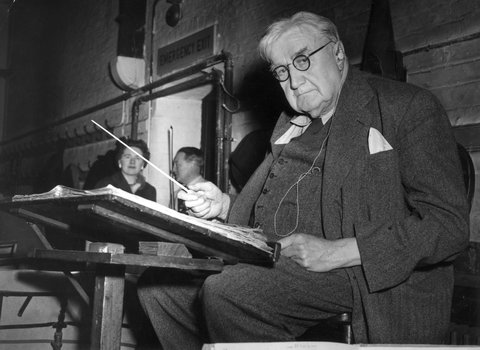
    Unlike Sir Edward Elgar, who was given the opportunity to record most of his major output, Ralph Vaughan Williams was generally overlooked as a conductor by the major labels – which is a shame, because the few recordings he did make are superb.

    This Sunday night on “The Lost Chord,” we’ll anticipate the 150th anniversary of the birth of one of England’s finest composers (October 12, 1872) by way of three rare recordings he made of his own music.

    Among the acoustical documents, none match the hilarity of RVW’s 1925 performance of “The Wasps” overture. Vaughan Williams’ recording is by far the fastest – and jauntiest – “Wasps” on record, although I’m unsure whether it is due to the composer’s own preference, or because of the limitations of the technology. It’s hard not to smile at such manic high spirits.

    By contrast, his 1937 recording of the Symphony No. 4 is a masterpiece of temperament and ferocity – all the more jarring in that the turbulence evoked in the work is not at all what most people associate with this composer. The urgency of the music is captured, eerily, at a time when the ink was still fresh on the page and the world was on the brink of chaos. It certainly belies the snide dismissal of much of the composer’s output as languid “cow-pat” music.

    In all, Vaughan Willliams’ meager commercial discography as a conductor wouldn’t even fill two hours. It is most fortunate, then, that a few concert recordings have emerged over the years. We’ll conclude with of one of RVW’s loveliest pieces, the “Serenade to Music,” a work which, at its first performance, actually brought tears to the eyes of Sergei Rachmaninoff. (On the first half of the concert, Rachmaninoff was soloist in his own Piano Concerto No. 2.) The text is taken from Act V, Scene I, of Shakespeare’s “The Merchant of Venice.”

    “How sweet the moonlight sleeps upon this bank!
    Here will we sit and let the sounds of music
    Creep in our ears: soft stillness and the night,
    Become the touches of sweet harmony.”

    The recorded performance was captured at Royal Festival Hall on November 22, 1951. Vaughan Williams was 79 years old. What’s especially remarkable is that the recording features 11 of the 16 soloists who sang in the work’s 1938 premiere. We’ll hear it from a compact disc issued on Albion Records, the official label of the Ralph Vaughan Williams Society.

    Vaughan Williams’ ashes are interred in Westminster Abbey alongside some of the nation’s greatest artists – yet, in some measure, the composer is still underestimated, especially by those outside the British Isles. I hope you’ll join me as we celebrate RVW for his sesquicentenary. That’s “Vaughan, But Not Forgotten,” this Sunday night at 10:00 EDT, on WWFM – The Classical Network and wwfm.org.

  • Górecki’s Fourth: A Tansman Tribute

    Górecki’s Fourth: A Tansman Tribute

    A performance of his Symphony No. 3 sold over a million copies, making it one of the best-selling classical records of all time.

    This Sunday night on “The Lost Chord,” we’ll hear the last major work by Polish composer Henryk Górecki – his Symphony No. 4, subtitled “Tansman Episodes.” The piece was written in tribute to his compatriot, Alexandre Tansman, who lived most of his life in Paris. Górecki was cajoled into writing the work by the organizer of an annual Tansman Festival, held in Łódź, the city of Tansman’s birth.

    The astounding success of his Symphony No. 3 was actually a source of consternation for Górecki. The celebrity and scrutiny thrust upon him had the effect of disrupting his routine and stirred up anguish about his future path. Remember, the Symphony No. 3 was composed in 1976. Most of the world had never even heard of Górecki before he skyrocketed to fame in 1992. That was the year that Nonesuch Records released its recording, which featured soprano Dawn Upshaw, and was conducted by David Zinman. However, in the 16 years or so between the work’s composition and its sudden, staggering popularity, Górecki had understandably moved on and continued to develop as an artist.

    The sudden recognition caused him, rather Sibelius-like, to agonize over his next symphony. The work wasn’t completed in short score until 2006. The composer died in 2010 without having orchestrated the piece. However, he did leave indications of his intentions and had played through the work at the piano for his son, Mikolaj Górecki, also a composer. It was Mikolaj who took up the task of fleshing it out into full score following his father’s death.

    The symphony was given its first performance on April 12, 2014, by the forces we’ll hear, the London Philharmonic Orchestra conducted by Andrey Boreyko, in its world premiere recording.

    Rather than reference any of Tansman’s actual music, Górecki decided to play on the letters of the composer’s name, devising a musical cipher made up of corresponding notes to act as a recurring theme. In the second movement, he also quotes Karol Szymanowski’s “Stabat Mater.” There are passing references to Stravinsky and John Adams in the work, as well, and an appearance by Wagner’s “Siegfried” theme toward the end. In general, he trades the mesmerizing lyricism of his Third Symphony for a more aggressive brand of minimalism in his Fourth.

    I thought we’d preface Górecki’s symphonic tribute with some music by Tansman himself, who was born on this date 125 years ago. We’ll hear the “Partita for Cello and Piano,” written in 1954 and 1955 for the famed Spanish cellist Gaspar Cassadó. It will be performed by the Cracow Duo – Kalinowski & Szlezer, Jan Kalinowski, cello, and Marek Szlezer, piano.

    I hope you’ll join me for “Repeating Episodes” – Henryk Górecki’s Symphony No. 4 “Tansman Episodes,” etc. – this Sunday night at 10:00 EDT, on WWFM – The Classical Network and wwfm.org.


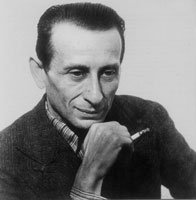
    POLE POSITIONS: Alexandre Tansman (left) and Henryk Górecki

  • Malcolm Arnold Tormented Genius

    Malcolm Arnold Tormented Genius

    “…[T]hou was a skellum,/A blethering, blustering, drunken blellum;/That frae November till October,/Ae market-dae thou was na sober.”

    Rabbie Burns wrote those lines about Tam O’Shanter. But they just as well could have applied to Sir Malcolm Arnold. Both men were, more or less, fond of the bottle, and both were driven by demons.

    Arnold, born 100 years ago today, began his professional career as a trumpeter with the London Philharmonic Orchestra. He was appointed its principal in 1943.

    During World War II, he registered as a conscientious objector. However, following the death of his brother, a pilot in the RAF, he was moved to enlist. At least for a time. While he never saw actual combat, serving instead in a military band, he quite literally shot himself in the foot so that he could return to civilian life.

    In 1948, he retired from orchestral playing to devote himself exclusively to composition. He possessed a rare melodic gift, which served him well in his light music and film scores. He won an Academy Award in 1957 for his work on “The Bridge on the River Kwai.”

    However, Arnold also had his dark side, as can be detected in certain passages of his symphonies. He was frequently cantankerous, often inebriated, and also highly promiscuous. He attempted suicide at least twice. He was treated for depression and alcoholism, rising above both, but in the early 1980s was given only a year to live. He actually lasted another 22, during which he completed his Symphony No. 9, among other works.

    Arnold died in 2006, one month shy of his 85th birthday. He was a brilliant composer, of great facility. When Malcolm Williamson was named Master of the Queen’s Music in 1975, Sir William Walton quipped that they had given the job to the wrong Malcolm. For a man with so many personal demons, Arnold wrote reams of perfectly delightful music.

    A good example, and one of my favorite Halloween pieces, is the programmatic overture “Tam O’Shanter” (1955). On market day, Burns’ antihero tarries at a pub, in defiance of his wife, then staggers out into the night. Under ominous skies, he detects the sound of bagpipes emanating from the ruins of an old church. Pressing his face to a chink in the mortar he espies “Auld Nick,” the Devil himself, “in shape o’ beast,” presiding over a coven of high-stepping witches and warlocks. When a particularly comely witch catches Tam’s eye, in his drunkenness, he roars, “Weel done, Cutty-sark!” (a reference to her short skirt). This brings the forces of darkness down up him, and there is a hell-for-leather sprint by horseback for a nearby river, since spirits are said not be able to cross running water.

    If you’re interested in the rest, you can read it for yourself here:

    http://loki.stockton.edu/~kinsellt/litresources/ayr/tam.html

    Then listen to Arnold’s musical response:

    Also, “Four Scottish Dances” (1957):

    From the film “The Belles of St. Trinian’s” (1954), in concert:

    On a more serious note, the Symphony No. 4 (1960), a plea for tolerance following the Notting Hill race riots of 1958:

    The Guitar Concerto (1959), played by Julian Bream:

    “Three Sea Shanties” (1943) for wind quintet:

    An interview by Bruce Duffie:

    http://www.bruceduffie.com/arnold2.html

    Happy centenary, Sir Malcolm Arnold, you tormented genius!


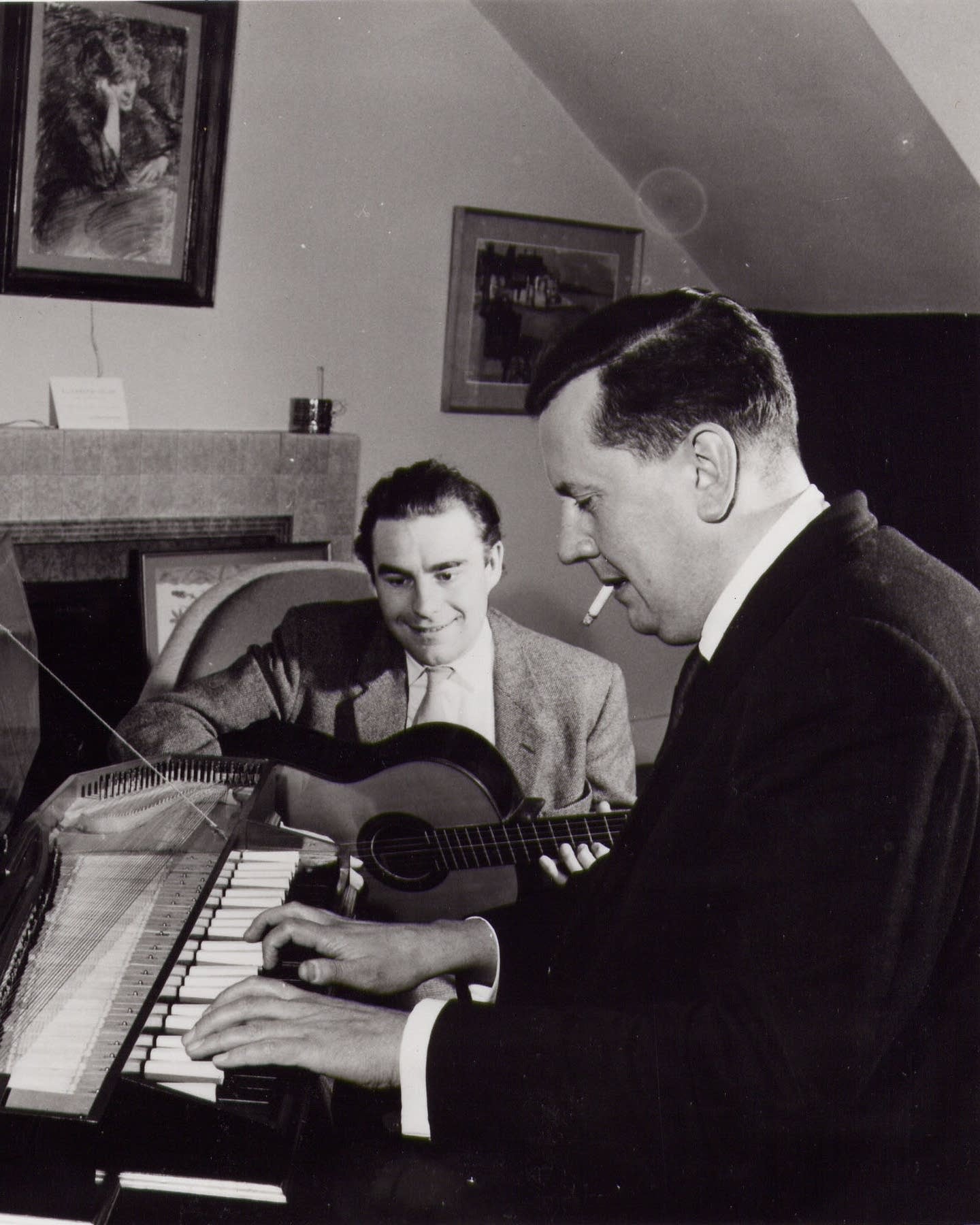
    PHOTO: Malcolm Arnold and Julian Bream

Tag Cloud

Aaron Copland (92) Beethoven (95) Composer (114) Film Music (123) Film Score (143) Film Scores (255) Halloween (94) John Williams (187) KWAX (229) Leonard Bernstein (101) Marlboro Music Festival (125) Movie Music (138) Opera (202) Philadelphia Orchestra (89) Picture Perfect (174) Princeton Symphony Orchestra (106) Radio (87) Ralph Vaughan Williams (85) Ross Amico (244) Roy's Tie-Dye Sci-Fi Corner (290) The Classical Network (101) The Lost Chord (268) Vaughan Williams (103) WPRB (396) WWFM (881)

DON’T MISS A BEAT

Receive a weekly digest every Sunday at noon by signing up here


RECENT POSTS