Tag: Symphony No. 4

  • Verdi, Mendelssohn & Italian Music from Marlboro

    Verdi, Mendelssohn & Italian Music from Marlboro

    Viva Italia!

    We’re off to sunny Italy for this week’s “Music from Marlboro.”

    Like a kind of musical Hannibal, Giuseppe Verdi brought elephants to the operatic stage. The premiere of “Aida” in Cairo in 1871 featured a dozen pachyderms and fifteen camels into the bargain. But when a Naples performance of Verdi’s grandest grand opera was delayed, the composer sought diversion on a much smaller scale. Verdi tossed off his first piece of chamber music at the age of 60.

    The String Quartet in E minor was given an informal performance at the Hotel delle Crocelle on April 1, 1873. Said Verdi of his latest creation, “I don’t know whether the Quartet is beautiful or ugly, but I do know that it’s a Quartet!” We’ll get to hear it in a 1969 performance featuring violinists Pina Carmirelli and Endre Granat, violist Martha Strongin Katz, and cellist Ronald Leonard.

    Felix Mendelssohn’s Symphony No. 4 – known as the “Italian” – had its origins in a European tour undertaken by the composer between 1829 and 1831. Mendelssohn’s Italian sojourn threw him into ecstasies. In a letter to his parents, he effused, “Italy at last! …[W]hat I have all my life considered as the greatest possible felicity is now begun, and I am basking in it. …[T]hank you, my dear parents, for having given me all this happiness.”

    The composer did his best to capture his impressions in music. The symphony’s first performance in London in 1833, which Mendelssohn himself conducted, made him the most emulated composer in England for the remainder of the 19th century. However, despite the work’s overwhelmingly positive reception, he continued to feel a nagging dissatisfaction with it. He revised the symphony in 1834, with plans for further changes, and the score was never published in his lifetime. He even claimed that it caused him some of the bitterest moments of his career. Naturally, it went on to become his best-loved symphony.

    We’ll hear Pablo Casals lead an enviable roster of musicians from the 1963 Marlboro Music Festival. It’s difficult to single anyone out, but Bernard Goldberg, John Mack, Myron Bloom, Shmuel Ashkenasi, Jaime Laredo, Caroline Levine, Irene Serkin, Sidney Curtiss, Samuel Rhodes, Herman Busch, Lynn Harrell, Julius Levine, and all four members of the Guarneri String Quartet are among the personnel. Casals was affiliated with Marlboro for the last 13 years of his life, from 1960 until his death, at the age of 96, in 1973.

    We’ve got sunshine on a rainy day on the next “Music from Marlboro,” this Wednesday evening at 6:00 EDT, on WWFM – The Classical Network and wwfm.org.


    This summer’s Marlboro Music Festival continues through August 12. Find out more at marlboromusic.org.

    Marlboro School of Music and Festival: Official Page
  • Górecki’s Symphony No. 4: A Lost Chord Found

    Górecki’s Symphony No. 4: A Lost Chord Found

    A performance of his Symphony No. 3 sold over a million copies, making it one of the best-selling classical records of all time.

    This Sunday night on “The Lost Chord,” we’ll hear the last major work by Polish composer Henryk Górecki – his Symphony No. 4, subtitled “Tansman Episodes.” The piece was written in tribute to his compatriot, Alexandre Tansman, who lived most of his life in Paris. Górecki had been cajoled into writing the work by the organizer of an annual Tansman Festival, held in Łódź, the city of Tansman’s birth.

    The astounding success of his Symphony No. 3 was actually a source of consternation for Górecki. The celebrity and scrutiny thrust upon him had the effect of disrupting his routine and stirred up anguish about his future path. Remember, the Symphony No. 3 was composed in 1976. Most of the world had never even heard of Górecki before he skyrocketed to fame in 1992. That was the year that Nonesuch Records released its recording, which featured soprano Dawn Upshaw, and was conducted by David Zinman. However, in the 16 years or so between the work’s composition and its sudden, staggering popularity, Górecki had understandably moved on and continued to develop as an artist.

    The sudden recognition caused him, rather Sibelius-like, to agonize over his next symphony. The work wasn’t completed in short score until 2006. The composer died in 2010 without having orchestrated the piece. However, he did leave indications of his intentions and had played through the work at the piano for his son, Mikolaj Górecki, also a composer. It was Mikolaj who took up the task of fleshing it out into full score following his father’s death.

    The symphony was given its first performance on April 12, 2014, by the forces we’ll hear, the London Philharmonic Orchestra conducted by Andrey Boreyko, in its world premiere recording.

    Rather than reference any of Tansman’s actual music, Górecki decided to play on the letters of the composer’s name, devising a musical cipher made up of corresponding notes to act as a recurring theme. In the second movement, he also quotes Karol Szymanowski’s “Stabat Mater.” There are passing references to Stravinsky and John Adams in the work, as well, and an appearance by Wagner’s “Siegfried” theme toward the end. In general, he trades the mesmerizing lyricism of his Third Symphony for a more aggressive brand of minimalism in his Fourth.

    I thought we’d preface Górecki’s symphonic tribute with some music by Tansman himself. We’ll hear the “Partita for Cello and Piano,” written in 1954 and 1955 for the famed Spanish cellist Gaspar Cassadó. It will be performed by the Cracow Duo – Kalinowski & Szlezer, Jan Kalinowski, cello, and Marek Szlezer, piano.

    I hope you’ll join me for “Repeating Episodes” – Henryk Górecki’s Symphony No. 4 “Tansman Episodes” – this Sunday night at 10:00 EDT, on WWFM – The Classical Network and wwfm.org.


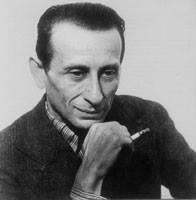
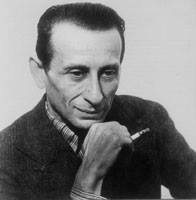
    POLE POSITIONS: Alexandre Tansman (left) and Henryk Górecki

  • Górecki’s Fourth: A Tansman Tribute

    Górecki’s Fourth: A Tansman Tribute

    A performance of his Symphony No. 3 sold over a million copies, making it one of the best-selling classical records of all time.

    This Sunday night on “The Lost Chord,” we’ll hear the last major work by Polish composer Henryk Górecki – his Symphony No. 4, subtitled “Tansman Episodes.” The piece was written in tribute to his compatriot, Alexandre Tansman, who lived most of his life in Paris. Górecki had been cajoled into writing the work by the organizer of an annual Tansman Festival, held in Łódź, the city of Tansman’s birth.

    The astounding success of his Symphony No. 3 was actually a source of consternation for Górecki. The celebrity and scrutiny thrust upon him had the effect of disrupting his routine and stirred up anguish about his future path. Remember, the Symphony No. 3 was composed in 1976. Most of the world had never even heard of Górecki before he skyrocketed to fame in 1992. That was the year that Nonesuch Records released its recording, which featured soprano Dawn Upshaw, and was conducted by David Zinman. However, in the 16 years or so between the work’s composition and its sudden, staggering popularity, Górecki had understandably moved on and continued to develop as an artist.

    The sudden recognition caused him, rather Sibelius-like, to agonize over his next symphony. The work wasn’t completed in short score until 2006. The composer died in 2010 without having orchestrated the piece. However, he did leave indications of his intentions and had played through the work at the piano for his son, Mikolaj Górecki, also a composer. It was Mikolaj who took up the task of fleshing it out into full score following his father’s death.

    The symphony was given its first performance on April 12, 2014, by the forces we’ll hear, the London Philharmonic Orchestra conducted by Andrey Boreyko, in its world premiere recording.

    Rather than reference any of Tansman’s actual music, Górecki decided to play on the letters of the composer’s name, devising a musical cipher made up of corresponding notes to act as a recurring theme. In the second movement, he also quotes Karol Szymanowski’s “Stabat Mater.” There are passing references to Stravinsky and John Adams in the work, as well, and an appearance by Wagner’s “Siegfried” theme toward the end. In general, he trades the mesmerizing lyricism of his Third Symphony for a more aggressive brand of minimalism in his Fourth.

    I thought we’d preface Górecki’s symphonic tribute with some music by Tansman himself. We’ll hear the “Partita for Cello and Piano,” written in 1954 and 1955 for the famed Spanish cellist Gaspar Cassadó. It will be performed by the Cracow Duo – Kalinowski & Szlezer, Jan Kalinowski, cello, and Marek Szlezer, piano.

    I hope you’ll join me for “Repeating Episodes” – Henryk Górecki’s Symphony No. 4 “Tansman Episodes” – this Sunday night at 10:00 EDT, with a repeat Wednesday evening at 6; or that you’ll listen to it later as a webcast at wwfm.org.


    POLE POSITIONS: Alexandre Tansman (left) and Henryk Górecki

  • Ives’ Symphony No. 4: Stokowski’s 1965 Premiere

    Ives’ Symphony No. 4: Stokowski’s 1965 Premiere

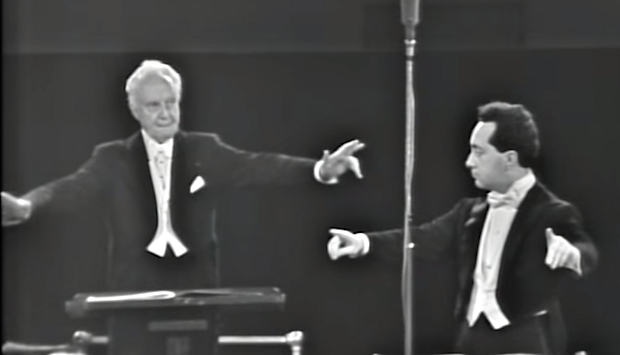
    It was on this date in 1965 that Leopold Stokowski gave the world premiere of Charles Ives’ Symphony No. 4. The performance took place at Carnegie Hall with the American Symphony Orchestra and the Schola Cantorum of New York. At the time, the work’s complex, kaleidoscopic tempos and layered, shifting meters required multiple conductors, and Stokowski enlisted the aid of David Katz and a young Jose Serebrier (pictured).

    The piece was composed between 1910 and the mid-1920s. Given the source, it’s hardly surprising that the music was decades ahead of its time. The first two movements had been performed by members of the New York Philharmonic under the direction of Eugene Goossens in 1927. This was the only occasion on which Ives would hear any of the music from the Fourth Symphony performed live by an orchestra. The composer died in 1954.

    Bernard Herrmann conducted an arrangement of the lovely third movement, the simplest and most conservative of the four (why, then, the need for an arrangement?), in 1933. The music as Ives wrote it was not heard until the complete performance in 1965.

    The composer’s biographer, Jan Swafford, describes the work as “Ives’ climactic masterpiece.”

    Stokowski recorded the symphony a few days after the premiere and led a televised studio performance, which can be seen here:

    Stokey kicks off twenty minutes of spoken introductory material (including commentary from producer John McClure) at the 4:30 mark. The symphony proper begins 25 minutes in.

    When’s the last time you saw anything like this on television?

  • Nielsen’s Inextinguishable Symphony Premiere

    Nielsen’s Inextinguishable Symphony Premiere

    It was on this date 100 years ago that an audience at the Copenhagen Musical Society was treated to the unusual experience of dueling kettle drums positioned at opposite sides of an orchestra. Carl Nielsen’s Symphony No. 4, “The Inextinguishable,” was given its premiere under the direction of its creator.

    Nielsen himself was responsible for the symphony’s nickname. Written against the backdrop of the First World War, the composer wished to express “the elemental will to live.” In the forward of the published score, he states, “Music is Life, and, like it, Inextinguishable.”

    At the climax of the piece, the thrilling clash of timpani gives way to a euphoric proclamation by the brass. Over strife and turmoil rises that which will endure. Nielsen, the eternal optimist, manages to convey that which is optimistically eternal.

Tag Cloud

Aaron Copland (92) Beethoven (95) Composer (114) Film Music (123) Film Score (143) Film Scores (255) Halloween (94) John Williams (187) KWAX (229) Leonard Bernstein (101) Marlboro Music Festival (125) Movie Music (138) Opera (202) Philadelphia Orchestra (89) Picture Perfect (174) Princeton Symphony Orchestra (106) Radio (87) Ralph Vaughan Williams (85) Ross Amico (244) Roy's Tie-Dye Sci-Fi Corner (290) The Classical Network (101) The Lost Chord (268) Vaughan Williams (103) WPRB (396) WWFM (881)

DON’T MISS A BEAT

Receive a weekly digest every Sunday at noon by signing up here


RECENT POSTS