With Thanksgiving right around the corner, it’s hardly surprising our thoughts, memories, and desires would be full of home. It’s a good time then to listen to John Fitz Rogers’ “Magna Mysteria.”
This Sunday night on “The Lost Chord,” we’ll hear this 2010 work, which weaves together Latin biblical texts and poetic verse of the 6th century philosopher Boethius, to elevate the idea of home – and the seeking of home – to a metaphorical or spiritual realm. If you have a fondness for the choral music of Morten Lauridsen or Stephen Paulus, I think you’ll really enjoy this, though Rogers is very much his own man. The music is tonal, melodic, and quite lovely.
Also on the program will be Aaron Copland’s “Letter from Home,” from 1943-44. The work was commissioned by Paul Whiteman for his Radio Hall of Fame Orchestra, and suggests the emotions of an American soldier, as he experiences a bittersweet reprieve, if only for a few moments, while savoring a letter from his family.
In a year when reunions may be difficult to achieve, home is in our hearts. I hope you’ll join me for “Homebodies,” this Sunday night at 10:00 EST, on WWFM – The Classical Network and wwfm.org.
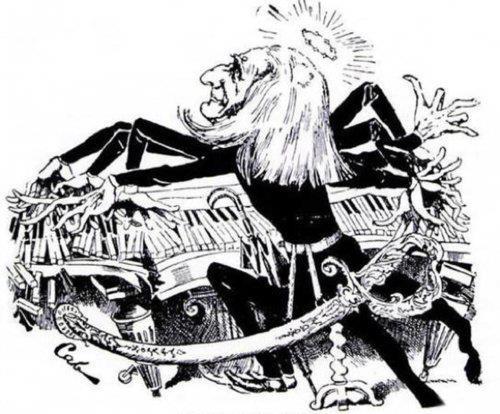
While the adjective “diabolical” could be applied to Franz Liszt, both in terms of his prowess as a pianist and as a ladies’ man, its application is justified, really, by only two aspects of his outsized personality.
Liszt was an especially complex individual, marked by much nobility of character. He was a generous human being, a humanitarian, and an all-around nice guy. He was also quite devout. It was his intention to marry his long-time companion, the Princess Carolyne zu Sayn-Wittgenstein, on his 50th birthday, but his hopes were dashed, after the Church refused to grant her an annulment (she had been estranged from her husband long before she met the handsome touring virtuoso). He reacted by taking minor orders and living in a monastic cell in Rome, where he became known as the Abbé Liszt. (He had also recently lost two of his three children born to him by Marie d’Agoult.)
Liszt’s religiosity was not something he wore lightly. From an early age, he felt certain he would be a musician or a priest. In the end, he became both.
This Sunday night on “The Lost Chord,” we’ll sample from two of at least seven of Liszt’s works inspired by his fascination with the saints – “The Legend of St. Elisabeth” and “St. Stanislaus.” St. Elisabeth was the Hungarian princess much concerned with the welfare of the poor, and St. Stanislaus the patron saint of Poland. These are the subjects of Liszt’s first and last oratorios.
I hope you’ll join me, on All Saints’ Day, for “Liszt of Saints,” this Sunday night at 10:00 EST, on WWFM – The Classical Network and wwfm.org.
THANK YOU to everyone who contributed to WWFM’s fall membership campaign. It’s because of listeners like you that The Classical Network is able to bring you homegrown specialty shows like “The Lost Chord.” If you haven’t had a chance to contribute and have been meaning to do so, you can still make your donation online at wwfm.org. You don’t have to be a saint to make a difference. Thanks again for your support of classical music on WWFM!
This Sunday night on “The Lost Chord,” lend a little color to your weekend, with seasonal evocations by two American composers.
Henry Hadley (1871-1937) studied at home with George Whitefield Chadwick and in Vienna with Eusebius Mandyczewski. In Europe, he befriended Richard Strauss and conducted the Berlin Philharmonic in his own Symphony No. 3. He was assistant conductor at the Mainz Opera, later music director of the Seattle Symphony, and became the first conductor of the San Francisco Symphony. One of his operas, “Cleopatra’s Night,” was performed at New York’s Metropolitan Opera. He served a stint as assistant conductor of the New York Philharmonic, he founded the National Association of Composers and Conductors, and he was instrumental in establishing the Berkshire Music Festival at Tanglewood. He guest conducted orchestras from Buenos Aires to Tokyo. Why then do so few remember him?
We’ll dig deep into the leaf pile of music history to revive Hadley’s Symphony No. 2, from 1901, subtitled “The Four Seasons.” The work begins with an evocation of a turbulent winter storm, followed by “Spring,” then “Summer.” The symphony concludes with a melancholy portrait of autumn, enlivened by the appearance of some rollicking hunting horns.
Toward the end of the hour, we’ll have just enough time for music by Leo Sowerby (1895-1968), sometimes called “the Dean of American Church Music.” Sowerby was awarded the Pulitzer Prize for Music in 1946 for his cantata “Canticle to the Sun.” As antidote to the reflective nature of Hadley’s “Autumn,” we’ll conclude with the exuberant “Comes Autumn Time,” an uplifting work for solo organ.
I hope you’ll join me for “Well-Seasoned” – American composers of experience celebrate autumn – this Sunday night at 10:00 EDT, on WWFM – The Classical Network and wwfm.org.
Sure, it’s artistically satisfying to perform with the New York Philharmonic and to have one’s works choreographed by Léonide Massine and George Balanchine – but at the end of the day, there’s really nothing like a good popular hit to keep food on the table.
This Sunday night on “The Lost Chord,” we’ll enjoy concert music by two artists more frequently associated with the musical theater.
Vernon Duke may be remembered for standards like “April in Paris” and “Autumn in New York,” with his greatest stage success being the Broadway musical “Cabin in the Sky.” However, his early ambition was to become a “serious” composer.
Born Vladimir Dukelsky in what in now Belarus in 1903, Duke studied composition with Reinhold Gliere. His music was championed by Serge Koussevitzky and admired by Sergei Prokofiev. Indeed, Duke continued to write works for the concert hall (as Dukelsky) right up into the 1950s.
In 1921, he arrived in New York City, where he was befriended by George Gershwin. It was Gershwin – himself born Jacob Gershowitz – who suggested Dukelsky’s nom de plume. Thereafter, Duke/Dukelsky lived a double-life, Duke writing for popular consumption and Dukelsky composing symphonies.
Dukelsky’s Piano Concerto was requested of the 19 year-old by none other than Arthur Rubinstein. Allegedly, Rubinstein and Gershwin were delighted with the piece when they heard it in its two-piano form. Unfortunately, so was impresario Serge Diaghilev. When Diaghilev heard Dukelsky play through it in Paris (with Georges Auric on the second piano), he immediately offered the talented young man a commission to write “Zephyr et Flore” for the Ballets Russes. This led to further offers from London’s West End. As a result, Dukelsky never got around to orchestrating the piece. It was left to pianist Scott Dunn to do so, in advance of some Gershwin centennial concerts in 1999.
Meredith Willson is best remembered for “The Music Man” and “The Unsinkable Molly Brown.” However, before his success in musical theater, he had been a flutist in the Sousa Band and with the New York Philharmonic. He worked as an orchestrator on Charlie Chaplin’s “The Great Dictator.” He was also a gifted conductor, author, librettist, and humorist. His autobiography, “And There I Stood with my Piccolo,” became a bestseller.
Willson composed two symphonies, both of them extended love letters to California landmarks. His Symphony No. 1 pays tribute to San Francisco. The Symphony No. 2, the one we’ll hear this evening, is evocative of the missions of Southern California, with individual movements devoted to Junipero Serra, San Juan Bautista, San Juan Capistrano, and El Camino Real.
I hope you’ll join me for “Broad Talents from Broadway” – musical theater composers hang on to their day jobs – this Sunday night at 10:00 EDT, on WWFM – The Classical Network and wwfm.org.
Dawn Upshaw sings “Autumn in New York”
Count Basie performs “April Paris”
Basie welcomes Sheriff Bart
“The Music Man,” Overture/Rock Island
“76 Trombones” – for 76 trombones!
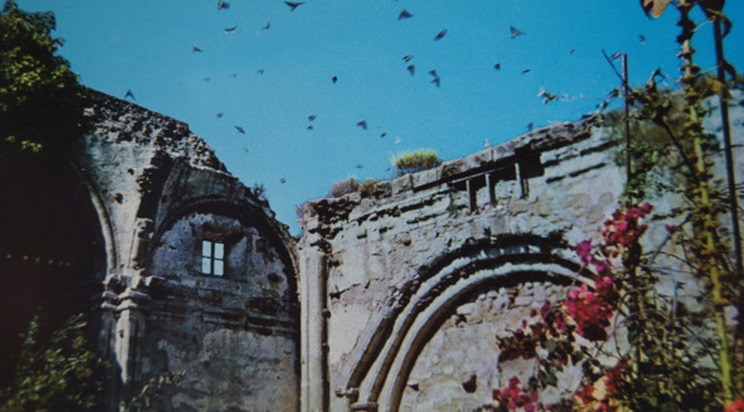
PHOTO: Are these menacing vampire bats, flittering about the ruins of Castle Dracula? No, they’re just the swallows, come back to Capistrano.
This Sunday night on “The Lost Chord,” it’s an hour of high adventure and satisfied bloodlust, as we listen to musical evocations of Odysseus’ homeward journey.
We’ll hear Ernst Boehe’s symphonic poem “Departure and Shipwreck,” from his cycle “From Odysseus’ Voyages” (1903-05), and Benjamin Britten’s radio play “The Rescue of Penelope” (1943), narrated by Dame Janet Baker.
Odysseus, of course, is one of the heroes of the Trojan War, waylaid time and again, on his return, by Poseidon and the frailties of his own men. It takes him ten years to find his way back to Ithaca. When he gets there, he finds his wife beset by boorish suitors all vying for her hand and his throne.
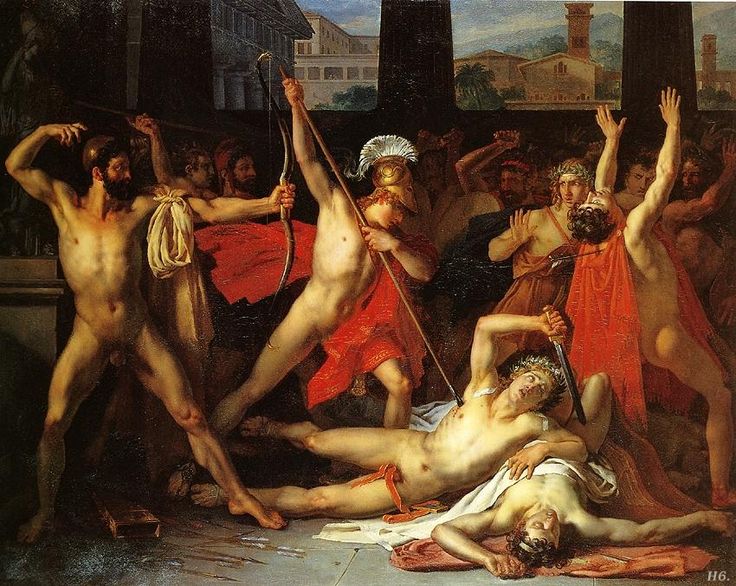
What happens next pushes all the same buttons that are still pushed whenever Sylvester Stallone or Arnold Schwarzenegger apply the camouflage, strap on the bandoliers, and sheathe the big knives. Along the way, there’s also some meaningful father-son bonding. Leave it to Homer, who always knew how to lend a little class to the classics.
Odysseus strings his bow, for “Home Sweet Homer,” this Sunday night at 10:00 EDT, on WWFM – The Classical Network and at wwfm.org.
“The Slaughter of the Suitors by Odysseus and Telemachus” (1812), by Louis-Vincent-Léon Pallière