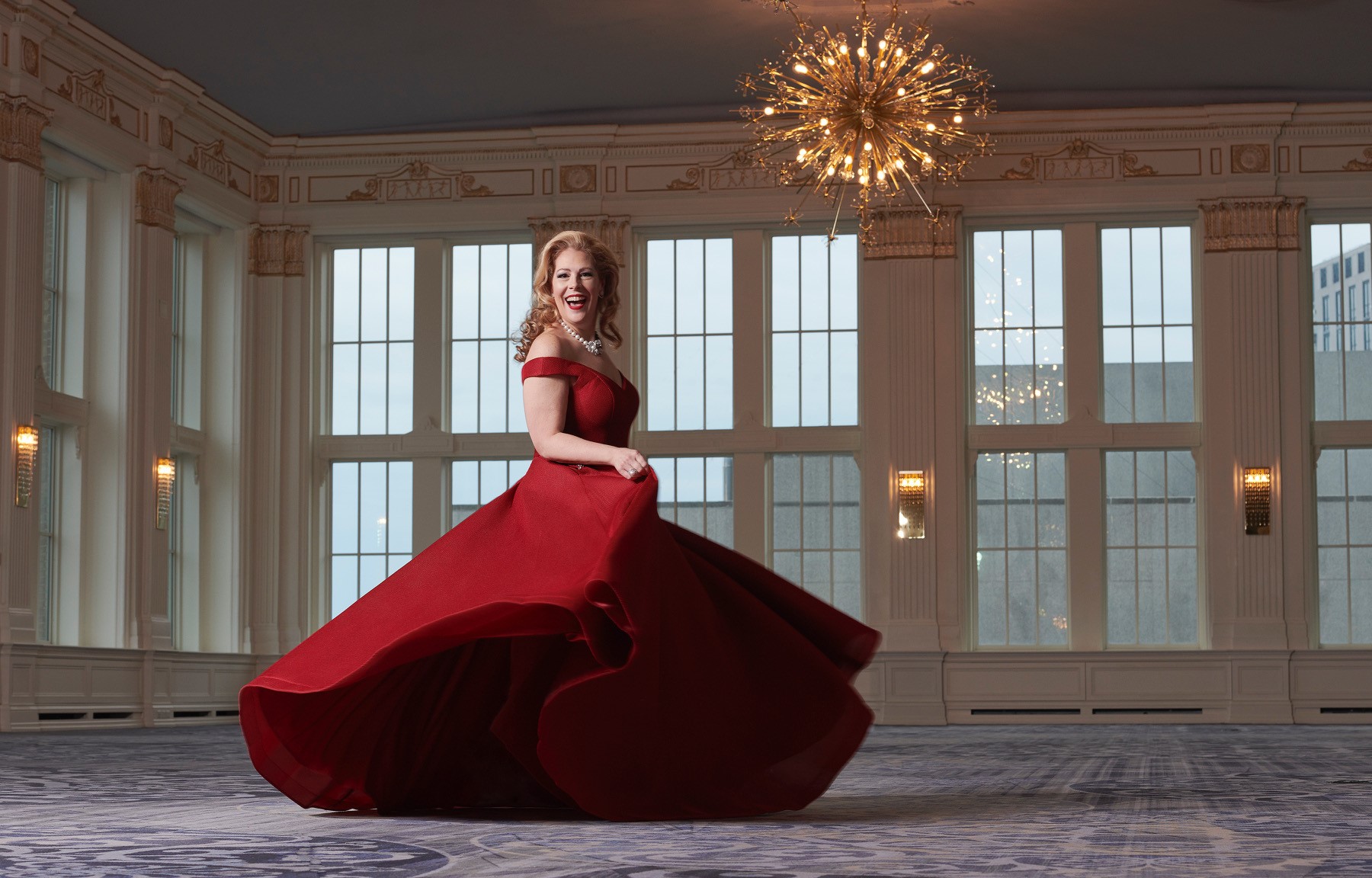
Because of safety concerns regarding the ill-timed thunderstorms that battered the region last night not long before curtain, it was nearly 9:00 before soprano Sondra Radvanovsky took the stage of the performance pavilion at Morven Museum & Garden for the second night of The Princeton Festival. But boy, when she did, did she deliver.
The program was perfectly tailored to suit her voice, with selections by Verdi (“La forza del destino”), Giordano (“André Chénier”), and Puccini (“Tosca” – which she’ll be singing at the Met next season – and an imperious Turandot). Her control was riveting, her dramatic presence hypnotic, and when she was under full sail, she flooded the tent with a magisterial voice that stirred overwhelming emotion.
She was joined by rising tenor Victor Starsky, a Princeton Festival veteran, who sang Cavaradossi in last year’s production of “Tosca” and will return next week as Pinkerton in “Madama Butterfly.” Starsky had his time in the spotlight with “Celeste Aida” and that old standby, “Nessun Dorma.” Nothing sets a crowd wild like a tenor in full voice.
But even more compelling, for me, personally, were his duets with Radvanovsky (from “Un Ballo in maschera” and “Manon Lescaut”), which allowed his passion to bubble over. I was left shaken by their concluding “Vicino a te s’acqueta,” from “André Chénier,” in which the couple anticipates fulfillment of their love in their impending death at the guillotine (“Viva la morte insiem!”) – so much so that, as I was chatting with some people behind me afterward, I nearly broke down.
No doubt there would have been encores, but it was already pushing 11:00. I’m sure a lot of contracted employees are going to be getting overtime.
Rossen Milanov conducted The Princeton Symphony Orchestra, in support of the singers, but also supplied the overtures and interludes by Verdi, Mascagni, and Leoncavallo. It was a late night, so I was thankful for having imbibed a strong cold brew beforehand. Even so, I think it would have been impossible to nod. It was definitely worth sweating it out in the car for an hour, waiting for the thunder and lightning to subside.
Today is the festival’s Community Day, with Yoga in the Garden (to live musical accompaniment) already underway. That will be followed this afternoon by family friendly activities, including an instrument “petting zoo,” a musical story time, a quilting exhibition, “Harriet Powers: American Icon,” with the Princeton Sankofa Stitchers Modern Quilt Guild, and American Repertory Ballet‘s 30-minute “Swan Lake Experience,” an accelerated story of the ballet with audience participation, from 12-3 p.m.
This evening, Milanov and the PSO will return to join the dancers for a program that will feature pas de deux from Tchaikovsky’s “Swan Lake” and “The Sleeping Beauty,” Samuel Barber’s “Adagio for Strings,” and a world premiere choreographed to music by Pulitzer Prize winner Caroline Shaw. But especially interesting to me will be a ballet set to Jean Françaix’s Piano Concerto, with Steven Beck the soloist. The event will commence in the performance pavilion on the Morven grounds at 7 p.m.
Morven Museum & Garden is located at 55 Stockton Street (Route 206) in Princeton, NJ.
The Princeton Festival runs through July 21. For tickets and information, visit princetonsymphony.org/festival.
——–
I didn’t take any pictures last night. I’ll add a more pertinent photo once the Princeton Festival makes one available!
Tag: Victor Starsky
-
Stunning Radvanovsky Worth the Wait, After Rain Delay at the Princeton Festival
-

The Princeton Festival’s “Tosca” Takes Flight
Once you see “Tosca,” you never forget it. But I never expected to be haunted by it!
I remember the first time I saw it on PBS back in the 1980s. It was one of those “Great Performances” broadcasts from the Metropolitan Opera, with Hildegard Behrens in the title role and Cornell MacNeil as the villainous Scarpia. Placido Domingo was Cavaradossi. From the perspective of my 19-year-old self, Domingo, especially, seemed a little long in the tooth to be cutting the romantic figure of a dashing young painter turned political prisoner. Funny to think back on it now, as he must have only been in his 40s at the time. And he’s still singing!
Now, 40 years on, what a difference it makes to experience the work with someone with the pipes AND the youth to really put it across. Last night at The Princeton Festival, tenor Victor Starsky sang Cavaradossi with power and vigor. In fact, all three leads, including soprano Toni Marie Palmertree as Tosca and baritone Luis Ledesma as Scarpia, were extraordinarily well-matched, at every turn heightening the drama and intensifying the passion, in what is really a lean chamber piece writ large by Giacomo Puccini. Frankly, I never recognized its genius before.
Never had I found myself so engrossed in the work’s interweaving themes, both musical (the interplay of heart-rending leitmotifs clearly paving the way for Hollywood film scores of the 1930s & ’40s) and textual (the libretto a fascinating blend of religion, politics, and sexuality). It really got me thinking about how each of the characters relates to love, death, and God in various combinations. And I thought “Tristan” was perverse in its celebration of love-death! Clearly, Wagner was not Italian.
It’s the kind of reflection one engages in when one experiences opera as theater, as opposed to listening to it on a recording, where the music and the quality of the singing take precedence. In the opera house, you get the total experience, as you’re also focusing on the action and the words.
“Tosca” really begins to insinuate itself as it explores various permutations of faith and blasphemy, eroticism and nihilism. Far from the laugh-out-loud experience of that PBS “Tosca” that had me howling in Act III, the opera, when done right, makes you forget how trashy the subject matter really is. It’s no longer the “shabby little shocker” derided by musicologist Joseph Kerman, but rather like Victor Hugo at his most twisted. You just don’t know how to feel about certain things, but you can’t help FEELING. Is there a more desolate aria than Cavaradossi’s “E lucevan le stelle?” Sometimes you’re just screwed. Interesting, though, that the character couches thoughts of impending doom in meditations on all the hot nights he’s going to be missing out on with Tosca. Molto Italiano!
Tosca’s thoughts, on the other hand, in her own expression of hopelessness, the aria “Vissi d’arte,” turn on contemplations as to why God has deserted her. For Scarpia, virile, dangerous, and subtle, well, he sings – in church no less – “Tosca, you make me forget God!” Because he’ll do anything to have her.
Ledesma not only has the voice, but the imposing carriage to convince as the morally bankrupt chief of police, who is the recipient of the opera’s most awe-inspiring leitmotif. He is an edifice in himself, the embodiment of power corrupted. We hear echoes of it, even as Tosca enacts a pious ritual with candles and crucifix over his corpse, as if to note, how the mighty have fallen.
Scarpia is no cartoon villain. He invokes Iago in the first act. Even in death, he dominates. It’s not for nothing that Tosca’s last line is “I’ll see you before God, Scarpia!” The full extent of his calculated evil comes to light only posthumously, and he looms over the fates of the other characters, just as the grim prison of the Castel Sant’Angelo looms over Rome.
For such a swift opera (Puccini was ruthless in trimming numbers from the libretto, based on a sprawling melodrama conceived by Victorien Sardou as a vehicle for Sarah Bernhardt), the characters are fascinatingly layered. Some contemporaries complained about the resulting sacrifice of lyricism (alleged), but the drama is inexorable. Since there are no set pieces or flashy effects (beyond perhaps that chorus at the end of Act I), it’s essential that all the singers be able to pull their weight, vocally and as actors.
The opera certainly offers a plum part for a soprano – a diva playing a diva – and Palmertree left nothing on the table. Like Starsky, she brought it when it counted. Tosca’s journey takes her from the comparative innocence of love, religious devotion, and petty jealousy in Act I to desperation and resourcefulness, as she pushes back against Scarpia’s objectification and harassment in Act II, to the point that she takes matters into her own hands. Palmertree made you feel the anguish of Tosca trying to keep her lover’s secret, even as she hears him being tortured in the next room, only to have to rein it in a few moments later to strike the right tone of introspection to navigate her dark night of the soul in “Vissi d’arte.”
The Princeton Symphony Orchestra was in impressive tune with its conductor, Rossen Milanov, who led the performance as to the manner born. Milanov has ample experience conducting opera and ballet in the U.S. and Europe, but it’s only comparatively recently that we’ve been exposed to that facet of his artistry in Princeton. Nothing I’ve heard at the Princeton Festival since its post-COVID resurrection in 2022 prepared me for what I heard and saw last night. Milanov conjured waves of sound and navigated passionate breakers, but he did so most undemonstratively, as a collaborator, yes, but also as a sensitive accompanist. Conducting opera is like steering a ship, and no matter how turbulent the drama got, Milanov at the helm kept his cool and rode the blue. I don’t know if it’s just that I haven’t been paying close enough attention, but even when conducting the orchestra’s regular subscription concerts at Richardson Auditorium, he really does seem to be more relaxed and just getting better all the time.
Also, not to be undersold was the production’s stage direction by Eve Summer. Even though I emphasize “Tosca’s” intimacy, the opera would seem to call for grand sets, at least for the outer acts. How do you believably conjure the church of Sant’Andrea della Valle on a stage the size of the one inside the performance pavilion on the grounds of Morven Museum & Garden? And how on earth do you hope to convey the height and imposing grandeur of the Castel Sant’Angelo, and still have room for a firing squad, much less to pull off the opera’s famous ending. Yet Summer and scenic designer Ryan McGettigan made it work. A masterstroke came at the end of the first act, when the chorus (prepared by Vinroy Brown), attired in cowls and miters, processed from the stage up and down the aisles of the tent to surround the audience with spinetingling sonorities.
Furthermore, I must say, I expected something far less spectacular from Tosca’s final act of defiance. Instead of simply dropping from the parapet, as I anticipated, Palmertree suddenly put on a burst of speed, dashing along the length of the battlement, at the far end flinging herself headlong into oblivion. Kudos for going for broke! I am nearly always slammed by a wave of emotion at the end of an opera, but the music, the visual, and the audience reaction really put it over the top.
I admit, when I first heard that the opera this summer was going to be “Tosca,” I had my doubts. Previously, the post-COVID, Princeton Symphony Orchestra incarnation of the Princeton Festival had dealt solely in comedy – “The Barber of Seville,” “Albert Herring,” “Cosi fan tutte,” “The Impresario” and “Scalia/Ginsburg” – certainly apt, given the season and the venue. These all had their enjoyments, but I was unprepared for “Tosca,” which despite the stage limitations, was a triumph.
Anything else this week is bound to seem anticlimactic, but there’s something to be said for just relaxing and enjoying a concert. The Princeton Festival runs through Saturday. For the remainder of this year’s schedule, visit https://www.princetonsymphony.org/festival.
Tag Cloud
Aaron Copland (93) Beethoven (95) Composer (114) Film Music (129) Film Score (143) Film Scores (255) Halloween (94) John Williams (192) KWAX (229) Leonard Bernstein (103) Marlboro Music Festival (125) Movie Music (144) Mozart (88) Opera (206) Philadelphia Orchestra (89) Picture Perfect (174) Princeton Symphony Orchestra (108) Radio (88) Ross Amico (244) Roy's Tie-Dye Sci-Fi Corner (290) The Classical Network (101) The Lost Chord (268) Vaughan Williams (103) WPRB (396) WWFM (881)