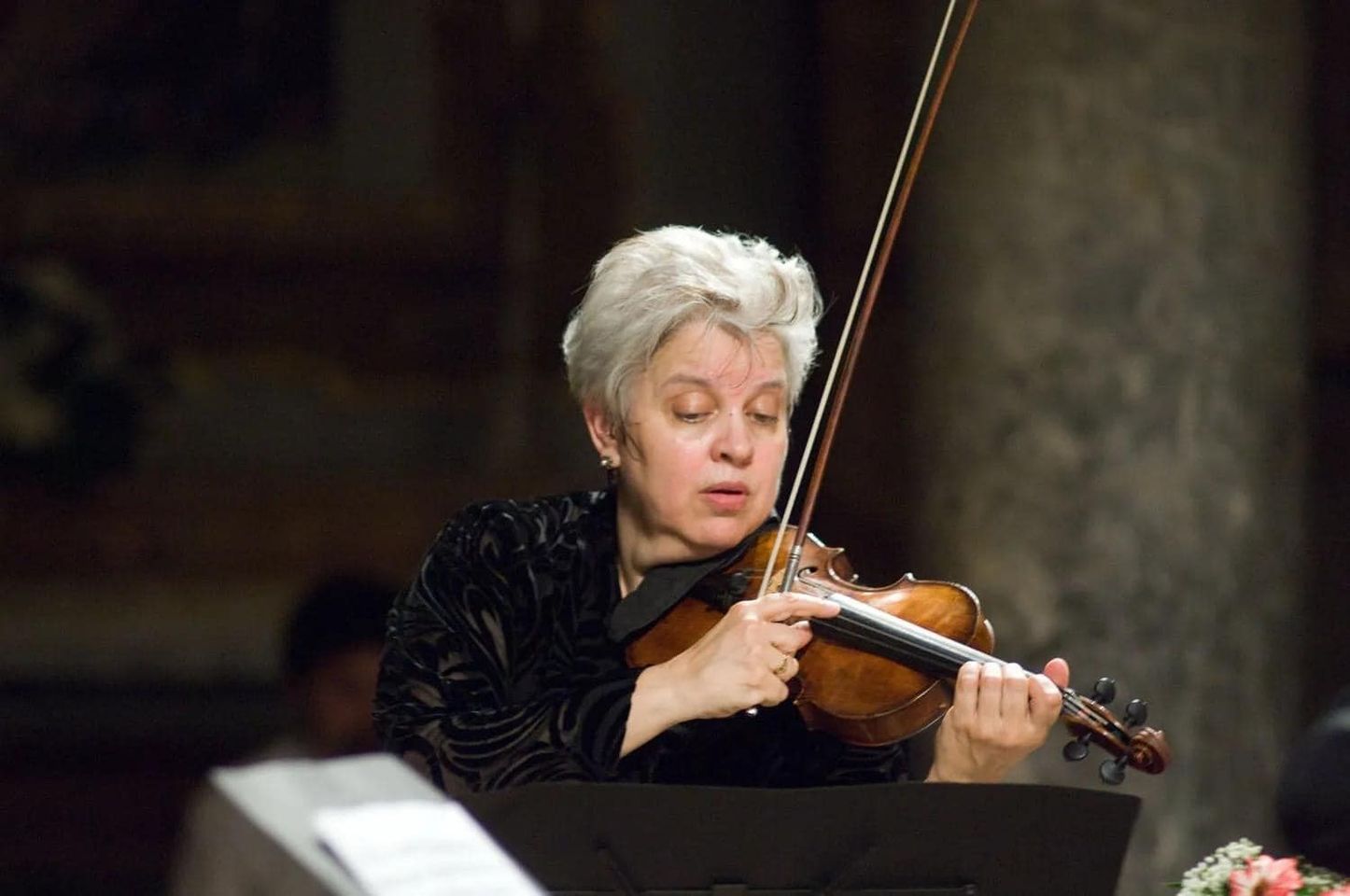
The violinist Jorja Fleezanis has died. Fleezanis served as concertmaster of the Minnesota Orchestra for twenty years (1989-2009). At the time of her appointment, she was only the second woman to be named concertmaster of a major U.S. orchestra.
Prior to her run in Minnesota, she was associate concertmaster in San Francisco for eight years. And before that, she was with the Chicago Symphony from the age of 23.
Fleezanis gave the world premiere of John Adams’ Violin Concerto, a work commissioned for her by the Minnesota Orchestra, in 1994.
With acclaimed pianist Garrick Ohlsson and principal cellist of the San Francisco Symphony Michael Grebanier, she formed the FOG Trio.
Public radio listeners with long memories will also remember her from her frequent appearances on “St. Paul Sunday” with Bill McGlaughlin.
Fleezanis was 70 years-old.
Plenty examples of her artistry on YouTube, both with the FOG Trio and her colleagues from the San Francisco Symphony.
Haydn & Brahms
Beethoven
Schumann
Arensky, Chausson & Saint-Saëns
Elgar
Dvořák piano trios
Dvořák quartet with members of the San Francisco Symphony
The Japanese violinist Yoko Sato has died. There is shockingly little documentation of her artistry available in the West, in terms of video and recordings, especially on CD, although she did make an album with Ennio Morricone, the soundtrack to “Dedicato al mare Egeo.” (All that’s posted on YouTube is a horrible disco cover, with no violin that I can perceive.) However, there is a great video that’s been circulating of her playing Khachaturian’s Violin Concerto at the age of 13, with the composer conducting.
Here, she appears at the Tchaikovsky Competition in 1966 (around the 3-minute mark), with some footage of her teacher, Leonid Kogan.
Wouldn’t mind hearing this album, in which Sato plays the rarely-heard concerto by Tikhon Khrennikov, who caused so much suffering for Shostakovich, Prokofiev, and others – including Khachaturian – as General Secretary of the Union of Soviet Composers.
Oh, this is very interesting. Apparently “Dedicato al mare Egeo” is a quasi-skin flick, directed by Masuo Ikeda, the painter, printmaker, sculptor, and novelist (and Akutagawa Prize winner for his novel “Offering in the Aegean,” upon which the film is presumably based), who was Sato’s partner from 1980.
A not-so-stern birthday observance for Isaac Stern, born 102 years ago today. The great violinist’s hands can be seen in the film “Humoresque” (1947), whenever John Garfield’s character “plays.”
Franz Waxman’s “Carmen Fantasie,” written for the film, took on a life of its own. Not surprisingly, Stern remained a champion of the piece.
He also appeared on the soundtrack of the film version of “Fiddler on the Roof” (1971), playing John Williams’ arrangements. No doubt his contributions helped Williams earn his first Oscar.
A decade later, a documentary about his trip to China, “From Mao to Mozart” (1979), won an Academy Award for Best Documentary Feature.
Of course, Stern’s impact ranged far beyond the silver screen. He was a prolific recording artist and kingmaker who held an enormous influence over other concert artist’s careers – many for the better, some for the worse.
Most famously, he is credited with having saved Carnegie Hall from the wrecking ball in 1960. Sure, it cost New York a parking lot, but the city seems to have done all right without it.
Happy birthday, Isaac Stern.
The Istomin-Stern-Rose Trio in music by Franz Schubert
Stern plays Bach
Stern plays Barber
Stern on “The Jack Benny Program”
Stern in a photo inscribed to Carnegie Hall, ten years before he rescued it from demolition
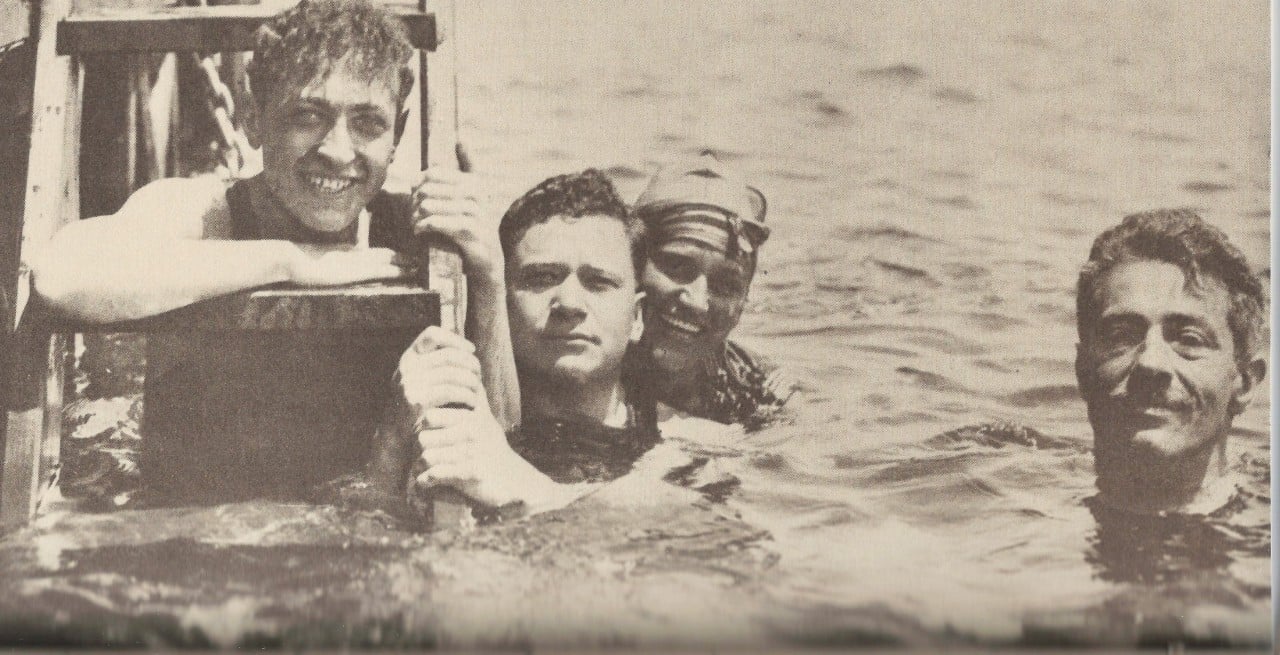
For those of you who are still reeling at the Groundhog’s forecast of six more weeks of winter, here’s a glimpse of two of the greatest violinists of their day – perhaps ever – fiddling around in their bathing suits: Jascha Heifetz, left, and Fritz Kreisler, right, convene at the old swimming hole with their colleague, Efrem Zimbalist, and his wife, soprano Alma Gluck.
It wasn’t just a refreshing summertime dip that the two shared. Kreisler and Heifetz were both born on February 2.
Kreisler, the sweet-toned confectioner and purveyor of violin bonbons, was born in Vienna on this date in 1875. Heifetz, the superhuman technician, who imbued perfection with tonal beauty, was born in Vilnius in 1901. Kreisler was warm, gregarious and easygoing. Heifetz acquired a reputation for a certain cool intensity.
At a point, Kreisler ruffled feathers, not with his playing, but because he casually let slip that many of the 18th century “rediscoveries” he had used to charm audiences, critics, and musicologists were in fact not rediscoveries at all. Nor did they date from the 18th century. Rather they were composed by Kreisler himself. When the professionals complained, Kreisler shrugged.
It would be futile to argue against his serious musical credentials. He gave the world premiere of the Elgar concerto and became a favorite recital partner of Sergei Rachmaninoff. A famous anecdote relates that Kreisler and Rachmaninoff were giving a concert in New York. In the middle of a performance, Kreisler suffered a memory lapse, and as he noodled around on his violin, trying to find his way back, he inched closer to his pianist. “Where are we?” Kreisler whispered. To which Rachmaninoff replied, dryly, “Carnegie Hall.”
In 1941, Kreisler was crossing the street, when he was hit by a milk truck. The accident fractured his skull and put him in a coma. Like something out of an early Woody Allen comedy, when he awoke, he could communicate only in Latin and Greek. Thankfully, the effect was only temporary.
Kreisler met Heifetz for the first time at a private press party in 1912. After listening to the boy play through the Mendelssohn concerto, he declared, “We can all just break our fiddles over our knees.” Arthur Nikisch, conductor of the Berlin Philharmonic, said he had never heard such an excellent violinist. The year before, Heifetz had played before a crowd of 25,000, and police had to be summoned to prevent the young virtuoso from being mobbed.
A little more collected was Groucho Marx. When Heifetz met Groucho, he mentioned that he had been earning his living as a violinist since the age of seven. Groucho responded, “Before that, I suppose, you were just a bum.”
Aside from his astounding accomplishments on the concert stage, Heifetz appeared as a mess hall jazz musician in Allied camps across Europe during the Second World War. Under a pseudonym, he wrote “When You Make Love to Me (Don’t Make Believe)” for Bing Crosby. In addition, Heifetz and Bing recorded the “Lullaby” from Benjamin Godard’s opera “Jocelyn.”
Heifetz was an advocate for certain socio-political and environmental causes. Decades before it was a thing, he had his Renault converted into an electric vehicle, and he lobbied for the acceptance of 911 as an emergency number.
Once, after a performance in Israel, he was attacked by a man wielding a crowbar for programming a violin sonata by Richard Strauss. Strauss had remained in Germany during World War II and maintained a fraught relationship with the Nazis. Heifetz, by the way, was Jewish.
Composers who wrote music for him, or whose music he premiered, include Mario Castelnuovo-Tedesco, Erich Wolfgang Korngold, and Sir William Walton. Heifetz commissioned Arnold Schoenberg’s Violin Concerto, but he never played it.
His standard of performance was stratospheric, and he subjected himself to a punishing, though strictly secret, regimen of self-discipline. He delivered until he felt he no longer could, retiring from the concert stage in 1972.
Itzhak Perlman reflected, “The goals he set still remain, and for violinists today, it’s rather depressing that they may never really be attained again.”
Here’s a French film about Heifetz. Interestingly, it opens with him playing one of Kreisler’s forgeries, the “Praeludium and Allegro in the Style of Pugnani”
Kreisler plays the “Meditation” from Massenet’s “Thaïs”
Kreisler plays the Mendelssohn concerto
Kreisler, master of the miniature
Two-part radio interview on the occasion of Kreisler’s 80th birthday, with spoken tributes from Elman, Menuhin, Milstein, Stern, Szigeti and others:
Footage of Heifetz performing Grigoras Dinicu’s “Hora Staccato.” The conductor is Donald Vorhees, longtime music director of the Allentown Symphony Orchestra in Allentown, PA.
Heifetz plays the first movement of the Tchaikovsky Violin Concerto in the 1947 film “Carnegie Hall.” That’s Fritz Reiner on the podium.
From back in the day when classical music was still popular entertainment, Heifetz playing Schubert and Mendelssohn in a short film, with Piatigorsky and Rubinstein. The three of them actually get to act (albeit badly).
Heifetz and Jack Benny
Heifetz and Bing Crosby with the “Lullaby” from Godard’s “Jocelyn”
Heifetz’s popular hit (as Jim Hoyle), sung by Bing
Heifetz plays it – on the piano!
If any of this seems oddly familiar, it’s because I used much of it in a post last year. But when I went back and reread it, I realized the Ross of 2022 couldn’t do it any better! At least I modified the opening to tie it in with the new photo.
Did Niccolò Paganini sell his soul to the Devil? At the very least, he must have leased it.
Paganini, born on this date in 1782, is often stated to have been the greatest violinist who ever lived. He took up the mandolin at the age of 5, and was playing his first fiddle by 7. His professional career began at 15, when he embarked on his first solo tour.
In an era full of extraordinary violinists, Paganini left them all behind. In fact, so far did he outstrip his peers, there were rumblings that, if he himself had not bargained his soul, then surely his mother must have.
At 13, he was sent to study with renowned violinist Alessandro Rolla. Rolla quickly ascertained that there was nothing he could teach this terrifying prodigy. So he referred him to his own teacher, Ferdinando Paer, who in turn handed him up the ladder to his teacher, Gasparo Ghiretti.
Despite Paganini’s preternatural talent, his early success began to take its toll. Almost immediately, he suffered a nervous breakdown and began drinking heavily. He also became a prodigious gambler and a prolific womanizer.
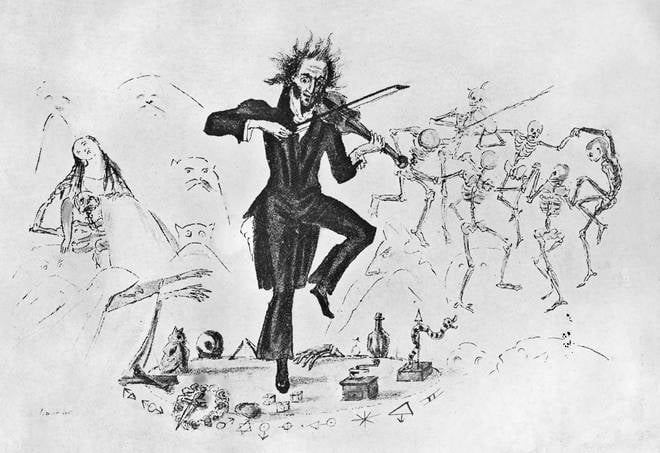
Combined with his uncanny abilities as a performer, his flamboyant lifestyle laid the foundation for the Paganini legend. It was said he once murdered a woman and used her intestines to string his violin, so that her imprisoned soul could be heard screaming as he played. Some claimed that sulfur could be smelled during his performances. Another swore that he saw the Devil standing beside him. Yet another, that he was the Devil himself. Paganini doppelgangers began to appear, bearing horns and hooves. Once, lightning struck the end of his bow as he played. Or so the stories went.
And if you saw Paganini, you’d probably believe it was all true. He was tall and thin, with hollow cheeks and pale skin, thin-lipped and adorned in black. His pallid hand, with unusually long, flashing fingers, raced hypnotically up and down the strings of his violin like an enormous, acrobatic spider. Its unusual span and uncanny flexibility have been attributed in modern times to genetic irregularities, Marfan’s syndrome and Ehlers-Danlos syndrome. Or perhaps he simply sold his soul to the devil.
Paganini’s skills on the violin were unparalleled. It’s said that he could play twelve notes per second. He performed without sheet music, contorted, and swung wildly about the stage. His outlandish mannerisms earned him the nickname “Rubber Man.”
Already sickly for most of his life, he contracted syphilis in 1822. This was treated with mercury, which led to further issues. In 1834, he contracted tuberculosis. He recovered, but retired from the stage later that year, at the age of 54. He spent his last years teaching.
Shortly before his death, of larynx cancer, at 57 in 1840, a priest arrived to administer last rites, but Paganini turned him away. It might have been because he was convinced he wasn’t going to die. Or it could have been because of… something else.
Paganini’s final tour was posthumous. When the Church refused to bury his body in consecrated ground, it was sent around Europe for the next four years, where it lay in state. When burial was still denied, it spent a year in a cellar. Then it was taken to a leper house. After that, it was moved to a cement vat in an olive factory. Then to a private house. Finally, Pope Gregory XVI allowed Paganini’s remains to be laid to rest in La Villetta Cemetery in Parma.
Niccolò Paganini was a Romantic icon, with a capital “R.” Hector Berlioz, himself no slouch in the seething Romantic department, wrote “Harold in Italy” so that Paganini could show off his new viola. Paganini didn’t think the solo part was flashy enough, and though he came eventually to admire the piece, he never actually played it. Even so, he continued to help Berlioz financially during his later years. He also became a good friend of Rossini.
Numerous other composers were inspired by Paganini’s own music. Liszt, another kindred spirit, who modeled his own concert persona after Paganini’s, wrote a set of “Paganini Etudes.” And how many composers have written sets of variations on Paganini’s famous 24th Caprice? Franz Lehár even wrote an operetta, highly fictionalized, about a romance between the virtuoso and Napoleon’s sister, Princess Anna Elisa.
Whether or not you believe the legends, Paganini sure could play like the Devil. Happy birthday, Niccolò Paganini, wherever you are!
Alexander Markov plays Paganini’s 24th Caprice
Arrau plays Liszt’s “Paganini Etude No. 6”
Liszt’s “Paganini Etudes,” complete
Rachmaninoff, “Rhapsody on a Theme of Paganini,” at the Proms, with Stephen Hough the soloist (the famous 18th Variation occurs 15 minutes in)
Brahms, “Variations on a Theme by Paganini,” played by Michelangeli