Not everyone with a stellar talent has had the privilege of having a “minor planet” named after them. But that’s precisely what happened to violinist Igor Oistrakh and his father, when Asteroid 42516 was dedicated to them in 1993.
While he never achieved quite the eminence of his old man – David Oistrakh, recognized as one of the greatest violinists of the 20th century – Igor carved out a respectable career for himself as a performer, a teacher, and a recording artist.
Of course, he also appeared as joint soloist in symphony concerts and in recitals of chamber music alongside his legendary father. The two made a specialty of Bach’s Double Concerto, which they recorded several times.
Igor taught at the Moscow Conservatory, and later in Brussels. With his wife, the pianist Natalia Zertsalova, he recorded the violin sonatas of Mozart, Beethoven, and Brahms.
Igor Oistrakh died on August 14 at the age of 90. The news was announced only today.
Igor Oistrakh and Natalia Zertsalova play Paganini:
Oistrakh, père et fils, play Sarasate:
Their recording, with orchestra:
The sublime middle movement of the Bach, captured in London in 1961:
In rehearsal:
The Oistrakhs and the Kogans play Vivaldi!
Igor plays the Beethoven concerto – with his father on the podium:
Today encompasses the anniversaries of the births of two of the greatest fiddlers who ever lived.
Fritz Kreisler, the sweet-toned confectioner and purveyor of violin bonbons, was born in Vienna on this date in 1875. Jascha Heifetz, the superhuman technician, who imbued perfection with tonal beauty, was born in Vilnius in 1901. Kreisler was warm, gregarious and easygoing. Heifetz acquired a reputation for a certain cool intensity.
At a point, Kreisler ruffled feathers, not with his playing, but because he casually let slip that many of the 18th century “rediscoveries” he had used to charm audiences, critics, and musicologists were not in fact rediscoveries at all. Nor did they date from the 18th century. Rather they were composed by Kreisler himself. When the professionals complained, Kreisler shrugged.
It would be futile to argue against his serious musical credentials. He gave the world premiere of the Elgar concerto and became a favorite recital partner of Sergei Rachmaninoff. A famous anecdote relates that Kreisler and Rachmaninoff were giving a concert in New York. In the middle of a performance, Kreisler suffered a memory lapse, and as he noodled around on his violin, trying to find his way back, he inched closer to his pianist. “Where are we?” Kreisler whispered. To which Rachmaninoff replied, “Carnegie Hall.”
In 1941, Kreisler was crossing the street, when he was hit by a milk truck. The accident fractured his skull and put him in a coma. Like something out of an early Woody Allen comedy, when he awoke, he could communicate only in Latin and Greek. Thankfully, the effect was only temporary.
Kreisler met Heifetz for the first time at a private press party in 1912. After listening to the boy play through the Mendelssohn concerto, he declared, “We can all just break our fiddles over our knees.” Arthur Nikisch, conductor of the Berlin Philharmonic, said he had never heard such an excellent violinist. The year before, Heifetz had played before a crowd of 25,000, and police had to be summoned to prevent the young virtuoso from being mobbed.
A little more collected was Groucho Marx. When Heifetz met Groucho, he mentioned that he had been earning his living as a violinist since the age of seven. Groucho responded, “Before that, I suppose, you were just a bum.”
Aside from his astounding accomplishments on the concert stage, Heifetz appeared as a mess hall jazz musician in Allied camps across Europe during the Second World War. Under a pseudonym, he wrote “When You Make Love to Me (Don’t Make Believe)” for Bing Crosby. In addition, Heifetz and Bing recorded the “Lullaby” from Benjamin Godard’s opera “Jocelyn.”
Heifetz was an advocate for certain socio-political and environmental causes. Decades before it was a thing, he had his Renault converted into an electric vehicle, and he lobbied for the acceptance of 911 as an emergency number.
Once, after a performance in Israel, he was attacked by a man wielding a crowbar for programming a violin sonata by Richard Strauss. Strauss had remained in Germany during World War II and maintained a fraught relationship with the Nazis. Heifetz, by the way, was Jewish.
Composers who wrote music for him, or whose music he premiered, include Mario Castelnuovo-Tedesco, Erich Wolfgang Korngold, and Sir William Walton. Heifetz commissioned Arnold Schoenberg’s Violin Concerto, but he never played it.
His standard of performance was stratospheric, and he subjected himself to a punishing, though strictly secret, regimen of self-discipline. He delivered until he felt he no longer could, retiring from the concert stage in 1972.
Itzhak Perlman reflected, “The goals he set still remain, and for violinists today, it’s rather depressing that they may never really be attained again.”
Here’s a French film about Heifetz. Interestingly, it opens with him playing one of Kreisler’s forgeries, the “Praeludium and Allegro in the Style of Pugnani”
Kreisler plays the “Meditation” from Massenet’s “Thaïs”
Kreisler plays the Mendelssohn concerto
Kreisler, master of the miniature
Two-part radio interview on the occasion of Kreisler’s 80th birthday, with spoken tributes from Elman, Menuhin, Milstein, Stern, Szigeti and others:
Footage of Heifetz performing Grigoras Dinicu’s “Hora Staccato.” The conductor is Donald Vorhees, longtime music director of the Allentown Symphony Orchestra in Allentown, PA.
Heifetz plays the first movement of the Tchaikovsky Violin Concerto in the 1947 film “Carnegie Hall.” That’s Fritz Reiner on the podium.
From back in the day when classical music was still popular entertainment, Heifetz playing Schubert and Mendelssohn in a short film, with Piatigorsky and Rubinstein. The three of them actually get to act (albeit badly).
Heifetz and Jack Benny
Heifetz and Bing Crosby with the “Lullaby” from Godard’s “Jocelyn”
Heifetz’s popular hit (as Jim Hoyle), sung by Bing
There are few superstars left in the world of classical music. Thankfully, Itzhak Perlman is still hale at 75. The bowing arm may not be what it used to be, but in his prime, he was one of the best. In particular, I always appreciated the warmth and commitment he brought to those composers of the so-called “second tier,” once championed by Heifetz. But I also love his Tchaikovsky concerto (particularly the first recording he made, with Alfred Wallenstein) and his Brahms sonatas (with Barenboim, even though the album with Ashkenazy seems to get all the raves). Happy birthday, Itzhak Perlman!
Brahms’ Violin Sonata No. 1
Perlman’s first recording of the Tchaikovsky Concerto
Mario Castelnuovo-Tedesco’s Violin Concerto No. 2 “The Prophets”
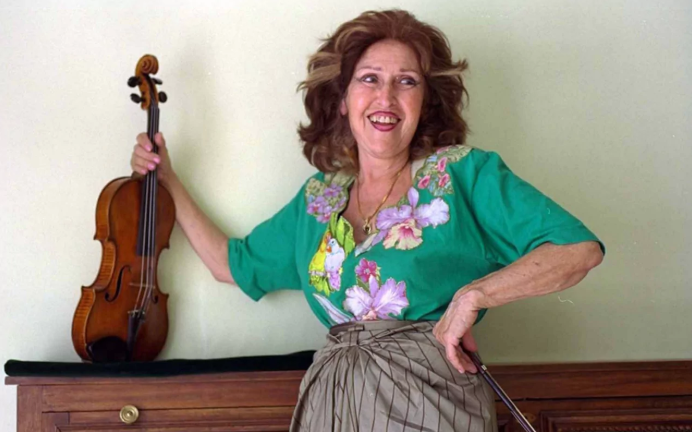
Haendel was born in Chelm, Poland, roughly a decade before the Nazi death marches and extermination camps began depleting most of its population of 18,000 Jews. It is no exaggeration to speculate that her gifts as a musician, and where they took her, saved her life and the lives of her immediate family.
To describe Haendel as a prodigy is an understatement. She won the Warsaw Conservatory’s Gold Medal and first Huberman Prize in 1933, at the age of five, for her performance of the Beethoven Violin Concerto. At seven, she was competing against David Oistrakh and Ginette Neveu, about twenty years her senior, to become a laureate of the first Henryk Wieniawski Violin Competition. Soon, she was studying in London and Paris with legendary pedagogues Carl Flesch and George Enescu.
During WWII she employed her talent to help boost the morale of British and American troops and factory workers. In 1937, she made her first appearance at the Proms. She went on to perform at the Proms no less than 68 times.
Internationally, she played with many of the great conductors, drawing particular acclaim for a recording of the Sibelius Concerto. Sibelius personally wrote her to say, “I congratulate you on the great success, but most of all I congratulate myself, that my concerto has found an interpreter of your rare standard.” In all, her recordings span some 70 years.
In 2006, she played before Pope Benedict XVI at the former concentration camp of Auschwitz-Birkenau. The organizers suggested that she play something Jewish. Instead, she chose Handel’s prayer from the “Dettingen Te Deum.” The work was arranged by her teacher, Carl Flesch.
Haendel was extremely fortunate in that her talent allowed her to escape the fate of so many of her townspeople. Her precise age at the time of her death, yesterday, in Miami, is unclear, since she had in her possession several different birth certificates, but the consensus seems to be that she was 91.
R.I.P.
Haendel plays Sibelius
Haendel plays Allan Pettersson’s Violin Concerto No. 2, a work written for and dedicated to her: