
Afro-British composer Samuel Coleridge-Taylor (1875-1912) achieved much in his comparatively short life, attracting the attention and advocacy of Sir Charles Villiers Stanford, Sir Edward Elgar, and Sir Malcolm Sargent.
His cantata “Hiawatha’s Wedding Feast” became a cultural phenomenon between the wars. Sargent conducted the piece annually, from 1928 to 1939, in a costumed, semi-ballet version, featuring close to a thousand performers. Unfortunately, this was among the works the composer had sold outright, his heirs thereby missing out on the royalties. By the time of Sargent’s advocacy, the short-lived Coleridge-Taylor had already been dead for 16 years.
This week on “The Lost Chord,” we’ll hear selections from a complete recording of “Scenes from ‘The Song of Hiawatha,’” one of the earliest to feature rising star Bryn Terfel, released on the Argo label back in 1991. We’ll also hear Sargent’s 1932 recording of Coleridge-Taylor’s “Othello Suite.” The hour will conclude with one of the composer’s musical explorations of his African heritage, the “Symphonic Variations on an African Air,” in a performance conducted by Grant Llewellyn, released on Argo in 1993.
I hope you’ll join me for “Taylor-Made,” music of Samuel Coleridge-Taylor, on “The Lost Chord,” now in syndication on KWAX, the radio station of the University of Oregon!
——–
Clip and save the start times for all three of my recorded shows:
PICTURE PERFECT, the movie music show – Friday at 8:00 PM EST/5:00 PM PST
SWEETNESS AND LIGHT, the light music program – Saturday at 11:00 AM EST/8:00 AM PST
THE LOST CHORD, unusual and neglected rep – Saturday at 7:00 PM EST/4:00 PM PST
Stream them, wherever you are, at the link!
https://kwax.uoregon.edu
Category: The Lost Chord
-

Louisiana Purchases on “The Lost Chord”
It’s Mardi Gras season! This week on “The Lost Chord,” we’ll adorn ourselves in purple, gold, and green, and carve ourselves some King Cake, as we listen to music from and about New Orleans.
Henry F. Gilbert, a slightly older contemporary of Charles Ives, and a composer of the New England School, was concerned with introducing folk song and the vernacular to the concert hall. His interest in the music of African Americans, then considered controversial, is reflected in works like “The Dance in Place Congo,” from 1908, a programmatic piece on Creole themes, suggestive of Sunday afternoon festivities of off-duty New Orleans slaves gathered in Congo Square.
We’ll also hear a piece by Chicago area composer Edward Joseph Collins, actually titled “Mardi Gras,” from 1923. Collins described the work as “boisterous and bizarre by turns,” evocative of the spirit of Carnival, with its enormous masks and clowns on stilts, colored streamers, confetti, lurid lights, fantastic floats and grotesque costumes.
Three Creole Romantics will offer some insiders’ views, as we hear works by Edmond Dédé, Charles Lucièn Lambert, and Louis Moreau Gottschalk, all figures born in New Orleans.
Laissez les bons temps rouler! I hope you’ll join me for “Louisiana Purchases,” on “The Lost Chord,” now in syndication on KWAX Classical Oregon!
——–
Clip and save the start times for all three of my recorded shows:
PICTURE PERFECT, the movie music show – Friday at 8:00 PM EST/5:00 PM PST
SWEETNESS AND LIGHT, the light music program – Saturday at 11:00 AM EST/8:00 AM PST
THE LOST CHORD, unusual and neglected rep – Saturday at 7:00 PM EST/4:00 PM PST
Stream them, wherever you are, at the link!
https://kwax.uoregon.edu -
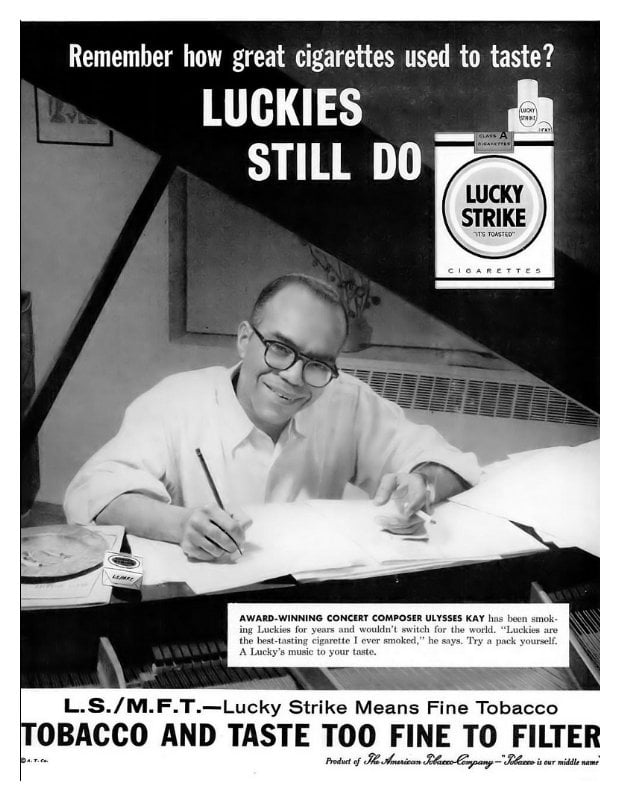
Giving Kay His Say on “The Lost Chord”
The time is ripe for the return of Ulysses.
In determining his life’s course, Ulysses Kay (1917-1995), received encouragement from his uncle, King Oliver, and William Grant Still. Among his teachers were Howard Hanson, Paul Hindemith, and Otto Luening. He also attended the American Academy in Rome.
A longtime resident of Teaneck, NJ, he composed music in all genres. This week on “The Lost Chord,” we’ll sample “Tromba” for trumpet and piano, his Concerto for Orchestra, a suite from the semi-documentary “The Quiet One,” and “Six Dances for String Orchestra.”
I hope you’ll join me for “Giving Kay His Say.” Ulysses strings his bow, on “The Lost Chord,” now in syndication on KWAX Classical Oregon!
———-
An interview with Kay conducted by Bruce Duffie:
http://www.bruceduffie.com/kay.html
———-
PHOTO: Kay gets Lucky! -
Music of the Spheres on “The Lost Chord”
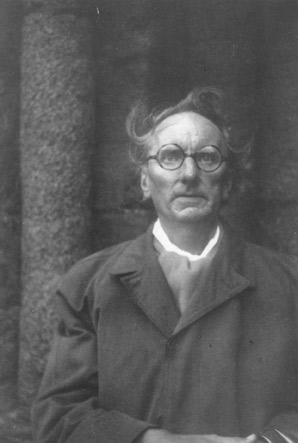
Even by composer standards, Rued Langgaard (1893-1952) was a little bit of a strange bird. Despite a promising start – born to musical parents, a precocious childhood, meetings with major conductors, and a symphony performed by the Berlin Philharmonic – his personal and creative eccentricities worked against him.
Langgaard followed his personal muse deep into the realm of late Romanticism at a time when most of the musical world was exploring modernist territory. Though he was given a state grant at 30, he failed to secure a permanent job until the age of 46, as an organist at the cathedral in Ribe, the oldest town in Denmark – which somehow seems appropriate for this most anachronistic of Danish outsiders.
An eccentric, shabby figure with wild hair, Laangaard died in Ribe 13 years later, in 1952, just shy of his 59th birthday, still largely unrecognized as a composer.
His reputation would not begin to gain traction for another 16 years. In all, he composed over 400 works, including 16 symphonies – which bear evocative titles such as “Yon Hall of Thunder” and “Deluge of the Sun” – and an opera, “Antikrist.”
It was in 1968 that no less a personage than György Ligeti found himself on a jury alongside Danish composer Per Nørgård. In this capacity, he examined a large number of new scores by Scandinavian composers. Unbeknownst to his fellow jurors, Nørgård had slipped in the score of Langgaard’s “Music of the Spheres.” Ligeti became captivated by what he found. When the ruse was revealed, he exclaimed, with a twinkle in his eye, “Gentlemen, I have just discovered that I am a Langgaard epigone!”
Langgaard had anticipated some of the technical aspects – tone clusters, layers, and so forth – which would appear in Ligeti’s avant garde experiments of the 1960s, in works such as “Atmosphères.”
I hope you’ll join me for “Rued Awakenings,” an hour of Rued Langgaard, including “Music of the Spheres,” on “The Lost Chord,” now in syndication on KWAX Classical Oregon!
——–
Clip and save the start times for all three of my recorded shows:
PICTURE PERFECT, the movie music show – Friday at 8:00 PM EST/5:00 PM PST
SWEETNESS AND LIGHT, the light music program – Saturday at 11:00 AM EST/8:00 AM PST
THE LOST CHORD, unusual and neglected rep – Saturday at 7:00 PM EST/4:00 PM PST
Stream them, wherever you are, at the link!
https://kwax.uoregon.edu -
Liking the Viking on “The Lost Chord”
This week on “The Lost Chord,” brace yourself for Icelandic composer Jon Leif’s “Saga Symphony.” Scored for tuned anvils, stones, whip, shields of iron, leather, and wood, great wooden casks played by large hammers, and six ancient long horns, or lurs, the work is an intriguing blend of extravagance and austerity.
Leifs studied in Leipzig and wound up stranded in Nazi Germany for much of World War II. You’d think the National Socialists would have gone ape for this musical advocate of Norse heroism, but two things worked against him: the modernist language of much of his output, and the fact that his wife and children were Jewish. Also, he found Wagner repellent, asserting that Wagner completely misunderstood the essence and artistic tradition of the North. Public performances of Leif’s works were discouraged (and would have been impractical anyway). Under the circumstances, he preferred to attract as little attention to himself as possible. He found escape in rereading the Icelandic sagas, even as he was used for propaganda purposes to strengthen Germany’s relations with Scandinavia.
Leifs finally managed to obtain permission to leave Germany in 1944. Unfortunately, suspicion of Nazi associations further hindered acceptance of his music abroad. It was only with a series of compact disc recordings released on the Swedish label BIS, beginning in the 1990s, that Leifs – who died in 1968 – was revealed to be Iceland’s most important composer, with a voice as distinctive as any of his time.
Iceland of a hundred years ago was a very different place than it is now. Leifs didn’t hear his first orchestra until he traveled to Leipzig. The “Saga Symphony” is a direct response to Franz Liszt’s “A Faust Symphony,” a performance of which sent the young composer into ecstasies. He went home and immediately began work on the piece we’ll hear tonight. However, his own approach is quite different from Liszt’s. In terms of symphonic development, there is none to speak of. In its place are evocative fields of static harmonies.
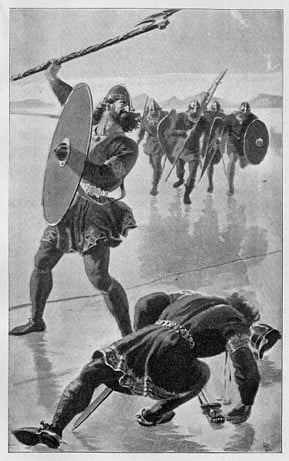
Each of the work’s five movements is a character portrait of a hero from the Norse sagas: the vitriolic warrior Skarphéðinn Njálsson (Njál’s Saga), who hacks and hews with his battle axe; the strong-willed Guðrún Ósvífsdóttir (Saga of the Laxardals), who avenges herself against her husband’s killer; the latently heroic comic braggart and coward Björn of Mörk, who takes shelter behind the swashbuckler Kári Sölmundarson, as Kári avenges the deaths of Njál and his sons; Grettir Ásmundarson, who vanquishes the ghost of Glámr in a wrestling match, only to be haunted ever after; and the warrior-poet Tormod Kolbrunarskald (The Foster Brother’s Saga), who pulls an arrow from his heart and even in the throes of death formulates an intricate poem.
Greet your fate with courage and stoicism. Join me for “Liking the Viking,” on “The Lost Chord,” now in syndication on KWAX Classical Oregon!
——–
Clip and save the start times for all three of my recorded shows:
PICTURE PERFECT, the movie music show – Friday at 8:00 PM EST/5:00 PM PST
SWEETNESS AND LIGHT, the light music program – Saturday at 11:00 AM EST/8:00 AM PST
THE LOST CHORD, unusual and neglected rep – Saturday at 7:00 PM EST/4:00 PM PST
Stream them, wherever you are, at the link!
https://kwax.uoregon.edu
Tag Cloud
Aaron Copland (92) Beethoven (94) Composer (114) Film Music (116) Film Score (143) Film Scores (255) Halloween (94) John Williams (185) KWAX (228) Leonard Bernstein (99) Marlboro Music Festival (125) Movie Music (131) Opera (197) Philadelphia Orchestra (86) Picture Perfect (174) Princeton Symphony Orchestra (106) Radio (86) Ralph Vaughan Williams (85) Ross Amico (244) Roy's Tie-Dye Sci-Fi Corner (290) The Classical Network (101) The Lost Chord (268) Vaughan Williams (99) WPRB (396) WWFM (881)