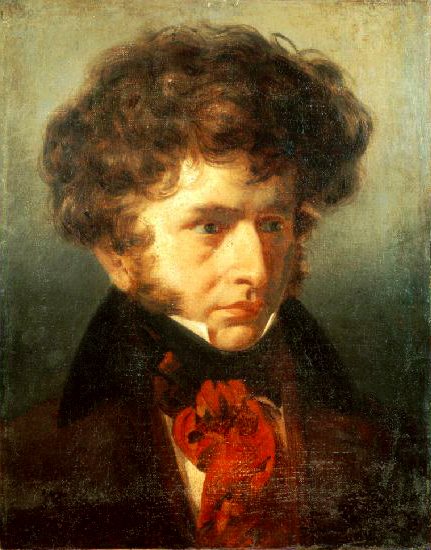
Hector Berlioz was a man easily swept away by his passions.
When denied by the object of his affection, the Shakespearean actress Harriet Smithson, he furiously scribbled his “Symphonie fantastique,” an opium-induced fever dream that imagines his own execution for murdering her. She then reappears during the course of a witches’ sabbath to mock his corpse. Perhaps counterintuitively, Smithson went for this in a big way, and the two were married, though, perhaps unsurprisingly, not at all happily.
Berlioz’s biography is full of crazy adventures . Whether in regard to his affairs of the heart, his musical education, or his notorious compositions, always he was driven by mercurial passions and excesses.
He lived large, and he dreamed big music. One need only think of his Requiem, with its massive choir, antiphonal brass ensembles, and 16 timpani. The composer even suggested the orchestration could be doubled or tripled, depending on the size of the space. (However, in an uncharacteristic show of restraint, he recommended the chorus be kept to only 400 singers, except for some of the larger numbers.)
Today is Berlioz’s birthday. It also happens to be the Christmas season, so naturally my thoughts gravitate to “L’enfance du Christ” – which, I must say, is not my favorite Berlioz work. Fortunately, he also composed a “Messe solennelle” in 1824, on virtually the same subject – the commemoration of the Feast of the Slaughter of the Holy Innocents by King Herod in his attempt to the snare the baby Jesus.
Berlioz was only 20 years-old at the time, but he was already driven by his creative demons. If you are a fan of the composer, you must hear this piece, which teems with presentiments of many of his major works, including the “Symphonie fantastique,” “The Damnation of Faust,” “Benvenuto Cellini” (with its “Roman Carnival Overture”), and of course the Requiem.
Berlioz himself played the tam-tam at the work’s premiere, and in his excitement gave it such a blow that it blew everyone back in their pews. The “Messe” was favorably received (unusual for this composer), but Berlioz decided he hated the piece and wound up burning the score.
The work was believed lost for nearly 170 years, until it was rediscovered by a Belgian schoolteacher in an organ gallery in Antwerp in 1991. Sir John Eliot Gardiner conducted the first modern performance two years later, and directs the live recording we will hear this afternoon.
I’ll preface that with a knock-out recording of the “Symphony fantastique,” led by the Argentinean powder keg Carlos Païta.
First, today’s Noontime Concert will feature the Dolce Suono Ensemble. Artistic director and flutist Mimi Stillman will join David Osenberg for “Music in the Second Capital,” which explores the musical tastes of the Founding Fathers and Philadelphia musical culture in the last quarter of the 18th century. Featured composers will include Wolfgang Amadeus Mozart, Franz Joseph Haydn, Johann Christian Bach, Arcangelo Corelli, Antonio Vivaldi, and Francis Hopkinson. That begins at 12:00 EST.
I’ll be along following the concert, around 1:40. Our celebration of Berlioz begins at 2:00. The passionate seething will continue unabated until 4:00, on WWFM – The Classical Network and wwfm.org.
Leave a Reply to กำจัดปลวกชลบุรีCancel reply