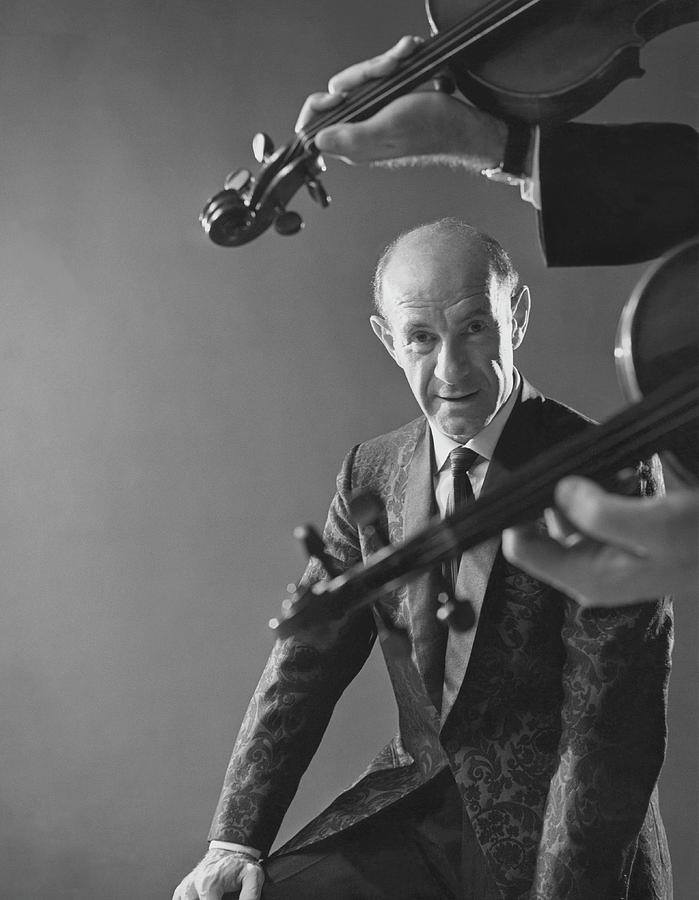
It was recently brought to my attention that we have Lyndon Johnson to thank for Erich Leinsdorf.
In 1938, Leinsdorf was 26 years-old and conducting at the Metropolitan Opera, when his visa expired. This was very bad timing indeed. Of course, Leinsdorf had been working hard to build a career in New York. But to really put things in perspective, the Anschluss had just taken place in March. For Leinsdorf, an Austrian Jew, to travel back to Vienna would have been the beginning of the end.
He immediately applied for a six month extension, but grew increasingly uneasy as he received no response. Fortunately, a couple of American friends with good connections were able to hook him up with Johnson, who was then but a young congressman of 30 himself. It was Johnson’s idea to have Leinsdorf leave the country but to reenter through Cuba as an immigrant. He did everything to smooth his path. Leinsdorf followed Johnson’s instructions and before long he was back in the U.S. to declare his intention to become a citizen.
The two men remained friendly for decades. Leinsdorf even supported Johnson’s run for the Senate. Later, however, when he disagreed with some of Johnson’s policies, he didn’t hesitate to let him know. The following was Johnson’s response to Leinsdorf’s criticisms: “Your letter makes me proud that I could have a hand in making a new citizen, who would so well use his citizenship.” Would that this story could play out that way today!
Leinsdorf may have had the good fortune to escape Hitler, but in 1962 he had the bad luck to land one of the most prominent conducting posts in the United States – music director of the Boston Symphony Orchestra – in the wake of the great Charles Munch. Not only was Leinsdorf unprepared to handle the politics of the organization – in a ceaseless battle against musicians and administration, his outspokenness didn’t earn him many friends – he also came in for a sound drubbing from the critical establishment, which found many of his performances to be just meh.
As someone who saw Leinsdorf conduct often in Philadelphia during his twilight years, I couldn’t disagree more. As a guest conductor, Leinsdorf brought plenty of interesting music and assembled it into satisfying programs. What’s more, unburdened by the pressures of being boss, he turned in some pretty good performances and actually seemed to enjoy himself.
This afternoon, I’ll celebrate Leinsdorf on the anniversary of his birth with some of his better recordings, which I’ll shuffle into the mix between 4 and 7 p.m. EST, on WWFM – The Classical Network and wwfm.org.
On November 22, 1963, Leinsdorf found himself in the unenviable position of breaking the news of President Kennedy’s assassination from the stage of Boston’s Symphony Hall and over WGBH radio. He then conducted the funeral march from Beethoven’s “Eroica” Symphony in JFK’s honor. It’s especially moving to hear the audience’s reaction in those days before cell phones. Remember also that the musicians were in the process of digesting the news themselves, as the replacement scores had only just been distributed.
Leave a Reply to altogelCancel reply