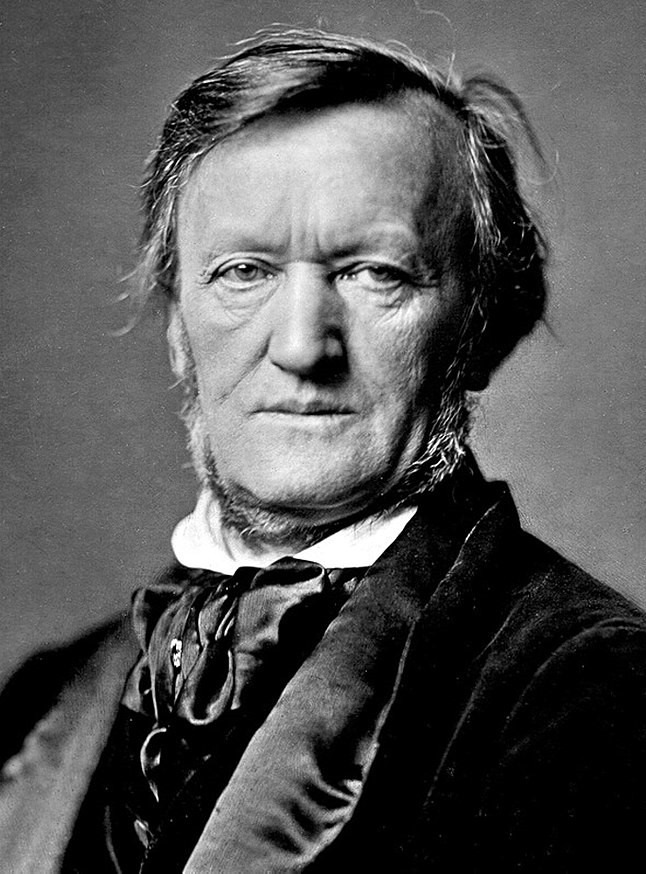
“The most tremendous genius raised Mozart above all masters, in all centuries and in all the arts.”
– Richard Wagner
So glad to hear you say that, Richie. Then you won’t mind if we enjoy an all-Mozart hour for your birthday, on this week’s “Music from Marlboro.”*
Mozart doubles the violas in his String Quintet No. 5 in D Major, K. 593. Composed in 1790, the work was recollected by the composer’s widow, Constanze, as having been written for a musical amateur, often speculated to be Johann Trost. Trost must have been quite the gifted dilettante. He also knew Haydn from Esterhaza, and Haydn dedicated some of his quartets to him.
When Haydn and Mozart played through the D Major Quintet together before Haydn’s first visit to London, the two men took turns indulging in the first viola part. The work was known for centuries as the “Zigzag” because of an alteration to the original manuscript that modified what had been a descending chromatic figure in the final movement into something decidedly more humorous.
We’ll hear it played at the 2005 Marlboro Music Festival by Sarah Kapustin and Diana Cohen, violins; Mark Holloway and Sebastian Krunnies, violas; and David Soyer, cello.
Mozart wrote his Symphony No. 35 in 1782. Subtitled the “Haffner,” it is not to be confused with his “Haffner Serenade,” though both works had their origins in commissions from the eminent Haffner family of Salzburg.
The “Serenade” was composed in 1776 to celebrate the wedding of Marie Elisabeth Haffner. A second serenade was written four years later for her brother, Mozart’s friend, Sigmund Haffner the Younger, for the occasion of his ennoblement. Mozart complained to his father at the time that he was “up to his eyeballs in work.” On top of his usual teaching obligations, he was pressed to complete an arrangement of his opera “The Abduction from the Seraglio,” even as he was looking to move into a house in Vienna prior to his marriage to Constanze Weber. Nevertheless, he began churning out music, sending it piecemeal to his father.
It was only later, when Mozart found a moment of calm, that he was able to take a look at what he had actually written and realized that it wasn’t half bad. He arranged material from this second “Haffner” serenade and expanded the orchestration to create what we now know as the “Haffner” Symphony – his Symphony No. 35 – in 1783.
We’ll hear an inspired performance of the work, featuring an ad hoc orchestra under the direction of Pablo Casals. Together, they manage to convey joy, intimacy, and exuberance in a cherishable recording from the 1967 Marlboro Music Festival.
Get the most from Mozart, on the next “Music from Marlboro,” this Wednesday evening at 6:00 EDT, on WWFM – The Classical Network and wwfm.org.
Marlboro School of Music and Festival: Official Page
(*For all you Wagnerites, tune in a little early to enjoy some of HIS music between 4 and 6!)
Leave a Reply