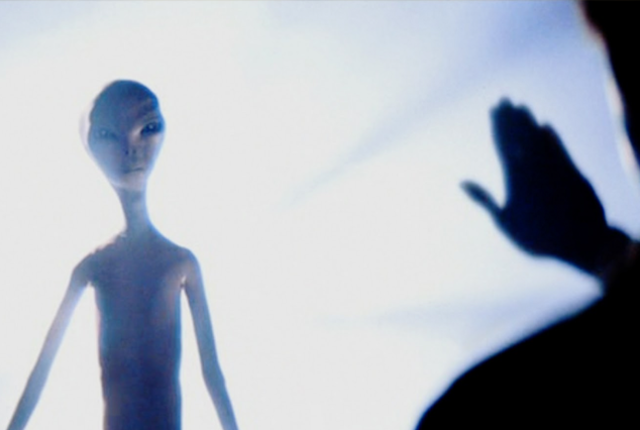
Is “Close Encounters of the Third Kind” the most musical non-musical blockbuster ever made?
I don’t know at what point I recognized Zoltán Kodály’s contribution to “CE3K.” It was certainly not as an 11-year-old boy, which is how old I was at the time I was first spooked and awed by Steven Spielberg’s UFO masterpiece. But somewhere along the way, Kodály took on more significance than simply an exotic-looking name on a chart.
In addition to being one of Hungary’s most respected composers – with his friend, Béla Bartók, at the forefront of the whole Hungarian nationalist movement – Kodály was extremely influential in the field of music education. The hand signals employed by François Truffaut’s Claude Lacombe, when he addresses a conference of UFO scientists and researchers, correspond to specific musical tones. The signals are an integral part of the Kodály method, and they contribute to the film’s memorable climax. Millions who have never heard of Kodály outside the context of “CE3K” will be familiar with the five-signal sequence.
Of course, music imbues just about every aspect of Spielberg’s storytelling. Composer John Williams went through over 300 permutations of the five-notes-to-a-theme before arriving at the now-iconic motive that ties the whole film together. There was no “aha! moment.” It was only after Spielberg learned there were over 130,000 possibilities that they just settled on a sequence they thought would be effective. A significant portion of the score for the last half hour of “CE3K” would be recorded in advance of the actual filming. It’s a rare luxury for composers to have a film cut to their music, as opposed to the other way around, but this is what was done, necessarily, for the film’s climactic encounter.
At the time, Williams’ “CE3K” theme was widely parodied and likely as well recognized as his theme for “Jaws.” His score would be nominated for an Academy Award in 1978. He actually wound up losing to himself, for “Star Wars.” A banner year for John Williams!
Interestingly, the composer tailored a cello solo specifically for Eleanor Aller Slatkin, formerly of the legendary Hollywood String Quartet. Aller was the widow of violinist Felix Slatkin and the mother of conductor Leonard Slatkin. She had been active in Hollywood since the 1940s, introducing Erich Wolfgang Korngold’s Cello Concerto in the film “Deception,” with Bette Davis and Claude Rains. Paul Henreid “played” the concerto onscreen.
French pianist and educator Odette Gartenlaub, a Messiaen pupil and solfège authority who taught at the Paris Conservatory, has a cameo during the climactic extraterrestrial communication scene.
And of course, “When You Wish Upon a Star” is heard on a music box early in the narrative, only to be picked up in Williams’ underscore during the film’s apotheosis. Spielberg said that he relied on the spirit of the song as a kind of guide for the overall feeling he wanted “CE3K” to convey.
“Close Encounters” is a work of great humanity, wonder and hope. Is it any wonder that music would play such an important role? In a story in which so many of the human characters experience frustration in their spoken interactions, running up against all kinds of barriers to effective communication, the key to universal understanding turns out to be music. It is one of the most satisfying and uplifting movies about music ever made. Unusually, it also seems to get everything right.
There were many experienced hands involved in the writing of the film, but in the end it was Spielberg who received the sole screen credit. Somebody really knew their music. I wonder who directed Spielberg to Kodály?
For further reflections on “CE3K,” join Roy Bjellquist and me – with a special appearance by my brilliant cousin, Joseph R. Metz – on the next “Roy’s Tie-Dye Sci-Fi Corner,” to be live-streamed on Facebook this Friday evening at 7:00 EDT.
https://www.facebook.com/roystiedyescificorner
More about the Kodály Method here (with hand signals):
And an interview with Kodály, in English!
Leave a Reply to หวยลาว lsm99Cancel reply