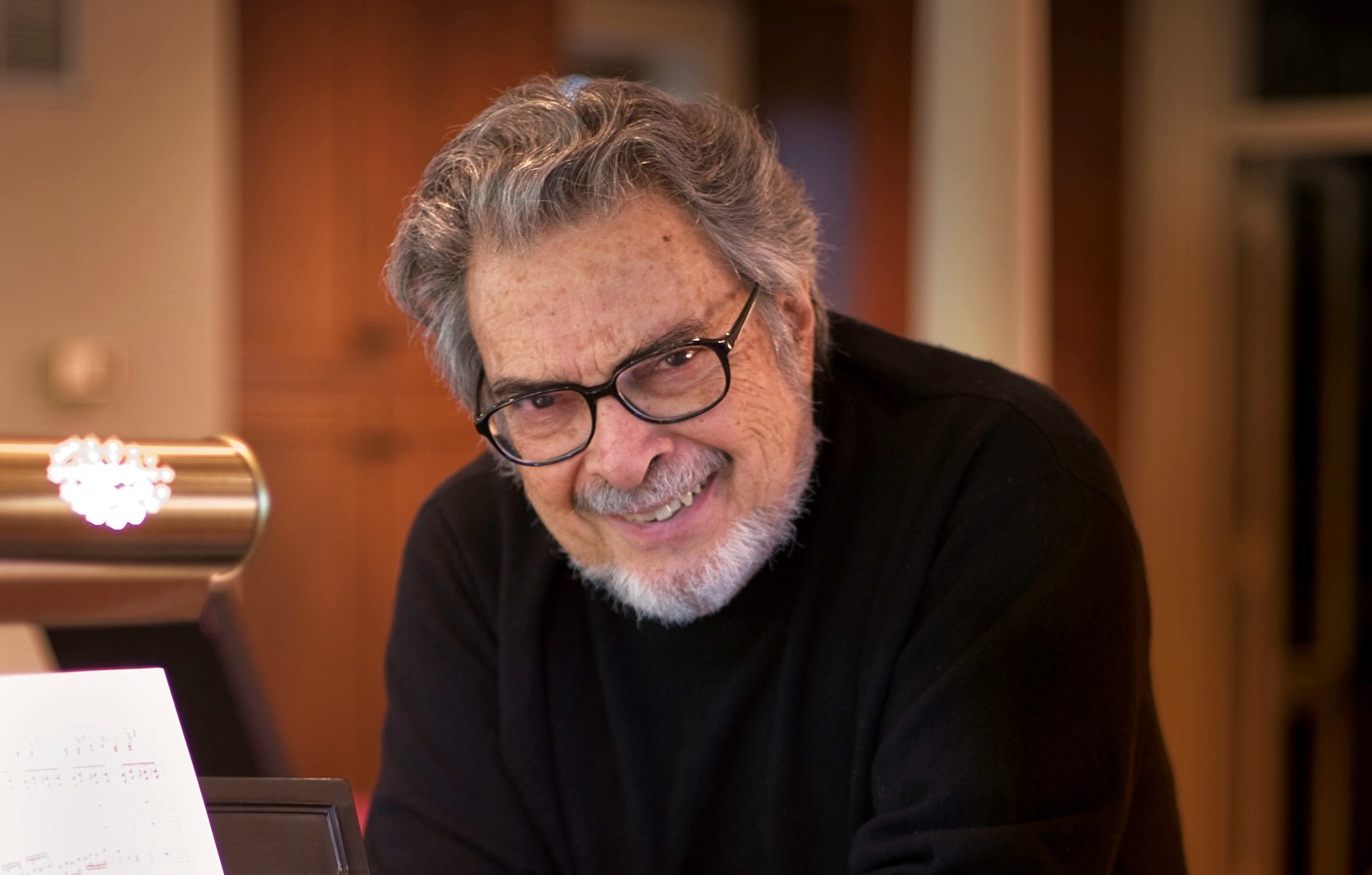
The word legend gets bandied a lot at times like these, but rarely has it been so completely deserved. Leon Fleisher has died at 92. He leaves us not only as one of the greatest pianists of his time, but also as one of the greatest all-around artists. The man exuded music, and he did so with genuine humility and unusual generosity.
Fleisher’s career as an interpreter of the standard, two-handed repertoire may have been cut short by focal dystonia at the age of 37 – by the mid-1960s, it had caused two of his fingers on his right hand to curl into his palm – but already he had distinguished himself as a lion of the keyboard. His prowess as a young man is preserved in benchmark recordings of works by Brahms, Beethoven, Rachmaninoff, and others.
But even with his dexterity diminished, Fleisher’s intelligence remained unimpaired. His recordings of music for the left hand alone, again, are some of the finest in existence. By the late ‘60s, he also turned to conducting – he became associate conductor of the Baltimore Symphony Orchestra and music director in Annapolis – but it was his generous spirit as a teacher that perhaps best reflected the man. Fleisher taught at the Peabody Institute since 1959. He also had ties to the Curtis Institute, the Royal Conservatory of Music in Toronto, and the Tanglewood Music Center, and he oversaw countless master classes.
He himself had been a pupil of Artur Schnabel, who had been a student of Theodor Leschetizky, who in turn had studied with Carl Czerny, who had learned directly from Beethoven. And Fleisher gave as good as he got. His benign influence sent off tendrils that now circle the globe. In his life’s work, Fleisher realized Schnabel’s maxim, that music came first, piano second.
As a performer, whenever Fleisher came near a piano in the middle of his career, it was to champion music for the left hand. Fortunately, the repertoire is substantial, and Fleisher added to it, as composers flocked to write new pieces for him.
Then, three decades after he was forced to give it up, suddenly he resumed performance of the two-handed repertoire, to an extent, thanks to Botox injections. He went on to record several more acclaimed albums, of both left-hand and two-handed works, later in life.
I had the privilege to hear him perform several times, including at the East Coast premiere of Paul Hindemith’s “Piano Music with Orchestra” at Philadelphia’s Kimmel Center for the Performing Arts. The work was written for Paul Wittgenstein, of Ravel concerto fame, who had lost his right arm during the First World War. Wittgenstein, who had somewhat conservative tastes, never played Hindemith’s concerto publicly, but it remained in his possession and was rediscovered, among his widow’s belongings, in a Pennsylvania farm house only in 2002! Fleisher gave the world premiere of the work, with the Berlin Philharmonic, in 2004.
Our delayed face-to-face meeting occurred several years after we had chatted by telephone. An earlier attempt had been thwarted by illness, but we finally got to shake hands and say hello following a recital at the Kimmel’s Perleman Theater. For a figure of his stature, you couldn’t have found a humbler, nicer man. At the time of our earlier interview, in 1987, when I called at the appointed hour, Fleisher – the legend – was only just driving home from work at Peabody, and he couldn’t have been more apologetic. The man who had studied with Schnabel, who at 16 was proclaimed by Pierre Monteux “the pianistic find of the century,” the artist who fearlessly collaborated with George Szell in some of the most revered music in the entire repertoire, was sorry to be late for our interview. Clearly, he was a person who put on no airs.
But judge for yourself. Here’s the raw audio of that interview, which came to pass about a half hour later. The occasion was the release of his new album of left-hand piano works, “All the Things You Are,” on the Bridge Records, Inc., that remains one of the finest of his later years. Keep in mind that the conversation would be edited into sequence for use, with musical interludes, on my Sunday night program, “The Lost Chord.”
Needless to say, I am very sorry to be cut off by COVID-19 from access to WWFM – The Classical Network’s production studios, or I would re-edit this material for a posthumous tribute.
Leon Fleisher was one of the most genuine people I ever met, totally without pretense – a great artist, yes, but also a gracious and lovely man.
Fleisher plays Beethoven with Szell and the Cleveland Orchestra:
Erich Wolfgang Korngold, “Suite for 2 Violins, Cello, and Piano Left-Hand;” the fourth movement “Lied,” about 25 minutes in, must be one of the loveliest things I’ve ever heard:
The West Coast premiere of Hindemith’s “Klaviermusik mit Orchester” (for piano left-hand):
Brahms’ left-hand arrangement of the Bach “Chaconne”:
PHOTOS (counterclockwise from top): Leon Fleisher; with Artur Schnabel; with George Szell; and with Classic Ross Amico
Leave a Reply to 1winprilozhenie.online/Cancel reply