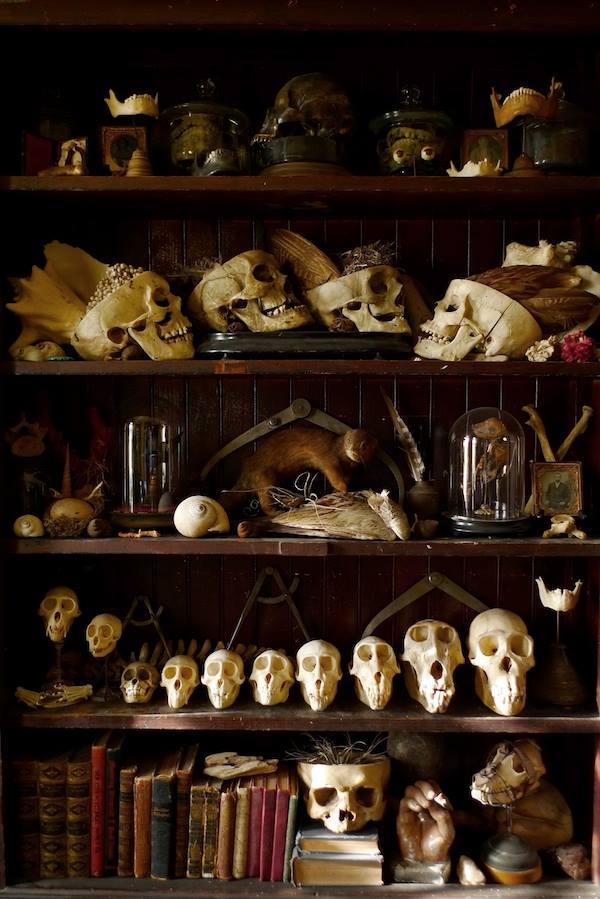
Cabinets of curiosities, also sometimes referred to as “wonder rooms,” were small collections of extraordinary objects, strange and often fanciful precursors of today’s museums, which attempted to categorize and explain oddities of the natural world. This Sunday night on “The Lost Chord,” we’ll have three examples of musical equivalents.
Princeton University professor Dmitri Tymoczko’s “Typecase Treasury” recalls a small table his parents acquired, made from a typecase subdivided into a hundred little compartments. “Each had been filled with a tiny mineralogical curiosity,” he writes, “a strange crystal, a piece of iron pyrite, a shark’s tooth, or a fossilized tribolyte.” He found it a useful metaphor for a multi-movement collection of short pieces, in which he attempts to produce “a sense of form through juxtaposition.”
Grammy Award-winner Michael Colina is perhaps best known for his jazz and Latin projects. However, Colina was classically trained, having studied at the North Carolina School of the Arts, and then abroad, at the Chigiana Academy, in Sienna, Italy. We’ll hear his Violin Concerto, subtitled “Three Cabinets of Wonder,” a work inspired by Fanny Mendelssohn, the Buddha, and an Amazonian nature spirit.
Finally, we’ll sample just a bit from “Cabinet of Curiosities” by Philadelphia-based composer Robert Moran, who’s something of a wonder himself. “The Hapsburg Kunstkammer” employs graphic notation and is scored for marimba, hairbrush, aluminum foil, bells played with fingers, finger cymbals, telephone bell, vibraphone, rubber ball, celesta and harpsichord.
I hope you’ll join me for “Curiouser and Curiouser,” a tour of musical wonder cabinets, this Sunday night at 10:00 EST, on WWFM – The Classical Network and wwfm.org.
More about cabinets of curiosities here:
Leave a Reply