Category: Daily Dispatch

  • Rosh Hashanah Music for the High Holy Days

    Rosh Hashanah Music for the High Holy Days

    L’shanah tovah! A little before the fact, maybe, but Rosh Hashanah, the Jewish New Year, begins at sunset.

    This Sunday night on “The Lost Chord,” we mark the High Holy Days, which encompass the observance of Rosh Hashanah and Yom Kippur – the Day of Atonement – with two complementary works.

    Jacob Weinberg’s String Quartet, Op. 55, of 1950, falls into three movements: “Rosh Hashana,” “Yom Kippur” and “Sukkot.” “Yom Kippur” is based on the familiar melody of the cantorial chant “Kol Nidre.” (You know, the one used by Max Bruch.)

    Ernest Bloch’s “Israel Symphony,” composed between 1912 and 1917, is more like an orchestral rhapsody, with its three sections – “Prayer in the Desert,” “Yom Kippur” and “Succoth” – played continuously and capped by parts for vocal soloists.

    Sukkot, which begins shortly after Yom Kippur, is the harvest festival which commemorates the period following the Exodus, when the Jews erected temporary dwellings, or sukkot, during their wanderings in the desert.

    The High Holy Days are a time of reflection, ten days of awe and repentance. I hope you’ll join me for “Totally Awesome,” tonight at 10 ET, with a repeat Wednesday evening at 6; or that you’ll listen to it later as a webcast at wwfm.org.
  • Schoenberg’s Jewish Journey Birthday Tribute

    Schoenberg’s Jewish Journey Birthday Tribute

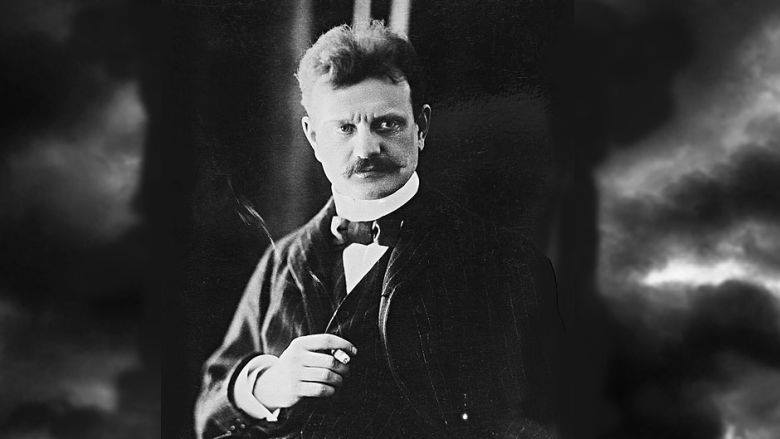
    Today is the birthday of dodecaphonic icon Arnold Schoenberg (1874-1951). Schoenberg, who was born Jewish, converted to Protestant Christianity in 1898 – not, as might be assumed, for professional reasons or in an attempt to assimilate, but because of a nagging spiritual hunger.

    He formally converted back to Judaism in defiance of the National Socialists, who came to power in 1933. He was on vacation in France, when he was warned that it would dangerous for him to return to Germany. He reclaimed membership in the Jewish faith in a Paris synagogue. Schoenberg was summarily denounced by the Nazis as a Jew and an exponent of degenerate art. He was dismissed from his post at the Prussian Academy of Letters, where he had taught since 1925.

    Unbowed, he drafted a “Four-Point Program for Jewry,” calling for a united Jewish party and the creation of an independent Jewish state. He emigrated to the United States, eventually settling in Los Angeles, where he taught at U.C.L.A.

    Throughout his career, Schoenberg produced a number of works on Jewish themes, including his opera “Moses und Aron” (which he worked at between 1930 and 1932, before his second conversion). In 1938, the year of Kristallnacht, he composed a setting of “Kol Nidre.” And in 1947, he wrote “A Survivor from Warsaw.” He also worked at an oratorio, “Die Jakobsleiter,” between 1917 and 1922.

    Even through his period of religious experimentation, Schoenberg always identified as a Jew. It’s not quite Yom Kippur yet, but here is his “Kol Nidre.”

    Happy birthday, Arnold Schoenberg.

  • Schumanns’ Forbidden Love Story & Musical Legacy

    Schumanns’ Forbidden Love Story & Musical Legacy

    On this date in 1840, the Schumanns finally got hitched. The couple had wanted to marry for years, but Clara’s father – Robert’s former teacher, Friedrich Wieck – bitterly opposed the match, so violently in fact that the matter landed everyone in court.

    At the time of their first meeting, Robert was 20 years-old and a live-in student at the Wiecks’. Clara was 11. Clearly circumstances were problematic. The minute Clara turned 18, she accepted Robert’s proposal of marriage. The elder Wieck declined to grant his permission, and the young couple was compelled to bring suit against him. In the end, the judge ruled in the lovers’ favor, and the two were at last able to wed – one day before Clara’s 21st birthday, at which point she would no longer have needed her father’s consent!

    Ah well. In the interim, after he had been tossed out of the house, Robert’s passion for Clara was sublimated into ardent love letters and bursts of creative energy. He composed reams of piano music at white heat up until the year of their marriage. Thereafter, he wrote for piano and orchestra, always with Clara in mind.

    The two maintained a joint diary, and the entries are frequently touching. The Schumanns, like any married couple, had their issues, but they clearly loved one another very much. They became one of the great power couples of their time, with Robert a composing dynamo and Clara one of the great concert pianists of her day. More than 20 years after Robert’s death, she became a professor at the Hoch Conservatory in Frankfurt. Her 61 year concert career played a huge role in molding public taste in so far as what we have come to expect, down to the present day, from a piano recital.

    Happy anniversary to the happy couple.


    Schumann’s “Widmung” (“Dedication”), written as a wedding present for Clara:

    Schumann’s love letters, read by Sting!

  • Magnificent Seven Elmer Bernstein’s Western Scores

    Magnificent Seven Elmer Bernstein’s Western Scores

    Chris (Brynner): You forget one thing. We took a contract.
    Vin (McQueen): It’s sure not the kind any court would enforce.
    Chris: That’s just the kind you’ve got to keep.

    Join me for seven magnificent western scores by Elmer Bernstein – “The Comancheros,” “The Shootist,” “The Sons of Katie Elder,” “True Grit,” “Wild Wild West,” “The Hallelujah Trail,” and of course “The Magnificent Seven” – on “Pictrure Perfect,” tonight at 6 ET, with a repeat tomorrow morning at 6; or listen to it later as a webcast at wwfm.org.

  • Arvo Pärt Turns 80 Celebrate Fratres

    Arvo Pärt Turns 80 Celebrate Fratres

    Today is the 80th birthday of the most-performed living composer of classical music. Many happy returns to Arvo Pärt.

    Mari Samuelsen plays “Fratres”:

    An interesting article from Estonian World:

    Sounds emanating love – the story of Arvo Pärt

Tag Cloud

Aaron Copland (92) Beethoven (95) Composer (114) Film Music (119) Film Score (143) Film Scores (255) Halloween (94) John Williams (185) KWAX (229) Leonard Bernstein (99) Marlboro Music Festival (125) Movie Music (134) Opera (198) Philadelphia Orchestra (87) Picture Perfect (174) Princeton Symphony Orchestra (106) Radio (87) Ralph Vaughan Williams (85) Ross Amico (244) Roy's Tie-Dye Sci-Fi Corner (290) The Classical Network (101) The Lost Chord (268) Vaughan Williams (102) WPRB (396) WWFM (881)

DON’T MISS A BEAT

Receive a weekly digest every Sunday at noon by signing up here


RECENT POSTS