Oh no! I opened my laptop this morning to learn that Teri Noel Towe died.
Teri was a larger-than-life personality, who was a Princeton fixture for a half-century, as a graduate of the university, a personal friend of philanthropist (and fellow Bach enthusiast) William H. Scheide, and the host of a long-running show on the university’s radio station, WPRB, on which he shared innumerable rare and sometimes perhaps not wholly authorized recordings.
He was an exemplar of a fading generation of radio hosts whose presence were as outsized as the masterworks they presented. Listeners tuned in to hear Teri expound, as much as for anything he actually programmed. He developed personal connections with many in his audience and was unabashed about devoting entire segments of his shows to shout-outs and inside jokes.
Needless to say, he was also a fount of anecdotes about the great performers. He was a friend of Rosalyn Tureck, among others, and had seen seemingly everyone in concert. I remember him telling me once about the reel-to-reel he carried in his brief case, with which he surreptitiously recorded Pablo Casals when the legendary cellist played in New York.
Teri was a commanding storyteller, and oh my, how he could pontificate! Outspoken would be an understatement. I can understand how some might consider him to be an acquired taste. Unquestionably, he had a high opinion of himself. But once that taste was acquired, there was no letting go. Teri was grand and lively, as colorful as he was indispensable.
In person, his features and facial expressions were strong and invited caricature. What a marvelous subject he would have been for Hirschfeld. (For all I know he could have been!) The widow’s peak, the expressive brows, the eyes that squinted when he smiled, the Cheshire grin – and always the bow tie. When he wanted to, he could also project self-importance.
He was bigger than life. But beyond that, his knowledge of performers, performances, and recordings will never be replicated. His astonishing record collection was eclipsed only by his extraordinary erudition.
He had many musical friends, and his reputation extended over the Atlantic. He was namedropped in Gramophone magazine (published in the U.K.) in April 2024. As part of a survey of recordings of Handel’s “Messiah,” an article he wrote in 1991 for Alan Blyth’s “Choral Music on Record” was referenced, in which he proclaimed Christopher Hogwood’s 1976 recording of the masterwork “Quite simply, one of the finest accounts of ‘Messiah’ ever recorded.”
Handel would have been right in Teri’s wheelhouse. He had a phenomenal knowledge of Baroque music and recordings and for many years participated in WKCR’s annual Bach Fest.
He was recognized with numerous awards and honors. He was twice the recipient of the ASCAP Deems Taylor Award for his writings, which also encompass not only liner notes and criticism, but two critical discographies of the works of Handel and Bach.
Teri was born in Greenwich, Connecticut, in 1948. He always spoke fondly of his parents, cultivated people who instilled and encouraged his early passion for the arts. He graduated from Deerfield Academy in 1966. At Princeton University, he majored in History of Art, graduating in 1970 with departmental honors and winning a prize in History of Architecture. He continued his studies at the School of Law of the University of Virginia in Charlottesville, which allowed him the means to earn a living. For many years, he handled intellectual property cases, including trademarks, copyrights, and fine arts law, for Ganz & Hollinger on Manhattan’s Upper East Side.
But music was ever his passion.
From 1974 to 1986, he hosted a weekly classical music and talk show on WBAI, for which he adopted the pseudonym “The Laughing Cavalier,” a nod to both his law school alma mater and his Princeton degree in art history. (It’s also the title of a painting by Frans Hals.) Radio was one of the mottos of his existence – I use motto in the musical sense, as a recurring phrase of significance – as he also broadcast on WPRB, WKCR, and toward the end of his life, WHDD. On one of the three Facebook pages he maintained, he billed himself as “America’s Oldest College DJ.”
I first met Teri on December 10, 2014, to interview him in connection with a radio documentary I was commissioned to produce for WWFM. The title, “William H. Scheide: A Job Well-Done,” was lifted from one of Teri’s observations about his late friend, which I used to cap a montage that opened the program that aired on what would have been Scheide’s 101st birthday, January 6, 2015.
For his weekly radio show “Towe on Thursday,” Teri would take the train down from New York on Wednesday nights for (“God willing and if the creeks don’t rise”) a 5 or 5:30 a.m. start time. Naturally, this was quite a commitment, and one he loyally adhered to for many years. But in May 2015, he reached out to me to see if I would be interested in covering for him as he took a 14-week sabbatical. Of course, I was both thrilled and humbled. Thrilled to be on the air at WPRB and humbled to be stepping into his shoes. However, I knew there could be only one Teri, so I resolved to very much make the show my own, while, I thought, I was basically keeping the chair warm for him until his return. Well, the sabbatical was extended – in the end indefinitely – and eventually it became a regular shift for me.
Teri got my foot in the door at a time when WWFM was weathering one of its financial shortfalls. (I had been on the air there since 1995.) I continued at WPRB until WWFM’s finances improved to the point that they could bring back its local hosts. In the meantime, I also wound up picking up a shift at WRTI in Philadelphia. At a point, I was on all three stations at once, in addition to writing my weekly music column for the Trenton Times. It would be the peak of my little vagrant empire. I would remain at WPRB for three years, before I foolishly reined it in and put all my eggs back into the WWFM basket. Of course, when COVID hit, I was out of a job. Silly me, I thought the layoff would only be temporary.
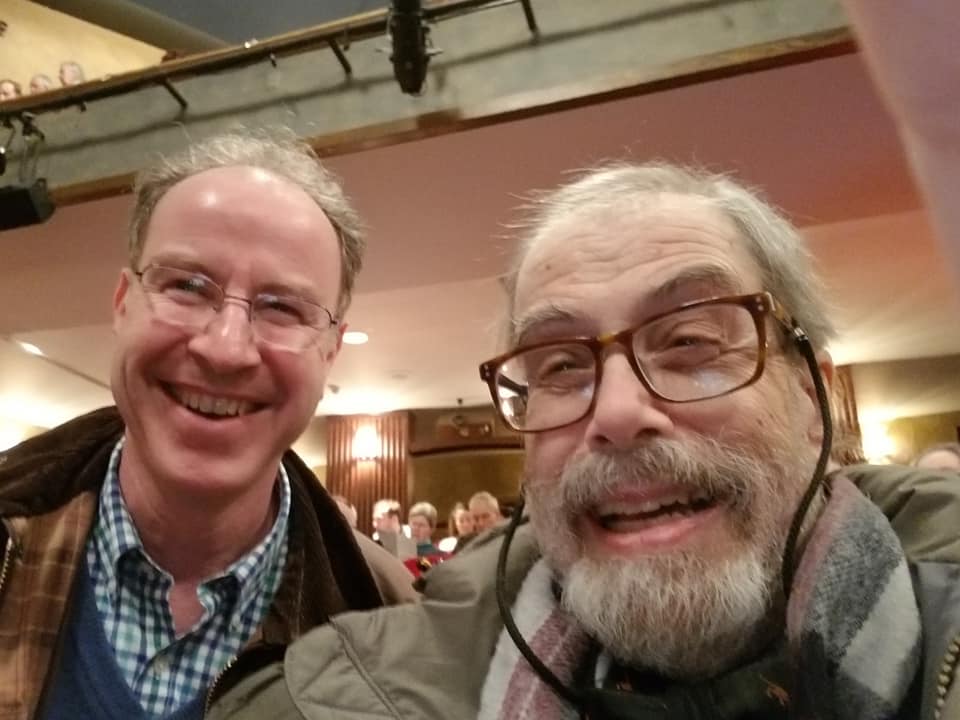
Although Teri made it a point to return to Princeton for its annual Reunions celebrations – appearing in the P-rade in his period “Governor Jonathan Belcher” attire (in 1747, Belcher founded the college that became Princeton University) – the last time I saw him in person was at a concert featuring Jordi Savall and Les Concerts de Nations at McCarter Theatre in 2019.
Teri suffered from ill health in recent years. Heart surgery in 2018 left him looking pallid and his voice weakened, but his spirit remained undiminished, as did his penchant for posting photos of cheese-laden, often fried foods and red meat. No question, the man knew how to enjoy life. He retired to rural Dutchess County, where he continued to prepare recorded broadcasts of his shows.
When he shared obituaries on his Facebook pages, he usually added “Ave atque vale” – Latin for “Hail and farewell.” On May 28, 2015, following what turned out to be the last installment of “Towe on Thursday,” we enjoyed a memorable lunch at the Princetonian Diner on Route 1, at which I was introduced to both Kenneth Hutchins and Alan Lesitsky. The Princetonian now, alas, is also no more. Teri, who was always taking pictures, documented the event. Characteristically, he made careful note of what we all ordered. (I had the Greek omelet; Teri had the cheeseburger deluxe.) When he posted about it, he described it as “an ‘Ave atque Vale’ lunch.”
In all, Teri did radio, sharing the music he loved, for nearly 60 years. His last Facebook posts were committed on February 2. I can’t claim to have known him well, but I knew him some. At the time of his death, he was 76-years-old.
Teri from the WKCR archive
https://www.cc-seas.columbia.edu/wkcr/archives/Classical%20Archive/artist/Teri%20Noel%20Towe?fbclid=IwY2xjawIQcXNleHRuA2FlbQIxMAABHXk584LE8cvgkfYsf8yfDl_Kt1oZTmQCp-bG7BJ1TupkZTpBbEXRxBNUjA_aem_8xo_BAwLDWG-uQz5nLMOZg
Further podcasts
https://www.ffrcc.org/weekly-broadcast?fbclid=IwY2xjawIQcZhleHRuA2FlbQIxMAABHU7Qxc1ADl_mdKfSV1lo-w-SeYvyt__TiKK1UzS5rwrzSnakZ0buR-zHzA_aem_sLAZbfBLgJ6Utrls0B_Igg
At the Princetonian
PHOTOS (counterclockwise from top): our last meeting at McCarter Theatre; in the P-rade as Governor Belcher; caricature by David Ritchie that ran in the University of Virginia’s The Cavalier Daily in 1973; Teri being interviewed at WWFM