
Now that it’s summer, it’s time to catch up on our reading! Whether it’s a beach book or a timeless literary classic, reading for pleasure is its own reward. This week on “Sweetness and Light,” imagine yourself in a lawn chair, under a good shade tree, perhaps with a beverage at your side, and enjoy an hour of music, hand-picked to get you in the spirit.
It will be a veritable lending library of compositions for concert hall, opera house, musical theater, salon, and film, with works inspired by J.K. Rowling’s Harry Potter, Mark Twain’s Huckleberry Finn, Lewis Carroll’s Alice in Wonderland, Leo Tolstoy’s “War and Peace,” Voltaire’s “Candide,” Victor Hugo’s “The Hunchback of Notre-Dame,” Jonathan Swift’s “Gulliver’s Travels,” Peter Benchley’s “Jaws,” Harper Lee’s “To Kill a Mockingbird,” and Henry Fielding’s “Tom Jones.”
Celebrate two of life’s great pleasures – music and books! Set aside your cares. They’ll still be here when you get back. Get yourself in the mindset to unplug and enjoy some quiet time. Prime yourself for a carefree summer of reading, on “Sweetness and Light,” this Saturday morning at 11:00 EDT/8:00 PDT, exclusively on KWAX, the radio station of the University of Oregon!
Stream it wherever you are at the link:
https://kwax.uoregon.edu/
Category: Daily Dispatch
-
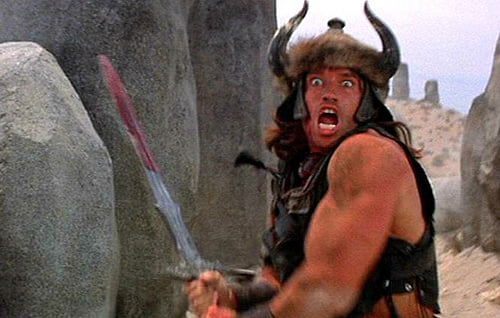
Movies Adapted from the Writings of Robert E. Howard on “Picture Perfect”
I prefer to keep my barbarians fictional, thank you. But with the nation’s 250th birthday approaching, I expect there will be plenty of instances in which truth will exceed credibility. It’s the world we live in, folks. Robert E. Howard, take me away!
This week on “Picture Perfect,” it’s an hour of music from movies inspired by Howard’s imaginative writings. Howard is best recognized for having created Conan the Cimmerian, a heroic warrior of the Hyborian Age. The character became the center of a series of lucrative stories first published in “Weird Tales” magazine, beginning in 1932.
It would be a half century before Conan made the leap to the big screen, under the direction of John Milius. “Conan the Barbarian” (1982) propelled Arnold Schwarzenegger, already a legend in the field of bodybuilding, to international superstardom. Okay, “Conan” isn’t exactly “Citizen Kane,” but it does have its pleasures. The intensity of the violence can be a little disturbing, but the ponderous tone is a blast. “Conan” is a film that takes itself just seriously enough to make it occasionally hilarious.
Another thing “Conan” has going for it is the fact that it was made on a blockbuster budget. The first-rate production values extend to the music by Basil Poledouris, who employs a full symphony orchestra to impressive ends. In fact, the “Conan” score was one of the strongest of the decade. It’s amazing that anyone would find so much inspiration in such a mediocre film, but Poledouris’ music intersperses Borodin-style Central Asia lyricism with brawny, thrilling action music.
Sadly, the sequel, “Conan the Destroyer,” betrays signs of penny-pinching, so that it often winds up feeling like a direct-to-video effort. Poledouris was forced to make do with a smaller orchestra, which sounds a bit too much like a television ensemble. Still, he gave it his all, and there’s something to be said for the fact that it is an original score, rather than a mere retread of the original.
Of perhaps related interest: it looks like a long-anticipated third Schwarzenegger Conan movie will finally be happening. “King Conan” is expected to begin filming next year, with Christopher McQuarrie writing and directing!
Let’s hope it fares better than an adaptation inspired by another one of Howard’s pulp creations, Kull of Atlantis, who was given the big screen treatment in “Kull the Conqueror” (1997). Kevin Sorbo, TV’s Hercules, plays the title role. The composer, Joel Goldsmith (son of Jerry), was asked to incorporate heavy metal riffs into his orchestral underscore. I haven’t actually seen this one, but for some reason I don’t feel like I’m missing anything.
The astoundingly prolific Ennio Morricone – with more than 500 motion picture and television scores to his name – had an uncanny knack for spinning garbage into gold. His music for “Red Sonja” (1985) lends the film an aura of ‘80s cheese ball fun, perhaps more so than it deserves. This is the film that introduced Brigitte Nielsen as the chain-mailed barbarian beauty. Schwarzenegger appears in the supporting role of Lord Kalidor.
There are those who would deny themselves the guilty pleasures of viewing these silly, cheesy, violent films. In “Conan the Destroyer,” when our hero is presented with the statement, “I suppose nothing hurts you,” he responds, “… Only pain.”
Make the music loud, Crom! Drive my enemies before me and drown the lamentations of their women! Saddle up with Conan the Barbarian on “Picture Perfect” – music for movies inspired by the writings of Robert E. Howard – now in syndication on KWAX Classical Oregon!
——-
Clip and save the start times for all three of my recorded shows:
PICTURE PERFECT, the movie music show – Friday at 8:00 PM EDT/5:00 PM PDT
SWEETNESS AND LIGHT, the light music program – Saturday at 11:00 AM EDT/8:00 AM PDT
THE LOST CHORD, unusual and neglected rep – Saturday at 7:00 PM EDT/4:00 PM PDT
Stream them, wherever you are, at the link!
https://kwax.uoregon.edu -
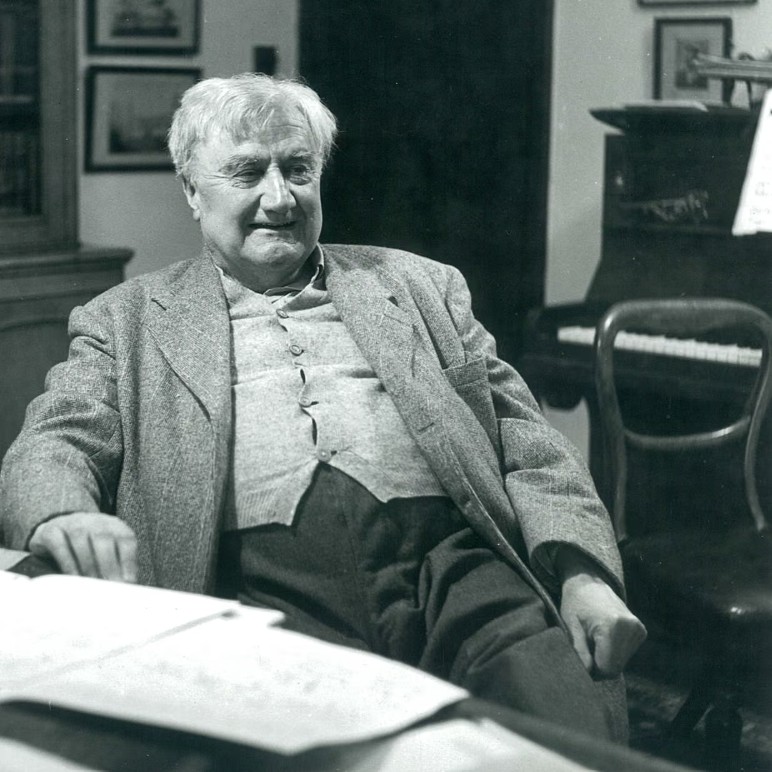
Vaughan Williams’ Vision of Hope and Shared Humanity
One of my favorite symphonies, the Symphony No. 5 by Ralph Vaughan Williams, makes today’s ”Composers Datebook.” As you’ll read (or hear) at the link below, the work was first performed on this date, at a time of great anxiety, in 1943. Vaughan Williams was 75-years-old.
In contrast to many wartime symphonies, there is no tub-thumping patriotism or gestures of defiance in RVW’s 5th. Instead, the composer takes the long view, sharing a larger vision of hope and serenity. The work surely resonated with listeners who lived through the Blitz, and even in 1943 continued to endure nightly air raids. The concert took place at Royal Albert Hall, because German bombings had gutted Queen’s Hall, the traditional venue of the summertime Proms. Also, it was held during the day, so that people could get back to their homes before London could be menaced after dark.
Reflected in the work is not only the soul of a nation, assimilating England’s proud sacred and secular musical traditions; it also exudes a unshakeable belief in our shared humanity. Contrast that with the anxiety, turbulence, and violence of the Symphony 4, completed in 1935, a time when the storm clouds were gathering – although the composer persistently denied any external influences. He always stood by his assertion that there was nothing at all programmatic about the work, and that he wrote what he wrote because he was compelled to write it. It was a wholly abstract piece of music.
The 5th symphony, on the other hand, shares themes with his long-gestating opera, “The Pilgrim’s Progress,” after John Bunyan’s popular Christian allegory; but again, there is no definitive extra-musical program. The composer himself stepped in for an indisposed Henry Wood to conduct the symphony’s premiere.
The work was dedicated to Jean Sibelius. Sibelius confided in a letter to Swedish composer Kurt Atterberg (who, in turn, was in touch with Vaughan Williams champion Adrian Boult), “This Symphony is a marvelous work… the dedication made me feel proud and grateful… I wonder if Dr. Williams has any idea of the pleasure he has given me?”
The music is transcendent in its luminosity. Why Vaughan Williams’ symphonies are not performed more often in the U.S. is a mystery. It’s probably just that people, even conductors, don’t really know the music. If it’s not “The Lark Ascending” or the “Fantasia on a Theme by Thomas Tallis,” they don’t even give it a second – or even a first – thought.
Which is a real shame, because the world can certainly use more reminders of the kind of positivity and reassurance expressed in the Symphony No. 5.
Listen to ”Composers Datebook” at the link.
https://www.yourclassical.org/episode/2026/06/24/composers-dateboo-ralph-vaughan-williams
Adrian Boult conducts the symphony here: -
A Dream to Some… A Nightmare to Others!
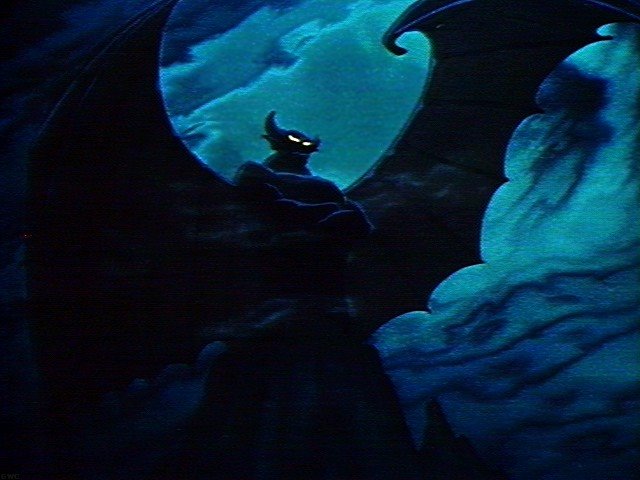
Even though the solstice was on Sunday, the longest day, a lot of Europeans celebrate the height of the season tonight, St. John’s Eve. For the record, that’s when the demon Chernobog is supposed to emerge from Bald Mountain – regardless of what Disney may think. (The narrator of “Fantasia,” Deems Taylor, says it’s supposed to be Walpurgis Night, April 30, the eve of May Day.)
In England, June 23 is Midsummer’s Eve, the setting of Shakespeare’s most famous comedy. I have a soft spot for the 1935 film version of “A Midsummer Night’s Dream,” overseen by Viennese impresario Max Reinhardt and featuring a real hodgepodge of actors from the Warner Bros. stable, including crooner (and later tough guy) Dick Powell as Lysander, Olivia de Havilland as Hermia, James Cagney as Bottom, and yes, 14-year-old Mickey Rooney as Puck.
But it’s the technical achievement that really puts it over. The opulent film (spun off from an extravagant Hollywood Bowl production) sports an effervescent score by Erich Wolfgang Korngold, woven together with dewy gossamer from the compositions of Felix Mendelssohn, enthralling production design and art direction by Anton Grot, with an especially delightful sequence of fairies ascending a woodland mist encircling a tree, and poetic choreography by Branislava Nijinska. There’s so much poetry in this movie it even sustains the ridiculous antlered crown worn by magnificent Victor Jury (soon to play John Wilkerson, the unsavory overseer in “Gone with the Wind”), putting his superior elocution to impressive use as Oberon.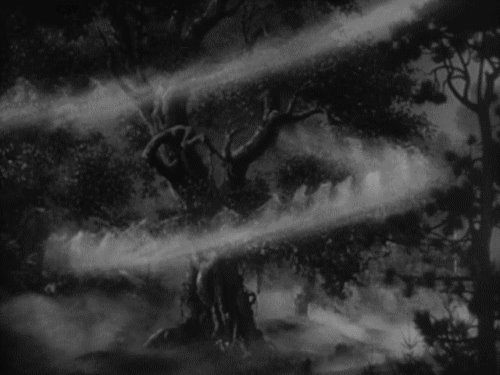
“A Midsummer Night’s Dream” has been filmed many times, of course. (I’m still trying to forget a middle-aged Stanley Tucci as Puck, riding a turtle, from the frustrating 1999 version, also starring Michelle Pfeiffer and Kevin Kline.)
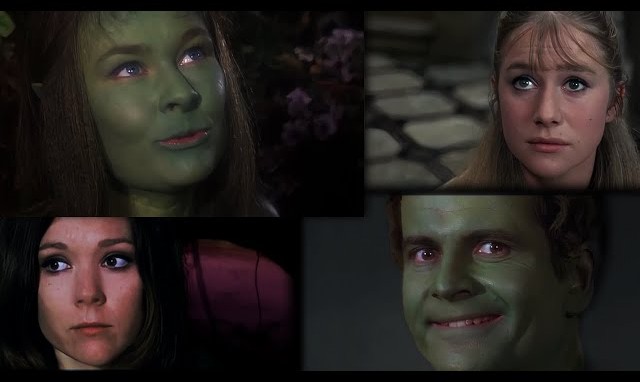
One I find especially unpleasant sports perhaps the most impressive pedigree of them all – a 1968 version that stars, among others, Judy Dench, Helen Mirren, Diana Rigg, David Warner, and Ian Holm, in green body paint, as perhaps the creepiest Puck in history. Also, for “Star Wars” aficionados, one-time Annakin Skywalker (before George Lucas scrubbed him out) Sebastian Shaw as Peter Quince. To think, the film is directed by theatrical deity Peter Hall! With such an assemblage of talent, how could it miss?
Well, it *was* 1968, and there were certainly more attractive, more lucid eras. As I recall, the film is uningratiating – ugly and claustrophobic, with hand-held cameras and “Kung Fu Theater” style editing, little concern for the beauty of the language, and perhaps Holm’s only bad performance (with that damn tongue).*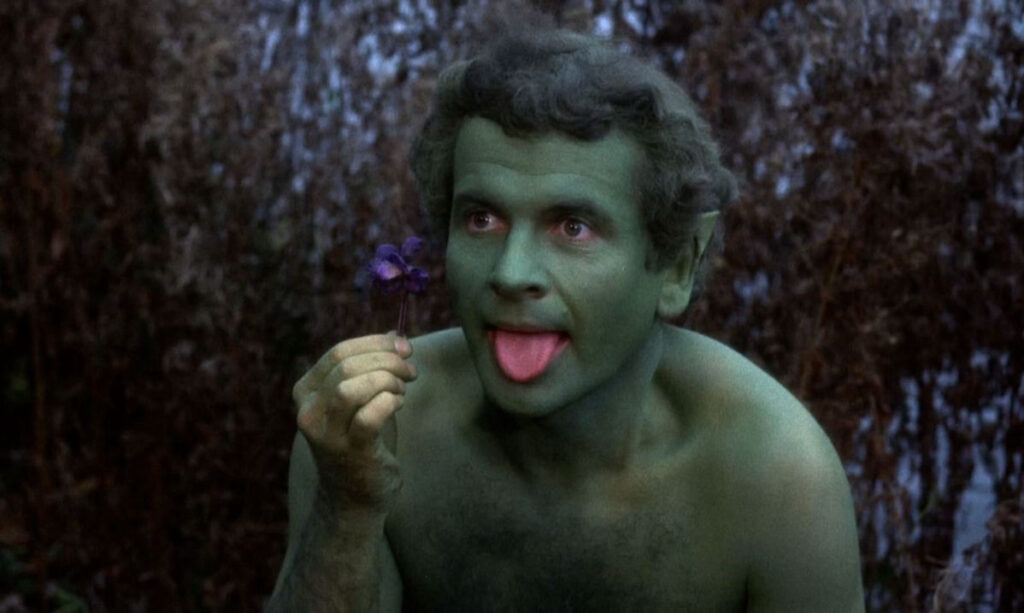
I disliked it so intensely, in fact, that it’s one of those instances in which I feel surely it couldn’t be as bad as I remember. This is the most dangerous kind of bad, because there’s a good chance I will wander back to it, lured beyond my will by curiosity and fey enchantment.
I must say, at least the print at the link is in the best resolution I have ever seen. I’m used to encountering it in transfers from grainy VHS. Here it is. Don’t say I didn’t warn you!
Then check out the 1935 version, for the production, especially. It really is like a dream. Perhaps it won’t hit you the same way it does me, but I find it to be pure enchantment. Here’s a taste.
It’s unfortunate I couldn’t find a crisper transfer.
Americans might question why Midsummer would fall at the beginning of the season. Traditionally, in much of Europe, summer began on May Day. Under the Julian calendar, the calendar employed the Roman Empire that traveled to Anglo-Saxon England, summer began on May 9. So Midsummer is June 24.
Yeah, they got it wrong, but when in Rome…
Happy Midsummer Night!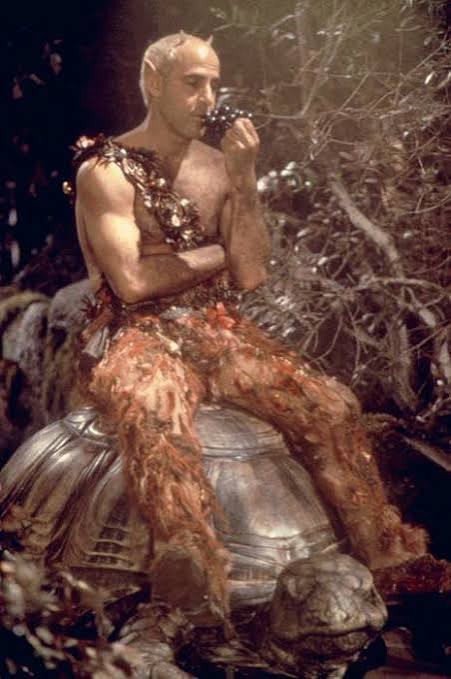
———-*EDIT: Okay, maybe I went too far in my savaging of the 1968 version with “little concern for the beauty of the language.” This is one cleanly-articulated text. I’ve been noticing of late how nobody these days enunciates. So the readings were actually quite refreshing. The problems (the rapid-fire delivery and disruptive editing) don’t really kick in until the fairies show up. Holm must have had a thermos of coffee and a kilo of cocaine every morning on the way to the shoot. It’s still an ugly movie, but if you just listen to the words, it’s actually quite good. And of course, you can’t dismiss it out hand with that cast!
-
Mozart’s Loss Is Our Guînes
The Mozart-related rediscoveries continue!
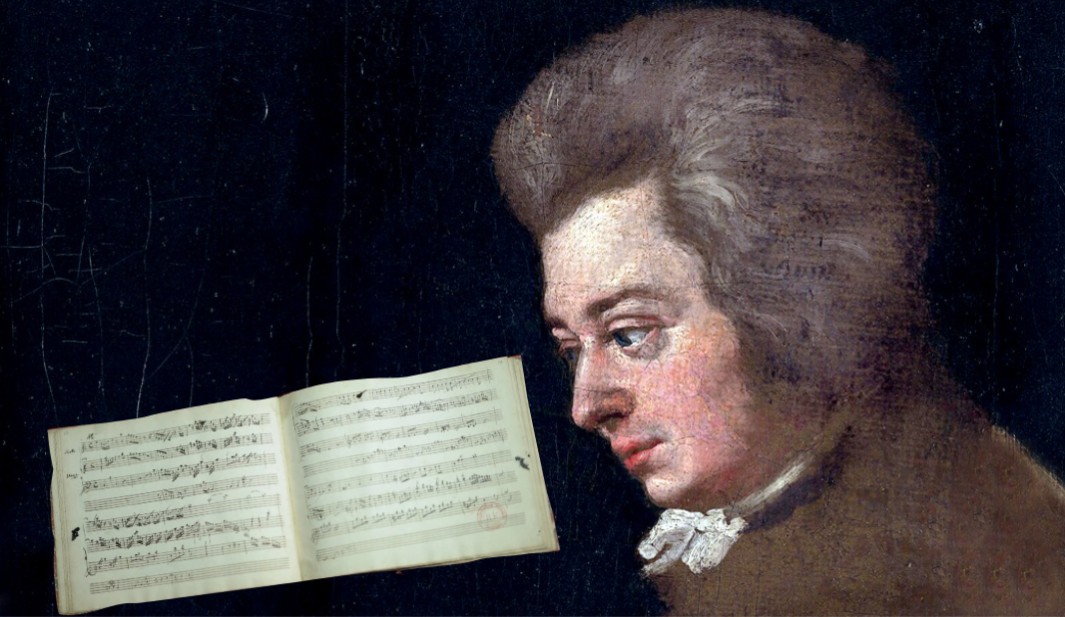
Last week, a 248-year-old notebook housed at France’s National Library was identified conclusively as having belonged to Mozart, when he was 22. The notebook, containing material set down between May and July 1778, was kept by the composer while he was employed as a music tutor in Paris for Marie-Louise-Philippine de Bonnières de Guînes. Her father, the Duke de Guînes, a highly-regarded flutist, commissioned Mozart’s Concerto for Flute and Harp, which you can’t help but encounter weekly if you ever listen to classical radio.
The notebook contains daily exercises for Mozart’s harp-playing protegée and seven original works for flute and harp, written under Mozart’s supervision. Mozart being Mozart, it appears he penned a substantial portion of the music himself. Presumably, these were designed to be played by Guînes and her father. The pieces were performed in public for the first time only yesterday at the library.
With the outbreak of the French Revolution, the Duke, a confidant of Marie-Antoinette, fled the country for England. Apparently, he stiffed Mozart for his work. In absentia, he authorized a butler to pay the composer half of what he was owed. Offended, Mozart refused to take it. Eat the rich!
As is so often the case, the rediscovery occurred when sorting through a pile of documents already stored at the library. A few years ago, somebody knocked over a stack at yet another library and discovered Stravinsky’s “Funeral Song,” a 12-minute orchestral piece composed in memory of his teacher, Nikolai Rimsky-Korsakov. It’s very important for librarians to catalogue their holdings well!
At any rate, the Mozart rediscovery is deemed to be a major one, a significant window into the mind, world, and creative and pedagogical processes of the 22 year-old master.
You’ll recall just the other week, a treasure trove of Salieri’s music was rediscovered. This seems then like an especially fortuitous summer for the Bard Music Festival to be focusing on “Mozart and His World” (to be held at Bard College in Annandale-on-Hudson, NY, August 7-16).
The thesis doesn’t mean it’s all Mozart. There will be works by his influences, his contemporaries and associates, and those he himself influenced and inspired; but as always at Bard, the real magic resides in the manner of the music’s presentation – the context, the juxtaposition of pieces, the pre-concert talks, and the scholarly panels. These are things you won’t find anywhere else.
The Bard Music Festival is part of the college’s larger celebration of the arts, Bard SummerScape (June 25-August 16), which encompasses opera, theater, dance, and cabaret at the campus’ Spiegeltent. If Mozart doesn’t really float your boat, there will be a fully-staged production of Richard Strauss’ opera “Die ägyptische Helena” (“The Egyptian Helen,” July 24-August 2). When’s the last time you heard that?
If I’m a little behind on sharing news of the discovery of the Mozart notebook, I take solace in the fact that the New York Times is only just getting around to reporting on it today as well! Read more about it at the link.
https://www.nytimes.com/2026/06/22/arts/music/mozart-music-flute-harp.html?unlocked_article_code=1.sFA.YSkW.l46NoRKsVayu&smid=url-share
For tickets and information about Bard SummerScape, the Bard Music Festival, and “Mozart and His World,” visit https://fishercenter.bard.edu/.
Concerto for Flute and Harp in C major, K. 299
Rediscovered pieces for flute and harp!
Tag Cloud
Aaron Copland (94) Beethoven (95) Composer (114) Film Music (149) Film Score (143) Film Scores (255) Halloween (98) John Williams (197) KWAX (232) Leonard Bernstein (105) Marlboro Music Festival (125) Movie Music (164) Mozart (91) Opera (215) Philadelphia Orchestra (90) Picture Perfect (174) Princeton Symphony Orchestra (110) Radio (90) Ross Amico (244) Roy's Tie-Dye Sci-Fi Corner (290) The Classical Network (101) The Lost Chord (269) Vaughan Williams (107) WPRB (397) WWFM (881)