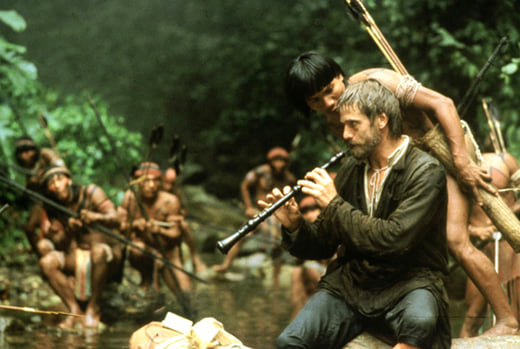
This week on “Picture Perfect,” in this season of wall-to-wall Biblical epics, I thought we’d enjoy a bit of counterprogramming in the form of music from films about faith, conscience, and the church.
Otto Preminger’s “The Cardinal” was released in 1963. Based on the novel by Henry Morton Robinson, the story follows a fictional Boston Irish Catholic priest from his ordination in 1917 to his appointment as cardinal on the eve of World War II. Tom Tryon played the lead. Tryon would later become a best-selling author himself (as Thomas Tryon), with books like “The Other” and “Harvest Home.”
An interesting factoid: The Vatican’s liaison officer for the production was Joseph Ratzinger, the future Pope Benedict XVI.
As always, Moross’ score is irrepressibly lyrical, even buoyant. The man never seemed to run out of good tunes.
We’ll also have music from “The Shoes of the Fisherman,” from 1968, another film based on a best-selling novel, this time by Morris L. West.
Anthony Quinn plays Kiril Pavlovich Lakota, an archbishop who serves 20 years in a Siberian labor camp. He is released and sent to Rome where is promoted to the cardinalate. When the Pope dies, suddenly, Lakota, a dark horse candidate, is elected as a replacement. The story balances Lakota’s internal struggles and personal torments with mounting global turmoil.
The music is by Alex North, who sets the melancholy lyricism of Russian folksong against the steely grandeur of his music for the Vatican.
The remainder of the program will be devoted to movies about missionaries. Georges Delerue provided a noble, austere score for the 1991 Bruce Beresford film “Black Robe,” based on a novel by the Irish Canadian writer Brian Moore, in which a Jesuit priest treks through 1500 miles of Canadian wilderness on a mission to convert the native tribes of the Huron and the Algonquin.
Ennio Morricone’s moving music for Roland Joffé’s 1986 film “The Mission,” which features Jeremy Irons as a Jesuit priest and Robert DeNiro as a reformed slave hunter in the South American jungle, has received a great deal of exposure over the years, both through its use in television commercials and by figure skaters, who made “Gabriel’s Oboe” a recognizable hit. It has become one of Morricone’s best-loved scores.
I hope you’ll join me for “Holy Men and Missions” this week, on “Picture Perfect,” music for the movies, now in syndication on KWAX Classical Oregon!
——–
Clip and save the start times for all three of my recorded shows:
PICTURE PERFECT, the movie music show – Friday at 8:00 PM EDT/5:00 PM PDT
SWEETNESS AND LIGHT, the light music program – Saturday at 11:00 AM EDT/8:00 AM PDT
THE LOST CHORD, unusual and neglected rep – Saturday at 7:00 PM EDT/4:00 PM PDT
Stream them, wherever you are, at the link!
https://kwax.uoregon.edu
Category: Daily Dispatch
-
Is There Still an Audience for “Ben-Hur”?
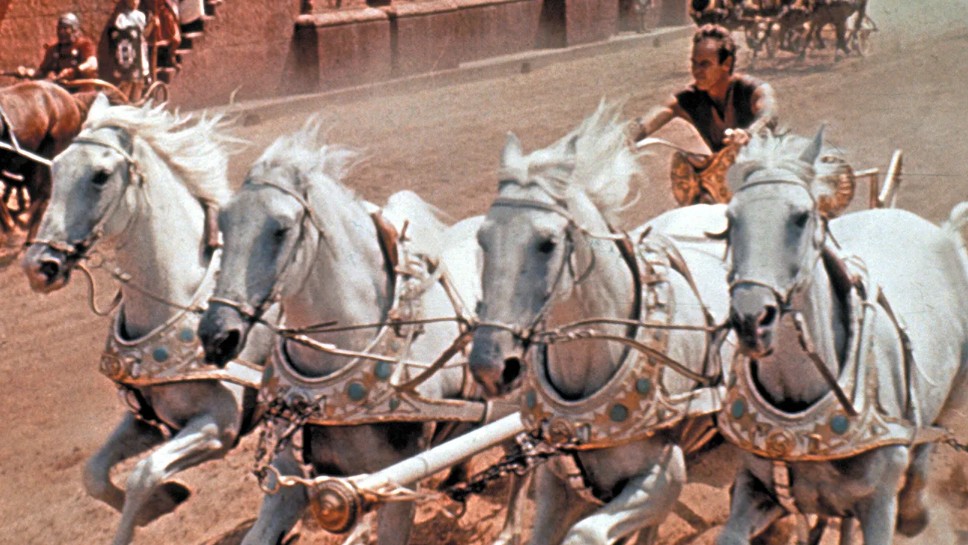
I devoted one of my posts the other day to news of a limited-time revival of “Ben-Hur,” back on the big screen, courtesy of Fathom Entertainment. The film has been showing at select theaters across the country over the past four days, with today being the last. If you’re at all interested in seeing it in its new 4K restoration, search for theaters in your area by clicking on “get tickets” at https://www.fathomentertainment.com/releases/ben-hur-2026/. Screenings tonight will likely begin sometime between 6:00 and 7:00.
And let me tell you, the film looks great. Also, I don’t know that it’s ever sounded better. Miklós Rózsa’s fanfares and choruses soar, the clatter, thundering horse hoofs, and roar of the crowd during the chariot race thrill, and the earthquake following Jesus’ crucifixion terrifies.
Granted, the film is four hours long (presented with a brief intermission), but it is an absorbing story told on a grand scale. Why, then, was I the ONLY PERSON IN THE THEATER when I saw it last night? I mean, this was the most-decorated film of all-time, with a record-breaking 11 Academy Awards. It was also the highest grossing picture since “Gone with the Wind.” Everything about it is immaculately rendered (no pun intended).
Were people put off because it’s an old movie? By the length? By the religion? Because it was a work night? Here, the film was over by 9:50.
Most likely, they stayed away because it doesn’t have Ryan Gosling in a spaceship. Also, it’s less demanding to stay home and stream “content” as background to scrolling on the phone and texting friends.
If any of these is the case, I feel sorry for those people. But I am also concerned for the future of everything I hold dear. A large segment of the population, it seems, possibly a majority, lacks the curiosity and the attention spans of our parents and grandparents, who might have considered this a deeply satisfying, even transformative night out.
Concerning the religion, “Ben-Hur” is a peculiar movie. On the surface, it has a Christian outlook (Lew Wallace’s book bears the subtitle “A Tale of the Christ”), but the hero, blue-eyed Charlton Heston as the Judean prince Judah Ben-Hur, is proudly Jewish. Of course, the conflict in the film is more political than religious. Ethnic distinctions are drawn mainly along the lines of those in occupied lands who bristle under their Roman conquerors. There’s one scene wherein the Romans make a sneering remark about a proposed chariot race with Judah. “A Jew?” one remarks, incredulously (sponsored by an Arab, no less). But the Romans, in general, are a proud, supercilious lot.
The other day, I mentioned an alleged gay subtext (according to Gore Vidal) in the establishing scene between Judah and his childhood friend, Messala (played by Stephen Boyd), which does exude a certain, unusually ardent quality, though things very quickly go south as the men’s allegiances drive a wedge between them. However, given that Judah’s later relationship with the Roman general Arrius (played by Jack Hawkins) deepens into an equally unguarded affection, it would be easy to chalk it up to simple phileō. This was, after all, the ancient world.
That said, if there’s a more homoerotic mainstream American movie, I can’t think of it. There are half-naked, well-oiled men everywhere. They stop just short of snapping each other with their towels. And if it’s an historical or Biblical epic, you can bet Heston will be standing around in a loin cloth for at least some of it. It must have been in his contract.
The film is adapted from a bestselling novel by Civil War general Lew Wallace, the most-read American novel in the period between “Uncle Tom’s Cabin” and “Gone with the Wind.” Wallace claimed not to be particularly religious at the time he took up his pen, but on completion of the manuscript, he found he had become a believer.
The story is really a mash-up of “The Count of Monte Cristo” and a Jesus movie. Jesus pops in every once in a while, always viewed from the back of the head, as Rózsa’s score strikes a mystic tone. But the film is not really about Jesus, or rather it isn’t JUST about Jesus, as much as it is about getting in touch with your own humanity and embracing your better angels. Yes, the ideals advocated by Jesus point the way, but Judah himself, as a good and thoughtful person, grapples with the complexity and corrupting nature of the impulse to revenge. Heston delivers a nuanced performance, a career best, that conveys much of his character’s conflict and evolution through his thoughts, facial expressions, and physical bearing, as much of it is not explicit in the dialogue, though certainly supported by the compassionate exchanges in Judah’s encounters with Jesus.
Interestingly, Judah recognizes the extraordinary in these silent encounters, but he remains a Jew to the end (as opposed to converting to Christianity). Throughout the film he touches his mezuzah reverently, even tenderly, when entering his house. When his family’s fortunes plummet, still he adjusts the scroll and carefully tends to this symbol of his identity and faith. At a point, he covers his head and prays for forgiveness for his desire to seek vengeance. Whether or not he embraces Christianity beyond the action of the movie is unclear, but I think not. Nevertheless, he is transformed.
In a way, Jesus is an external symbol of Judah’s inner goodness. Or perhaps, putting it another way, Jesus becomes a catalyst for Judah’s self-awareness. A Roman early in the film remarks that Jesus teaches that God exists inside every one of us. (“It’s quite profound, actually,” he adds, with a far-away look.) Whether or not you are a “religious” person, whether you are Jewish or Christian, the film should still work for you. It’s interesting that, for such an earnest, at times histrionic presentation, it manages to satisfy when viewed from multiple perspectives.
Judah’s journey leads him through physical trials and into the emotional abyss. But he does believe in a higher power. He makes it clear several times throughout the film, most especially when he tells Arrius he cannot believe that God would keep him alive in the galleys for three years only to have him drowned at the bottom of the sea.
It’s an inspiring movie, not least of all for all the craftsmanship that went into it. The starfield in the film’s prologue, as the Three Magi travel to Bethlehem to pay homage at the manger, is magical. The kings, captured in profile, are like a Rembrandt brought to life. The stable scene is touchingly reverent, but the chance cavorting of a rambunctious calf saves it from stiffening into sanctimonious kitsch. And then the credits! My god, Miklós Rózsa’s music!
There were no computers back then, remember, so everything you see was made by hand. The sets, the expert matte paintings, the costumes on the cast of thousands. Those nine chariots racing around the arena with their teams of frothing horses are real. Stuntmen risked life and limb, and Heston and Boyd can be seen in some of the shots actually maneuvering their rigs. I know it’s a hackneyed phrase, but they really don’t make ‘em like this anymore!
I should add, the film is not for ironists. It is absolutely in earnest from beginning to end, but as I suggest, it’s open to a range of interpretations. It is the visual equivalent of reading a book. It feels like a literary experience. Whether or not it reflects Wallace’s original in that regard, I cannot say. I have yet to read it, but I’ll get around to it one of these days. For now, and as has been the case for decades, I hold the movie very close.
Heston, Boyd, Hawkins, Finlay Currie (as the king Balthasar), and Frank Thring (who plays Pilate as a consummate politician) have never been better. William Wyler (who was Jewish) was one of the most skilled Hollywood directors of all time. Google him and just look at his credits. He directed all kinds of pictures, from “Wuthering Heights” and “The Heiress” to “Roman Holiday” and “Funny Girl,” with very few of them being less than wholly satisfying. Several of them, including “The Best Years of Our Lives” and “The Big Country,” are among my all-time favorites.
You have one more chance to catch “Ben-Hur” on the big screen in its 4K restoration. I don’t care how good your system is at home. Watching it on your couch with distractions of the phone, the refrigerator, and easy access to a bathroom is not the same experience. Go, and prepare to be overwhelmed. -
“The Crucible,” Unfortunately, Never Goes Out of Style
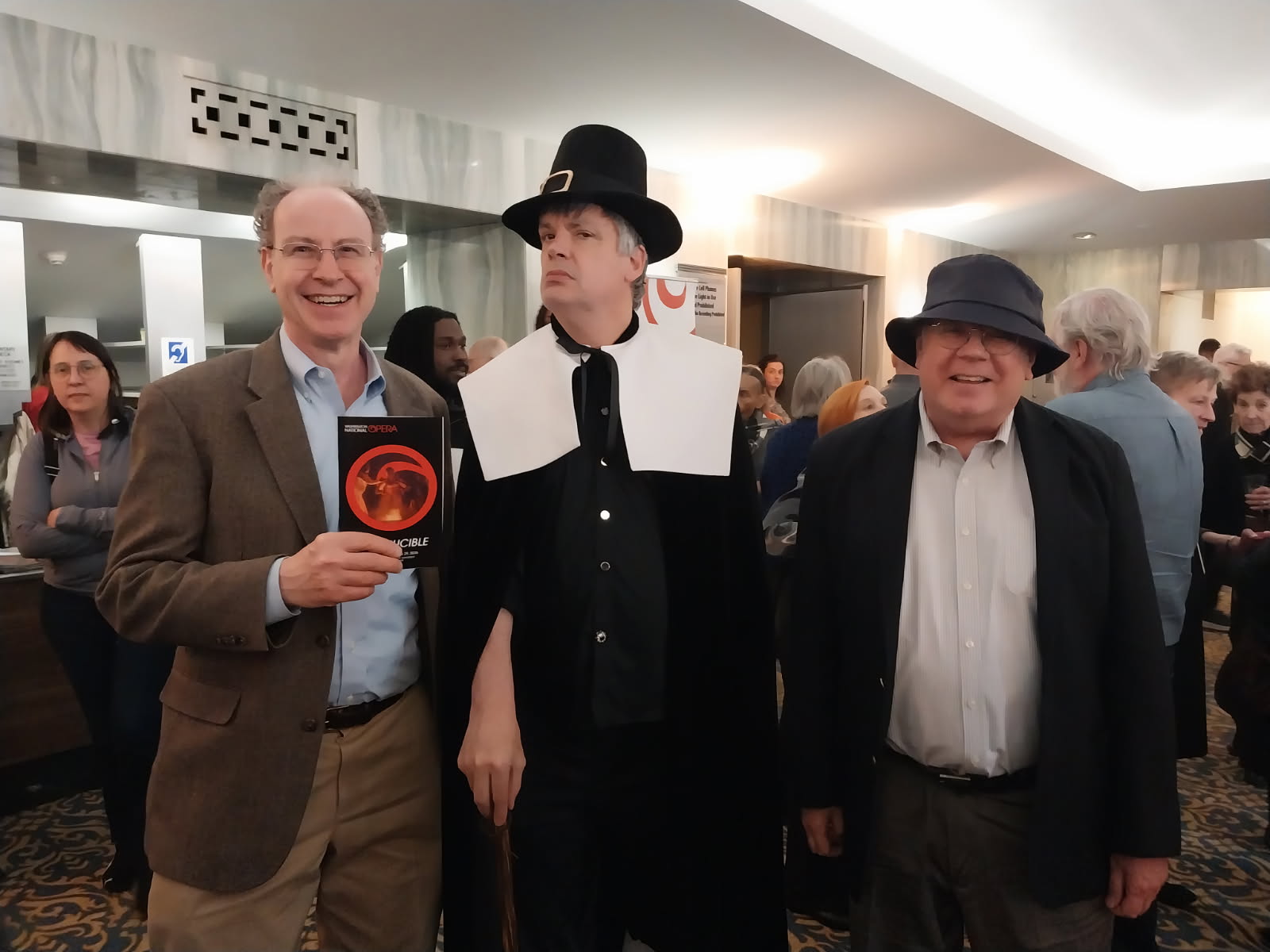
This lighthearted photo isn’t actually what I had planned to post today, but I think it suits the mood for April Fools’. Here I am on the left, in the lobby of George Washington University’s Lisner Auditorium this past Sunday, with Mather Pfeiffenberger on the right, during intermission at the final performance of Robert Ward’s 1963 Pulitzer Prize winning opera “The Crucible,” presented by Washington National Opera.
Between us is a gentleman who identified himself in his contact info (presented so that I could send him a copy of the photo) only as “Crucible Puritan Guy.” It turns out he’s Gary O’Connor, a DC resident who also frequently attends performances at the Met. An opera cosplayer of sorts, Gary has also worn theme costumes to performances of “Die Frau ohne Schatten” (complete with faux falcon), “Lohengrin,” “Der Rosenkavalier” (in silver face paint), “Tosca,” and “Tristan und Isolde” (with the “Tristan chord” on the sail of a headdress resembling a dragon boat).
Of course, there’s nothing foolish about “The Crucible” itself. Adapted from the Arthur Miller play, it’s perennially, chillingly relevant (people are people, after all, no matter what era they live in), but especially so now. Ward’s opera is inexorable, riveting, and powerful, with a dramatic sweep that makes it seem almost like American verismo.
It was certainly well-cast, with J’Nai Bridges and Ryan McKinny as the ill-fated Proctors, who manage to wrest grace and redemption from the Salem Witch Trials. There were good voices throughout, with the men (including McKinny as John Proctor, Chauncey Packer as Judge Danforth, and Nicholas Huff as Giles Corey) carrying especially well. I had my concerns at the start, as some of the voices were muddied as the singers moved upstage, but everyone soon rose to the occasion. I am sorry to have to leave out some of their names, but I didn’t really intend this as a review.
I will add, however, they were also good actors, with Lauren Carroll exuding menace and unpredictability as Abigail Adams. Bridges has some great moments, especially touching in the final scene, which concludes “He have his goodness now. God forbid I take it from him.”
Robert Spano conducted in the cramped pit, and the musicians played well. Had I not been made aware of it in another write-up, I would never have known that the brass and percussion had to be piped in from another room.
Bravo to Washington National Opera, now free of the Kennedy Center. Hopefully they’ll be back, if there’s anything left of the performing arts complex, a memorial to fallen president John F. Kennedy, under a different administration.
It’s shameful that the Washington Post, now under the ownership of Jeff Bezos, did not review “The Crucible.” Then, all the qualified music people have been driven out.
“West Side Story” will conclude the WNO season, at Lyric Baltimore and the Music Center at Strathmore, May 8-15. If I remember correctly the organization’s 2026-27 season will be announced on May 5. For more information, visit https://washnatopera.org/.
Robert Ward’s “The Crucible” is no laughing matter, but Gary the Crucible Puritan Guy brought some welcome levity to a gorgeous DC afternoon. If only it didn’t take me 4 ½ hours to drive home! -
Bernstein and Haydn: Synergy of Strange Bedfellows
I’m not sure elegance is near the top of anyone’s list when they consider the attributes of Dionysian Leonard Bernstein. I mean, he could cut a dapper figure, especially during the “matinee idol” years of his youth and early middle-age. He spoke well, and at concert time or before the cameras, he was invariably well-dressed, with that hair and that cigarette, seductively cool in black and white. But by the 1970s, he started to let it all hang out. That’s when he would show up at rehearsal dressed like a French wharf rat, all stubbly, in a striped sailor shirt and neckerchief. You be you, Lenny.
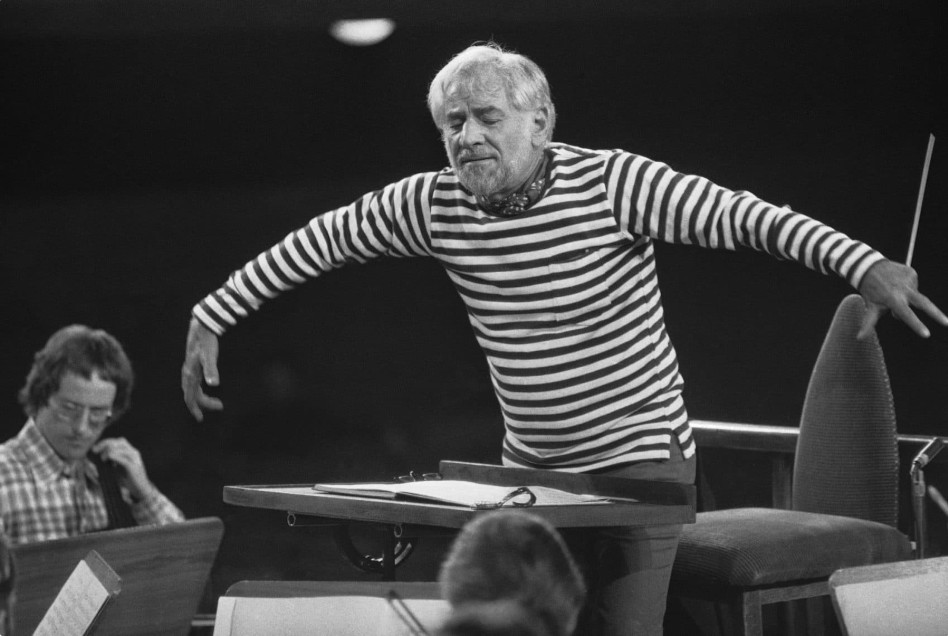
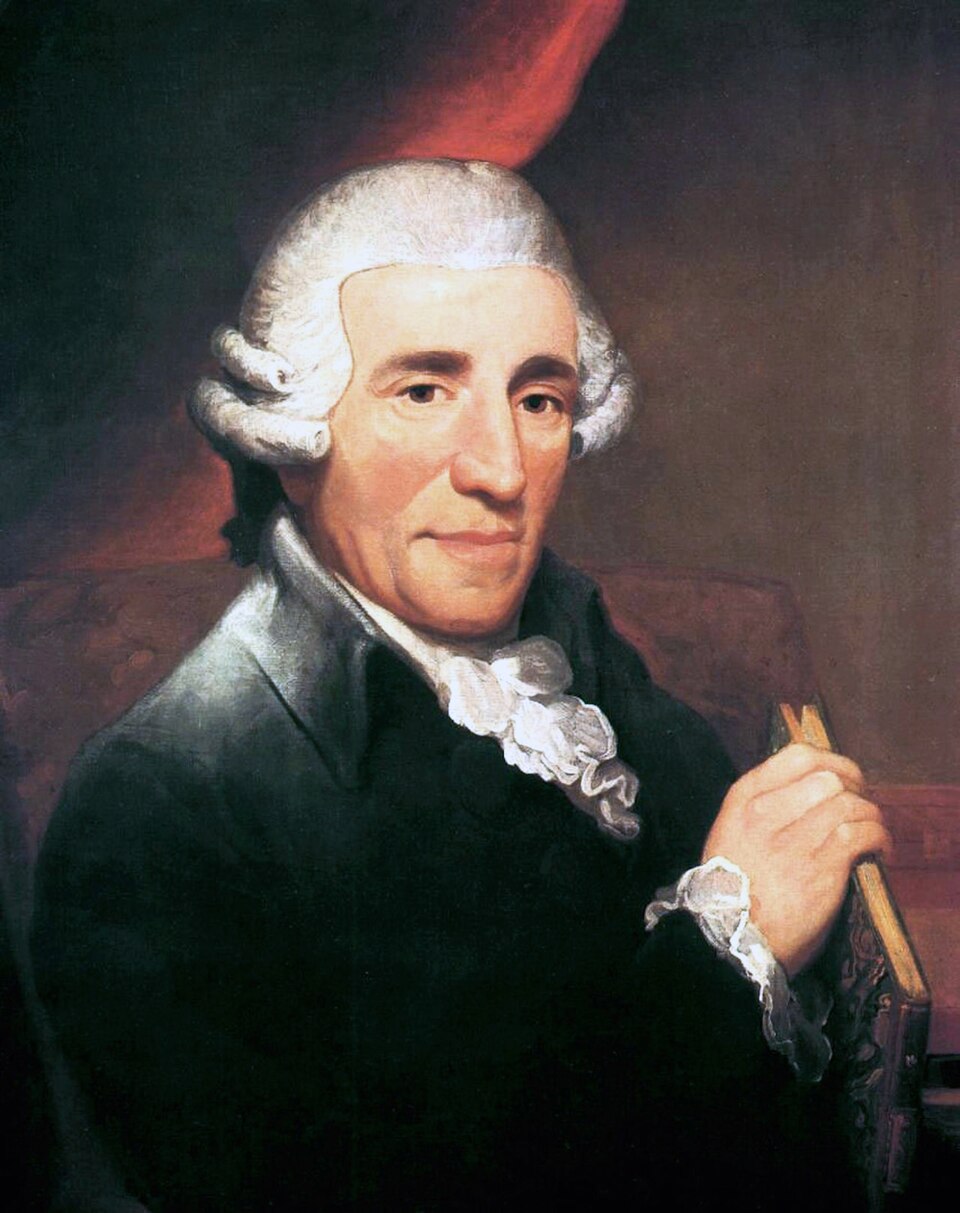
But a strange synergy occurred whenever he conducted the music of Franz Joseph Haydn. Haydn, that most elegant of composers – except when he wasn’t (cue flatulent bassoon jokes) – virtually invented the modern symphony, or perfected it anyway. During the Classical era, it adhered to some pretty strict rules – which Haydn would then either humorously or dramatically manipulate or subvert.
In the arts, it was once common knowledge that the way to freedom was through order. Once you internalize the rules and master the technique, you can pretty much do whatever you want. And no one knew his way around the symphony better than Haydn. He composed at least 106 of them (104 of them numbered) over a period of about 40 years. That’s an astronomic level of devotion to a single form, and it was far from Haydn’s exclusive focus. (He’s also credited as the father of the modern string quartet.)
Bernstein, of course, developed a reputation for bringing great energy and involvement to highly subjective interpretations of music by composers such as Gustav Mahler. At his most thrilling, his identification with the composer could be so complete, it was as if he was creating the music himself. That doesn’t always mean his “identification” was exactly what the composer had in mind. But, totally unexpectedly, this celebrated proponent of some of the most flamboyant music in the repertoire turned out to be an outstanding Haydn interpreter.
Bernstein’s Haydn is marked by great fluency and fun. He just GOT him, and I suspect there wasn’t a hell of a lot of analytical thinking behind it. The way we all just click with certain people and not with others – that’s how it was with these two. The high priest of emotional truth saw past the formal principles of the 18th century to Haydn the man and totally grokked where he was coming from. Haydn at his best is not a dry or boring “textbook” composer. He was a living, breathing human being, full of clever ideas, subject to a range of emotions, and brimming with good humor.
Whenever I need a lift, I need look no further than Lenny’s recordings of the “Paris” Symphonies. Of these, the Symphony No. 82, subtitled the “Bear,” is perhaps my favorite. Bernstein’s “Bear” (not to be confused with a Berenstain Bear) is a treasure, energetic, lyrical, and exhilarating.
FUN FACTS: The first performance was conducted by Joseph Bologne, Chevalier de Saint-Georges. Saint-Georges was a talented athlete, a respected swordsman, and the first classical composer of African descent to achieve widespread acclaim in Europe.
The symphony’s nickname, the “Bear,” was bestowed not by Haydn, but by someone else, picking up on the repeated drone in the work’s finale. In those days, dancing bears were accompanied by bagpipes as a popular form of street entertainment. See if you can hear the dancing bear in the fourth movement of Haydn’s symphony.
https://www.youtube.com/watch?v=3SjNmqj0czM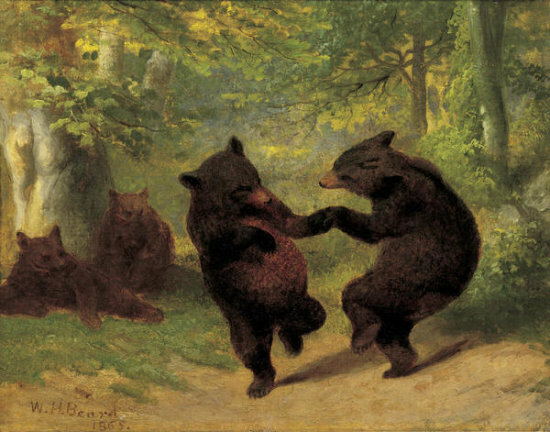
When it comes to Lenny’s Haydn, there’s also this precious document, in which he conducts the last movement of the Symphony No. 88 – with his eyes! Of course, he does it as an encore. For the complete performance, you can scroll back to the beginning of the video.
https://www.youtube.com/watch?v=bXEldU1UC70&t=1511s
Want more? Here you go: the “Paris” Symphonies (82-87), the Symphony No. 88, and from the “London” Symphonies, the Symphony No. 93 (with a flatulent bassoon joke in the slow movement), the Symphony No. 94 (the famous “Surprise” Symphony), and the Symphony No. 95. The collection starts with the “Bear.” You can either skip over it or revel in it all over again.
https://www.youtube.com/watch?v=VOrjmUI5f9Y
Happy birthday, Haydn! -
Bach in Bloom at Princeton University
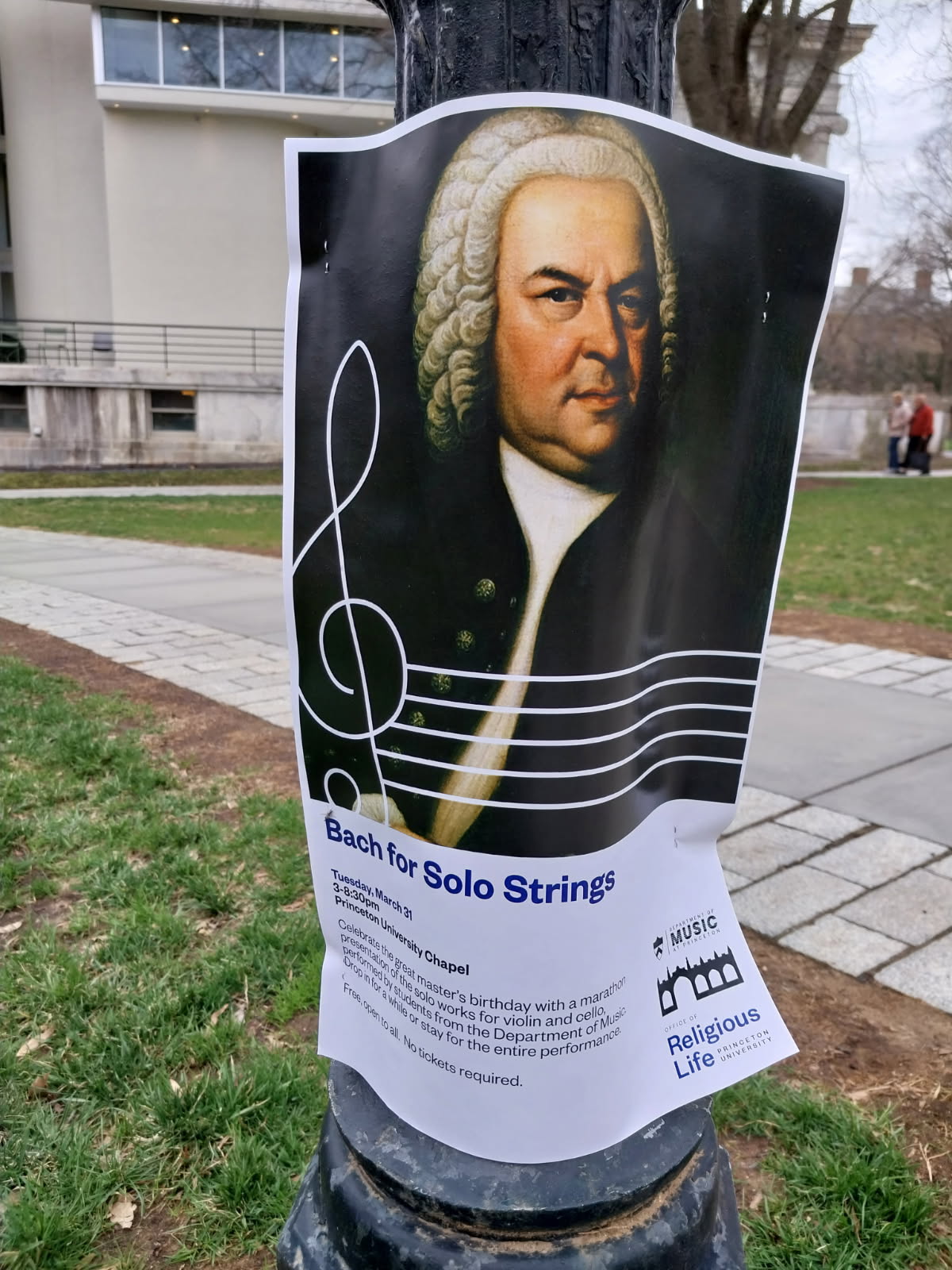
It’s Holy Week, so expect Bach’s sacred oratorios to be in bloom. But for me, give me the intimacy of the cello suites and violin sonatas. Fortuitously, Bach’s works for solo strings will be presented in their entirety in the contemplative setting of Princeton University Chapel, performed by students from the university’s music department. If you’re in the area, stop by or go the distance. The Bach marathon will take place tomorrow (Tuesday) from 3:00 to 8:30 p.m. Admission is free, so Bach ‘til you drop.
Tag Cloud
Aaron Copland (94) Beethoven (95) Composer (114) Film Music (149) Film Score (143) Film Scores (255) Halloween (98) John Williams (197) KWAX (232) Leonard Bernstein (105) Marlboro Music Festival (125) Movie Music (164) Mozart (91) Opera (215) Philadelphia Orchestra (90) Picture Perfect (174) Princeton Symphony Orchestra (110) Radio (90) Ross Amico (244) Roy's Tie-Dye Sci-Fi Corner (290) The Classical Network (101) The Lost Chord (269) Vaughan Williams (107) WPRB (397) WWFM (881)