Category: Daily Dispatch

  • Sinbad Zardoz Fashion Film Fest Tonight

    Sinbad Zardoz Fashion Film Fest Tonight

    If you’ve got a passion for fashion, have I got an “Ideal” double feature for you!

    I hope you’ll join me, as I present “A Thousand and One Nights at the Movies” on “Picture Perfect” – with selections from “The Seventh Voyage of Sinbad” (Bernard Herrmann), “Sinbad and the Eye of the Tiger” (Roy Budd), “Aladdin” (Alan Menken), and “The Thief of Bagdad” (Miklos Rozsa) – at 6:00 this evening (EDT) on WWFM – The Classical Network and wwfm.org.

    Then at 7:00, I guarantee it will be all you’ll ever want to see of Sean Connery. The giant floating head wasn’t the only thing stoned in the making of John Boorman’s “Zardoz” (1974). Roy Bjellquist and I will engage in a spirited conversation about Brutals, Eternals, Renegades, and Apathetics, on the next “Roy’s Tie-Dye Sci-Fi Corner.”

    How catty will it get on the catwalk? As catty as we knead!

    Catch it via Facebook live stream, and leave a question or comment!

    https://www.facebook.com/roytiediescificorner/


    For a hit of “Zardoz,” here’s the trailer:

    And David Munrow’s arrangement of Beethoven’s 7th:


    PHOTOS: Rocking the whole pony tail/red diaper thing, Rex Ingram as the Genie in “The Thief of Bagdad” (left) and Sean Connery as Zed the Exterminator in “Zardoz”

  • Arabian Nights Cinematic Delights

    Arabian Nights Cinematic Delights

    Open sesame! It’s an Aladdin’s Cave of cinematic delights.

    This week on “Picture Perfect,” the focus is on tales from “The Arabian Nights.”

    These traditional folk stories from the Orient have come down to us filtered through the sensibilities of Western translators. Further translation was required to get the stories from page to screen; so it’s hardly surprising to find Sinbad, for instance, fighting a giant walrus at the North Pole.

    The film versions are often showcases for the work of production designers and special effects artists, but composers have certainly gotten in on the act with suitably imaginative scores.

    Bernard Herrmann lent plenty of color and wit to the skeleton duel in “The Seventh Voyage of Sinbad” (1958) by employing a battery of castanets, xylophone, and brass. Stop motion artist Ray Harryhausen was responsible for the memorable effects. “Sinbad” proved to be a dry run for the climax of “Jason and the Argonauts,” in which Harryhausen outdid himself by animating not one, but seven skeletons, and again, Herrmann supplied the music.

    Harryhausen animated two further Sinbad adventures – “The Golden Voyage of Sinbad” (1974) and “Sinbad and the Eye of the Tiger” (1977). Over the course of the three “Sinbad” films, audiences were treated to fantastic encounters with, in addition to the skeleton, a Cyclops, a roc, a dragon, a statue of the goddess Kali, a centaur, a giant walrus, and a saber-tooth tiger, among others.

    “Sinbad and the Eye of the Tiger” was scored by Roy Budd. Budd’s reputation was largely that of a jazz musician and composer. He wrote scores for over 50 films, including “Get Carter” and “The Wild Geese,” before his early death of a brain hemorrhage, at the age of 46, in 1993.

    Walt Disney created a modern classic in “Aladdin” (1992). The music was by Alan Menken, with lyrics by Howard Ashman and Tim Rice. “Aladdin” won Academy Awards for Best Original Score and Best Original Song (“A Whole New World”). Menken has a whole shelf full of Oscars for his work for Disney. Need I say, Robin Williams was the voice of the manic, freewheeling Genie?

    Rex Ingram’s Genie steals the show in “The Thief of Bagdad” (1940). Ingram emerges from his magic lamp and looms over a cowering Sabu, whom he addresses as “Little Master of the Universe.” The beach resounds with his maniacal laughter. There was an earlier, justly celebrated, silent version of “Thief,” with Douglas Fairbanks. The remake splits the thief and the prince into two separate characters. Sabu plays the incorrigible Abu (the thief), and Conrad Veidt is his nemesis, the treacherous vizier Jaffar.

    The score is by three-time Academy Award winner Miklós Rózsa. Rózsa was in London, in the employ of Alexander Korda, when the lavish Technicolor production was moved to Hollywood on account of the Blitz. Rózsa would go on to become one of Hollywood’s greatest composers. His music for “Ben-Hur” alone has earned him a place in the film music pantheon. He never wrote a more charming score, however, than he did for this.

    I hope you’ll join me for an hour of cinematic enchantments. That’s “A Thousand and One Nights at the Movies,” on “Picture Perfect,” this Friday evening at 6:00 EDT, on WWFM – The Classical Network and wwfm.org.

  • Zardoz Typecasting Actor’s Extreme Lengths

    Zardoz Typecasting Actor’s Extreme Lengths

    Just how far will an actor go to avoid typecasting?

    No need to ask Sean Connery, so desperate to get away from James Bond that he exploded his cash cow by strapping on red-hot bandoliers, fire engine mankini, and thigh-high kink boots for John Boorman’s inscrutable masterpiece, “Zardoz.”

    Join Roy Bjellquist and me as we chip away at a giant stone head (floating gracefully to Beethoven’s 7th Symphony, then vomiting guns), explore the blurred relationships between myth, legend, and religion, and delve into the very mysteries of life and death, on the next “Roy’s Tie-Dye Sci-Fi Corner.”

    “Zardoz” is nothing if not ambitious. But did it – could it – ever rise to the level of its aspirations? When “Zardoz” opened in 1974, it was met by widespread confusion and scathing reviews. Is it possible that an overtly bad movie could actually mask a fairly good one?

    46 years of brain bleach has been powerless to dispel the enduring WTF of “Zardoz.” I hope you’ll join Roy and me in slack-jawed wonder on the next Facebook live-stream of “Roy’s Tie-Dye Sci-Fi Corner,” this Friday evening at 7:00 EDT.

    https://www.facebook.com/roytiediescificorner/?fref=ts

  • Respighi’s Long Shadow Classical Music Surprises

    Respighi’s Long Shadow Classical Music Surprises

    Wow! Did you know that Respighi’s widow died in 1996? That’s as crazy to contemplate as the fact that Gustav Mahler (whose birthday it was on Tuesday) would have turned 80 on the day Ringo Starr was born. And of course, there are those photos of Alma talking with Leonard Bernstein. History is collapsing in on itself like a telescope!

    Respighi’s wife, Elsa, outlived him by some 60 years. A singer and composer herself, she died one week shy of her 102nd birthday. She remained her husband’s biggest cheerleader, tirelessly promoting his music, after his own untimely death in 1936, at the age of 55, and even completed his last opera, “Lucrezia.”

    Respighi, of course, is best known for his trilogy of opulent, at times rafter-rattling tone poems celebrating the scenes and history of Rome – “Fountains of Rome” (1916), “Pines of Rome” (1924), and “Roman Festivals” (1928) – and his time-tripping sets of Renaissance lute recreations, the “Ancient Airs and Dances” (composed in 1917, 1923 & 1932).

    In 1929, when conductor Serge Koussevitzky suggested Respighi orchestrate some of Rachmaninoff’s keyboard pieces, Rachmaninoff responded enthusiastically. He supplied Respighi with hidden programs behind the works to lend additional insights into their creation. Koussevitzky was impressed with the results, which he unveiled with the Boston Symphony Orchestra in 1931. More importantly, Rachmaninoff found the orchestrations to be faithful to the spirit of the originals.

    Here is “The Sea and the Seagulls,” from “Cinq Études-Tableaux” by Respighi, after Rachmaninoff.

    Also, footage of Arturo Toscanini conducting “Pines of Rome” in 1952, with the NBC Symphony. Toscanini conducted the work’s U.S. premiere, with the New York Philharmonic, in 1926.

    https://www.youtube.com/watch?v=vThMQzLbN-Y

    Happy birthday, Ottorino Respighi!


    PHOTO: Respighi (second from right), horsing around with quattro vitelloni

  • Buck Moon Twins: Antheil & Grainger’s Mad Genius

    Buck Moon Twins: Antheil & Grainger’s Mad Genius

    It’s got have something to do with that Buck Moon.

    July 8 marks the birthdays of two of music’s looniest pianist-composers.

    George Antheil, self-proclaimed “Bad Boy of Music,” was born in Trenton on this date in 1900. Antheil’s “Ballet Mécanique,” scored for player pianos, airplane propellers, siren and electric bells, inspired one of the great classical music riots at its Paris premiere in 1926.

    Antheil would practice the piano with such ferocity that he would have to pause, periodically, to thrust his hands into two fish bowls filled with ice water. Before commencing a recital, he would remove a pistol from a silk holster sewn into his jacket and ostentatiously place it atop the piano, to send a message that he would brook no nonsense.

    Later, he became a Hollywood film composer, a war correspondent, the author of a column of advice to the lovelorn, an expert in endocrinology, and co-inventor, with actress Hedy Lamarr, of a frequency-hopping system for the guidance of Allied torpedoes that would become the basis for modern spread-spectrum communications technology.

    In 1944, he scored a notable success with his Symphony No. 4, after it was taken up by Leopold Stokowski and later Sir Eugene Goossens, who recorded it. Antheil was also the author of a bestselling autobiography, “Bad Boy of Music.” He died of a heart attack at the age of 59. A third recorded cycle of his symphonies is currently underway, on the Chandos label. Not bad for a boy from Trenton.

    Wouldn’t you know, Percy Aldridge Grainger was also born on this date, outside Melbourne, Australia, in 1882. Grainger, one of classical music’s great eccentrics, was an outstanding pianist and an innovative composer, who also happened to be obsessed with physical fitness. Rather than drive or take the train between towns and engagements, it was his preference to jog. He was also known to throw a ball over one side of a house, and then race around the other side to catch it.

    Enamored with Nordic culture, he went out of his way to use only Anglo-Saxon words, avoiding in his letters anything of Norman or Latin origin. However, the dominance of German music rankled him, and he loved Duke Ellington.

    He was unusually close to his mother and exhibited sadomasochistic tendencies. He donated whips and blood-stained clothes to the Grainger Museum, which he founded in 1932. (His request to have his skeleton displayed – posthumously, of course – was denied.)

    Later, while living in White Plains, NY, he experimented with electronics and “machine music,” in a sense paralleling an obsession of Antheil, who besides “Ballet Mécanique,” wrote such works as “Airplane Sonata” and “Death of Machines.”

    Sadly, only the tiniest portion of Grainger’s output is known by the general public, and he is celebrated as the composer of such folksy trifles as “Country Gardens,” “Molly on the Shore,” and “Shepherd’s Hey.” But Grainger’s treatment of harmony and rhythm could be highly original. He was a brilliant musician, and wholly unconventional in more ways than one.

    Grainger died in White Plains in 1961 at the age of 78. His remains, including his skeleton, rest in Adelaide.

    Antheil and Grainger. What are the odds? Blame it on that old devil moon.


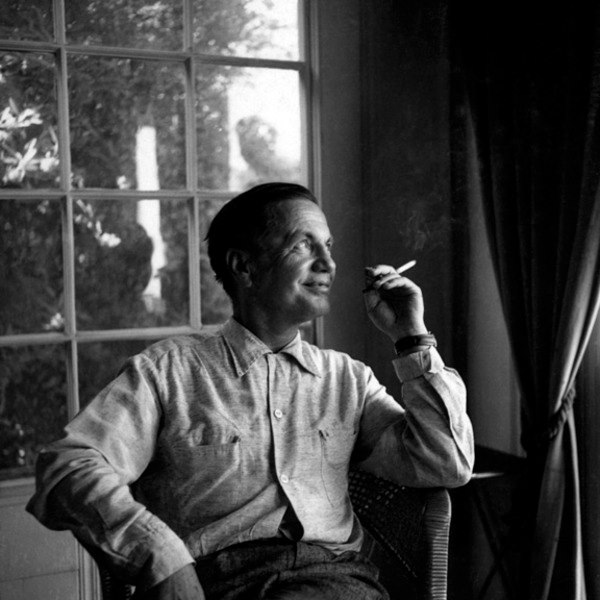
    Two peas in a pod: George Antheil, smoking, and Percy Grainger, smoking hot, in self-designed “toweling clothes”


Tag Cloud

Aaron Copland (93) Beethoven (95) Composer (114) Film Music (137) Film Score (143) Film Scores (255) Halloween (94) John Williams (195) KWAX (229) Leonard Bernstein (103) Marlboro Music Festival (125) Movie Music (152) Mozart (88) Opera (208) Philadelphia Orchestra (89) Picture Perfect (174) Princeton Symphony Orchestra (108) Radio (88) Ross Amico (244) Roy's Tie-Dye Sci-Fi Corner (290) The Classical Network (101) The Lost Chord (268) Vaughan Williams (103) WPRB (396) WWFM (881)

DON’T MISS A BEAT

Receive a weekly digest every Sunday at noon by signing up here


RECENT POSTS