With the grand cacophony of Christmas still fresh in everyone’s ears, I thought it only appropriate this week on “Picture Perfect” to focus on music from movies about toys.
Without giving anything away, in the unlikely event you don’t already know the story’s big pay-off, “Citizen Kane” (1941) is a film flanked by toys. There’s even a snow globe in the film’s opening montage. A certain memory of Kane’s childhood provides a poignant glimpse of the larger-than-life newspaper magnate’s lost innocence. “Kane” is often cited as one of the greatest films ever made. Orson Welles triumphed in his debut as writer-director-star, even if, ultimately, his creation proved to be a bottle rocket that blew up in his face. The film also marked the Hollywood debut of composer Bernard Herrmann.
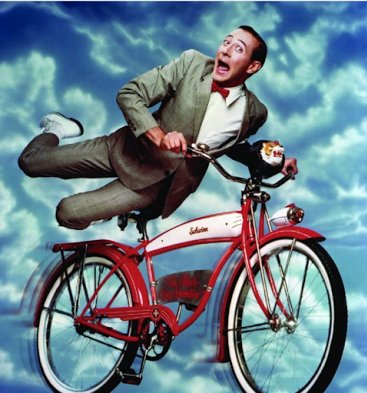
I’m not sure that “Pee-wee’s Big Adventure” (1985) could be described as the “Citizen Kane” of the ‘80s, exactly, but this endearingly goofy sojourn into the surreal does revolve around the recovery of a lost toy, as Pee-wee, the eternal boy, determines to make his way to “the basement of the Alamo” in an attempt to reclaim his stolen bike. The feature was director Tim Burton’s first. It was also his first collaboration with Danny Elfman, who is obviously a big fan of Nino Rota.
The husband-and-wife team of Charles and Ray Eames are better known for their contributions to architecture, industrial design, and manufacturing, but they also made short films. “Toccata for Toy Trains” (1957) was inspired by the Eames’ passion for vintage toys. The score was provided by their go-to composer, Elmer Bernstein.
Finally, in acknowledgement of the greatest toy series of our day, we’ll conclude with music from “Toy Story” (1995), the first full-length computer animated feature. The quality of the film propelled it beyond mere novelty status into the realm of instant classic, and the beloved “Toy Story” franchise has raked in hundreds of millions of dollars. Early on, it was decided by the filmmakers that they did not want “Toy Story” to be a musical, but that songs could be used to underline its emotional content. Randy Newman has provided the music for all the “Toy Story” films so far. He was recognized with an Academy Award for his work on “Toy Story 3,” for the song, “We Belong Together.”
Keep popping those aspirin. It’s “Toys Everywhere” this week, on “Picture Perfect,” music for the movies, now in syndication on KWAX Classical Oregon!
——–
Clip and save the start times for all three of my recorded shows:
PICTURE PERFECT, the movie music show – Friday at 8:00 PM EST/5:00 PM PST
SWEETNESS AND LIGHT, the light music program – Saturday at 11:00 AM EST/8:00 AM PST
THE LOST CHORD, unusual and neglected rep – Saturday at 7:00 PM EST/4:00 PM PST
Stream them, wherever you are, at the link!
https://kwax.uoregon.edu
Category: Daily Dispatch
-

The Sound of Silence, Christmas Eve Edition
Christmas Eve, already.
On this date in 1818, the Christmas carol “Silent Night” was first sung at St. Nicholas Church in Obendorf, Austria. The words were from a poem, “Stille Nacht,” written by a young Catholic priest, Joseph Mohr, in the aftermath of the Napoleonic Wars. It’s said that Mohr was inspired in part by a walk he took, on which he was impressed by the quiet, wintry aspect of his town at peace.
He handed the words off to the church’s choir director, Franz Xaver Gruber, who wrote the melody with a deadline looming for that evening’s mass. The carol was introduced on Christmas Eve, its creators singing it in duet, with Mohr on the guitar. (St. Nicholas Church was prone to flooding, which may have damaged the organ. Eventually, the church would be replaced by Silent Night Chapel.)
An organ builder and repairman heard the carol and took it with him back to his own village, where it was picked up by two separate families of traveling folk singers, the Strassers and the Rainers. The Rainers performed it before the King of Prussia and Tsar Alexander I and sang it for the first time in the United States, where they introduced it at the Alexander Hamilton Monument outside Trinity Church in New York City.
Nearly two centuries before social media, the carol went viral. You’d be hard-pressed to find anyone who doesn’t know it. It’s been recorded over 137,000 times, for the first time back in 1905.
Even given the irresistibly Romantic story of a priest introducing the carol to his congregation on a guitar on Christmas Eve, there had been speculation over the years attributing its creation to starrier names. It was only in 1994 that the original manuscript was discovered in Mohr’s hand. Scholars now believe that two years elapsed between the actual writing of the poem in 1816 and Gruber’s last-minute contribution of the indelible melody.
If this is true, it does nothing to take away from the carol’s magic, and the rare alchemy between poet and composer.
———-
Stained glass from Silent Night Chapel, reinforcing the legend of Gruber (as opposed to Mohr) on the guitar

-
German Christmas: A Time for Fantastic Fairy Tale Operas
How many people do you know that own TWO recordings of Hans Pfitzner’s “Das Christ-Elflein” (“The Christmas Elf”)? Well, now you know ONE.
I was riding around in the car yesterday, trying to knock out some last-minute, long-distance Christmas shopping, and after listening to Josef Rheinberger’s “The Star of the Bethlehem,” I popped in the Orfeo recording of “Das Christ-Elflein,” with Helen Donath in the title role and Kurt Eichhorn conducting. (That’s right, my car still has a CD player. In fact, it was the deciding factor in purchasing the vehicle.) If you’re curious, my other recording is a more recent one, on the CPO label, with Marlis Petersen as the Elf and Claus Peter Flor conducting.
The plot, based on an airy-fairy play by Ilse van Stach, concerns an Elf, who’s never heard of Christmas, and a grumpy old Fir Tree, who has and doesn’t like it. (Firs get chopped down at Christmas.) Despite the Fir Tree’s warnings about the heartlessness of the human race, the inquisitive Elf ventures into the world of men. It turns out it’s a rather depressing place.
When the Christ Child appears on Christmas Eve, the Elf wants to follow Him into heaven. But the Christ-Child has work to do: He’s to escort the soul of a dying girl. When the guileless Elf offers himself in her place, the Christ-Child accepts. The girl is restored, and the Elf returns every year at Christmas as the Christmas Elf. The opera concludes with a joyous Christmas party with the girl’s family.
In the Eichhorn recording, Donath makes a good Elf. Her voice and characterization convey innocence and purity. The jaded and embittered Fir Tree, on the other hand, is sung by Alexander Malta, whose pleasingly resonant voice belies a gruff exterior. Bass-baritones, it happens, are thick on the ground, and Nikolaus Hillebrand sings an authoritative, even noble Knecht Ruprecht (a gift-bearing companion of St. Nicholas).
The work itself is entertaining – it’s got some good bits, especially fun in the parts that incorporate quotations of “O Tannenbaum,” and there’s obviously also an ample amount of Christmas sentiment (okay, schmaltz) – but if I’m to be honest, it doesn’t hold a Christmas candle to the ne plus ultra of the genre, Engelbert Humperdinck’s “Hansel und Gretel.”
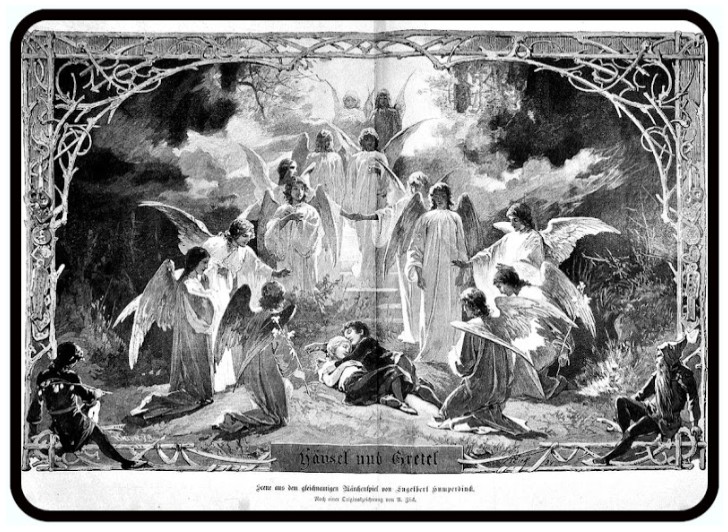
For a time, the fairy tale opera was to Germany what the ghost story was to England, a cherished Christmas tradition. “Hansel und Gretel” was given its first performance on this date in 1893 – with Richard Strauss, no less, directing the orchestra and cueing singers from the pit of Weimar’s Hoftheater. With its folk-like simplicity, visions of sweets, and Evening Prayer (replete with angels), it’s been part of the Christmas season ever since.
“Hansel und Gretel” had a foundational advantage in the familiar Brothers Grimm fairy tale. “Das Christ-Elflein” is a much stranger concoction, mixing sacred and secular – indeed pagan – elements into a heady Christmas punch.
The opera, really a singspiel (an entertainment with sung parts linked by spoken passages), first appeared in 1906 and was revised in 1917. It still gets revived in German-speaking countries, but in the two recordings I own, anyway, there is the drawback of interludes delivered by a German narrator. I would have preferred had the singer’s spoken dialogue been retained.
“Hansel and Gretel” was the first opera broadcast live on the radio from the Metropolitan Opera in 1931. Here’s a lovely, classic staging from the Met, prior to the current rage for Regietheater:
My favorite recording of the “Dream Pantomime,” with Otto Klemperer:
Elisabeth Schwarzkopf and Irmgard Seefried, with Josef Krips conducting, from 1947:
“Das Christ-Elflein”
-

The Holidays Are Not for the Weak
Limber up for the feats of strength. It‘s December 23rd. A Festivus for the rest of us! Seldom have I felt its spirit as strongly as I have this year. Gather ‘round the Festivus pole, and let the airing of grievances begin…

Tag Cloud
Aaron Copland (94) Beethoven (95) Composer (114) Film Music (149) Film Score (143) Film Scores (255) Halloween (98) John Williams (197) KWAX (232) Leonard Bernstein (105) Marlboro Music Festival (125) Movie Music (164) Mozart (91) Opera (215) Philadelphia Orchestra (90) Picture Perfect (174) Princeton Symphony Orchestra (110) Radio (90) Ross Amico (244) Roy's Tie-Dye Sci-Fi Corner (290) The Classical Network (101) The Lost Chord (269) Vaughan Williams (107) WPRB (397) WWFM (881)