I don’t know what it’s like where you are, but the madness is already underway here. If you celebrate Christmas, it’s likely your adrenaline is already up, as we prepare for a last-minute dash to the stores, a little surreptitious gift-wrapping, some early baking, or perhaps already receiving family.
This week on “Sweetness and Light,” we’ll stick to the basics, with an hour of music inspired by familiar Christmas carols and traditional Christmas songs.
In the former category, we’ll hear works by Philip Lane, Benjamin Britten, and Rick Sowash (his “Variations on The Boar’s Head Carol”). Then we’ll enjoy selections from a favorite Christmas album of mine, “Old Christmas Return’d,” from 1992, featuring early music performances by the York Waits. Some of these Christmas melodies have been around for an awfully long time!
In between, we’ll hear an original carol by John Rutter – now SIR John Rutter, who turned 80 in September – unbelievably, composed all the way back in 1972. I remember when it was a fairly new piece!
None of us are getting any younger. Recollect the holidays of your misspent youth with an hour of traditional carols for Christmas, on “Sweetness and Light,” this Saturday morning at 11:00 EST/8:00 PST, now in syndication on KWAX Classical Oregon!
Stream it wherever you are at the link:
https://kwax.uoregon.edu/
Category: Daily Dispatch
-

Carols Are Served on “Sweetness and Light”
-

A Cookie Platter of Christmas Television Specials on “Picture Perfect”
This week on “Picture Perfect,” slip into your jammies for an hour of music from classic Christmas television specials.
“The Snowman” (1982), based on the picture book by Raymond Briggs, is about a boy whose snowman comes to life and whisks him away on a journey to the North Pole. The show became enormously popular in the UK and through occasional showings on U.S. television. It was nominated for an Academy Award for Best Animated Short. Like the book, the film is wordless, using animation and music to tell its story, with the exception of an enchanting interlude, known as “Walking in the Air,” which employs a boy treble. “Walking in the Air” is easily the best-known music by Howard Blake.
The television film “The Homecoming” (1971) stars Patricia Neal and Richard Thomas in a heart-warming story about a rural family Christmas in 1933. Written by Earl Hamner, the film’s success spawned the television series “The Waltons.” Jerry Goldsmith wrote the music. He would return to work on “The Waltons” – though as of “The Homecoming,” he had yet to write the show’s indelible theme.
An adaptation of Charles Dickens’ “A Christmas Carol” (1954) was the subject of a special episode of the anthology series “Shower of Stars.” Fredric March plays Ebenezer Scrooge, and Basil Rathbone is Jacob Marley’s ghost. But it is Ray Middleton, who appears as both Scrooge’s nephew and the Spirit of Christmas Present, who is given arguably the show’s most memorable tune, “A Very Merry Christmas.” The teleplay and lyrics are by Maxwell Anderson, and the music is by Bernard Herrmann!
Finally, Christmas time is here, happiness and cheer, with “A Charlie Brown Christmas” (1965). We’ll hear the Vince Guaraldi Trio perform selections from this most beloved of Christmas classics.
For once, the snow will have nothing to do with your reception. We’ll think inside the box on “Picture Perfect,” music from classic Christmas television specials, now in syndication on KWAX Classical Oregon!
——–
Clip and save the start times for all three of my recorded shows:
PICTURE PERFECT, the movie music show – Friday at 8:00 PM EST/5:00 PM PST
SWEETNESS AND LIGHT, the light music program – Saturday at 11:00 AM EST/8:00 AM PST
THE LOST CHORD, unusual and neglected rep – Saturday at 7:00 PM EST/4:00 PM PST
Stream them, wherever you are, at the link!
-

Making Time for MacDowell
The holidays are already really heating up here. So much so, I’m not even getting around to posting today until just about suppertime.
The American pianist and composer Edward MacDowell was born on this date in 1860. Hopefully, you’re not as busy as I am, and you can cozy in for his “Fireside Tales.”
Of course, MacDowell’s best-known music would be the old chestnut “To a Wild Rose,” from his “Woodland Sketches.”
Here, Earl Wild performs MacDowell’s Piano Concerto No. 2. The composer’s admiration for Grieg (as well as Saint-Saëns and Liszt) is evident.
Hey, look! I found some footage of Wild playing the scherzo in a 1957 television broadcast.
Happy birthday, Edward MacDowell.
Now that my radio shows are in for the next two weeks, I’d better get back to shipping boxes and writing some Christmas cards…
Ho ho ho! -

“The Nutcracker” as Subversive Family Classic
If you ever detected a sinister undertow in Tchaikovsky’s ballet “The Nutcracker,” the source material, by E.T.A. Hoffmann, is much worse.
Hoffmann’s 1816 story focuses on the Nutcracker’s battle with the evil Mouse King, filtered through the vivid imagination of a doomed dreamer with a perpetual mistrust of adults. It’s Herr Drosselmayer all the way, baby.
It often puzzles me how so many adaptations of Hoffmann’s stories gloss over the sinister and the uncanny elements. “The Nutcracker” has its share of up-tempo numbers. They’re mostly the ones we hear in stores while we’re out Christmas shopping. However, there’s little doubt the composer grasped the inexorable undertow of Hoffmann, since his score conveys plenty of anxiety to counterbalance the twee sweets.
Listen to the bass clarinet slither beneath that glittery celesta in the “Dance of the Sugar Plum Fairy.” And what’s all that creeping around, with the disturbing sforzandi? There’s something desperate and perhaps a little manic underpinning the magic.
Maurice Sendak completely gets it. If you have never seen Carroll Ballard’s 1986 film of “The Nutcracker,” with the Sendak designs and dancers of Pacific Northwest Ballet, you should make it a point to do so. Its sugar plums are all steeped in acid. Sir Charles Mackerras conducts the London Symphony Orchestra on the soundtrack.
I’m not even sure I could describe the subtext as Freudian. It’s just out there. And it has the best WTF ending of all “Nutcracker” adaptations.
But if it’s snowflakes and flowers you’re interested in, here’s an extended suite of highlights with the Boston Pops conducted by Arthur Fiedler, on Fiedler’s birthday.
Get crackin’!
-
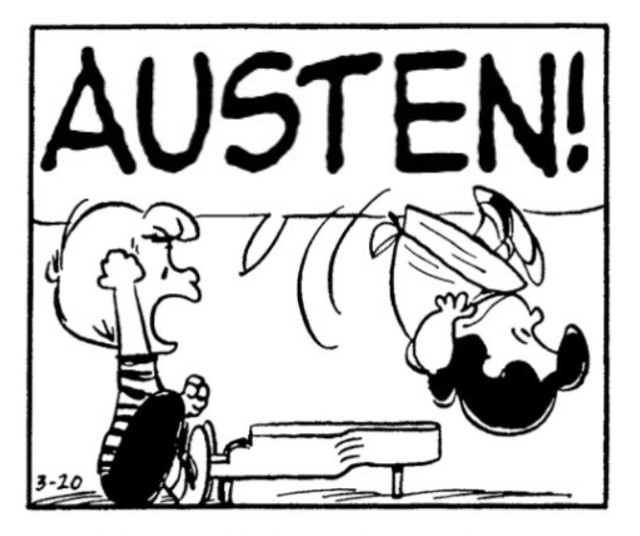
A Lot of Candles for Beethoven and Jane Austen
Beethoven (1770-1827) and Jane Austen (1775-1817) share a birthday!
Although the two were contemporaries, they most certainly never met, although Jane’s family kept music books. 18 collections survive – 600 hundred pieces of sheet music – two of the volumes consisting of music copied out in Jane’s hand.
Beethoven doesn’t appear to have been a great favorite. Rather, the Austens gravitated more toward Clementi, Handel, Haydn, Mozart, Pleyel, and Thomas Arne (Jane painstakingly transcribed the overture to “Artexerxes”). Allegedly, in her novels, Austen mentions only one composer by name: Johann Baptist Cramer. I haven’t read enough of her books (only two, but working on a third), or kept notes, to be sure. But there are allusions to others.
The Austen family music books may be perused online, thanks to the University of Southampton. You’ll find access at the bottom of the page at the link:
https://www.southampton.ac.uk/news/2015/12/jane-austen-music-books.page
Gillian Dooley, who catalogued the contents, has written her own book, “She Played and Sang: Jane Austen and Music” (Manchester University Press, 2024), based on her research.
https://janeaustensworld.com/tag/austen-music-manuscripts/
Of perhaps related interest, Sony Classical recently released an album by Jeneba Kanneh-Mason, “Jane Austen’s Piano,” a recital of works Jane might have known, including music by Handel, Haydn, Kiallmark, and Cramer, as well as a transcription of some of Dario Marianelli’s music for the 2005 film adaptation, “Pride & Prejudice.”
https://www.kannehmasons.com/2025/10/03/jeneba-kanneh-masons-new-ep-jane-austen-piano-coming-december-2025-on-sony-classical/
Jane attended recitals in salon settings and opera performances at Covent Garden when visiting her brother in London. She herself played the piano for pleasure.
Happy 250th birthday, Jane Austen, and happy 255, Beethoven!
Tag Cloud
Aaron Copland (94) Beethoven (95) Composer (114) Film Music (149) Film Score (143) Film Scores (255) Halloween (99) John Williams (197) KWAX (232) Leonard Bernstein (105) Marlboro Music Festival (125) Movie Music (164) Mozart (91) Opera (215) Philadelphia Orchestra (90) Picture Perfect (174) Princeton Symphony Orchestra (110) Radio (90) Ross Amico (244) Roy's Tie-Dye Sci-Fi Corner (290) The Classical Network (101) The Lost Chord (269) Vaughan Williams (107) WPRB (397) WWFM (881)