Category: Daily Dispatch

  • Classical Christmas Music Beyond the Carols

    Classical Christmas Music Beyond the Carols

    This time of year, with Christmas still weeks away, I’m never quite sure if I’m programming too much holiday music, or not quite enough. I walk away from an air shift feeling vaguely uneasy, as if I’ve served up a platter that is neither fish nor fowl.

    Of course, if I were putting together a playlist entirely for myself, it would be all-mistletoe all the time. But I’m confident that, as the Big Day draws nigh, I will cross the tipping point and everything will start to feel a bit more natural and perhaps more satisfying. In the classical music world, the demarcation seems to be Beethoven’s birthday (December 16).

    When it comes to Christmas, I think classical music stations tend to work against themselves. By the third week of December, listeners have already been subjected to countless arrangements of the same ten or 15 carols. Naturally, a kind of fatigue begins to creep in. 1000 years of Christmas music, and the scale tips in favor of “Hark! The Herald Angels Sing.”

    If stations were more creative in their programming for Christmas, balancing the secular with the sacred, and broadening the coverage to incorporate music from all eras, from the Middle Ages to the present – allowing for abundant interludes in the form of winter portraits or evocations of the seasons – it could make for a truly stimulating month, and perhaps the backlash wouldn’t be so extreme. There’s so much music that we never get to hear.

    Consider all this as preamble to today’s Noontime Concert on The Classical Network. Piffaro, The Renaissance Band will be joined by Les Canards Chantants and actors Mark Jaster and Sabrina Mandell for a program of 15th century Christmas music, titled “A French Noël.” David Osenberg will be your host and Piffaro artistic directors Joan Kimball and Robert Wiemken will provide commentary.

    I’ll be around at 1:40. At 2:00, we’ll cross the channel for Rutland Boughton’s “Bethlehem,” a choral drama adapted from the 14th century Coventry Nativity Play. Composed in 1915 and written very much in the English pastoral idiom, the work incorporates familiar carols, such as “O come all ye faithful” and “The Holly and the Ivy.”

    Taking a page from Richard Wagner, Boughton composed a cycle of five operas on Arthurian themes and started a Glastonbury Festival, in the style of Bayreuth. Alas, neither the operas nor the festival, as it was originally conceived, have endured.

    In Boughton’s “Bethlehem,” the shepherds bear gifts of a penny whistle, a hat, and a pair of warm mittens. The Three Wise Men hobnob with Herod, Zarathustra, and yes, Merlin. If you gravitate toward the music of Ralph Vaughan Williams, you’re bound to fall under the work’s disarming spell.

    It’s never too early to be Early. Join us for a Piffaro Noël, and then on to Coventry, from 12 to 4 p.m. EST, on WWFM – The Classical Network and wwfm.org.
  • Emil Waldteufel Christmas Roses and Waltzes

    Emil Waldteufel Christmas Roses and Waltzes

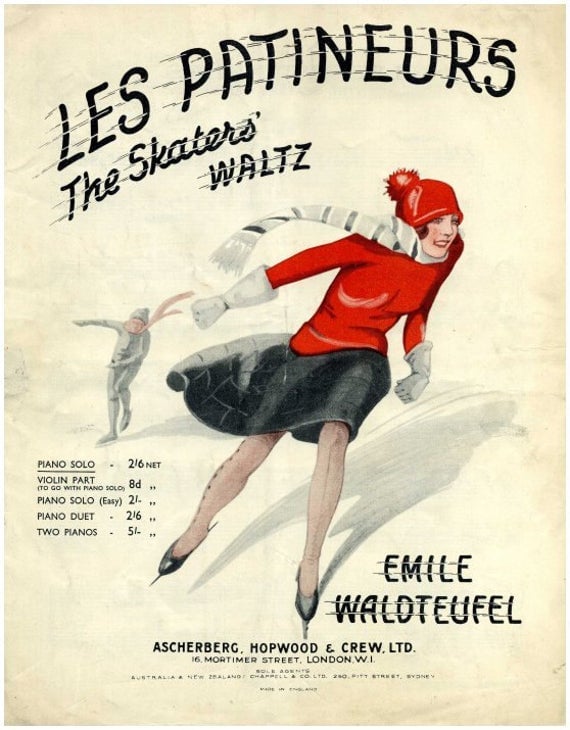
    Only days after the arrival of Krampus, the Christmas devil, comes Emil Waldteufel. Waldteufel is German for forest devil. Emil Waldteufel was born on this date in 1837.

    Though Waldteufel had long been a mainstay of Paris society balls of the Second Empire, he was nearly 40 by the time he achieved international fame. It was the Prince of Wales – the future King Edward VII – who introduced him to London, and his music came to dominate Queen Victoria’s state balls at Buckingham Palace. One of his best-known works, “Les Patineurs” (“The Skaters’ Waltz”) was introduced there in 1882. Another of his most successful waltzes, from the other end of the decade, was “Roses de Noël” (“Christmas Roses”).

    The holidays are in bloom! Take time to smell the roses, from 4 to 7 p.m. EST, on WWFM – The Classical Network and wwfm.org.
  • Sibelius Board Game and Incidental Music This Sunday

    Sibelius Board Game and Incidental Music This Sunday

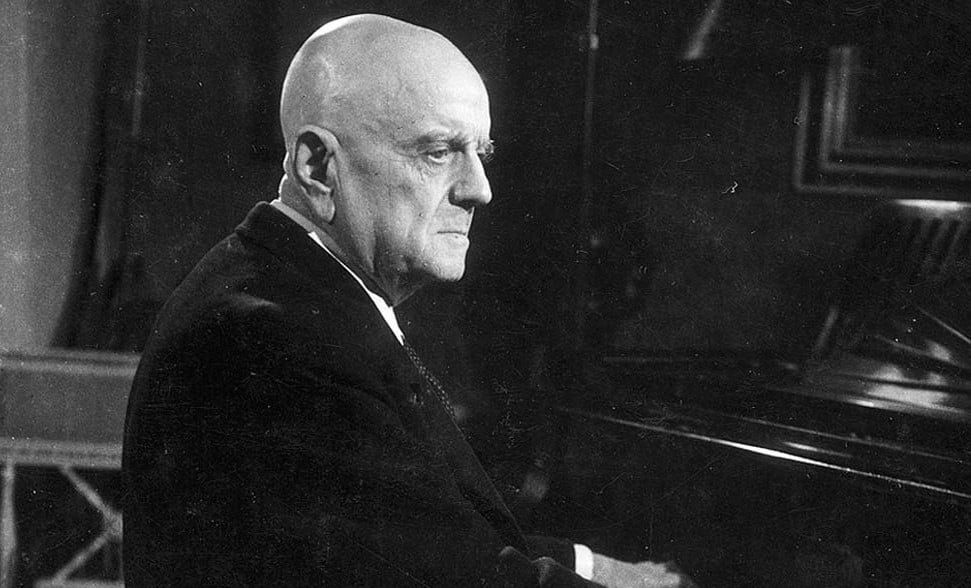
    Looking to kill time until tonight’s episode of “The Lost Chord?” Why not gather the family for a rollicking game of Sibelius? I’m not kidding, there really is a Sibelius board game (see below).

    Then join me for “Sibelius, Incidentally” – an hour of incidental music by Finland’s most famous composer – this Sunday night at 10:00 EST, on WWFM – The Classical Network and wwfm.org.
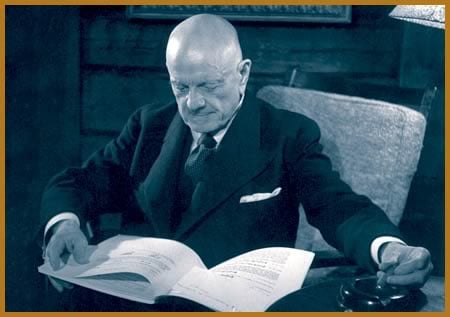
    Is this a drinking game?

    Sibelius Board Game

  • Sibelius’ Lost Symphony The Mystery of Ainola

    Sibelius’ Lost Symphony The Mystery of Ainola

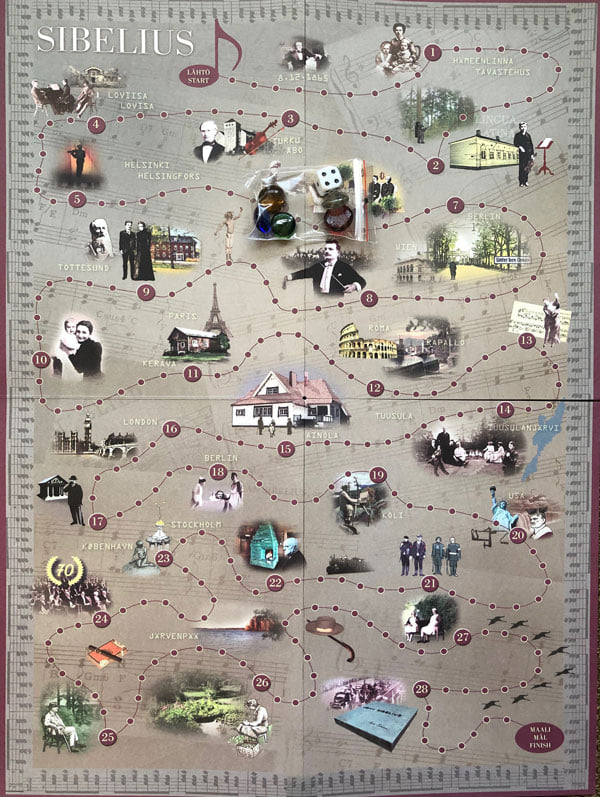
    For the last 30 years of his life, Jean Sibelius was gripped by what became known as “The Silence from Järvenpää.” Järvenpää is the name of the Finnish market town outside of which the composer made his home. He called that home Ainola, after his wife, Aino, who in turn was named for a character in the Kalevala, the Finnish national epic.

    After the completion of the Symphony No. 7 and the tone poem “Tapiola” in the mid-1920s, Sibelius created no further major works. Or did he? He was known to have grappled with the composition of an eighth symphony, the manuscript of which he is said to have destroyed. I heard as much from the mouth of his own grandson, who claimed to have been present at its burning.

    However a few tantalizing sketches emerged, seemingly out of nowhere, in 2011. Is it possible that more may have survived? Perhaps somewhere, among the composer’s papers, a draft could even exist. I’m not in favor of reconstruction from mere fragments, but if there is a somewhat complete version of the symphony, even in embryonic form, I would be very interested to hear it.

    It makes my heart ache to listen to these sketches and contemplate that there might actually have been another Sibelius symphony, had the composer only been able to conquer his demons and hold it together one more time.

  • Sibelius Stage Music Rediscovered

    Sibelius Stage Music Rediscovered

    Jean Sibelius was the composer of seven numbered symphonies that stand like granitic monoliths at the heart of 20th century music. Less well known, perhaps, is the abundant music he wrote for the stage.

    This Sunday night on “The Lost Chord,” we’ll mark the anniversary of Sibelius’ birth with a selection from his incidental music.

    Born on this date in 1865, Finland’s most celebrated composer was known to agonize over every aspect of his large-scale compositions. He wound up burning the unfinished manuscript to what would have been his eighth symphony and composed nothing of consequence for the last three decades of his life.

    Any opportunity to work in the theater must have come as an enormous relief. Here, Sibelius could act as a kind of sketch artist, setting scenes or creating moods in the most succinct fashion. Of course, he also would have written music for the entr’actes and interludes, which could have satisfied a desire for a bit more development.

    His output for the stage was fairly substantial, and yet – with the exception of the ever-popular “Valse triste” (from the play “Kuolema,” or “Death”) and perhaps some selections from “Pelleas and Melisande” or “The Tempest” – it remains stubbornly unfamiliar. When is the last time anyone heard music from “The Lizard?”

    In 1905, Hjalmar Procopé wrote a play on the subject of “Belshazzar’s Feast,” dramatizing the well-worn episode from the Book of Daniel, about a Babylonian tyrant who literally sees the writing on the wall. We’ll hear a 1932 recording of a selection from Sibelius’ music, conducted by the composer’s good friend and drinking buddy, Robert Kajanus.

    “Jedermann” (or “Everyman”) was the product of Strauss librettist Hugo con Hofmannsthal, an updated version of a medieval morality play. Sibelius worked at his contributions to a 1915 production, alongside substantial revisions to one of his greatest works, the Symphony No. 5. We’ll sample from the world premiere recording of incidental music to “Jedermann,” conducted by Osmo Vänskä.

    That’s “Sibelius, Incidentally” – Jean Sibelius treads the boards – this Sunday night at 10:00 EST on WWFM – The Classical Network and wwfm.org.

Tag Cloud

Aaron Copland (93) Beethoven (95) Composer (114) Film Music (137) Film Score (143) Film Scores (255) Halloween (94) John Williams (195) KWAX (229) Leonard Bernstein (103) Marlboro Music Festival (125) Movie Music (152) Mozart (88) Opera (208) Philadelphia Orchestra (89) Picture Perfect (174) Princeton Symphony Orchestra (108) Radio (88) Ross Amico (244) Roy's Tie-Dye Sci-Fi Corner (290) The Classical Network (101) The Lost Chord (268) Vaughan Williams (103) WPRB (396) WWFM (881)

DON’T MISS A BEAT

Receive a weekly digest every Sunday at noon by signing up here


RECENT POSTS