Category: Daily Dispatch

  • Copland’s Violin Sonata A Pearl Harbor Elegy

    Copland’s Violin Sonata A Pearl Harbor Elegy

    On the morning of December 7, 1941, a Japanese strike force of 353 aircraft laid waste to the United States naval base on Oahu, Hawaii. Thousands of American servicemen and civilians were killed, precipitating the country’s entry into World War II.

    Though Europe, Russia, and the Far East were already at war, for the U.S. the attack on Pearl Harbor was an unwelcome surprise in peacetime. It brought with it not only the loss of life, but also a loss of innocence. It is a date that has, as President Roosevelt so memorably expressed, lived in infamy.

    For Aaron Copland, in common with millions of Americans, the war was not simply an abstraction. The ripple effect from Pearl Harbor would claim the life of his friend, Lieutenant Harry H. Dunham, a pilot killed while on active duty in the Pacific.

    News of Dunham’s death reached Copland just as he had put the finishing touches on his Violin Sonata in 1943. Copland’s response was to dedicate the work to the memory of his friend. While there is no way Copland could have known of Dunham’s imminent demise, for a listener, the extra-musical association lends the sonata’s central movement an added poignancy.

    A graduate of Princeton University, Dunham was a familiar figure on the New York City arts scene. He was close enough to Copland to have traveled to Morocco with him and writer-composer Paul Bowles.

    Virgil Thomson wrote of the Violin Sonata in the New York Herald Tribune, “I suspect it is one of the author’s most satisfying pieces… It has a quality at once of calm elevation and buoyancy that is characteristic of Copland and irresistibly touching.”

    Here is Copland’s sonata at its world premiere, with violinist Ruth Posselt and the composer at the keyboard. Amazing what one can find on YouTube.

  • St Nicholas Day Celebration on WWFM

    St Nicholas Day Celebration on WWFM

    Today is the feast day of St. Nicholas!

    The gruff-but-lovable bishop, who bears little resemblance to his jolly, elfin descendant, is the patron saint of just about everyone, but most especially children.

    We’ll honor him with music performed by treble choristers of King’s College, Cambridge, under the direction of the late Stephen Cleobury, and a selection from the Anonymous 4 album, “Legends of St. Nicholas.”

    We’ll also celebrate the birthday today of another Nicholas – Nikolaus Harnoncourt – who would have been 90. Harnoncourt will conduct one of the orchestral suites of Georg Philipp Telemann. In addition, we’ll light some candles and share some cake with composers John Fernstrom, Henryk Gorecki, Joseph Lamb, Alexander Moyzes, Bright Sheng, Tomas Svoboda, and Orazio Vecchi.

    At 6:00, we’ll recollect the wonders of childhood, with music from cinematic fairy tales, on “Picture Perfect,” including “The Wonderful World of the Brothers Grimm” (Leigh Harline), “The Company of Wolves” (George Fenton), “Puss in Boots” (Henry Jackman), and “La Belle et La Bête” (Georges Auric).

    Hopefully, St. Nicholas will be on his best behavior. Even when he punches out heretics, he always means well.

    Join me, in the nick of time, from 4 to 7 p.m. EST, on WWFM – The Classical Network and wwfm.org.

  • Fairy Tale Film Scores for St Nicholas Day

    Fairy Tale Film Scores for St Nicholas Day

    This week on “Picture Perfect,” on this St. Nicholas’ Day, we revisit familiar tales learned in childhood.

    George Pal’s “The Wonderful World of the Brothers Grimm” (1962) was filmed in Cinerama and features the producer-director’s trademark stop motion effects. Its all-star cast includes Laurence Harvey, Claire Bloom, Barbara Eden, Russ Tamblyn, and Buddy Hackett. The narrative incorporates a number of familiar Grimm tales, while dealing with the brothers’ real-life struggles.

    The music is by Leigh Harline. Harline was an integral part of the Disney team that scored an earlier fairy tale adaptation, “Snow White and the Seven Dwarfs.” He won two Academy Awards for his work on “Pinocchio,” including one for Best Original Song, for “When You Wish Upon a Star.”

    “The Company of Wolves” (1984), one of director Neil Jordan’s earlier films, explores the psychological underpinnings of the tale of “Little Red Riding Hood,” which is presented as an allegory of adolescence and the loss of innocence. Angela Carter co-wrote the screenplay, based upon a selection of her original short stories. The film features Angela Lansbury, any number of werewolves, and Terence Stamp as the Devil. The music is by George Fenton.

    With the advent of computer animation, a snarkier, post-modern take on the fairy tale predominates, most notably with the “Shrek” series, beginning in 2001. The “Shrek” films were so successful, they led to a spin-off, centered on the character of “Puss in Boots” (2011).

    Voiced by Antonio Banderas, Puss provides ample opportunity to vamp on the actor’s swashbuckler image, especially as depicted in “The Mask of Zorro.” Likewise, the composer, Henry Jackman, chooses to rib James Horners’ “Zorro” score.

    Finally, we’ll hear selections from perhaps the finest fairy tale ever committed to film, Jean Cocteau’s “La Belle et la Bête” – “Beauty and the Beast” (1946). Moody, atmospheric, dreamy, clever, hypnotic, funny and romantic, Cocteau’s masterpiece stars Jean Marais and Josette Day. The production design looks like something Gustav Doré might have conceived while smoking some Dutch Masters cigars.

    The alternately mysterious and majestic score is by Georges Auric. Cocteau, you’ll recall, was the one-man publicity machine that propelled Auric and his composer-colleagues, Francis Poulenc, Darius Milhaud, Arthur Honegger, Germaine Tailleferre, and Louis Durey, to fame in Paris circa 1920, dubbing them “Les Six.”

    I hope you’ll join me for an hour of once-upon-a-time and happily-ever-after, on “Picture Perfect,” music for the movies, this Friday evening at 6:00 EST, on WWFM – The Classical Network and wwfm.org.

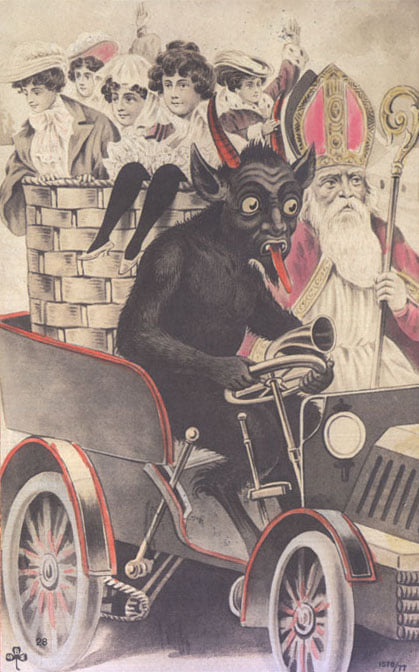
  • Krampus Piano Christmas Devil Has a Heart

    Krampus Piano Christmas Devil Has a Heart

    Even the Christmas devil has his sensitive side. Enjoy the piano stylings of Krampus.

    December 5 is Krampus Night. Season’s beatings!

  • Mozart’s Death Krampus Connection?

    Mozart’s Death Krampus Connection?

    How is it that I never before drew the connection?

    You know, every once in a while, how someone comes up with a new theory about the identity of Jack the Ripper, or claims to have discovered the secret of Elgar’s “Enigma Variations?” Well, it only just occurred to me, I may have solved the mystery of Wolfgang Amadeus Mozart’s death. And it is far more sinister than any alleged poisoning by Antonio Salieri.

    Mozart gave up the ghost on this date in 1791. A prodigy at the keyboard and on the violin, and a composer from the age of five, alas, in death he was also ahead of the curve.

    Mozart was 35 at the time of his passing, yet there was always something childlike in his personality. At times, he seemed much younger than his years. There’s no question that he could be naughty. He was certainly disobedient to his father, autocrat though he was. He defied the Pope, was extravagant in his spending, was inappropriate in his speech, and could be perhaps a mite too arrogant for his own good.

    The cause of Mozart’s death was recorded as “severe military fever.” Even so, over the years, there have been dozens of theories put forth as to the true nature of his passing. Acute rheumatic fever. Streptococcal infection. Influenza. Mercury poisoning. A rare kidney ailment. Even a bad pork chop. Combined, of course, with overwork.

    Alas, we’ll never know for sure. Mozart was buried in a common grave – not a communal grave, or a pauper’s grave, as has been frequently stated, but one whose wooden marker has long since worn away.

    Here’s the thing. December 5, the date of Mozart’s passing, also happens to be Krampusnacht. As a former native of Salzburg and later Vienna, Mozart should have known better. Because, you see, Austria is the dark, beating heart of the Christmas devil.

    What exactly is Krampus? Why, he’s St. Nicholas’ austere helper. Horned, hairy, and egregiously long-tongued, Krampus emerges from his Alpine domain to assist the patron saint of children on the eve of his feast day. Saint Nick bestows small gifts to all the good girls and boys. The rest are handed over to Krampus.

    For milder offenses, there is the sting of the switch; for the especially ill-behaved, there are chains, a short ride in a wicker basket, and drowning in a stream or immolation by hellfire. When a recalcitrant child hears the dull clatter of approaching cow-bells on December 5, he knows it’s all over. With anxiety a thousand times worse than the anticipation of a bad report card, the wee sinner pulls the sweat-soaked blankets over his head and prays vociferously for a stocking full of coal.

    No doubt, Mozart was a chronic offender. Could he have withstood a sound thrashing in his weakened state?

    Confutatis maledictus, indeed.

Tag Cloud

Aaron Copland (93) Beethoven (95) Composer (114) Film Music (137) Film Score (143) Film Scores (255) Halloween (94) John Williams (195) KWAX (229) Leonard Bernstein (103) Marlboro Music Festival (125) Movie Music (152) Mozart (88) Opera (208) Philadelphia Orchestra (89) Picture Perfect (174) Princeton Symphony Orchestra (108) Radio (88) Ross Amico (244) Roy's Tie-Dye Sci-Fi Corner (290) The Classical Network (101) The Lost Chord (268) Vaughan Williams (103) WPRB (396) WWFM (881)

DON’T MISS A BEAT

Receive a weekly digest every Sunday at noon by signing up here


RECENT POSTS