31 DAYS OF HALLOWEEN (DAY 17)
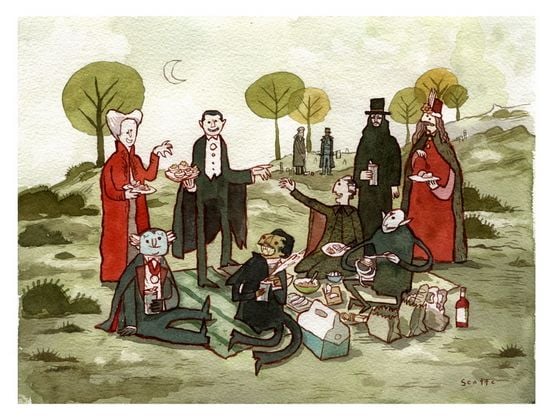
Eat your heart out, Debussy – or the Count will do it for you!
“L’après-midi du Dracoula” by Robert Moran:
IMAGE: “Picnic with the Draculas,” Scott Campbell
31 DAYS OF HALLOWEEN (DAY 17)
Eat your heart out, Debussy – or the Count will do it for you!
“L’après-midi du Dracoula” by Robert Moran:
IMAGE: “Picnic with the Draculas,” Scott Campbell
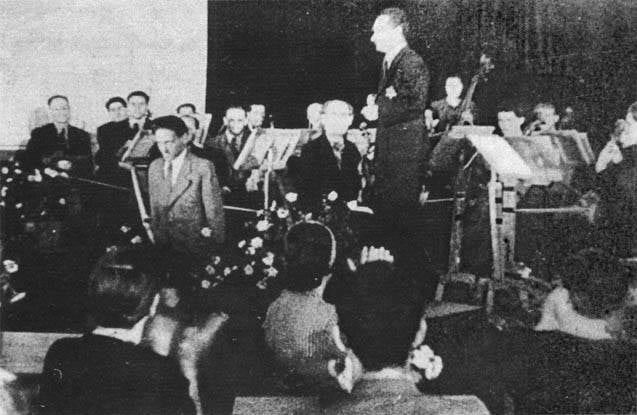
75 years ago today, three of the most promising composers of their generation were snuffed out in the gas chambers at Auschwitz. Pavel Haas, Hans Krása and Viktor Ullmann were all transported in cattle cars from Theresienstadt (Terezin), the Nazi propaganda camp, three days after their final concert on October 14. With them was the famed conductor Karel Ančerl, who had led the performances.
Immediately upon arrival, Krása, Ullmann and Ančerl were marked for death by Josef Mengele, while Haas was selected to join the forced laborers. Then all at once Haas began to cough. Ančerl was passed over and Haas was sent to be gassed in his place.
In the propaganda film “Theresienstadt,” Haas is shown taking a bow after a performance in Terezin of his “Study for String Orchestra,” a work he had written in the camp. Ančerl can be seen on the podium.
In the same film, children sing a selection from Krása’s opera “Brundibár.” When filming wrapped, having served their purpose, 18,000 prisoners, Haas and the children included, were deported to Auschwitz. By a large margin, most did not survive.
Haas had become despondent upon his arrival in Terezin. It was fellow composer Gideon Klein who urged him to continue to create. (Klein would die under unclear circumstances in 1945.) Haas wrote at least eight compositions during his internment. His “Study for String Orchestra,” rescued by Ančerl after the liberation of the camp, would become his best-known music. Haas was at work on a large-scale symphony at the time of his deportation. The surviving turso of the piece was orchestrated by Zdeněk Zouhar in 1994.
It was Ančerl himself who related the circumstances of Haas’ death to the composer’s brother after the war. Ančerl had lost his own family, his wife and a young son. He himself went on to a bright future. He became artistic director of the Czech Philharmonic in 1950, in which capacity he championed the great Czech composers and helped to foster a distinctly Czech sound in orchestral performance.
After the Warsaw Pact invasion, he left Czechoslovakia for Toronto, Canada, where he served as music director of the Toronto Symphony Orchestra until his death in 1973. None of it would have happened, if not for a quirk of fate.
Thirty years after his death, the music of Haas and his colleagues began to be performed with much more frequency. Much of it is now available in recordings. Listening to it, one can’t help but marvel at the will to create and to survive, even under the most horrific of circumstances, and lament at how history, musical and otherwise, might have been very different had those interned been allowed to live out their natural lives.
Here’s a clip of “Brundibár,” particularly affecting when we realize that few of the children survived:
Also, Haas’ “Study for String Orchestra”:
PHOTO: Pavel Haas, inadvertent savior of Karel Ančerl (also pictured), takes his final bow
31 DAYS OF HALLOWEEN (DAY 16)
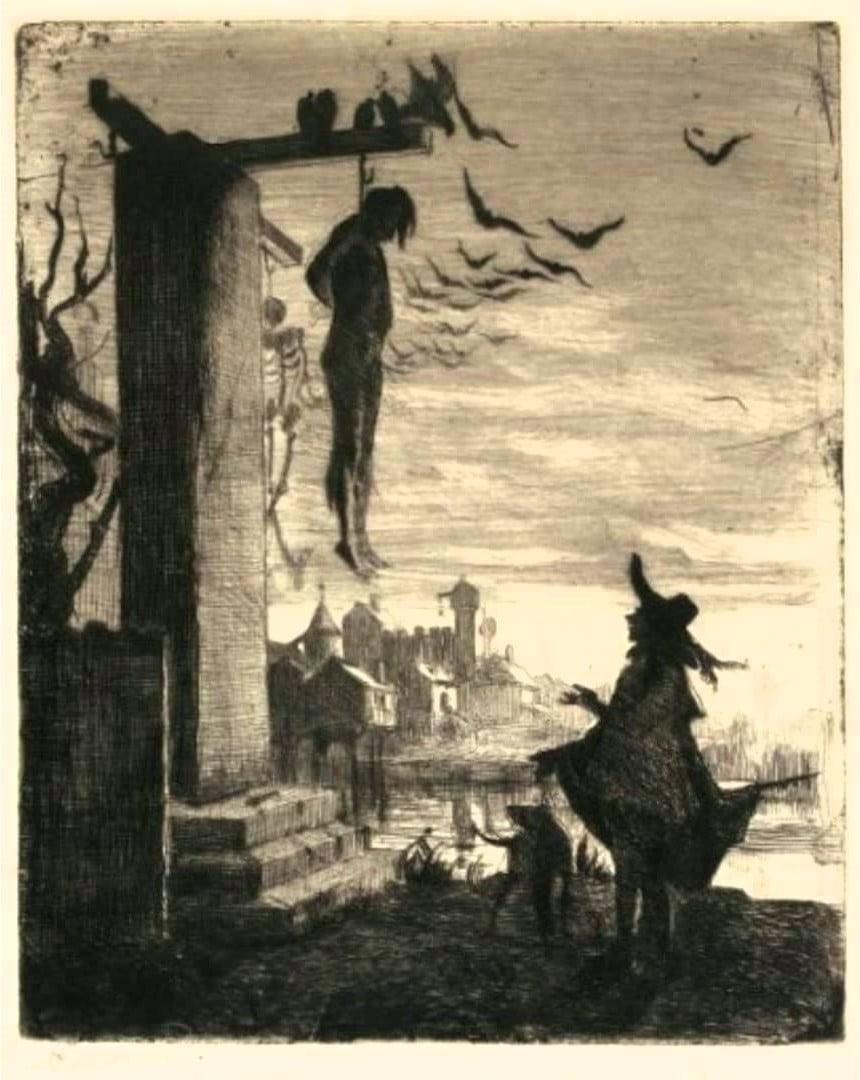
It’s a dark and stormy night. Keep an eye out for Ondine, Scarbo, and the hanged man on the gibbet! Sir John Gielgud recites Aloysius Bertrand’s poetry, and Gina Bachauer performs Maurice Ravel’s “Gaspard de la Nuit.”

Autumn comes to Vermont on this week’s “Music from Marlboro,” as Pablo Casals conducts the Marlboro Festival Orchestra in a performance of Wolfgang Amadeus Mozart’s Symphony No. 40 in G minor.
Of Mozart’s 41 numbered symphonies, only two are cast in a minor key. (The other, in case you’ve forgotten, is the Symphony No. 25, also in the key of G minor.) This is the Mozart of shadows and dark poetry. The performance, from 1968, is a strong one, propulsive and compelling, with a powerful sense of purpose. It’s hard to believe the maestro was 91 years-old!
Some of Casals’ recordings as conductor can be a little raggedy from time to time – this was, after all, a makeshift ensemble, albeit one made up of some of the world’s greatest musicians – but any rough edges are of secondary consideration, when taking into account the spontaneity and excitement of the live concert experience. In the case of Mozart’s 40th, the players follow their leader with uncanny precision and plenty of fire.
Franz Schubert’s “Introduction and Variations on ‘Trockne Blumen’” takes its theme from his song cycle “Die schöne Müllerin.” These settings of poems by Wilhelm Müller form a narrative about a wanderer who falls in love with a miller’s beautiful daughter (hence, the title). Unfortunately, he is supplanted in her affections by a strapping hunter bedecked in green. The color becomes something of a morbid obsession. The wanderer fantasizes about his own death and ultimately drowns himself in the stream that had led him to the mill.
“Trockne Blumen” (“Withered Flowers”) is one of the last songs in the cycle. The wanderer imagines reclaiming his dried-up flowers from the miller’s daughter and bearing them to his grave, from which, he muses, they will spring afresh as witnesses to his true love.
Schubert’s variations on his own song were performed at the Marlboro Music Festival in 1968, by flutist Paula Robison and pianist Rudolf Serkin.
Remember that the first of this season’s Marlboro tours will take place from October 19th to October 27th, with stops in Groton, Massachusetts; Weill Recital Hall at Carnegie Hall in New York City; the Perleman Theater at the Kimmel Center for the Performing Arts in Philadelphia; the Freer Gallery’s Meyer Auditorium in Washington D.C., and at Longy School of Music in Boston.
On the program will be Mozart’s Oboe Quartet in F major, Beethoven’s String Quartet in F, Op. 59. No. 1, and a work by Brett Dean, for soprano and string quartet, “And Once I Played Ophelia” – Dean’s String Quartet No. 2. Brett Dean was composer-in-residence at Marlboro in 2017. For tickets and information, visit marlboromusic.org.
It’s withered flowers and minor keys, on this week’s “Music from Marlboro.” Mozart and Schubert get their brood on, this Wednesday evening at 6:00 EDT, on WWFM – The Classical Network and wwfm.org.
Marlboro School of Music and Festival: Official Page
31 DAYS OF HALLOWEEN (DAY 15)
On this date in 1886, Modest Mussorgsky’s “A Night on Bald Mountain” was given its posthumous debut. The premiere took place in St. Petersburg, with the Russian Symphony Orchestra conducted by Nikolai Rimsky-Korsakov.
Mussorgsky’s rough-hewn textures, idiosyncratic harmony, slap-dash orchestration, and illogical modulations were often viewed as “mistakes” by his well-intentioned contemporaries. The composer was notoriously fond of alcohol, flamboyantly reckless, until a series of seizures sent him into a rapid decline. A week after his 42nd birthday, Modest Mussorgsky was dead.
Understandably, many of the artistic choices of this raging bull of a man were regarded with skepticism and even pity.
It is through the arrangements, revisions and completions of his friend, Rimsky-Korsakov, that “A Night on Bald Mountain,” “Boris Godunov,” and “Khovanschina” became world-famous. It is only in recent decades that Mussorgsky’s original thoughts have been reassessed. And you know what? The guy may have been a total slob, but he was brilliant.
“A Night in Bald Mountain” exists in several incarnations, the first dating all the way back to 1867. It was a symphonic poem; it was outfitted with a chorus for a collaborative project by members of the Mighty Handful (the opera-ballet “Mlada”); and it was plugged into one of Mussorgsky’s own operas, “Sorochinsky Fair,” left incomplete at the time of the composer’s death.
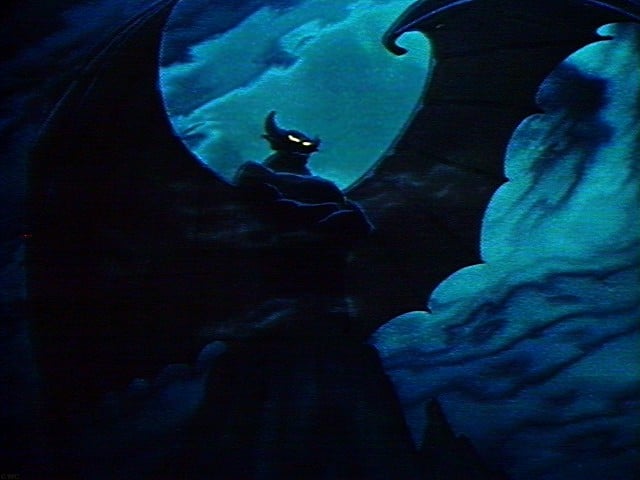
Some fifty years after “Bald Mountain’s” debut in the Rimsky edition, Leopold Stokowski made his own arrangement for the Walt Disney classic, “Fantasia.” And it’s been scaring the hell out of little kids ever since. Happy Hallowe’en!
Behold, the demon Chernabog:
“The Scary Origins of Disney’s Most Evil Character”
Aaron Copland (93) Beethoven (95) Composer (114) Film Music (137) Film Score (143) Film Scores (255) Halloween (94) John Williams (195) KWAX (229) Leonard Bernstein (103) Marlboro Music Festival (125) Movie Music (152) Mozart (88) Opera (208) Philadelphia Orchestra (89) Picture Perfect (174) Princeton Symphony Orchestra (108) Radio (88) Ross Amico (244) Roy's Tie-Dye Sci-Fi Corner (290) The Classical Network (101) The Lost Chord (268) Vaughan Williams (103) WPRB (396) WWFM (881)