You may have heard the big news by now, that a couple of organ works by Johann Sebastian Bach have been rediscovered. New works by Bach! Well, kind of. They were actually uncovered all the way back in 1992, while researcher Peter Wollny was cataloguing Bach manuscripts at the Royal Library of Belgium in Brussels. But the mills of the gods grind slowly, and IT TOOK 30 YEARS, I guess, to confirm their authenticity.
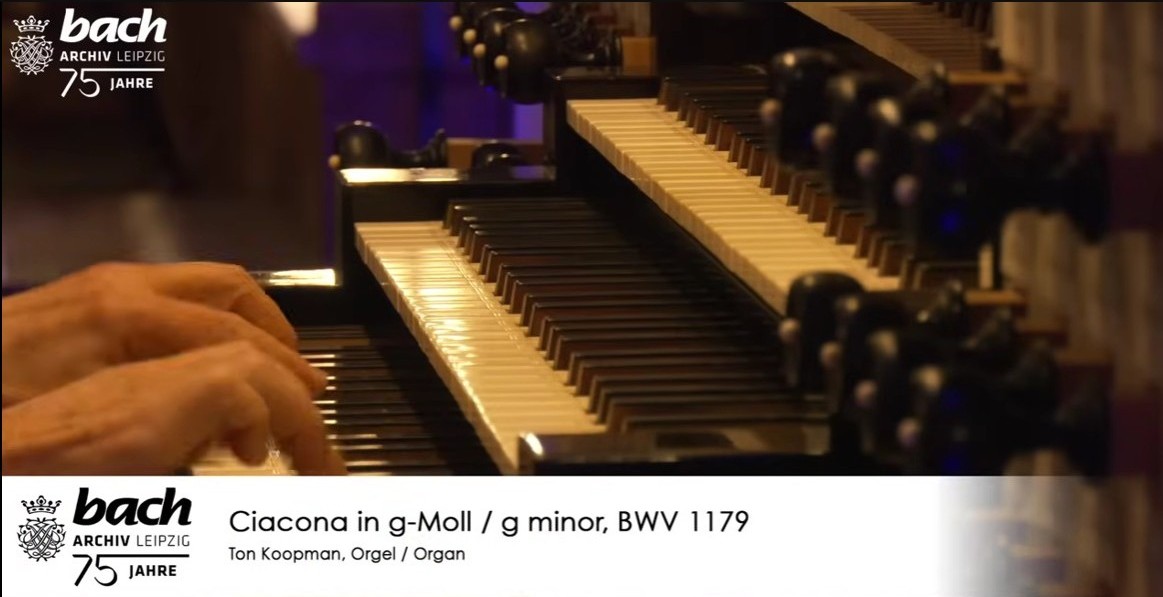
Be that as it may, the “new” Chaconne in D minor, BWV 1178, and Chaconne in G minor, BWX 1179, were performed for the first time in probably 320 years yesterday. A stream of the double debut, at St. Thomas Church in Leipzig – where Bach served as cantor for 27 years (less time than it took for the organ pieces to be authenticated) and where his remains are interred beneath a bronze marker – with Baroque authority Ton Koopman at the organ, has been archived on YouTube.
There’s some annoying A.I. Bach at the start and plenty of German speechifying, but if you want to cut to the chase, the Chaconne in D minor can be heard twice, at 15:28/59:40, and the Chaconne in G minor at 22:45/1:07:02 at the link below.
The undated, unsigned manuscripts are believed to be in the hand of Salomon Günther John, one of Bach’s pupils. The chaconnes are thought to have been composed early in Bach’s career, when he was working as an organ teacher in Arnstadt in Thuringia.
Unsurprisingly, Koopman finds the music to be “of very high quality.”
Here’s the link:
https://www.youtube.com/watch?v=4hXzUGYIL9M
Category: Daily Dispatch
-
Bach Better Late Than Never
-

At 95, Amram Collects No Moss
Philadelphia’s musical polyglot is 95 today.
David Amram, born in Philadelphia on this date in 1930, has always been equally at home in classical music, jazz, folk, and world music. The composer of over 100 orchestral and chamber works, music for Broadway and film (including the scores for “Splendor in the Grass” and “The Manchurian Candidate”), and two operas, he’s also the author of three books: “Vibrations: The Adventures and Musical Times of David Amram” (1968), “Offbeat: Collaborating with Kerouac” (2002), and “Upbeat: Nine Lives of a Musical Cat” (2007).
Amram, who now makes his home in Putnam Valley, NY, was raised on a farm in Bucks County, PA. There, he was introduced to classical, jazz, and cantorial music by his father and uncle. He took piano lessons and experimented with instruments of the brass family, finally centering on the French horn. Following a year at Oberlin, he lit out for George Washington University, where he studied history. While there, he performed as a freelance hornist with the National Symphony. He also studied privately with two musicians in the orchestra.
Amram became a pioneer of the “jazz French horn,” as well as the New York Philharmonic’s first composer-in-residence (designated such in 1966). He’s worked with artists ranging from Dizzy Gillespie to Bob Dylan to Leonard Bernstein, from Jack Kerouac to Arthur Miller, from Christopher Plummer to Johnny Depp. He’s a musician without borders, always open to new experiences.
At 95, Amram is still cookin’. Think I’m exaggerating? Check out his calendar at his website.
https://www.davidamram.com/calendar.php?year=2025
He just performed in Tarrytown last week, and he’s got a couple of birthday concerts imminent, in Schenectady and NYC (at Dizzy’s Club at Columbus Circle, presented by Jazz at Lincoln Center).
A new recording of his chamber music was just issued on Naxos on November 14. This follows an album on Guthrie Legacy Recordings dedicated to Woody Guthrie and Phil Ochs, released in August.
Clearly he ascribes to the maxim that to rest is to rust. He’s also keeping busy with a new orchestral piece, his fourth book, and a transcription for symphonic winds of “This Land: Symphonic Variations on a Song by Woody Guthrie” for a scheduled premiere at Ohio State College in June.
Amram is high on life, he exudes love, and he makes the world a better place. The guy deserves all his success.
Sending another happy birthday via “ESP thought-o-gram” to David Amram. May there be many more.
————
Trailer for “David Amram: The First 80 Years”
https://www.youtube.com/watch?v=q5v6MeanQ28
Amram Horn Concerto
https://www.youtube.com/watch?v=V8J0w1uMfXo
Amram with Dizzy Gillespie
https://www.youtube.com/watch?v=j69jBSwi-f4
Amram’s music for “The Manchurian Candidate”
https://www.youtube.com/watch?v=AWrtyCzWE_w&t
Wonderful snapshot of the man and artist, who more and more seems a prophet of our age
https://www.youtube.com/watch?v=Gk0M6n_nBYo
Amram jamming at the Philadelphia Folk Festival in 2011
https://www.youtube.com/watch?v=yHdo_-GnUgI
Amram in February (age 94)
https://www.youtube.com/watch?v=_mQ7FBwbAkw
“Pull My Daisy”
https://www.youtube.com/watch?v=1lCBNfnVGtc -
The Philadelphia Orchestra and Mark Twain’s Daughter: One Degree of Separation
Happy birthday, The Philadelphia Orchestra! Looking pretty good for 125.
The Fabulous Philadelphians gave their first public concert under Fritz Scheel on this date in 1900. The event took place at the orchestra’s former home of the Academy of Music, located on the southwest corner of Broad and Locust Streets. On the program were works by Carl Goldmark (“In Spring” Overture), Beethoven (Symphony No. 5), Tchaikovsky (Piano Concerto No. 1), Weber-Berlioz (“Invitation to the Dance”), and Wagner (“Entry of the Gods into Valhalla”).
The soloist on that occasion was Ossip Gabrilowitsch. Gabrilowitsch’s teachers at the Saint Petersburg Conservatory included Anton Rubinstein and Nikolai Medtner. He then studied for two years in Vienna under the legendary pedagogue Theodor Leschitizky. Not only was Gabrilowitsch a prominent pianist, he was also offered the music directorship of the Boston Symphony Orchestra, which he politely declined. Later, he became founding director of the Detroit Symphony in 1918. He was also Mark Twain’s son-in-law. In my possession is a biography I picked up for $3 at a public library sale, “My Husband, Gabrilowitsch,” that I noticed had been inscribed by Twain’s daughter, Clara Clemens!
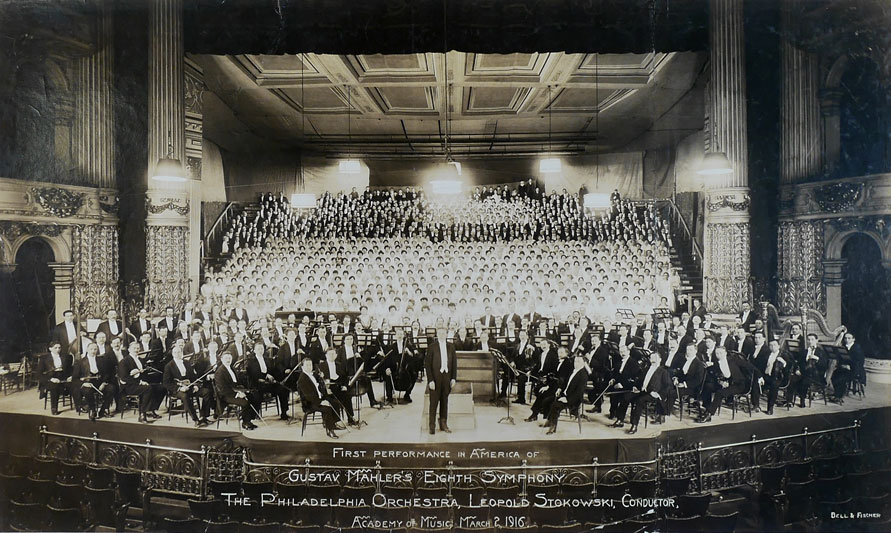
Fritz Scheel was succeeded as music director of the Philadelphia Orchestra by Carl Pohlig in 1908. Leopold Stokowski (pictured) followed in 1912; Stoky would lead the group for the next 24 years. Then came Eugene Ormandy, who held the podium until 1980 – 44 years. Ormandy passed the baton to Riccardo Muti, who directed from 1980 to 1992. Muti was followed Wolfgang Sawallisch, who remained with the orchestra for the next decade. Sawallisch was succeeded by Christoph Eschenbach in 2003. Eschenbach was followed by Charles Dutoit, appointed “Chief Conductor” in 2008. And, bringing us up to the present, Yannick Nézet-Séguin arrived, with vitality to burn, in 2012. What a history!
Since I lived in Philadelphia for over three decades, this was my resident orchestra. I saw many of the greats there, with some particularly unforgettable nights at the Academy of Music, especially when I was in my 20s. Also in the summers, at the Mann Center in Fairmount Park, when the orchestra played three or four different programs a week. A lot of those artists aren’t around anymore. I have some cherished memories of the orchestra at its current home at the Kimmel Center for the Performing Arts, too, but perhaps inevitably I view those earlier concerts through rose-tinted glasses, halcyon experiences preserved in the amber of my youth. It’s astonishing to realize that I have been attending concerts with this ensemble over a span of 41 years! It’s been an indispensable part of my life.
Thank you, and a happy 125th, Philadelphia Orchestra!
—————
A great read about Clara Clemens and Ossip Gabrilowitsch in the Star-Gazette of Elmira, NY
https://www.stargazette.com/story/news/local/2024/03/08/mark-twain-daughter-clara-clemens-studied-music-performed-in-elmira/72775353007/
The Twain plaque was stolen from a joint monument dedicated to the author and Gabrilowitsch at Elmira’s Woodlawn Cemetery, but returned, in 2015
https://www.syracuse.com/state/2015/09/mark_twain_stolen_plaque_returned_to_tomb.html
An account of Gabrilowitsch, guest conducting the Philadelphia Orchestra, addressing the audience on the subject of applause. (He was in favor of it; apparently Stokowski was not.)
https://www.nytimes.com/1930/02/01/archives/gabrilowitsch-urges-audience-to-applaud-takes-issue-with-stokowskis.html
—————
PHOTO: Stokowski and the Philadelphia Orchestra at the Academy of Music in 1916, ready to go for the American premiere of Gustav Mahler’s “Symphony of a Thousand” -

Salty Cossacks on “The Lost Chord”
This week on “The Lost Chord,” our ears will burn from the haughty and profane response of the Zaporozhy Cossacks to an ultimatum from Sultan Mehmad IV. The Sultan demanded the peaceful surrender of the Cossacks, after they had scored a glorious defeat against his Ottoman forces. To his giddy and inebriated foes, he was not exactly negotiating from a position of power.
Among Reinhold Glière’s works steeped specifically in Ukrainian lore is the symphonic poem/ballet “The Zaporozhy Cossacks,” based on the famous canvas by Ilya Repin. Glière, born in Kyiv in 1875, is best known for his ballet “The Red Poppy,” with its ubiquitous “Russian Sailor’s Dance,” and perhaps for his epic Symphony No. 3, “Ilya Muromets.”
In 1913, Glière attained an appointment to the school of music in Kyiv, which was raised to the status of conservatory shortly thereafter. Glière served as director of the conservatory from 1914 to 1920.
One of his pupils there was Boris Lyatoshynsky, who lived from 1895 to 1968. Lyatoshynsky was a student at the conservatory at the start. The first movement of his Symphony No. 1 was written as a graduation work. The other two movements followed in 1919.
The first performance of the piece took place under Glière’s direction in 1923. If you get all sweaty listening to the orchestral works of Alexander Scriabin, you certainly won’t want to miss this, an opulent work by a young man determined to impress.
I hope you’ll join me for “Steppe Lively” – classical music from Ukraine – on “The Lost Chord,” now in syndication on KWAX, the radio station of the University of Oregon!
——–
Clip and save the start times for all three of my recorded shows:
PICTURE PERFECT, the movie music show – Friday at 8:00 PM EST/5:00 PM PST
SWEETNESS AND LIGHT, the light music program – Saturday at 11:00 AM EST/8:00 AM PST
THE LOST CHORD, unusual and neglected rep – Saturday at 7:00 PM EST/4:00 PM PST
Stream them, wherever you are, at the link!
https://kwax.uoregon.edu/
——–
If you aren’t too squeamish, you can read more about the Cossacks’ reply, with a rough (and I do mean rough) translation here. The translation was removed from a Wikipedia page about the painting, but preserved in a screenshot taken for the purpose of Ukrainian studies by the Department of Slavic Languages and Literatures at the University of Toronto.
https://tarnawsky.artsci.utoronto.ca/courses/Cossacks/Reply%20of%20the%20Zaporozhian%20Cossacks%20-%20Wikipedia,%20the%20free%20encyclopedia.pdf
——–
IMAGE: Ilya Repin’s “Reply of the Zaporozhian Cossacks” (1880-1891) -

The Days Grow Short on “Sweetness and Light”
You don’t have to strong-arm anyone into liking Armstrong Gibbs. It’s impossible not to fall in love with the easy charm and seductive melody of his light music classic “Dusk.” Sure, he also wrote works on a grander scale, such as the “Odysseus Symphony,” for soloists, chorus and orchestra, clearly cut from the same cloth as that of “A Sea Symphony” by his teacher, Ralph Vaughan Williams. But it’s this atmospheric slow waltz, composed in 1935 and requested by Princess Elizabeth – later Queen Elizabeth II – for performance on her eighteenth birthday, that is his best-known music.
Enjoy this crepuscular classic this morning on “Sweetness and Light,” as part of a playlist organized around the observation that the days grow precipitously shorter.
Soon, it will be as if morning runs into evening. So it’s not by accident that we’ll also hear Alexander Alyabyev’s “Morning and Evening Overture.” I’ll even toss noon into the mix with Franz von Suppé’s “Morning, Noon and Night in Vienna.”
But twilight will be here before you know it. In addition to the Gibbs miniature, we’ll also delight in “At Dusk” by Second New England School luminary Arthur Foote.
Finally, seemingly out of left field, and because I say so, we’ll listen to Jean Sibelius’ Symphony No. 6. Sibelius was once asked by a journalist to provide a motto for his new symphony. The composer responded, “When shadows lengthen.” It could be argued it’s not a “light” piece, exactly, but it is ravishingly beautiful, and it’s not played all that often. So there!
The days grow short, but hopefully the music will be long on enjoyment, on “Sweetness and Light,” this Saturday morning at 11:00 EST/8:00 PST, exclusively on KWAX, the radio station of the University of Oregon!
Stream it wherever you are at the link:
https://kwax.uoregon.edu/
Tag Cloud
Aaron Copland (94) Beethoven (95) Composer (114) Film Music (149) Film Score (143) Film Scores (255) Halloween (99) John Williams (197) KWAX (232) Leonard Bernstein (105) Marlboro Music Festival (125) Movie Music (164) Mozart (91) Opera (215) Philadelphia Orchestra (90) Picture Perfect (174) Princeton Symphony Orchestra (110) Radio (90) Ross Amico (244) Roy's Tie-Dye Sci-Fi Corner (290) The Classical Network (101) The Lost Chord (269) Vaughan Williams (107) WPRB (397) WWFM (881)