It may be the first weekend of September, but there’s still time for one more summer road trip.
This Sunday night on “The Lost Chord,” it’s an hour of quintessentially American music about travel by car.
Frederick Shepherd Converse’s “Flivver Ten Million” traces the Ford Motor Company’s affordable assembly line automobile, from its creation in a Detroit factory to the manifest destiny of America’s roadways.
John Adams’ “Road Movies” has nothing at all to do with Bob Hope and Bing Crosby, alas. What it is, however, is a violin sonata written firmly within the American tradition, with a special affinity at its core with Aaron Copland’s Violin Sonata.
Virgil Thomson’s “Filling Station,” written for Leon Kirstein’s Ballet Caravan, may have the distinction of being the only ballet set at a gas station. The work’s success gave Copland the confidence to follow through on another Caravan commission, which resulted in “Billy the Kid.”
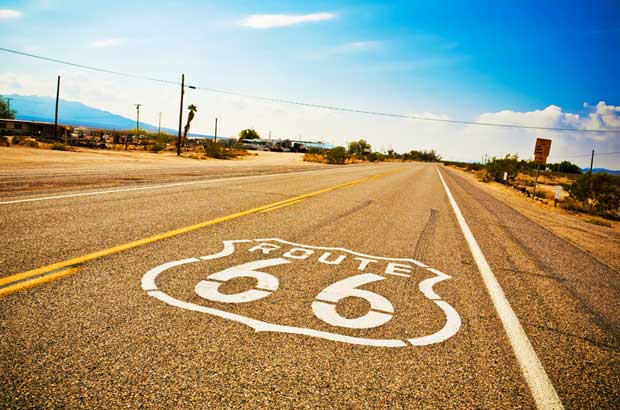
Finally, we’ll hear one of Michael Daughtery’s most performed works, the exuberant “Route 66,” inspired by the storied “Main Street of America.”
Put the pedal to the metal. American composers hit the road for Labor Day, on “The Last Roads of Summer,” this Sunday night at 10:00 EDT, on WWFM – The Classical Network and wwfm.org.
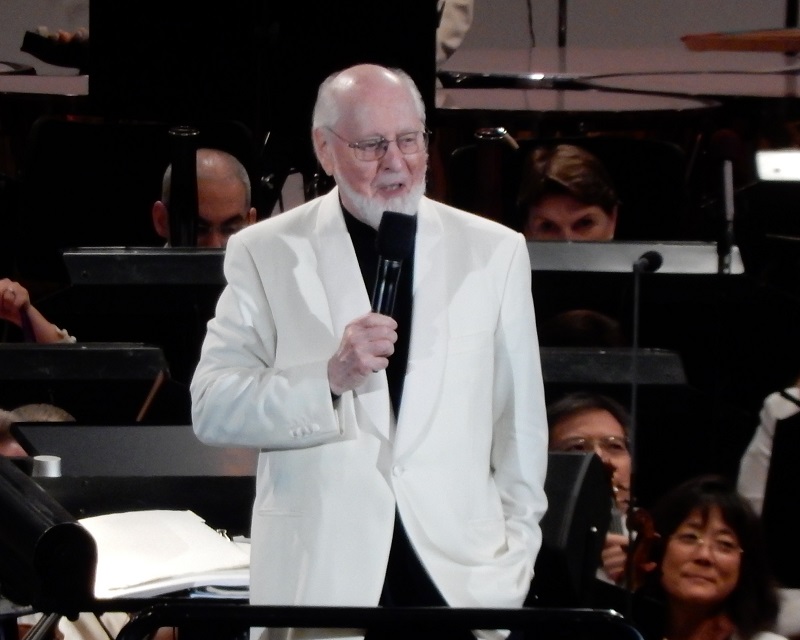
Check out the first new Indiana Jones music in 14 years. John Williams conducts the Los Angeles Philharmonic in “Helena’s Theme,” last night at the Hollywood Bowl. Sounds pretty vintage to me! The still-untitled Indy 5 is scheduled for release on June 30, 2023.
“I coulda had class. I coulda been a contender. I coulda been somebody – instead of a bum, which is what I am.”
We’ve all had those kinds of days, haven’t we?
Yet Leonard Bernstein’s score for “On the Waterfront” (1954) was always a contender, even if at times the composer found himself on the ropes.
“On the Waterfront” was the only original film score composed by Bernstein (the screen adaptations of his stage musicals were adapted by other hands). Narrative film, of course, is a collaborative effort, in which music is usually the last to the table and the first to go. Bernstein’s score was edited and dialed down to suit the overall needs of the film.
Unused to such rough treatment, Bernstein found his brush with Hollywood to be dispiriting, to say the least. He arranged his music into a concert suite, over which he had complete control, and the work has gone on to become one of his better-known pieces. That said, what can be heard in the film remains a powerful statement, and one of the great film scores.
The original recordings, as they appear in the film, were long believed to have been lost. However, in the course of restoration of “On the Waterfront” for release on BluRay, it was discovered that audio had been preserved on acetate discs used for playback during the original recording sessions. Material from these were issued for the first time in 2014, on the Intrada label.
Bernstein’s music would be nominated for an Academy Award, one of “On the Waterfront”s twelve nominations. The film would be recognized with wins in eight categories, including Best Picture, Best Actor (Marlon Brando), and Best Director (Elia Kazan). Bernstein may have lost out to Dimitri Tiomkin for his work on “The High and the Mighty.” However, like Brando’s Terry Malloy, his score to “On the Waterfront” proves itself a champion.
We’ll hear selections, alongside some of Aaron Copland’s music for “The Red Pony” (1949), once again, from the film’s original elements; dances from the only film score ever to be awarded the Pulitzer Prize for Music, “Louisiana Story” (1948), by Virgil Thomson; and the music that lends “Picture Perfect” its signature tune, “They Came to Cordura” (1959), by Elie Siegmeister.
It’s an hour of New York composers in Hollywood this week, on “Picture Perfect,” music for the movies, this Saturday evening at 6:00 EDT, on WWFM – The Classical Network and wwfm.org.
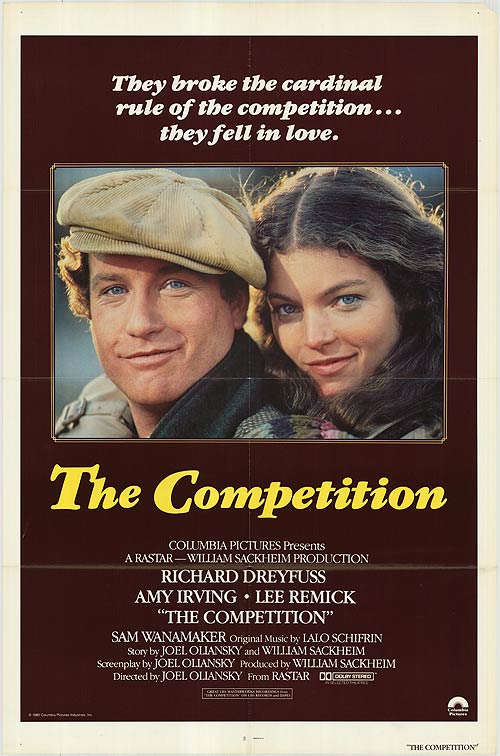
Anybody else remember this piece of corn? I saw it in the theater back in 1980. Two pianists (Richard Dreyfuss and Amy Irving) improbably fall in love while preparing for the biggest competition of their lives.
Of course, I enjoyed “The Competition,” even if it was preposterous, but it gained an awful lot from Prokofiev’s Piano Concerto No. 3 – a mid-performance substitute for a Mozart concerto (!) – and those creepy trees that were so memorably featured in the remake of “Invasion of the Body Snatchers.” Sam Wanamaker makes a good caricature of a Bernstein-type conductor.
The whole thing is an eyeball-rolling throwback to the kind of classical music melodramas once overseen by middlebrow movie moguls in the 1940s. Was the always-pugnacious Dreyfuss the John Garfield of his day?
Limp trailer employing Lalo Schifrin’s love theme
More compelling TV ads using the Prokofiev 3rd
What’s the last Hollywood movie that gave us something like this?
On this day when the birthdays of Johann Pachelbel and Engelbert Humperdinck are generally observed, Othmar Schoeck is foremost in my thoughts.
Schoeck (1886-1957) may be largely forgotten now, but he once enjoyed international recognition for his art songs, which he composed prolifically. He also produced opera, orchestral, and instrumental works. His ambitious Violin Concerto – some 40 minutes in length – was composed at white heat, out of love for Stefi Geyer, the same violinist who captivated Béla Bartók and inspired Bartók’s Violin Concerto No. 1.
Schoeck was born in Switzerland and spent most of his life there, other than a brief period during which he lived in Leipzig, where he studied with Max Reger. He had considered pursuing a career in the visual arts, as had his father, before finally committing himself to music. He was fortunate enough to secure patronage so that he could compose more or less undisturbed.
When Ferruccio Busoni settled in Switzerland during the First World War, the two developed a friendship, despite some disagreements on certain artistic matters. In fact, Busoni provided the libretto for Schoeck’s opera “Das Wandbild” (“The Picture on the Wall”), marked by the kind of chinoiserie that characterized Busoni’s own “Turandot” (in no way to be confused with the later, more famous opera by Puccini).
Schoeck’s music experienced a stylistic shift as he became acquainted with the works of Alban Berg and Arthur Honegger. A torrid affair with the pianist Mary de Senger seems to have changed him for good. When their relationship ended, so did Schoeck bid farewell to his earlier, Romantic style.
Though he was no Nazi sympathizer, Schoeck had the bad judgment or naivete to attend the premiere of one of his operas in Berlin in 1943. This led to a lot of stress at home, with the Swiss unhappy with his actions. Schoeck suffered a heart attack, but continued to compose. He died in 1957.
I seem to recall his reputation was such that the writer Hermann Hesse referred to Schoeck in one of his books – I think it was “Journey to the East” – in the same breath as Richard Strauss. I suppose it didn’t hurt that Hesse and Schoeck were friends and Schoeck set some of Hesse’s poems (as did Strauss). Hesse pitched the idea of an operatic collaboration, and even wrote a libretto, but the proposal never came to anything.
Here is Schoeck’s lovely “pastoral intermezzo,” as the composer described it, “Summer Night.” It tells of a summer harvest, during which field hands come to the aid of a widow and work all night in order to get in her crop, before embarking on their own day jobs.
Here’s a song, “Summer Night,” on a text of Hesse, with Dietrich Fischer-Dieskau

6 responses