• Westerns from the Old World

    Westerns from the Old World

    by 

    in
    5 responses

    Before American composers like Jerome Moross and Elmer Bernstein made the western distinctly their own, the task of scoring the genre fell largely to European émigrés. This week on “Picture Perfect,” we’ll take a look at some outside perspectives on how the West was won.

    Literally the godson of Richard Strauss, Max Steiner came from Vienna, where he studied with Johannes Brahms and Robert Fuchs. In Hollywood, he wound up scoring such classics as “King Kong,” “Gone with the Wind” and “Casablanca.”

    Among his over 300 film projects were a number of westerns. One of these was “They Died with Their Boots On” (1941), which starred Errol Flynn as George Armstrong Custer and Olivia de Havilland as Libby, the woman who becomes his wife. Steiner’s score features familiar folk material, some old-fashioned faux “Indian” music, and one of his characteristically lush love themes.

    Born in Ukraine in 1894, Dimitri Tiomkin was a pupil of Alexander Glazunov. He came to revolutionize the sound of the American West, when he wrote the music for “High Noon,” the first of his “ballad” scores. Advanced word, based on an early screening for the press, was that the picture would be a failure. However, Tiomkin had such faith in the theme song, sung in the film by Tex Ritter, that he hired Frankie Laine to record it, and the record became a world-wide hit. In fact, his score is largely credited with having saved the film.

    Tiomkin was recognized with two Academy Awards: one for Best Original Song, and one for the score itself. It was the first time a composer won two Oscars for his work on the same movie. It also changed the way western scores were done. In the 1950s, Tiomkin became THE western composer of choice. He produced a number of subsequent ballad scores, including that for “Gunfight at the O.K. Corral” (1957). Asked how it was that a composer from Ukraine could write so convincingly for the American West, Tiomkin quipped, “A steppe is a steppe is a steppe.”

    Another unexpected source of classic western music, Franz Waxman was born in Upper Silesia. He arrived in the U.S. by way of Germany. Nonetheless, as part of the composer’s varied and prolific output, he did indeed score a number of films in the genre, including “The Furies” (1950), a peculiar noir-western hybrid. Walter Huston, in his final film, plays a cattle baron who remarries and throws his empire into jeopardy. Barbara Stanwyck is his strong-willed daughter.

    Hungarian-born composer Miklós Rózsa scored many films with historical settings – “Quo Vadis,” “Ben-Hur,” and “King of Kings,” among them. However, to my knowledge, his only western was “Tribute to a Bad Man” (1956). James Cagney stars as a rancher who doles out some frontier justice.

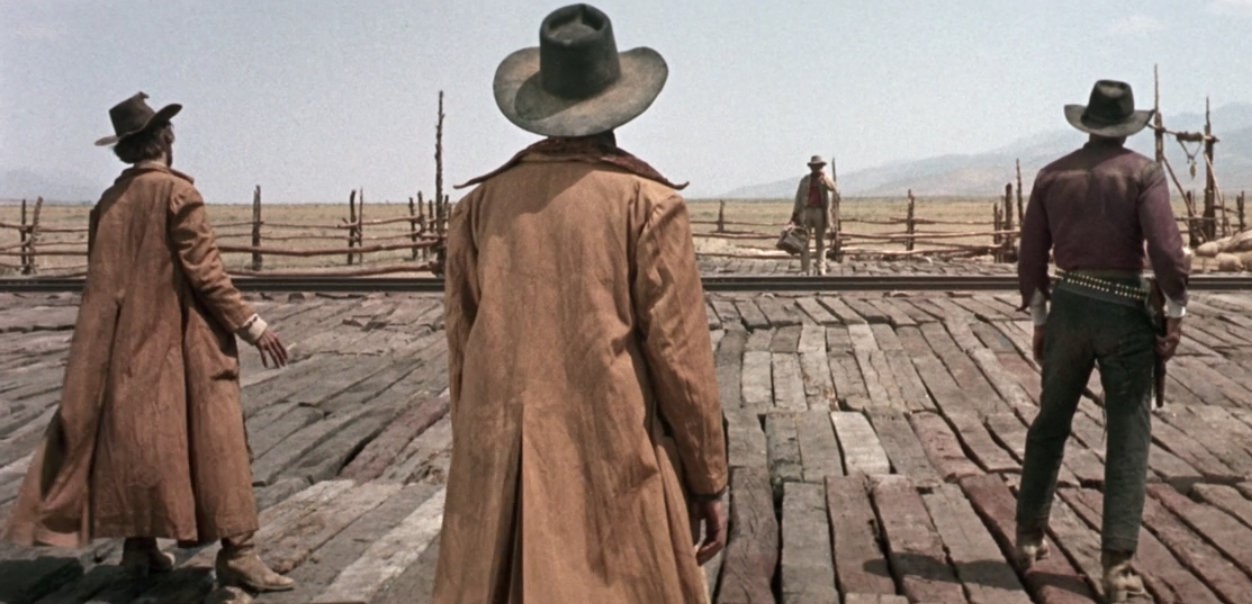
    Finally, we’ll hear music by Ennio Morricone, from arguably the most operatic of all spaghetti westerns, “Once Upon a Time in the West” (1968). As a reaction to Tiomkin’s ballad scores and the neo-Coplandisms of Elmer Bernstein and the rest, Morricone brings his own quirky sensibility to bear on the classic western iconography. Get ready for indelible motifs for harmonica and banjo, but also an unexpectedly moving elegiac arioso, underscoring the close of the American West with the arrival of the railroad.

    Better wind your pocket watches. Old World composers go west this week on “Picture Perfect,” music for the movies. The train arrives this Saturday evening at 6:00 EDT, on WWFM – The Classical Network and wwfm.org.
  • Woman in Gold Ryan Reynolds & Schoenberg’s Legacy

    Woman in Gold Ryan Reynolds & Schoenberg’s Legacy

    by 

    in
    6 responses

    Would you believe Ryan Reynolds as Arnold Schoenberg’s grandson?

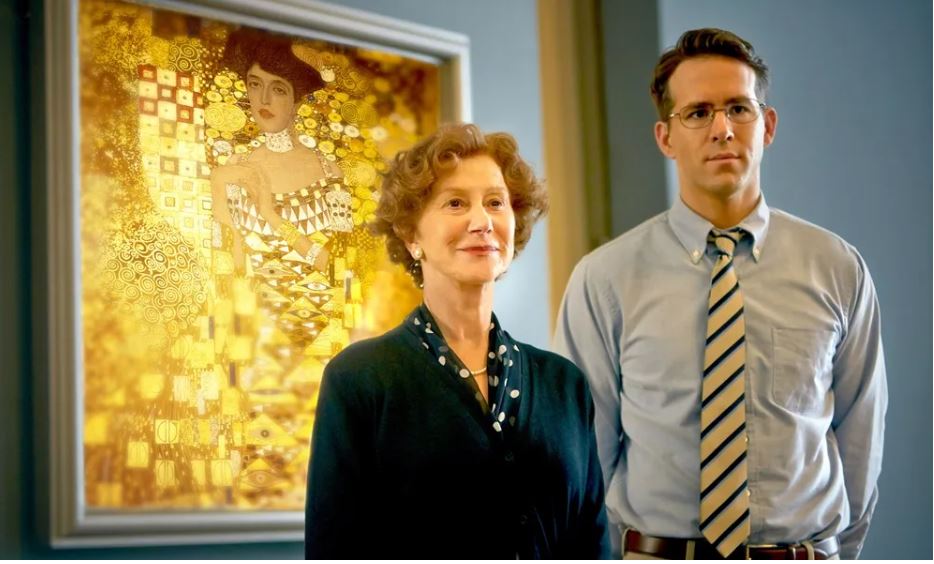
    Another random discovery last night on Netflix: “Woman in Gold” (2015), a Helen Mirren film that somehow escaped my notice. Mirren plays Maria Altmann, an 82 year-old Jewish refugee living in Los Angeles in 1998, who fights to reclaim from the Belvedere Museum in Austria a portrait of her aunt, painted by none other than Gustav Klimt, that was stolen from her family sixty years earlier by the Nazis. Assisting her in her quest for justice is an untried underdog lawyer, played by Ryan, whose grandfather happened to be one of the 20th century’s most influential composers.

    The painting in question was originally titled “Portrait of Adele Bloch-Bauer I,” more commonly known, both for simplicity’s sake and, for the Nazis, to hide the subject’s inconvenient ethnicity, as “Woman in Gold,” but described by one of the characters in the film as “The Mona Lisa of Austria.” Predictably, Austrian bureaucrats throw up any impediment they can to retain ownership of the painting.

    Following the pattern of every rogue cop movie ever, young Schoenberg’s gruff boss (Charles Dance, who’s the actor you call for these things when Christopher Plummer is too busy) goes from bemused indulgence to forbidding him to pursue the case any further. In response, Schoenberg quits the firm and rides his scrappy gumption all the way to the Supreme Court – and beyond. Every time either he or Altmann are on the verge of throwing in the towel at the latest setback, they get one another riled up again and off they go.

    The entire exercise is diverting enough for a slow evening when you’re not feeling particularly demanding, and it may get you thinking about injustices past and present, and the struggles for restitution for the survivors or descendants of families who lost everything, but I’m afraid on the whole the execution is rather TV movie-like.

    All the traditional elements are in place; all the beats fall where expected – the very opposite, in fact, of Arnold Schoenberg’s music. There is lip-service paid to Schoenberg’s revolutionary twelve-tone method, but it’s telling that the only Schoenberg we actually hear is “Transfigured Night” – Schoenberg for people who think they don’t like Schoenberg. Tonal, romantic, and entirely movie-friendly. To compound the irony, the film’s unremarkable score is cranked out by Hans Zimmer and company.

    Mirren is fine, as always, and I did get some enjoyment out of all the unexpected casting choices, as many familiar faces turn up, some for only a single scene – Charles Dance, Jonathan Pryce, Elizabeth McGovern, and Allan Corduner (who played Arthur Sullivan in Mike Leigh’s Gilbert & Sullivan homage “Topsy Turvy”). Katie Holmes has little to do as the crusading lawyer’s understandably concerned, but always supportive wife.

    As for the lawyer himself, Schoenberg’s grandson, Reynolds does okay, especially when called on to be a fast-talker, but it’s hard to buy him as the actual real-life E. Randol Schoenberg. He has my respect for trying something different, I thought after the enormous success of “Deadpool.” But it turns out “Woman in Gold” was released the year before!

    While we’re considering the timeline, the film is a Weinstein production, so I had to check the dates to see if Harvey’s recent woes may have had something to do with its comparative obscurity. But Weinstein’s sins didn’t really boomerang in a big way until 2017 – two years later. Then I thought maybe Covid had thrown a wrench in its distribution. Nope, that would have been 2020. Maybe I just wasn’t paying enough attention.

    The director is Simon Curtis, whose credits include “My Week with Marilyn” (2011), for which Michelle Williams and Kenneth Branagh earned Oscar nominations for their portrayals of Marilyn Monroe and Laurence Olivier, respectively, and television adaptations of “Cranford” and “David Copperfield.” He also directed the most recent “Downton Abbey” movie. Ah, so he’s actually married to McGovern!

    In the end, “Woman in Gold” is not much better than a by-the-numbers courtroom drama in which justice is inevitably served. (If you think that’s a spoiler, it’s recent history and the outcome has graced many a headline.) There are some lovingly shot Klimts, beside the predictable outrages, once the Nazis march into Austria, and also some fleeting suspense. Closer to the present, there’s the infuriatingly smug Austrians on the board of the Belvedere Museum who stand between Altmann and her stolen property. The film is well-intentioned, but winds up being fairly anodyne. Good for undemanding viewers who enjoy the kind of easy fuzzies you get from watching a Penny Marshall or Rob Reiner movie.

    All told, it was definitely better than “Orca.”


    A couple of parodies that actually hold Schoenberg in greater affection:

    “187 Hits from the Beloved Twelve-Tone Masters”

    “Gimme Some of That Ol’ Atonal Music”


  • Orca Discussion Postponed Richard Harris Fish Cake

    by 

    in
    6 responses

    Due to unforeseen circumstances, our chummy discussion of Dino De Laurentiis’ “Orca” (1977), which was to have taken place this evening on @[100063986017424:2048:Roy’s Tie-Dye Sci-Fi Corner], has been postponed. Keep a glittering eye on Roy’s Facebook page for further developments.

    Someone left Richard Harris’ fish cake out in the rain.


  • “Orca” The “Jaws” Ripoff & Boyd Theatre Memories

    “Orca” The “Jaws” Ripoff & Boyd Theatre Memories

    by 

    in
    6 responses

    On the evening of July 22, 1977, as I stood in line in the lobby of the Boyd Theatre in Bethlehem, PA, the doors to the auditorium swung open, and the audience for the previous showing began to file out. Someone in line asked, “How was it?” He received the flat, noncommittal response, “It was a big fish.”

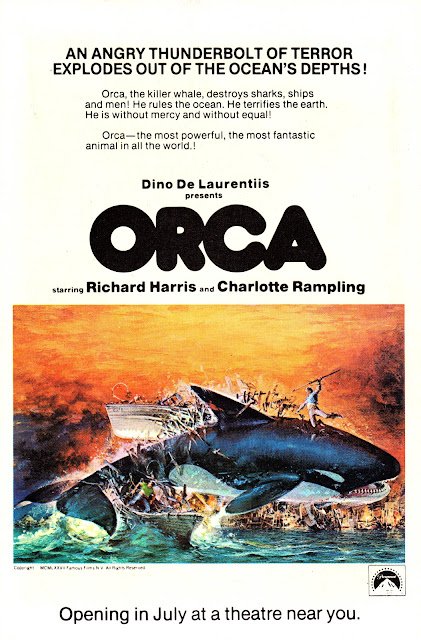
    Even at the age of 11, I knew “Orca” was going to suck. Heavily promoted on the back of every Marvel comic for weeks, the poster art featured an improbably large, breaching killer whale, looking all the world like a mottled Moby-Dick, splintering the hull of a ship, against the backdrop of an entire seaside village in flames, and a miniscule seaman (presumably Richard Harris) defying this vengeance-fueled juggernaut with a harpoon the size of a toothpick. The entire enterprise bore the unmistakable aroma of desperate hyperbole.

    This week on “Roy’s Tie Dye Sci Fi Corner,” we finally honor a long-term request from viewer Lesley Siedt to sink our teeth into “Orca.”

    Clearly intended to inspire awe, the Marvel ad couldn’t disguise the fact that “Orca” was a transparent “Jaws” cash-grab, with perhaps a little “King Kong” and maybe some “Death Wish” tossed into the mix. Executive producer Dino De Laurentiis’ “Kong” remake had only just been in theaters in December, and “Death Wish” made him a mint in 1973.

    Either way, the audience is clearly meant to sympathize with the aquatic avenger. And why not? Harris’ character is a jerk. And supposedly the actor wasn’t much better on set. He insisted on performing his own stunts, nearly getting himself killed, spent most of the shoot inebriated, contemplated murdering his wife and her suspected lover, and punched out producer Luciano Vincenzoni. If only the actual film had conveyed as much drama. On Rotten Tomatoes, its current approval rating is 9 percent.

    You can’t argue with the cast, which includes, beside Harris, Charlotte Rampling, Will Sampson, Bo Derek, and Keenan Wynn. But nobody behaves in a way that makes sense, and at the end of the day, there’s little to do but get picked off one by one.

    Composer Ennio Morricone clearly perceived it as a western, providing an underscore of melancholy guitar, an air of heartbreak in the strings, and none other than Edda dell’Orso lending her wordless soprano, so indelibly associated with “Once Upon a Time in the West.”

    I’ve got to hand it to my parents. We were a moviegoing family, and we saw everything, the good, the bad and the ugly. As my stepfather, bearing equally low expectations, observed, “If it’s produced by De Laurentiis, it’s got to stink.” A gross generalization, admittedly, but he was kind of right: approached in the correct frame of mind, a De Laurentiis film seldom disappointed.

    We’ll blubber over this tragic tale of lost love and the destructive consequences of reckless greed on the next Roy’s Tie-Dye Sci-Fi Corner. Bring your seals (of approval) to the comments section, when we livestream on Facebook, this Friday evening at 7:30 EDT!

    https://www.facebook.com/roystiedyescificorner

    Haven’t seen the movie? It’s even better dubbed in Hindi.

    https://www.youtube.com/watch?v=S3tn22nvY7A

    The Boyd Theatre was my favorite venue in the Lehigh Valley at which to view movies. It was the only theater that did the big movies justice, an old-fashioned movie palace that somehow still offered decent projection and stirring sound. Opened in 1921, it was demolished only this year. What rises in its place? A 14-story “luxury apartment” building. Nice job, Bethlehem. It breaks my heart a little every time I think that the Boyd’s gone.

    A Farewell to the Boyd Theater

    http://cinematreasures.org/theaters/7852

    https://www.lehighvalleylive.com/bethlehem/2022/03/redesigned-bethlehem-boyd-theatre-project-retains-iconic-look-photos.html

    Abandoned Boyd Theater, Bethlehem PA. Built in 1920
    byu/Mr_Chubblez inurbanexploration


  • Leonard Bernstein A Life with Not Enough Time

    Leonard Bernstein A Life with Not Enough Time

    by 

    in
    3 responses

    “To achieve great things, two things are needed: a plan and not quite enough time.”

    Leonard Bernstein ought to have known. He had only 72 years to become this country’s most visible, extraordinarily versatile classical musician, as a conductor, composer, pianist, Broadway luminary, educator, author, and humanitarian. (I’m sure I left something out.)

    Happy birthday, Lenny. Thanks for making the most of the time you were given.


    Bernstein talks Beethoven at the piano with Maximilian Schell – and ever-present cigarette

    “Rhapsody in Blue” from the keyboard, with the fearless Stanley Drucker on clarinet

    Bernstein conducts “Prelude, Fugue and Riffs” on “Omnibus” in 1955

    Bernstein and Aaron Copland create demo record of “Fancy Free” for Jerome Robbins. Stick around for commentary at the end, with self-incriminating interjection by Copland!

    Bernstein’s sensational eleventh-hour debut with the New York Philharmonic, at 25, in 1943

    Bernstein’s European conducting debut, with the Czech Philharmonic in 1946

    An entire playlist of Bernstein rarities!

    Conducting Shostakovich in Tokyo

    Conducting Haydn – with his face

    Lauren Bacall sings “The Saga of Lenny,” lyrics by Stephen Sondheim (with apologies to Kurt Weill), for Bernstein’s 70th birthday celebration

    Bernstein’s death reported on ABC News in 1990

    Bernstein conducts his recently-composed “Candide Overture” on a televised Young People’s Concert in 1960

    Bernstein conducts Mahler’s “Resurrection Symphony” as a memorial tribute, broadcast live, two days after the assassination of President Kennedy in 1963

    https://www.youtube.com/watch?v=qruHjywjE_g

    Bernstein on the future of music, from one of his Harvard lectures. The answer is yes!

    Bernstein celebrates the fall of the Berlin Wall with a multinational ensemble and Beethoven’s 9th


Tag Cloud

Aaron Copland (93) Beethoven (95) Composer (114) Film Music (145) Film Score (143) Film Scores (255) Halloween (94) John Williams (195) KWAX (229) Leonard Bernstein (104) Marlboro Music Festival (125) Movie Music (160) Mozart (91) Opera (213) Philadelphia Orchestra (89) Picture Perfect (174) Princeton Symphony Orchestra (109) Radio (88) Ross Amico (244) Roy's Tie-Dye Sci-Fi Corner (290) The Classical Network (101) The Lost Chord (269) Vaughan Williams (105) WPRB (397) WWFM (881)

DON’T MISS A BEAT

Receive a weekly digest every Sunday at noon by signing up here


RECENT POSTS