• Roque Cordero Panama’s Only Composer

    Roque Cordero Panama’s Only Composer

    by 

    in
    3 responses

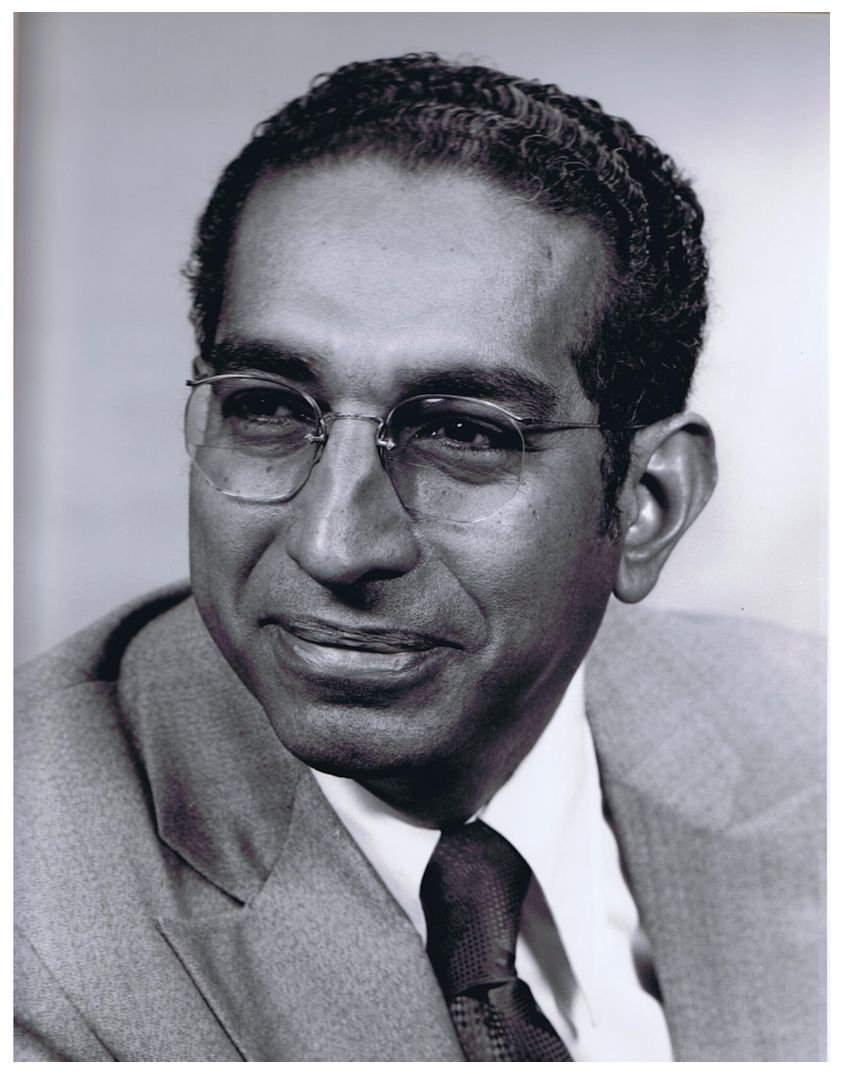
    He’s not only Panama’s greatest composer. He’s Panama’s ONLY composer. At least according to Roque Cordero, stated half-jokingly in an interview he gave in 1989, when he had just turned 72 years-old.

    Cordero’s music tends to balance Panamanian folklore with more advanced techniques, as exemplified in perhaps his most frequently performed work, the “Eight Miniatures for Small Orchestra” of 1948.
    More challenging is his Violin Concerto from 1962. I only just came across a concert performance of the piece from 2010 with Rachel Barton Pine as soloist – in the work’s Panamanian premiere? – which I’m adding to the links below.

    I was already familiar with the concerto from Paul Freeman’s “Black Composers Series,” which originally appeared on vinyl, on Columbia Records, back in the 1970s (reissued as a box set of CDs by Sony Classical only in 2019). Sanford Allen was the soloist in the world premiere recording. Barton Pine’s performance is distinguished not only by her characteristically superb commitment, but also because the concert actually took place in the composer’s home town of Panama City. Cordero was born there on this date in 1917.

    He won a scholarship to pursue music education at the University of Minnesota. There he studied conducting with Dmitri Mitropolous. It was Mitropolous who introduced him to Ernst Krenek, with whom he studied composition at Hamline University. (Mitropolous, recognizing his promise, paid all his expenses.)

    Back in Panama, Cordero became director of the National Music Institute and was appointed artistic director and conductor of the Panama National Symphony. Later, he was assistant director of the Latin American Music Center, professor of composition at Indiana University, and, from 1972, distinguished professor emeritus at Illinois State University. He died in Dayton, Ohio, in 2008, at the age of 91.

    “I am Panamanian,” he told Bruce Duffie, in the 1989 interview linked below. “I am not an American citizen, simply because I represent something to my country. If I become an American citizen, I would be just one more composer of the United States. I am a composer from Panama. When you read about me, you will find that I am the only composer from Panama, and because I am the only one, I am called the best. If there were two, I wouldn’t be the best [laughs], and I have to be the best. Unfortunately, Panama doesn’t have a musical tradition. How I became a composer is a mystery to me, and to anyone who has studied the music of Latin America.”

    Start with the “Adagio trágico” or “Sonatina Rítmica.” Then move on to “Eight Miniatures for Small Orchestra.” When you feel like your ears are awake, only then, check out Barton Pine’s performance of Cordero’s Violin Concerto.

    Happy birthday, Roque Cordero!


    “Adagio trágico” (1946-55), begun after the death of the composer’s mother; taken up again after the assassination of Panamanian President José Antonio Remón Cantera, whose wife had been one of Cordero’s benefactors

    “Sonatina Rítmica” (1943)

    “Eight Miniatures for Small Orchestra” (1948)

    Symphony No. 2 (1957)

    Violin Concerto (1962)

    Interview with Bruce Duffie

    http://www.bruceduffie.com/cordero.html


  • Lukas Foss A Centennial Remembrance

    Lukas Foss A Centennial Remembrance

    by 

    in
    3 responses

    Today would have been the 100th birthday of Lukas Foss.

    Foss was a multi-talented musician, who received considerable recognition in his lifetime, certainly, but I wonder if was as much as he deserves. Part of the problem is pinning him down. As a composer, it was always difficult to categorize him, as he drew from so many different styles. With Foss, you never knew what you were going to get. Serialism? Aleatory? Populism? Polystylism?

    He was born Lukas Fuchs in Berlin in 1922. A piano prodigy, he began studies at the age of 6. In 1933, his family moved to Paris, where he also studied composition and flute. He arrived in Philadelphia in 1937. By then, the family had changed its name, and Foss entered the Curtis Institute of Music. At Curtis, he studied piano with Isabelle Vengerova, composition with Rosario Scalero, and conducting with Fritz Reiner.

    Leonard Bernstein, a classmate, described him as an “authentic genius.” Bernstein would conduct first performances of several of Foss’ works. In return, Foss would conduct the premiere of Bernstein’s “West Side Story Symphonic Dances.” He also appeared as piano soloist in two recordings of Bernstein’s Symphony No. 2, “The Age of Anxiety,” both with Bernstein conducting.

    In addition, he was one of four esteemed American composer-pianists on Stravinsky’s recording of “Les noces.” (The others were Aaron Copland, Samuel Barber, and Roger Sessions.)

    Foss pursued further studies in conducting with Serge Koussevitzky, during summers at the Berkshire Music Center (Tanglewood), and composition with Paul Hindemith. He became an American citizen in 1942.

    In 1953, he replaced Arnold Schoenberg as composition professor at UCLA. Later, in 1991, he taught at Boston University. He served as music director of the Buffalo Philharmonic (1963-70) and the Brooklyn Philharmonic (1971-88) and as conductor of the Milwaukee Symphony (1981-86).

    As a young man, he was frequently categorized as one of the “Boston School” of composers. Other notable members included Bernstein, Irving Fine, Arthur Berger, Harold Shapero, Ingolf Dahl, and Louise Talma.

    I met him once at a reception at the Academy of Music in Philadelphia, back in the 1980s, following a concert with the Curtis Symphony Orchestra, a student band, but one of a very high caliber. A significant number of seats in U.S. orchestras, including a disproportionate number of principal chairs, are occupied by Curtis graduates. Nearly half of the Philadelphia Orchestra is made up of Curtis alumni.

    Foss hadn’t been Curtis’ first choice for this particular occasion. Bernstein was originally scheduled to appear, but this was toward the end of Bernstein’s life, and he was canceling concerts like crazy. The original program was to consist of Ives’ “Decoration Day,” Tchaikovsky’s “Francesca da Rimini,” and Sibelius’ Symphony No. 1. Sadly, when Foss took over, the Sibelius was swapped out for Brahms.

    Nevertheless, it was great to have a chance to talk with him. Foss was living history, not least as friend and frequent collaborator of Bernstein, and a significant composer in his own right. Even so, in our few minutes of conversation, he impressed me as modest and low-key. Maybe it was because he had just been conducting for two hours.

    I was a little awed at first and reluctant to approach him. But somebody urged me to go ahead, that he would really appreciate it. And so it proved. He had been lingering in a corner, looking a little aimless and nursing a glass of water. He seemed especially pleased that I knew his Bach record.

    I first discovered Foss all the way back in the infancy of my record collecting, from a Turnabout LP on which he appeared as soloist and conductor of the Jerusalem Symphony Orchestra. The repertoire consisted of Bach’s Keyboard Concertos Nos. 1 & 5. Foss played them on a modern piano. To my knowledge, this has never been reissued on CD, but in my early teens, it sounded pretty good. It was probably among my first five or ten classical LPs.

    Years later, I met his son at the opening of the reconstituted Charles Ives Studio at the American Academy of Arts and Letters in New York City. By then, Foss had already been gone for five years. He died in 2009 at the age of 86.

    On October 3, JoAnn Falletta, music director of the Buffalo Philharmonic Orchestra – Foss’ former group – will honor him with a centenary concert at Carnegie Hall. The program is set to include some of his most attractive music.

    https://www.carnegiehall.org/Calendar/2022/10/03/Lukas-Foss-Centennial-Celebration-0700PM

    Happy birthday, Lukas Foss!


    “Three American Pieces”

    “Renaissance Concerto”

    Bernstein conducts the premiere of Foss’ “Phorion,” including an interview with the composer. The concert is introduced by Milton Cross. The interview begins around the 13-minute mark.

    Foss plays Bach in 1961 (not the same performance as on my LP)

    Stravinsky’s “Les noces,” with Foss, Copland, Barber, and Sessions on pianos

    An early recording of Bernstein’s “The Age of Anxiety”

    In conversation with Bruce Duffie

    http://www.bruceduffie.com/foss.html

    Check out some additional nifty Foss photos in the comments section!


  • Lukas Foss 100th Birthday Signed CD Story

    Lukas Foss 100th Birthday Signed CD Story

    by 

    in
    7 responses

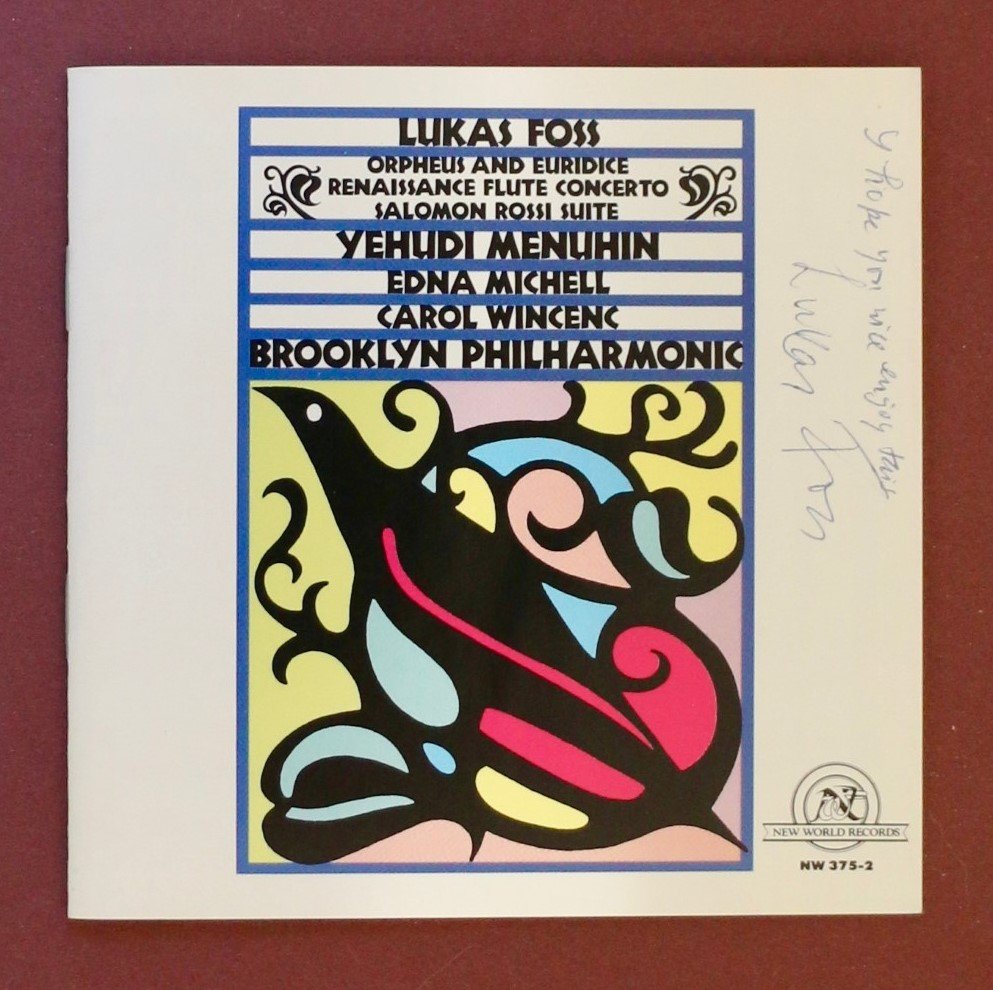
    For Lukas Foss’ 100th birthday, here’s a CD he inscribed for me in 1989. Pretty good album, by the way.


  • Pastoral Piano English Folk Idylls

    Pastoral Piano English Folk Idylls

    by 

    in
    3 responses

    According to a certain school of thought, folk music – music of the land – embodies the spirit of a nation. And no nation’s composers milked that cow quite as soulfully as the English.

    This Sunday night on “The Lost Chord,” we’ll have an hour of bucolic reflections for the keyboard of a time lost to technology and industrialization.

    We’ll begin with Gerald Finzi’s “Eclogue” for piano and string orchestra. Originally drafted in the mid-‘20s as the projected slow movement of a piano concerto, the material was later reshaped by the composer, who was content to let it stand on its own. In case you’re not familiar with the term, an eclogue is a short pastoral poem.

    If you find yourself transported by this, I think you will also really enjoy Cyril Rootham’s “Miniature Suite” of 1921. Rootham, better known for his choral music, was a friend of Ralph Vaughan Williams and Gustav Holst. His work at Cambridge University exerted a significant influence over English musical life. Like the “Eclogue,” the “Miniature Suite” is scored for piano and strings.

    In between, I’ll provide a palate cleanser in the form of E.J. Moeran’s “Summer Valley.” Moeran was one of the last composers to really thrive on English folk music. “Summer Valley,” composed for solo piano in 1925, was dedicated to Frederick Delius.

    Finally, we’ll engage in a bit of musical time travel. In addition to the whole folk song perspective, England is justifiably proud of its formal musical past. The legacy of the Tudors was a particular influence on works such as Benjamin Britten’s “Gloriana,” Gordon Jacob’s “William Byrd Suite,” and Vaughan Williams’ “Fantasia on a Theme by Thomas Tallis.”

    In the case Herbert Howells – like Rootham, a composer better recognized for his choral endeavors – he fell under the spell of the clavichord, after he was lent one by one Herbert Lambert, a photographer with a passion for building replicas of early keyboard instruments.

    The fortuitous encounter led to the composition of three suites, written in different periods of Howells’ life, which hark back to the glory days of the “Fitzwilliam Virginal Book.” All three sets are characterized by an inventive blend of Tudor and English folk influences. Each of the individual movements are dedicated to a friend or colleague of the composer. We’ll hear the first set, titled “Lambert’s Clavichord,” written in 1927, which was sanctioned for performance on the modern piano.

    I hope you’ll join me for an hour of musical escapes to the countryside and the golden musical past. That’s “Idyll Thoughts” – pastoral English works for piano – this Sunday night at 10:00 EDT, on WWFM – The Classical Network and wwfm.org.


  • Nichelle Nichols Tribute & Trekonderoga

    Nichelle Nichols Tribute & Trekonderoga

    by 

    in
    3 responses

    Last night proved to be a lovefeast for Nichelle Nichols, Star Trek’s Lieutenant (later Lieutenant Commander, then Commander) Uhura. Thank you so much to those of you who dropped by to share your anecdotes and observations.

    Nichols was a pioneer in more ways than one, who leveraged her celebrity to create a better world. Also, she had the ability to connect with people and to make them feel special, as attested to in every one of last night’s viewer comments and video testimonials. Two qualities that were noted repeatedly were Nichols’ kindness and her graciousness. May she rest in peace.

    Other highlights included an impromptu crossover, when we patched into Captain Phil Merkel’s radio show on WUSB, and Warren Friedrich’s startling revelation that I wasn’t wearing pants!

    We’ll be taking the night off next Friday, so that Roy can head north to Ticonderoga, NY for this year’s Trekonderoga, presented by the Star Trek Original Series Set Tour. Roy will be giving a couple of presentations there, so consult the website and keep an eye on the Facebook page.

    I’ll be sitting this one out, but we’ll soon reunite for another Roy’s Tie-Dye Sci-Fi Corner, on Friday, August 27, at 7:30 pm, and another nostalgic conversation with a few laughs, when we livestream on Facebook – the topic to be announced.

    https://www.facebook.com/roystiedyescificorner

    In the meantime, have a great couple of weeks! Live long and prosper!


Tag Cloud

Aaron Copland (93) Beethoven (95) Composer (114) Film Music (145) Film Score (143) Film Scores (255) Halloween (94) John Williams (195) KWAX (229) Leonard Bernstein (104) Marlboro Music Festival (125) Movie Music (160) Mozart (91) Opera (213) Philadelphia Orchestra (89) Picture Perfect (174) Princeton Symphony Orchestra (109) Radio (88) Ross Amico (244) Roy's Tie-Dye Sci-Fi Corner (290) The Classical Network (101) The Lost Chord (269) Vaughan Williams (105) WPRB (397) WWFM (881)

DON’T MISS A BEAT

Receive a weekly digest every Sunday at noon by signing up here


RECENT POSTS