Remember: in the summer, it’s important to stay “hydrated.”
On the next Roy’s Tie-Dye Sci-Fi Corner, we’re enlisting a crew of hirsute, out-of-shape fighting men (including a 39 year-old Hercules, who looks, at best, to be in his late 50s) for a journey to the far-side of the world in our quest for the Golden Fleece and a discussion of “Jason and the Argonauts” (1963).
Everything that you loved about this movie as a kid still holds up: the vindictive, fruit-loving harpies, an oversized bronze automaton in serious need of WD-40, destruction by crumbling cliff-faces narrowly averted by tuna-tailed Triton, and sinister skeleton warriors sprung nonsensically from hydra’s teeth. Also, Nancy Kovack (a.k.a. Mrs. Zubin Mehta) and Honor Blackman!
Roy and I will do our best to emulate the perfect alchemy of Ray Harryhausen and Bernard Herrmann this week, when we talk about “Jason and the Argonauts.” Are we stop-motion animation, or is it just Roy’s internet connection? Pour yourself a tall glass of water and join the conversation in the comments section. We livestream on Facebook, this Friday evening at 7:30 EDT!
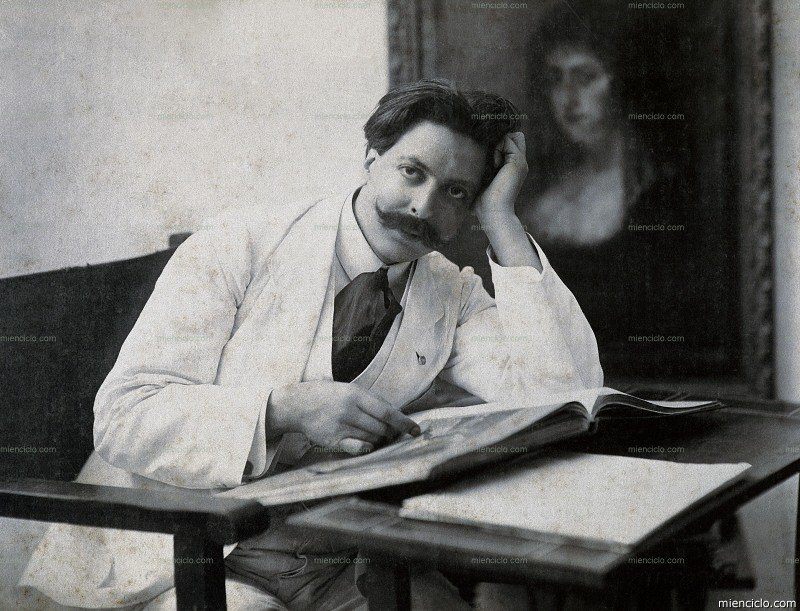
Yesterday, I wrote about the untimely death of Enrique Granados in connection with his delayed return from the U.S., after being invited to the White House by Woodrow Wilson following the sensational debut of his opera “Goyescas” at the Metropolitan Opera. Granados’ ship was torpedoed in the English Channel by a German U-boat, and the composer drowned when attempting to save his wife.
Granados was born on this date in 1867. He is best-remembered, of course, for his delectable piano miniatures, which contain music of great beauty and sensitivity. He’s sometimes described as “the Spanish Chopin.” I prefer to think of him as “the Spanish Grieg.” And that is not in any way to damn him with faint praise. He may be my favorite Spanish composer.
Here’s a pleasing recital by Pablo Matías Becerra (including “Valses poéticos,” Spanish Dance No. 2 “Oriental,” “El pelele,” Spanish Dance No. 7 “Arabesca,” “Allegro de concierto,” and “Escenas románticas”)
Anyone looking to gain a more comprehensive overview of the scope of Granados’ compositional output could do worse than to seek out three volumes of his orchestral works recorded by Pablo González and the Barcelona Symphony Orchestra and National Orchestra of Catalonia, on the Naxos label.
Also, a piece for piano, organ, and three choruses, called “Song of the Stars,” lost for nearly a century.
None of the orchestral pieces rise to the level of the piano music, in my opinion, but they all contain some very charming, wholly neglected music. One of the volumes includes a half-hour symphonic poem, “Dante” (little charm here, perhaps, but plenty of drama), which will surely modify your view of the composer.
Just before Granados’ fateful homeward journey from New York, he made some live-recorded player piano rolls for the Aeolian Company’s “Duo-Art” system. Here are two of them.
Granados playing “The Maiden and the Nightingale” from “Goyescas”
And the Spanish Dance No. 5 “Andaluza”
In 1909, he began a piano concerto. This was interrupted by “Song of the Stars” and the operatic version of “Goyescas.” The concerto would be left unfinished at the time of Granados’ death.
In 2011, the sketches were rediscovered and a realization undertaken. Keep in mind, the completed work is purely conjectural, the first movement built on two surviving fragments. The other movements were adapted from existing Granados works: the Spanish Dance No. 2 “Oriental” and “Capricho español” (for Movement II) and “Allegro de concierto” (for Movement III). Here’s a performance in concert.
An ironic footnote: one of the Granados’ sons, also named Enrique, became a champion swimmer, who competed in the 1952 Summer Olympics.
Happy birthday, Enrique Granados. And gracias.
Alicia de Larrocha plays “Goyescas,” in its original guise
While Béla Bartók is respected as the foremost Hungarian composer of the 20th century, Ernő Dohnányi, until recently, has been subject to neglect, at least in proportion to his significance. Sure, Bartók and his friend, Zoltán Kodály, were at the forefront of the whole nationalist movement, traipsing around the countryside in order to document authentic folk traditions before they were swallowed up forever by industrialization. But as director of the Budapest Academy of Music and music director of the Budapest Philharmonic Orchestra, Dohnányi would exert as much influence over his country’s musical development as that of his folk music-mad friends and contemporaries
Unfortunately, he would become the target of character assassination campaigns after World War II, in which he was painted as a Nazi sympathizer. Dohnányi was investigated and cleared several times by the U.S. Military Government, and in fact has been defended as a forgotten hero of Holocaust resistance, since it was through his administrations that countless Jewish musicians survived. Also, between the wars, he went to bat for Kodály, a leftist, by refusing to fire him from the Budapest Academy. As a result, Dohnányi too lost his position, albeit temporarily. Nevertheless, he continued to be eyed with suspicion, and his slandered reputation never fully recovered.
Equally fatal is the fact that much of his music bears a more cosmopolitan stamp than that of the Hungarian composers of his era that are now so celebrated. His composition teacher, the German-born Hans von Koessler (known in Hungary as János Koessler), was a cousin of Max Reger. Of course, Koessler also taught Bartók and Kodály. But Dohnányi was perfectly happy nestled in the world of Brahms. For his international career, he assumed the name Ernst von Dohnanyi.
I’ve always been partial to Sir Malcolm Sargent’s recording of Dohnanyi’s gorgeous Serenade in F sharp minor, with the London Symphony Orchestra. Unfortunately, the sound file doesn’t seem to be posted anywhere. For as much as I appreciate the existence of this CD, the performance is a comparatively weak substitute – in my humble opinion, of course:
In the meantime, nice to have discovered this live performance of Dohnanyi’s best-known piece, the “Variations on a Nursery Tune,” with André Previn conducting. The soloist is the Brazilian pianist Cristina Ortiz, cute as a button. The piece has its share of “inside” musical jokes, but the best one must be the agonizingly portentous build-up to the pianist’s first entrance – here complete with a stroll through the cemetery, beneath the chilly gaze of an ominous medieval castle!
Furthermore, the entire orchestra appears to be dressed as Captain Kirk.
Happy birthday, Ernő Dohnányi. Energize!
PHOTO: Dohnányi (left), boldly taking the train with Bartók
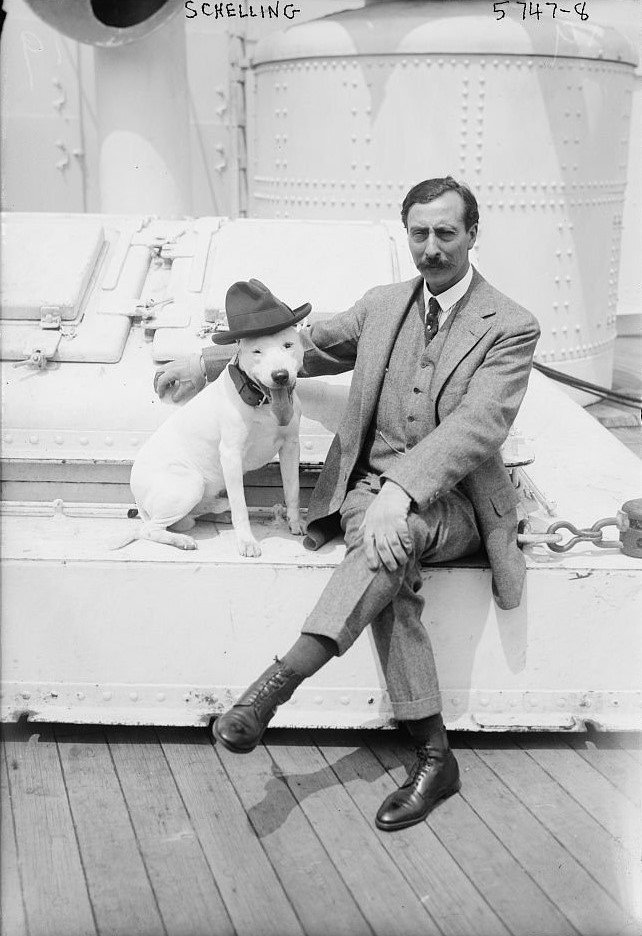
You might say that Ernest Schelling was a Jersey boy who made good. He also happened to be responsible, in part, for the death of Enrique Granados.
Schelling, a celebrated pianist who for a period of three years became the exclusive pupil of Ignacy Paderewski, was born in Belvidere, NJ on this date in 1876.
A child prodigy, he made his debut at Philadelphia’s Academy of Music at the age of 4. At 7, he was admitted to the Paris Conservatory. Among the other notable musicians he worked with were Hans Huber, Moritz Moszkowski, and Theodor Leschetizky. Leschetizky was the pupil of Carl Czerny, who of course studied with Beethoven.
As a conductor, Schelling became music director of the Baltimore Symphony Orchestra, which he led from 1935 to 1937. Well before Bernstein, he conducted the New York Philharmonic Young People’s Concerts, beginning in 1924. They were such a success, he took them on tour, with stops in Philadelphia, Los Angeles, London, and Rotterdam.
Schelling gave the U.S. premiere of Granados’ piano cycle “Goyescas.” In fact it was he who encouraged the composer to craft the music into an opera. Granados liked the idea, and “Goyescas” was given its first performance at the Metropolitan Opera in 1916.
It created such a sensation that Woodrow Wilson – former president of Princeton University and former governor of New Jersey – invited the composer to the White House, an offer Granados could hardly refuse. Granados postponed his homeward journey. A few weeks later, he was drowned in the English Channel, after his ship, the S.S. Sussex, was torpedoed by a German submarine.
Thanks a lot, Ernest Schelling – and by the way, happy birthday.
Schelling plays Liszt’s Sonata in B minor:
Willem Mengelberg conducts Schelling’s “A Victory Ball:”
Season 4 of “Stranger Things” breathtakingly jumped the shark in innumerable ways. And yet somehow it remained compellingly watchable. Once I was able to get into it, that is. And I have to say, all the classical music on the soundtrack was a very nice bonus.
I’m aware that the latest season dropped on Netflix some time ago (in two “volumes,” on May 27 and July 1), but after watching the underwhelming first episode – which, for me, ventured a little too eyerollingly into CW Network-style teen angst – I wound up taking a prolonged break. I tune in to “Stranger Things” for the calculated ‘80s nostalgia and monsters from the Upside-Down, thank you.
Fortunately, at the urging of friends, I finally took it up again in earnest, and sure enough, yet again I found myself caught up in its icky tendrils. It’s been the pattern with this series that there’s been a kind of slow burn at the start that belies the relentless insanity to come. Hats off to the Duffer Brothers, the show’s creators, for their willingness to gamble big, because for as ludicrous as the whole thing has become, they’ve managed to take the series in some truly unexpected directions, while remaining true to its core.
If you’re unfamiliar with the series, one of its most charming characteristics is the way it raids the pop culture of the 1980s (Steven Spielberg, Stephen King, Dungeons & Dragons and, this season especially, “A Nightmare on Elm Street” and “Poltergeist” ) and rearranges it in fresh ways. Actor Robert Englund, Freddy Krueger himself, has a pivotal cameo.
The episode that allows everything that’s been presented in the first three seasons to be viewed in a totally different light (from multiple perspectives, even) is a knockout. But I always go in for that sort of thing when it’s done well. Admittedly, not everyone does. I was one of the few who was delighted with the topsy-turvy “Back to the Future Part II.”
Tonally, Season 4 is all over the place, but that’s kind of become a “Stranger Things” hallmark. Even as the stakes are impossibly high, it’s not afraid to go goofy. For most of its 13-hour running time, the show kept me engaged and laughing.
And what do you know, in this series driven by demons, conspiracy theory, and the paranormal, the KORNGOLD VIOLIN CONCERTO gets a major showcase in Episode 6, when the gang shows up in Salt Lake City to enlist a computer hacker. Her household turns out to be a mash-up of the kinds of theatricals once staged by the Bronte siblings and the March sisters. Wild children cavort with swords and bows-and-arrows and ruffed collars and pasted-on mustaches, while on a portable record player on the floor spins an LP of Korngold’s concerto.
According to the show’s timeline (set in 1985), it would have to be either the Heifetz or Perlman recordings, since I believe those were the only performances available then. But I’m skeptical as to whether or not the creative team was so scrupulous as not to employ a recording of more recent vintage. Of course, now the concerto is in the repertoire of every major violinist.
Erich Wolfgang Korngold, a former prodigy from Vienna, came to Hollywood in the 1930s, where he achieved wider popularity with his swashbuckling film scores for Errol Flynn classics like “Captain Blood,” “The Adventures of Robin Hood,” and “The Sea Hawk.”
For the average viewer, Kate Bush, Metallica, and Ella Fitzgerald will probably leave the biggest impressions, but Season 4’s soundtrack also sports selections by Verdi, Puccini, Bach, Debussy, Tchaikovsky, and Philip Glass, with Paisiello’s opera “Nina” a major influence on the plot that few will catch. These days, you can’t get much stranger than that!
Heifetz plays the last movement of Korngold’s Violin Concerto



2 responses