• Easter Bliss Ryelandt Josquin & Mass

    Easter Bliss Ryelandt Josquin & Mass

    by 

    in
    4 responses

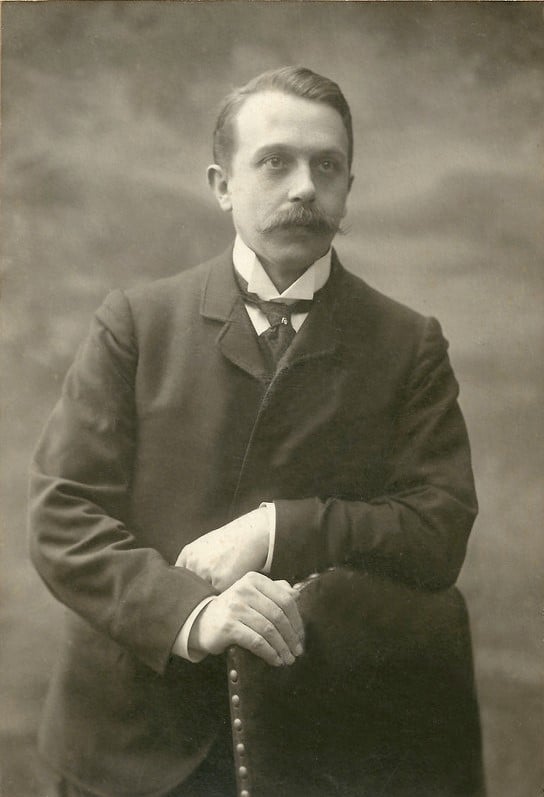
    Soon all the guests will have left, and all the dishes will be cleaned. Time to pop a couple of malted eggs, or to pour yourself a malt scotch, and to wrap up your Easter in inspiring fashion, with the Symphony No. 4 by the devout Belgian composer Joseph Ryelandt.

    Ryelandt’s symphony, completed on the very eve of World War I, concludes with a triumphant statement of the Credo from the Catholic Mass. Then stick around for a Credo setting by the Franco-Flemish composer, of some four centuries earlier, Josquin des Prez.

    Enjoy these two spiritual discoveries rooted in the Mass. That’s “Creative Spirit,” this Sunday night at 10:00 EDT, on “The Lost Chord,” on WWFM – The Classical Network and wwfm.org.


  • Henry Mancini Film Music Birthday Tribute

    Henry Mancini Film Music Birthday Tribute

    by 

    in
    6 responses

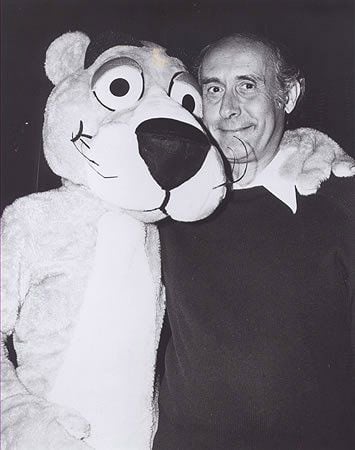
    Happy birthday, Henry Mancini! Like any great film composer, you always knew just how to set the tone.

    Musical hook for grappling hook

    Perambulating with pachyderms

    Sunday night by flashlight

    Early morning elegance

    Thanks, Hank. You helped make it a great age.


  • Biblical Epics Adapted from Novels on Picture Perfect

    Biblical Epics Adapted from Novels on Picture Perfect

    by 

    in
    4 responses

    This week on “Picture Perfect” it’s the second installment in a mini-festival of very big films, as we present another hour of Biblical epics, though this time with a twist. Rather than go directly to the Gospels, these are all films adapted from bestselling historical novels.

    Lloyd C. Douglas’ “The Robe” was given the Hollywood treatment in 1953. Richard Burton plays Marcellus, the Roman tribune who oversees the crucifixion and wins Christ’s robe in a game of dice. Victor Mature (last week’s Samson) is his well-oiled slave, Demetrius, and Jean Simmons, his childhood sweetheart, now betrothed to Caligula (a scene-stealing Jay Robinson).

    “The Robe” holds the distinction of being the first film released in CinemaScope. Allegedly, it is also the only Biblical epic ever to yield a sequel (“Demetrius and the Gladiators”). The score, by Alfred Newman, has always been popular.

    Thomas B. Costain’s “The Silver Chalice” was brought to the big screen in 1954. The film introduced Paul Newman in the lead, as a lowborn artisan commissioned to fashion a decorative casing for the cup from which Christ drank at the Last Supper (i.e. the Holy Grail).

    The film is interesting in that it features quasi-abstract sets by stage designer Rolfe Gerard and a stunning score by Franz Waxman, which incorporates the “Dresden Amen,” also used in Wagner’s “Parsifal.” However, Newman was mortified by his performance and famously took out an ad in Variety, essentially to apologize.

    “Barabbas” is worlds away from the usual Hollywood epic. Based on the Nobel Prize-winning novel of Pär Lagerkvist, the film is a ruminative slog through the guilt-ridden psyche of the title character, played by Anthony Quinn. Barabbas is the thief who is pardoned to make way for the crucifixion of Christ. He spends the rest of his life searching for meaning in a meaningless world.

    In a quixotic attempt at verisimilitude, director Richard Fleischer shot the crucifixion scene during an actual solar eclipse. Mario Nascimbene (who composed the music for last week’s “Solomon and Sheba”) wrote the score.

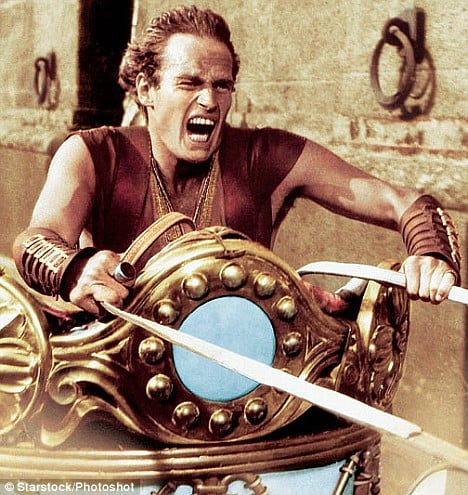
    Finally, we’ll wrap things up with music from one of the all-time Oscar champs, “Ben-Hur,” from 1959. Based on the 1880 novel of General Lew Wallace, “Ben-Hur” was honored with 11 Academy Awards, including those for Best Picture, Best Director (William Wyler) and Best Actor (Charlton Heston).

    The highlight of the film, of course, is the jaw-dropping chariot race, but there is a grandeur to the whole that makes it difficult to look away. Miklós Rózsa wrote the magnificent score, arguably the best of any film of its kind.

    The “Ben-Hur” Oscar record has been tied twice – in 1998, by “Titanic,” and in 2004, by “The Lord of the Rings: The Return of the King” – but this is before computer generated imagery, folks. They just don’t make ‘em like this anymore.

    The New Testament is all-new, by way of adaptations of historical novels, on “Picture Perfect,” music for the movies, this Saturday evening at 6:00 EDT, on WWFM – The Classical Network and wwfm.org.
  • Wagner’s Parsifal Good Friday Soundtracks

    Wagner’s Parsifal Good Friday Soundtracks

    by 

    in
    6 responses

    I mean no disrespect in saying that, for me, Good Friday is made better by Wagner’s “Parsifal.” I try to listen to it every year, whether I need it or not.

    Here’s my annual posting of Leopold Stokowski’s transcendent Houston recording of the “Good Friday Spell” from Act III.

    Also, a fascinating 1927 recording of the Transformation Music and Grail Scene from Act I, set down at the Bayreuth Festspielhaus. The recording employs the original bells designed by Wagner, which were later melted down by the Nazis for ammunition during World War II. A rare opportunity to experience “Parsifal” as Wagner actually knew it. (The bells begin at 5:57.)

    The conductor, Karl Muck, was associated with the Bayreuth Festival since 1892. He became its principal conductor in 1903. Between 1901 and 1930, he conducted “Parsifal” at Bayreuth 14 times.

    Another conductor who was a pillar at Bayreuth was Hans Knappertsbusch. Of Kna’s 95 appearances there, 55 were conducting “Parsifal,” for which he was especially renowned.

    I was going to post a link to one of his performances of the Prelude to Act I , but then I couldn’t help it. Here’s the whole blessed thing – all four hours of it – from 1962. The live recording is regarded as the benchmark by many, rivaled only by Kna’s performances from the 1950s.

    Sacrifice, compassion, healing, and rebirth. Every Friday is good, but Good Friday with “Parsifal” is subime.


    The metal canisters used to produce Bayreuth bell sounds from the 1880s to about 1929:

    https://www.monsalvat.no/parsifal-bells.htm

    IMAGE: Set design by Paul von Joukowsky for the 1882 Bayreuth debut of “Parsifal”


  • Kilar’s Exodus Passover and a Klezmer Motif

    Kilar’s Exodus Passover and a Klezmer Motif

    by 

    in
    3 responses

    Chag Sameach! Passover begins at sunset.

    Wojciech Kilar (1932-2013) is probably best-known in this country for his film scores. He composed music for well over 100 movies, gaining a toehold in international cinema fairly late in his career. American audiences may recognize his work for “Bram Stoker’s Dracula” (1992), “The Portrait of a Lady,” (1996), and “The Pianist” (2002).

    But in his native Poland, he was also a major concert composer, of the same generation as Krzysztof Penderecki and Henryk Górecki. My own first exposure to Kilar was on a concert of the Philadelphia Orchestra, given back in 1987, when Witold Rowicki conducted a fascinating work titled “Krzesany” (1974), a symphonic poem evocative of a Polish mountain dance that employs aleatoric elements.

    In 1979-81, Kilar composed “Exodus,” a 23-minute crescendo, after the manner of Ravel’s “Boléro,” only crowned by the entrance of a chorus, which sings “Domine ecce venit populus tuus” (“Lord, behold, your people come”), in a spirit of mounting exultation.

    Though it is by no means film music, its genesis was in Kilar’s research in writing music for Peter Lilienthal’s film, “David” (1979). The composer stumbled across a klezmer motif in a Jewish songbook, and it basically took him over. He dedicated the finished piece to Krzysztof Zanussi, another filmmaker.

    Interestingly, Kilar’s “Exodus” did enjoy a brief vogue in the movies, in trailers, such as the one for “Schindler’s List.”

    You can view a live performance of it here:

    Be sure to stick around for a golf clap from the clergy at the end (except for the guy at the far end of the pew, who seems to have genuinely enjoyed it).


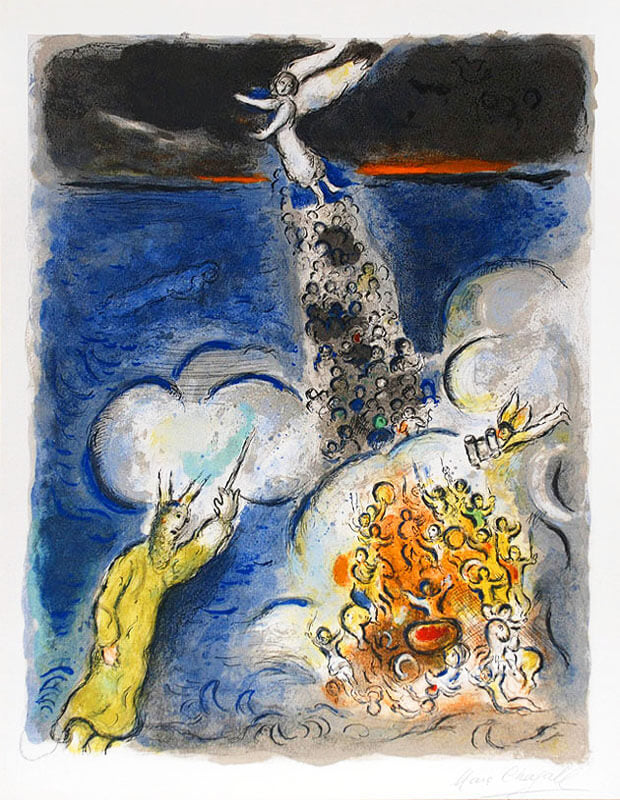
    Marc Chagall, “The Train Crossed the Red Sea” from “Exodus” (1966)


Tag Cloud

Aaron Copland (93) Beethoven (95) Composer (114) Film Music (145) Film Score (143) Film Scores (255) Halloween (94) John Williams (195) KWAX (229) Leonard Bernstein (104) Marlboro Music Festival (125) Movie Music (160) Mozart (91) Opera (213) Philadelphia Orchestra (89) Picture Perfect (174) Princeton Symphony Orchestra (109) Radio (88) Ross Amico (244) Roy's Tie-Dye Sci-Fi Corner (290) The Classical Network (101) The Lost Chord (269) Vaughan Williams (105) WPRB (397) WWFM (881)

DON’T MISS A BEAT

Receive a weekly digest every Sunday at noon by signing up here


RECENT POSTS