• Maundy Thursday Music: Lekeu, Sabata, Palestrina

    Maundy Thursday Music: Lekeu, Sabata, Palestrina

    by 

    in
    9 responses

    Is it Monday, or is it Thursday? Why, it’s Maundy Thursday!

    Of course, Maundy has nothing to do with Monday. The word is most likely derived from the Latin “mandatum,” as in “Mandatum novum do vobis ut diligatis invicem sicut dilexi vos” (“A new commandment I give you, That ye love one another; as I have loved you”). Or it could come from the Middle English and Old French words “maund” and “mendier,” respectively, after the Latin “mendicare,” meaning to beg.

    In any case, we are now entering the holiest days of the Christian calendar. Maundy Thursday commemorates Jesus’ washing of the feet of his disciples, the Last Supper, and the betrayal and arrest of Christ in the garden of Gethsemane.

    Here’s an exceedingly somber work for Maundy Thursday by the Belgian composer Guillaume Lekeu (1870-1894). Lekeu died of typhoid the day after his 24th birthday. In his short life, he managed to produce about 50 works. Admittedly, some are incomplete. If one were to judge solely from his music, he was a melancholy soul indeed.

    This is “Molto Adagio,” composed by a 16 year-old Lekeu, inspired by the words of Christ in the garden of Gethsemane, “My soul is exceeding sorrowful, even unto death.”

    From 1999 to 2014, the Brentano Quartet served as ensemble-in-residence at Princeton University. Among its other achievements, the ensemble played on the soundtrack of the 2012 film “A Late Quartet,” starring Christopher Walken, Philip Seymour Hoffman, Catherine Keener, and Wallace Shawn. The group’s cellist, Nina Lee, also appeared onscreen, as a fictionalized version of herself.

    A couple of days ago, I posted about conductor Victor de Sabata, for his birthday. De Sabata too wrote a lovely piece for Maundy Thursday, called “Gethsemani.” I highly recommend it in its orchestral guise, available on a CD of De Sabata’s symphonic poems on the Hyperion label. However, since either Hyperion or the algorithm is so hyper-vigilant, Hyperion recordings seem to get yanked off YouTube very quickly.

    So here’s the work in a version for piano. Still beautiful, still contemplative, but without the orchestral sheen.

    Finally, from a gorgeous album of Palestrina’s music for Maundy Thursday on the Chandos label, here’s a playlist of performances by Musica Contexta.

    All sensitively done, I think. There’s little maudlin in this Maundy.


    “Jesus in the Garden of Gethsemane,” c. 1500, by Pedro Berruguete (1450–1504)


  • Mozart’s Vatican Heist The Stolen Miserere

    Mozart’s Vatican Heist The Stolen Miserere

    by 

    in
    One response

    When the 14 year-old Mozart perpetrated a daring theft from the most powerful institution in the world, there was no need to circumvent a laser grid by descending on cables from on high.

    Mozart and his father attended a Holy Week service at the Vatican in 1770. There, they encountered for the first time Gregorio Allegri’s haunting “Miserere.”

    Allegri composed his setting of Psalm 51 (50) in the 1630s. The piece was intended for exclusive performance in the Sistine Chapel, as part of the Tenebrae service of Holy Wednesday and Good Friday.

    Its conception is a striking one, with two choirs: one intoning a simple chant, and the other, spatially separated, providing ornamentation. The effect of a stratospheric top C makes the “Miserere” one of the most enthralling works in the choral literature of the late Renaissance.

    The Vatican, realizing it had a good thing, forbade performance of the piece or copies of the score to be circulated outside its walls, under pain of excommunication.

    It was Mozart who blithely liberated the piece, copying it down from memory and handing it off to author and music historian Charles Burney, who published it without delay.

    Mozart was summoned before the Pope, and rather than being excommunicated, he was showered with praise for his feat of musical genius. The ban on the “Miserere” was lifted.

    Mission accomplished!


    These portraits, of Allegri (left) and the teenage Mozart, will self-destruct in five seconds


  • Montserrat Caballé Google Doodle Celebrates La Superba

    Montserrat Caballé Google Doodle Celebrates La Superba

    by 

    in
    3 responses

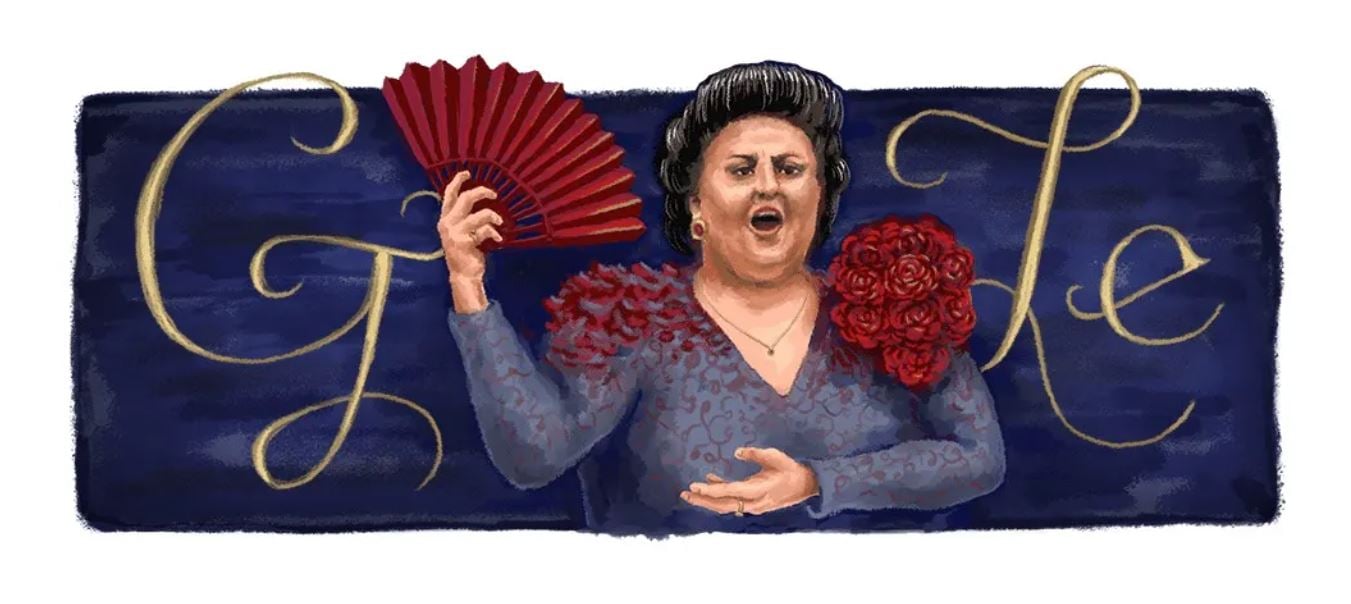
    Montserrat Caballé gets a Google Doodle on what would have been her 89th birthday. Naturally in Google’s write-up, they emphasize her collaboration with Freddie Mercury, with imbedded video of “Barcelona.” Oh yeah, she also happened to be one of the greatest sopranos of her generation. I guess that’s why they called her “La Superba.”

    Google Doodle pays tribute to Spanish opera singer Montserrat Caballé on 89th birthday

    From her American debut, filling in for a indisposed Marilyn Horne. The performance earned her a 25-minute standing ovation.

    “Il Pirata”

    Hypnotic in “Maria Stuarda,” with great anecdote in the comments section about Caballé upstaged by a peacock!

    A favorite Caballé album of songs by Enrique Granados

    Meltingly beautiful Donizetti

    Lock up the crystal! Superhuman in “Don Carlo.”

    Quite a blast from “Hérodiade”


  • Pietro Nardini 300th Birthday

    Pietro Nardini 300th Birthday

    by 

    in
    2 responses

    What, is no one celebrating the 300th birthday of Pietro Nardini?

    Nardini was pupil of violinist Giuseppe Tartini, who found employment at the court chapel in Stuttgart for a few years in the 1760s. Then he returned home to become Kappelmeister to the Grand Duke of Tuscany in Florence.

    Nardini met the teenage Wolfgang Amadeus Mozart on one of his trips to Italy in 1770-71. This was on the same tour during which Mozart liberated Allegri’s “Miserere” from the Sistine Chapel in Rome, copying it down from memory, though it was forbidden for the music to be distributed elsewhere. (The Pope let it slide.)

    If we’re to believe Mozart’s father, Leopold, an accomplished violinist himself, Nardini played his instrument beautifully, but struggled in more difficult passages. A poet, then, if not a virtuoso. He was also criticized for his lack of depth. Hey, we can’t all be Tartini.

    Still time to pick up a card and some flowers. It’s 300 candles on Nardini’s ice cream cake. Buon compleanno!


    Sonatas for strings

    Violin concertos

    String quartets


  • Song of Songs Love & Music on The Lost Chord

    Song of Songs Love & Music on The Lost Chord

    by 

    in
    3 responses

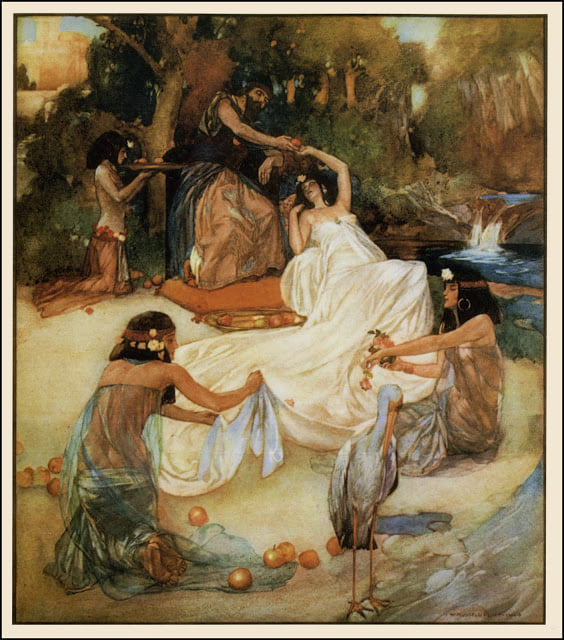
    The Song of Songs. Attributed to King Solomon, this Biblical book contains some of the most ardent poetry ever written. Whether interpreted as the communion of man and woman, or as something of a more allegorical nature – the relationship, depending upon one’s system of belief, between God and Israel, between God and the Church, or between Christ and the human soul – over the centuries it has inspired some meltingly lovely music.

    Since it is customary to read from the Song of Songs as part of the observance of Passover, this Sunday night on “The Lost Chord,” in anticipation of Pesach, we’ll sample two complementary settings: one by Sir Granville Bantock – selections from his massive, 2 ½ hour oratorio – and one by Lukas Foss – a more intimate song cycle, in which divine and romantic love unite in understated metaphor.

    What if I told you your temples behind your veil are like the halves of a pomegranate? If you fall for that, there’s plenty more where that came from, on “King Solomon’s Lines,” this Sunday night at 10:00 EDT, on WWFM – The Classical Network and at wwfm.org.


Tag Cloud

Aaron Copland (93) Beethoven (95) Composer (114) Film Music (145) Film Score (143) Film Scores (255) Halloween (94) John Williams (195) KWAX (229) Leonard Bernstein (104) Marlboro Music Festival (125) Movie Music (160) Mozart (91) Opera (213) Philadelphia Orchestra (89) Picture Perfect (174) Princeton Symphony Orchestra (109) Radio (88) Ross Amico (244) Roy's Tie-Dye Sci-Fi Corner (290) The Classical Network (101) The Lost Chord (269) Vaughan Williams (105) WPRB (397) WWFM (881)

DON’T MISS A BEAT

Receive a weekly digest every Sunday at noon by signing up here


RECENT POSTS