• Chausson’s Death and Debussy’s Music

    Chausson’s Death and Debussy’s Music

    by 

    in
    2 responses

    Suicide by bicycle?

    That’s the theory put forth by Debussy biographer Edward Lockspeiser concerning the untimely death of Ernest Chausson. In 1899, Chausson hurtled downhill into a brick wall at the age of 44. While Chausson was certainly prone to depression, the theory of slamming into a wall with intent was emphatically refuted by Chausson’s own biographer, Ralph Scott Grover.

    Chausson left behind a comparatively small, but meticulous output, a mere 39 opus numbers – Chausson got a late start, abandoning law at 25 to devote himself to composition – among them are the ravishing “Poème” for violin and orchestra, the song cycle “Poème de l’amour et de la mer,” and the Concert for Piano, Violin and String Quartet.

    Chausson’s “Concert” of 1891 is especially noteworthy, its title recalling chamber music of the French baroque by composers such as Couperin and Rameau, but also suggesting more of a concerto than a sextet, with solo violin and piano playing against the backdrop of a standard string quartet. It’s a creative gamble with its own unique challenges, and Chausson acquits himself marvelously.

    On this week’s “Music from Marlboro,” we’ll hear a 1968 performance, featuring solo violinist Jaime Laredo and pianist Ruth Laredo, with violinists Michael Tree and Hidetaro Suzuki, violist Nobuko Imai, and cellist Robert Sylvester. That’s a starry line-up by anyone’s standards. You’ll note that Tree is best known as a violist from his 45-year tenure with the Guarneri String Quartet.

    Chausson and Claude Debussy were like brothers. Chausson invited his friend for a long stay in the summer of 1893 at a rented house in Luzancy. To make the visit even more agreeable, Chausson sent away for the score to Mussorgsky’s “Boris Godunov,” knowing Debussy’s fondness for it, and the they passed many enjoyable hours together at the piano, with Debussy playing through the opera while Chausson acted as page-turner.

    The two were close enough that Chausson felt he could speak frankly of his disapproval of Debussy’s profligate lifestyle. Whether or not he overstepped his bounds, their friendship did cool somewhat after that, though they continued to find much to admire in one another’s music.

    Chausson did not live to hear Debussy’s Sonata for Flute, Viola and Harp, a late work composed in 1915. We’ll hear it performed at the 1978 Marlboro Music Festival by flutist Carol Wincenc, violist Samuel Rhodes, and harpist Moya Wright.

    Incidentally, Chausson biographer Ralph Scott Grover lived next store to my grandparents. Grover was the head of the music department at Lafayette College and also a great Anglophile – so much so that he spoke with a Mid-Atlantic accent. Even as a boy, I found this puzzling. It turns out he was a world authority on the music of Edmund Rubbra and a personal friend of the composer. In fact, he wrote a book on Rubbra in 1993 and his encapsulated biography for “The New Grove Dictionary of Music and Musicians.” Grover died in 2002. Though I regret not comprehending who he was, as a child, well before I developed my passion for music, we did get to know one another a little toward the end of his life, by which time he was already listening to me on the radio. We nearly missed one another completely, but I am thankful for the conversations we enjoyed. If only the timing had been better, I might have benefited from more of a master-disciple relationship.

    But let us not speak of regrets! Rather, join me for works of Debussy and Chausson on the next “Music from Marlboro,” this Wednesday evening at 6:00 EST, on WWFM – The Classical Network and wwfm.org.

    Marlboro School of Music and Festival: Official Page


    PHOTO: Chausson turning pages for Debussy


  • Medieval Bestiary Music on The Classical Network

    Medieval Bestiary Music on The Classical Network

    by 

    in
    5 responses

    In the Middle Ages, a bestiary was a collection of descriptions and stories about animals, ranging from the mundane to the fantastical, from which moral and theological lessons were gleaned from the natural world. The symbols of the bestiary were likewise absorbed into the conventions of courtly love.

    On today’s Noontime Concert on The Classical Network, the ensemble Marginalia will present “The Book of Beasts: A Medieval Bestiary,” musical evocations of the lion, the panther, the unicorn, the elephant, the phoenix, the pelican, and the dragon, from medieval sources.

    The program, part of a free midday concert series presented by Gotham Early Music Scene (or GEMS), was given at Saint Bartholomew’s Church, 50th Street and Park Avenue, in New York City. Free concerts are held there every Thursday at 1:15 p.m.

    Following the broadcast, stick around, as we’ll continue with an afternoon of zoological and cryptozoological wonders, including Peter Schickele’s “Bestiary,” Jennifer Higdon’s “An Exaltation of Larks,” Lucas Richman: Conductor/Composer’s “Behold the Bold Umbrellaphant” – and, okay, Camille Saint-Saëns’ “The Carnival of the Animals,” among others.

    Take a walk on the wild side, this afternoon from 12 to 4:00 EST, on WWFM – The Classical Network and wwfm.org.


  • Bach, Schweitzer, Růžičková: Music for the Soul

    Bach, Schweitzer, Růžičková: Music for the Soul

    by 

    in
    6 responses

    If there is any doubt that Bach is good for the soul, one need look no further than two spiritual titans whose birthdays we’ll celebrate today.

    Albert Schweitzer (1875-1965) is widely remembered for his humanitarian efforts. A lifelong scholar, a missionary, and a physician who brought medical assistance to the people of Gabon, he was awarded the Nobel Prize in 1952.

    A frail child, Schweitzer took to the organ as soon as he was tall enough to reach the pedals. His love of music paralleled his development as a philosopher and a theologian. In fact, no less an authority than Charles-Marie Widor was stunned by Schweitzer’s insights into Bach’s organ works, which were informed in part by a Lutheran background he shared with the composer. Schweitzer wrote extensively on Bach, in French, German, and English. In addition, he gave numerous organ recitals in Europe to finance his hospital in Africa.

    A reverence for life was central to Schweitzer’s philosophy. While he continued his humanitarian work in Lambaréné throughout World War II, Zuzana Růžičková (1927-2017) weathered the incomprehensible in several Nazi concentration camps.

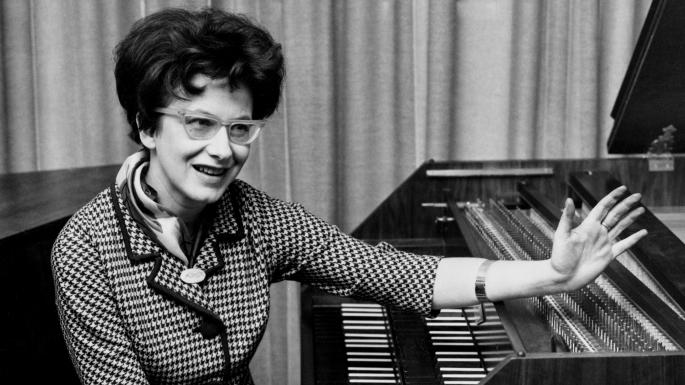
    Růžičková survived internment at Terezin, Auschwitz, and Bergen-Belsen. Of the latter, in particular, she recalled, “If ever there was Hell, this was the lowest part of Hell.” Following the war, she stood up for years against political and anti-Semitic persecution under Czechoslovakia’s communist rule. She survived Stalin and lived through the Velvet Revolution, maintaining her integrity and gaining recognition as “first lady of the harpsichord.” Růžičková became the first harpsichordist to record all of Bach’s keyboard music.

    Unlike Schweitzer, Růžičková was not particularly religious, but her spirit was large and her will indomitable. Her love of music was with her always, even in the camps. (At Terezin, she transcribed some of Bach’s music to take with her to Auschwitz.) Both she and Schweitzer were acutely aware of human suffering on a scale that most of us are lucky never to have encountered. Yet they also recognized a greater good. Perhaps it’s no coincidence that they both lived to be 90.

    I hope you’ll join me today as we sample their artistry, among my featured offerings from 4 to 7 p.m. EST, on WWFM – The Classical Network and wwfm.org.


  • Beecham’s Byron A Romantic Lost Chord

    Beecham’s Byron A Romantic Lost Chord

    by 

    in
    4 responses

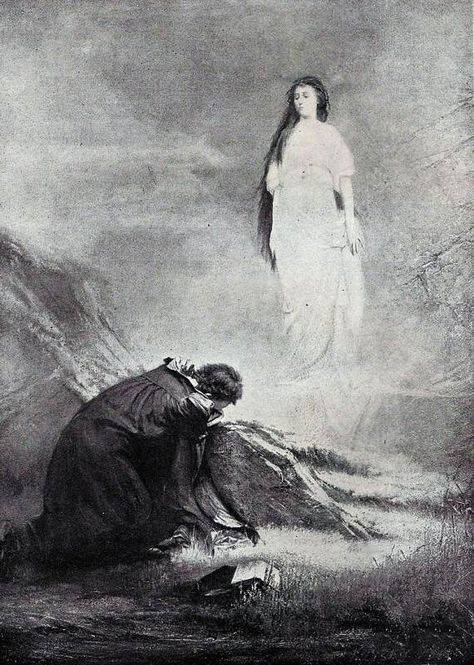
    “Oh God! If it be thus, and thou art not a madness and a mockery, I yet might be most happy…” So laments Lord Byron’s Manfred when confronted by the specter of Astarte.

    Manfred is the quintessential Byronic hero, a romantic superman who endures unimaginable sufferings and mysterious guilt in connection with the death of his beloved. He wanders the Alps, longing for extinction, and meets his fate defiantly, rejecting all authority, corporeal and supernatural.

    Robert Schumann was intoxicated by Byron’s dramatic poem from the time he first encountered it at the age of 19 in 1829. In 1848, he began to compose music for it, concurrently with that for his “Scenes from Goethe’s ‘Faust.’” Wrote Schumann, “I have never before devoted myself to a composition with such love and such exertion of my powers as to ‘Manfred.’” The piece was given its first performance in Weimar in 1852, with Franz Liszt conducting.

    This Sunday night on “The Lost Chord,” we’ll hear highlights from a recording made 102 years later by Sir Thomas Beecham.

    When Beecham came to record Schumann’s incidental music in 1954, it was an act of total reimagination. Unquestionably the work, as written, contains much attractive music. However, if we’re to be completely frank, it can be a bit dramatically static at those times when the music falls silent in deference to florid monologue. Beecham recognized this and enlisted the help of Eugene Goossens and Julius Harrison to assist him in orchestrating a number of Schumann’s piano pieces to be used as underscore for some of the spoken dialogue. He also incorporated a couple of part-songs and even invented a ballet. Fear not! Beecham’s license is nowhere in the same league as that he would later take with Handel’s “Messiah.”

    Beecham’s Byronic credentials are unimpeachable. Byron was among his favorite poets. Of course, he also happened to conduct one of the great recordings of “Harold in Italy” (after “Childe Harold’s Pilgrimage”), with the violist William Primrose. Furthermore, Beecham had been familiar with Schumann’s “Manfred” since at least 1918, when he led two performances of the complete incidental music at the age of 39. Some 36 years later, he decided to resurrect the work via a broadcast performance and then as a program at Royal Festival Hall.

    I first encountered this remarkable recording in the 1980s, in the middle of the night, when it was broadcast over the now-extinct WFLN, for 48 years Philadelphia’s classical music station. Henry Varlack used to play it from time to time on his program, “Sleepers Awake.” Finally, having not heard it for a while, I called in to his Friday night/Saturday morning request show, and he told me with regret that the record had become so worn that it was no longer suitable for airplay.

    Imagine my excitement, then, when I learned in the mid-‘90s that it was being reissued on CD. I promptly special-ordered it from England, and it couldn’t get here fast enough. That was on the Beecham Collection label – alas now long out of print. It has since appeared and disappeared (like Astarte?) on Sony.

    The recording featuring actors, chorus, and orchestra. Laidman Browne may be a bit long-in-the tooth for Byron’s anti-hero, but no one elongates “eeeeeeeeviiiiiiiiiiiiiiiiiiiiiiiiiilllllllll” quite like him.

    I hope you’ll join me for “Byronic Beecham,” this Sunday night at 10:00 EST, on WWFM – The Classical Network and wwfm.org.


  • Remembering Henry Varlack Sleepers Awake

    Remembering Henry Varlack Sleepers Awake

    by 

    in
    7 responses

    I mentioned Henry Varlack today in an earlier post. Varlack was host of “Sleepers Awake,” the overnight show on WFLN in Philadelphia.

    He was also probably my favorite radio announcer. I mean, I loved Dave Conant’s resonance, and I enjoyed listening to Bill Shedden, Terry Peyton, and the rest, but there was something about Varlack’s unconventional timbre and the fact that the guy was on from midnight to 6:00 every night that kind of endeared him to me. Many were the times that the side of a record would run out and you could hear the stylus bumping around, wearing a groove at the end. I’d call him up later, and Varlack would apologize, admitting that he was in the bathroom and he’d miscalculated the time. He may even have fallen asleep once or twice.

    Not incidentally, he also happened to play some of my favorite music in those days, and introduced me to a number of pieces I’d never heard: Alan Hovhaness’ “And God Created Great Whales,” Morton Subotnik’s “Silver Apples of the Moon,” and Robert Schumann’s incidental music to “Manfred,” selections from which I’ll be airing tonight at 10:00 EST on “The Lost Chord,” on WWFM – The Classical Network and wwfm.org. Such was Varlack’s influence.

    I’d never met Varlack in person, when he was described to me by a former WFLN engineer as looking like a black Santa Claus. Our paths eventually crossed at a remote broadcast, and finally, after all those late night phone calls, I was able to shake his hand.

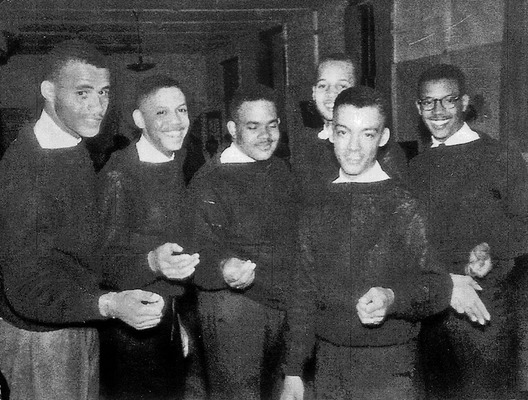
    Trying to find a photo of Varlack online is not an easy matter, since those were the days before social media, but I did find this very interesting picture of him singing in a Doo-Wop group called the Blend-Tones! Varlack is the one in the center, with his eyes closed. When he wasn’t spinning the vinyl, Varlack was also a baseball scout for the Chicago White Sox.

    He impressed me as a very interesting man, and a good-natured one, totally without pretense. I still think of him whenever I hear Gabriel Fauré’s “Pavane,” his signature music for “Sleepers Awake.” Varlack died in 2006 at the age of 65.


    Listen to some of the Blend-Tones’ records here:

    http://doo-wop.blogg.org/blend-tones-c26505866

    Gabriel Fauré’s “Pavane:”


Tag Cloud

Aaron Copland (93) Beethoven (95) Composer (114) Film Music (145) Film Score (143) Film Scores (255) Halloween (94) John Williams (195) KWAX (229) Leonard Bernstein (104) Marlboro Music Festival (125) Movie Music (160) Mozart (91) Opera (213) Philadelphia Orchestra (89) Picture Perfect (174) Princeton Symphony Orchestra (109) Radio (88) Ross Amico (244) Roy's Tie-Dye Sci-Fi Corner (290) The Classical Network (101) The Lost Chord (269) Vaughan Williams (105) WPRB (397) WWFM (881)

DON’T MISS A BEAT

Receive a weekly digest every Sunday at noon by signing up here


RECENT POSTS