• Christmas Music on WWFM Today

    Christmas Music on WWFM Today

    by 

    in
    4 responses

    Sunday night’s “The Lost Chord” aside, this afternoon will be my last blast before Christmas. Unfortunately, there is no wintry blast forthcoming from the actual weather. Heat Miser, it seems, has triumphed.

    Be that as it may, we’ll enjoy Bernard Herrmann’s “Currier and Ives Suite,” Philip Lane’s “Three Christmas Pictures,” and “A Musical Sleigh-Ride” by Leopold Mozart,” among others. If those aren’t enough of an enticement, then tune in for the original version of “Jingle Bells,” as it was published in 1857, by James Pierpont. It’s a riot!

    I’ll be wishing you all a Mele Kalikimake, this afternoon from 4 to 6 p.m. EST – “Picture Perfect” follows, with music from Christmas television specials, at 6 – on WWFM – The Classical Network and wwfm.org.


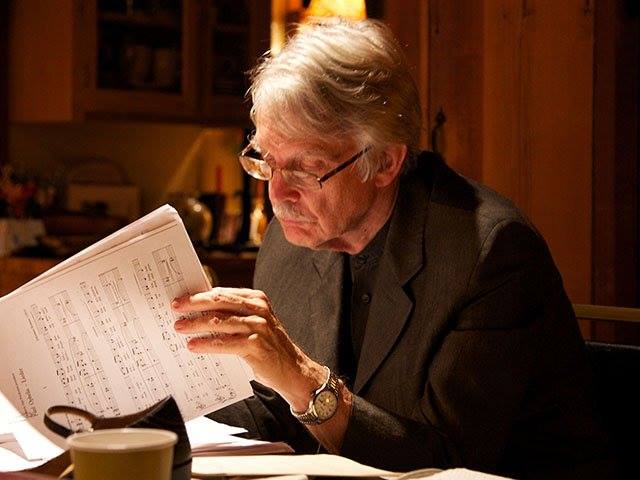
  • John Harbison Octogenarian from Orange Celebrated

    John Harbison Octogenarian from Orange Celebrated

    by 

    in
    9 responses

    Join us today in celebrating an octogenarian from Orange.

    John Harbison was born in Orange, NJ, on this date in 1938. A former student of Walter Piston and Roger Sessions, he has written music in all genres. His opera, “The Great Gatsby” was commission by the Met and given its premiere there in 1999.

    In 1987, Harbison was awarded the Pulitzer Prize for Music for “The Flight into Egypt,” a work scored for vocal soloists, chorus and chamber orchestra. The text, from the Book of Matthew, recounts the dark side of the Christmas story: the Holy Family’s flight into Egypt following the birth of Jesus and Herod’s over-the-top Massacre of the Innocents.

    Sadly, not much has changed in 2000 years. Christmas may be a time for celebration, but it is also a time for remembering those in need.

    Unfortunately, there doesn’t seem to be a complete audio file of “The Flight into Egypt” posted anywhere online.

    By way of consolation, today’s Noontime Concert on The Classical Network will feature Harbison’s “Motteti di Montale.” The song cycle will be presented in its rarely-heard complete version for chamber orchestra. The texts, on the subject of unrequited love, are drawn from the writings of the Nobel Prize winning poet Eugenio Montale. In a sense, the work was 20 years in the making, assembled from several earlier cycles, scored for different vocal and instrumental combinations.

    The performance will be by the Boston-based ensemble Collage New Music, which gave the work its premiere in this form back in 2006.

    Carl Hemmingsen will be your host for today’s Noontime Concert broadcast of John Harbison’s “Motteti di Montale,” beginning at 12:00 EST, on WWFM – The Classical Network and wwfm.org.


  • Prescription Change Relatable Experiences

    Prescription Change Relatable Experiences

    by 

    in
    5 responses

    As someone who’s recently had a prescription change, I can certainly relate.


  • A Brahms Christmas at Marlboro Music

    A Brahms Christmas at Marlboro Music

    by 

    in
    2 responses

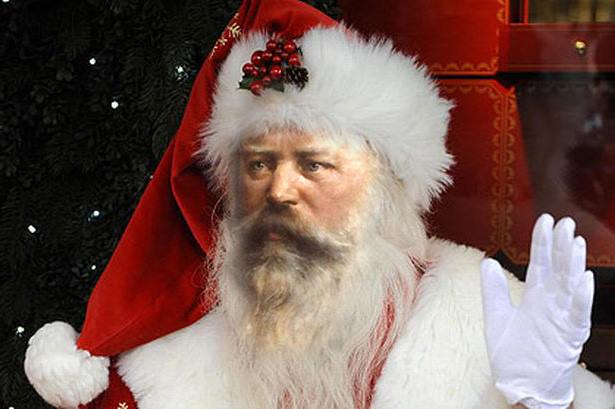
    Despite his remarkable resemblance to a certain Mr. Claus, Brahms is probably about the last composer you’d think of cozying up to on Christmas. This is the man who infamously left a party, after all, with one of the all-time great exit lines: “If there’s anyone here I’ve failed to insult, I apologize!”

    This week on “Music from Marlboro,” it’s a Brahms Christmas.

    Actually, Johannes Brahms had a very generous spirit. He did not shoot cats with a homemade bow-and-arrow and work the sounds of their pain into his music, as his enemies suggested. What he did enjoy was Christmas shopping! On one occasion he gifted the Schumann boys some rather pricey toy soldiers. On another, he surprised his housekeeper’s sons with a Christmas tree. Sure, Brahms could be a bit of a hard nut sometimes, but he retained a certain child-like demeanor at Christmas throughout his life.

    The second of his “Zwei Gesänge” (“Two Songs”) for voice, viola and piano, Op. 91, was written in 1863 for his friend, the violinist Joseph Joachim, and Joachim’s wife, Amalie. It had originally been intended as a wedding present, but Brahms resubmitted it the following year for the baptism of the couple’s son (who was named after him). Joseph was also well-versed on the viola, and Amalie was a contralto.

    The work, “Geistliches Wiegenlied” (“Sacred Lullaby”), after a text by Emanuel Geibel, is a cradle song sung by Mary, mother of Jesus, who addresses the holy angels, requesting that they silence the rustling palms because her Child is sleeping. The viola quotes the Christmas melody “Joseph, lieber Joseph mein,” a sly reference on the part of the composer, who incorporates the carol’s text in order to include Joachim’s given name.

    We’ll hear a performance from the 2011 Marlboro Music Festival, featuring mezzo-soprano Jennifer Johnson Cano, violist Hélène Clément, and, at the keyboard, Marlboro co-director Mitsuko Uchida.

    The adult Brahms had no family of his own. He divided Christmas Day between his favorite tavern and coffee shop, but Christmas Eve was another matter. In his later years, he greatly enjoyed passing the night with friends – once he was done shopping, that is – as part of a kind of extended family.

    Though he rarely spent Christmas with his longtime crush, Clara Schumann, Brahms thought of her every year, on at least one occasion writing her a nice Christmas letter in which he imagines sitting beside her at her breakfast table, conversing with her, and delighting in all of her last-minute holiday preparations.

    Clara joined Brahms for the first performance of his “Variations on a Theme by Haydn,” in its original version for two pianos, at a private gathering in Bonn, in August of 1873. The first performance of the orchestral version took place three months later, with the Vienna Philharmonic conducted by the composer.

    Brahms owed much of his interest in Haydn, who died 60 years earlier and whose music had pretty much fallen out of fashion, to his friend Karl Ferdinand Pohl, scholar-librarian of the Vienna Philharmonic. The theme that had so captivated Brahms is the famous “St. Anthony Chorale,” employed in the Wind Partita in B-flat, which at the time was attributed to Haydn.

    This evening, we’ll have an opportunity to compare both versions of Brahms’ celebrated variations. First, we’ll hear them performed in 1976 by pianists Stephanie Brown and Cynthia Raim; then the great Pablo Casals will conduct the Marlboro Festival Orchestra, from 1969.

    Of course, the theme is probably not by Haydn at all, but who are you going to believe, scholarship or Brahms? It is the Christmas season, after all. I’m willing to take it on faith. I hope you’ll join me for the next “Music from Marlboro,” this Wednesday evening at 6:00 EST, on WWFM – The Classical Network and wwfm.org.


    In the meantime, feel free to enjoy this profile of Pablo Casals by Marlboro’s Frank Salomon:

    https://mailchi.mp/marlboromusic/from-the-archives-pablo-casals?fbclid=IwAR1JlaAnoqYGZYZqzaUQtEjCU5NouYF_QzWw5-rDrIb9vWfryIt43xbYppE

    Marlboro School of Music and Festival: Official Page


  • Honegger’s Christmas Cantata on The Classical Network

    Honegger’s Christmas Cantata on The Classical Network

    by 

    in
    3 responses

    Hear ye! Let it be known that I will include, by popular demand, Arthur Honegger’s “Une cantate de Noël” (“A Christmas Cantata”), among my mid-winter offerings this afternoon on The Classical Network.

    Composed in 1953, Honegger’s musical journey from dark-to-light is thought to have been his final work. And quite a journey it is, from its jet-black opening; through the redemptive entrance of children’s voices in radiant settings of familiar carols; to the ecstatic conclusion, the chorus singing “Gloria in excelsis Deo” with carols in counterpoint, this music is very special indeed. The despair of “De profundis clamavi” only serves to heighten a sense of delirious joy and uplift when the clouds finally part.

    Also on today’s program, enjoy Ariel Ramirez’s festive “Navidad Nuestra,” selections from Franz Liszt’s “Christus” and “Christmas Tree Suite,”and “Old Christmas Return’d,” early music from England, Germany, and France, performed by the York Waits.

    The star atop the tree will be a Brahms Christmas, on “Music from Marlboro.” I’ll be decking the halls and untangling the lights, from 4 to 7 p.m. EST, on WWFM – The Classical Network and wwfm.org.


Tag Cloud

Aaron Copland (93) Beethoven (95) Composer (114) Film Music (145) Film Score (143) Film Scores (255) Halloween (94) John Williams (195) KWAX (229) Leonard Bernstein (104) Marlboro Music Festival (125) Movie Music (160) Mozart (91) Opera (213) Philadelphia Orchestra (89) Picture Perfect (174) Princeton Symphony Orchestra (109) Radio (88) Ross Amico (244) Roy's Tie-Dye Sci-Fi Corner (290) The Classical Network (101) The Lost Chord (269) Vaughan Williams (105) WPRB (397) WWFM (881)

DON’T MISS A BEAT

Receive a weekly digest every Sunday at noon by signing up here


RECENT POSTS