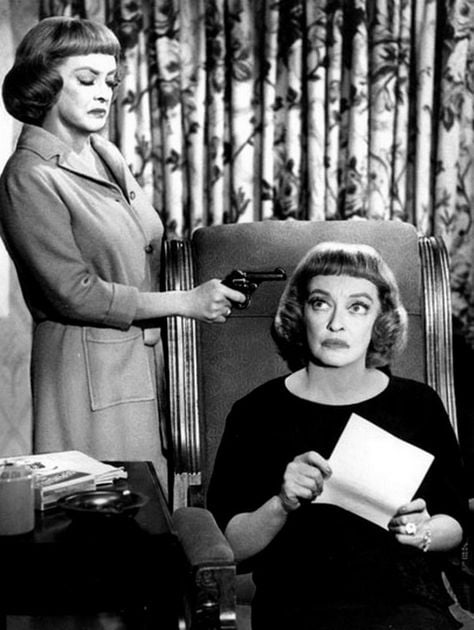
This week on “Picture Perfect,” we’re seeing double.
James Stewart plays Scottie Ferguson, a traumatized police detective who becomes obsessed with the woman he loves – and loses – in Alfred Hitchcock’s “Vertigo” (1958). Kim Novak portrays both the enigmatic beauty and her spitting image, who Ferguson, rather creepily, attempts to mold. Bernard Herrmann wrote the hypnotic score.
Krzysztof Kieślowski’s “La double vie de Véronique”/“The Double Life of Véronique” (1991) depicts parallel characters living in Poland and France who are mysteriously linked, both of them played by Irène Jacob. The performance(s) earned Jacob an award for Best Actress at the Cannes Film Festival. The music, which plays a significant role in the actual plot, is by Zbigniew Preisner.
For the second time in her career, Bette Davis gets a chance to play an evil twin in “Dead Ringer” (1964). The first was in the 1946 good twin-bad twin melodrama, “A Stolen Life.” When asked what the difference was between the two performances, Davis quipped, “About 20 years.” “Dead Ringer” was directed by her longtime friend and “Now, Voyager” co-star Paul Henreid. The music is by André Previn, whose score employs a stock-in-trade sinister harpsichord, yet when he comes to write the love theme, he manages to whip up one hell of a tribute to Erich Wolfgang Korngold.
Korngold scored a number of Davis’ films in the 1940s, though he is principally remembered for his work on the swashbucklers of Errol Flynn. To capitalize on Flynn’s star-making performance in “Captain Blood,” Warner Brothers produced a big screen adaptation of Mark Twain’s Tudor switcheroo, “The Prince and the Pauper” (1937). Flynn steals the show as Miles Hendon, the devil-may-care guardian of Prince Edward and Tom Canty, Edward’s mirror image, played by real-life twins Bobby and Billy Mauch. If you’re a Korngold fan, or an enthusiast of violin concertos, you may recognize some of the music. Korngold recycled the theme for use in the last movement of his Violin Concerto, championed by Heifetz and others.
Double your pleasure with an hour of doppelgangers, twins, and dual identities, on “Picture Perfect,” music for the movies, now in syndication on KWAX Classical Oregon!
——–
Clip and save the start times for all three of my recorded shows:
PICTURE PERFECT, the movie music show – Friday at 8:00 PM EST/5:00 PM PST
SWEETNESS AND LIGHT, the light music program – Saturday at 11:00 AM EST/8:00 AM PST
THE LOST CHORD, unusual and neglected rep – Saturday at 7:00 PM EST/4:00 PM PST
Stream them, wherever you are, at the link!
https://kwax.uoregon.edu
Tag: Bernard Herrmann
-
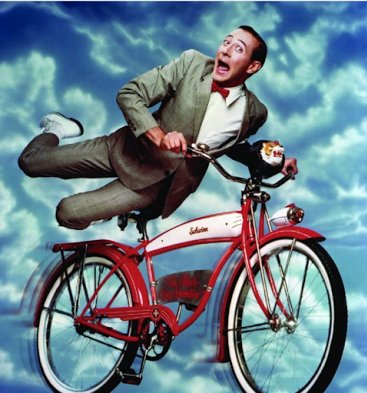
From Bernard Herrmann to Pee-wee Herman: Toys Everywhere on “Picture Perfect”
With the grand cacophony of Christmas still fresh in everyone’s ears, I thought it only appropriate this week on “Picture Perfect” to focus on music from movies about toys.
Without giving anything away, in the unlikely event you don’t already know the story’s big pay-off, “Citizen Kane” (1941) is a film flanked by toys. There’s even a snow globe in the film’s opening montage. A certain memory of Kane’s childhood provides a poignant glimpse of the larger-than-life newspaper magnate’s lost innocence. “Kane” is often cited as one of the greatest films ever made. Orson Welles triumphed in his debut as writer-director-star, even if, ultimately, his creation proved to be a bottle rocket that blew up in his face. The film also marked the Hollywood debut of composer Bernard Herrmann.
I’m not sure that “Pee-wee’s Big Adventure” (1985) could be described as the “Citizen Kane” of the ‘80s, exactly, but this endearingly goofy sojourn into the surreal does revolve around the recovery of a lost toy, as Pee-wee, the eternal boy, determines to make his way to “the basement of the Alamo” in an attempt to reclaim his stolen bike. The feature was director Tim Burton’s first. It was also his first collaboration with Danny Elfman, who is obviously a big fan of Nino Rota.
The husband-and-wife team of Charles and Ray Eames are better known for their contributions to architecture, industrial design, and manufacturing, but they also made short films. “Toccata for Toy Trains” (1957) was inspired by the Eames’ passion for vintage toys. The score was provided by their go-to composer, Elmer Bernstein.
Finally, in acknowledgement of the greatest toy series of our day, we’ll conclude with music from “Toy Story” (1995), the first full-length computer animated feature. The quality of the film propelled it beyond mere novelty status into the realm of instant classic, and the beloved “Toy Story” franchise has raked in hundreds of millions of dollars. Early on, it was decided by the filmmakers that they did not want “Toy Story” to be a musical, but that songs could be used to underline its emotional content. Randy Newman has provided the music for all the “Toy Story” films so far. He was recognized with an Academy Award for his work on “Toy Story 3,” for the song, “We Belong Together.”
Keep popping those aspirin. It’s “Toys Everywhere” this week, on “Picture Perfect,” music for the movies, now in syndication on KWAX Classical Oregon!
——–
Clip and save the start times for all three of my recorded shows:
PICTURE PERFECT, the movie music show – Friday at 8:00 PM EST/5:00 PM PST
SWEETNESS AND LIGHT, the light music program – Saturday at 11:00 AM EST/8:00 AM PST
THE LOST CHORD, unusual and neglected rep – Saturday at 7:00 PM EST/4:00 PM PST
Stream them, wherever you are, at the link!
https://kwax.uoregon.edu -

Herrmann’s Fantasy Film Scores for Halloween
Hallowe’en is fast approaching. This week on “Picture Perfect,” it’s high time we get the pumpkin rolling, with an hour of fantasy film scores of Bernard Herrmann.
Just about everyone has some awareness of Herrmann’s fruitful run with Alfred Hitchcock, a collaborative relationship which yielded scores to “Vertigo,” “North by Northwest” and “Psycho,” among others. Concurrently, Herrmann worked with producer Charles H. Schneer to create a series of classic films on fantastic subjects, featuring special effects by stop-motion maestro Ray Harryhausen. We’ll be listening to selections from two of these.
Jules Vernes’ novel, “Mysterious Island,” was a sequel of sorts to “20,000 Leagues under the Sea.“ During the American Civil War, a ragtag band of Union soldiers escape from a Confederate prison by hot air balloon. A storm sweeps them off to the titular island, where they encounter pirates, a castaway, and an orangutan. Indeed Captain Nemo turns up late in the narrative, though no giant creatures, as in the film (made in 1961). Herrmann has a field day characterizing an enormous crab, bee, and especially bird, for which he employs a fugue!
Harryhausen’s skeleton fight from Schneer’s “Jason and the Argonauts” (1963) stands as one of the all-time classic fantasy sequences, a dream marriage of visuals and music. Herrmann, who always provided his own orchestrations, was well known for putting together unique combinations of instruments, the better to illustrate the special character of a given film. In the case of “Jason,” he went in the opposite direction from what he had taken with “Psycho,” stripping away the strings and concentrating instead on winds, brass and percussion.
On a somewhat gentler note, Herrmann scored the beautiful spectral romance, “The Ghost and Mrs. Muir” (1947), with Gene Tierney as a young widow who moves with her daughter to a seaside village, where she encounters the ghost of salty Captain Gregg (played by Rex Harrison). Of course, their banter leads to a hopeless attraction developing between them. Herrmann was a master at creating musical evocations of yearning, and his score for “The Ghost and Mrs. Muir” is full of romantic longing.
Criminally, for a composer whose career spanned over four decades, from “Citizen Kane” to “Taxi Driver,” Herrmann received only a single Oscar, for “The Devil and Daniel Webster” (released in 1941 as “All That Money Can Buy”). Walter Huston makes a meal of his role as Mr. Scratch in Stephen Vincent Benét’s recasting of the Faust legend, transferred to the New England countryside. Director William Dieterle, who had his roots in German Expressionism, creates some truly eerie visuals, and Herrmann’s score barn-dances deftly back and forth between dread and whimsy.
Join me for fantasy film scores of Bernard Herrmann this week on “Picture Perfect,” music for the movies, now in syndication on KWAX, the radio station of the University of Oregon!
Clip and save the start times for all three of my recorded shows:
PICTURE PERFECT, the movie music show – Friday at 8:00 PM EDT/5:00 PM PDT
SWEETNESS AND LIGHT, the light music program – Saturday at 11:00 AM EDT/8:00 AM PDT
THE LOST CHORD, unusual and neglected rep – Saturday at 7:00 PM EDT/4:00 PM PDT
Stream them, wherever you are, at the link!
-

Hitchcock’s Other Composers Beyond Herrmann
Alfred Hitchcock’s most celebrated musical collaborator was Bernard Herrmann. Herrmann scored just about every one of Hitch’s films over the span of a decade, enhancing the impact and memorability of such classics as “Vertigo,” “North by Northwest,” and “Psycho.” But Hitchcock also worked with a number of other notable composers.
This week on “Picture Perfect,” we’ll cast some light into Herrmann’s shadow with selections from “Rebecca” (Franz Waxman), “Strangers on a Train” (Dimitri Tiomkin), “Spellbound” (Miklós Rózsa), and “Family Plot” (John Williams).
Herrmann goes on hiatus, and the suspense is killing us, on “Picture Perfect,” music for the movies, now in syndication on KWAX, the radio station of the University of Oregon!
Clip and save the start times for all three of my recorded shows:
PICTURE PERFECT, the movie music show – Friday at 8:00 PM EDT/5:00 PM PDT
SWEETNESS AND LIGHT, the light music program – Saturday at 11:00 AM EDT/8:00 AM PDT
THE LOST CHORD, unusual and neglected rep – Saturday at 7:00 PM EDT/4:00 PM PDT
Stream them, wherever you are, at the link!
-
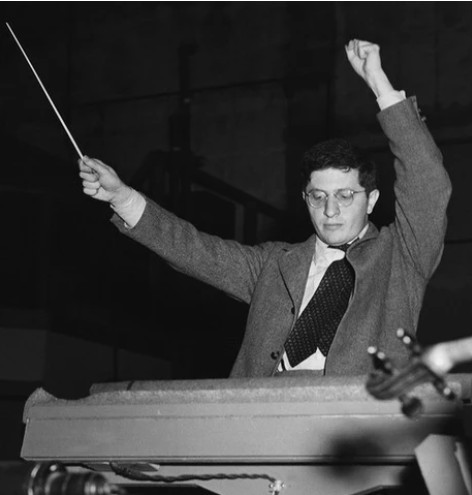
Herrmann’s Mentor: Percy Grainger
Bernard Herrmann may be best-recognized as the greatest film composer the United States ever produced, but he was also a passionate Anglophile. I’ve written a lot about Herrmann over the years, from many different perspectives, but in light of my recent visit to the Percy Grainger Home & Studio in White Plains, NY (where Grainger lived for 40 years), I thought I’d share a little bit about the relationship of these two artists today, for the anniversary of Herrmann’s birth.
Herrmann studied composition with Grainger at New York University in the early 1930s. Even in untested youth, his extensive knowledge and passion for English music (and music in general) endeared him to his mentor – they also shared an ear for unusual orchestration – and a genuine affection sprang up between them. In particular, they both adored Frederick Delius, whom Grainger got to know fairly well in the early years of the 20th century. (Grainger, born in Melbourne, lived in England from 1901-14.)
For Herrmann, Grainger was like a magic fountain of information about many of the living composers he so admired. Herrmann himself would later get to know some of them himself during guest conducting engagements with the BBC Symphony, the Halle Orchestra, and the London Symphony Orchestra.
Here’s a little more about Grainger and Herrmann, largely drawn from Steven C. Smith’s Herrmann biography, “A Heart at Fire’s Center.” I’ve read Smith’s book, of course, but for convenience’s sake, I am cutting and pasting this excerpt from an article about Herrmann’s Anglophilia compiled by Ian Lace for the MusicWeb International website. To access the complete article, which would certainly be worth your while, if it’s a topic that interests you, look for the link below.
From Lace’s piece:
Also in 1932 Herrmann attended a bi-weekly course in advanced composition and orchestration led by the brilliant but wildly unorthodox Percy Grainger.
‘Percy Grainger was Australia’s most innovative advocate of music past and present, from his childhood days as “the flaxen-haired phenomenon” of Melbourne to his years of international fame as folk song collector, composer, and recitalist. At the heart of Grainger’s unstable, erratic character was a fixation on truth, contempt for tradition and a passion for the outrageous.
‘Since becoming head of NYU’s music department in 1931, Grainger had offered a syllabus of musical eccentricity and frequent brilliance that left many students puzzled and unimpressed. The class of 1932, however, had one exception. In Grainger, Herrmann saw qualities he himself was cultivating: individualism and dedication to one’s craft and beliefs, however unpopular and unfashionable.
‘The relationship between the fifty-year-old teacher and the twenty-one year old student was one of mutual respect. “Grainger did not place orchestration examples before [his students],” Grainger biographer John Bird wrote, “Instead, he allowed them to choose their pieces and gave them advice when and where needed. Herrmann for instance, decided to orchestrate MacDowell’s Celtic Sonata and felt the need to employ the sonorities of a tenor tuba. The Australian knew little of this unusual piece of plumbing, so together, they familiarised themselves with the instrument and found suitable moments to include it.”
‘Herrmann and Grainger also discovered a shared love of Whitman and the music of Delius. One of Herrmann’s favourite NYU memories peripherally involved the latter: one morning the gaunt, sprightly Grainger leapt onto the lecture stage and announced, “The three greatest composers who ever lived are Bach, Delius and Duke Ellington. Unfortunately Bach is dead, Delius is very ill – but we are happy to have with us today the Duke!” Ellington and his band then mounted the stage and played for the next two hours.
‘If other Grainger lectures were less dramatic, they were no less influential to Herrmann: ancient monophony, folk music, atonality, polyphony, the indigenous rhythms of Africa, Asia, and the South Seas – each was examined by Grainger with alternating lucidity and jumbled mysticism. When the scholastic year ended in mid-August 1933, Grainger considered his work a failure, as few students had been as responsive as Herrmann; but it cemented a friendship between him and his intense young pupil that affected Herrmann for the rest of his life.’
For more about Grainger and Herrmann (and Herrmann’s chum Jerome Moross), there’s also this entry on the Percy Grainger Society website.
https://percygrainger.org/blog/8103609
Happy birthday, Bernard Herrmann!
PHOTOS (clockwise from upper left): Herrmann conducting at CBS radio in the 1930s; Grainger conducting the National High School Orchestra at Interlochen in 1937; Grainger with Duke Ellington at New York University in 1932; Herrmann and Orson Welles at CBS
Tag Cloud
Aaron Copland (94) Beethoven (95) Composer (114) Film Music (148) Film Score (143) Film Scores (255) Halloween (97) John Williams (196) KWAX (232) Leonard Bernstein (105) Marlboro Music Festival (125) Movie Music (163) Mozart (91) Opera (215) Philadelphia Orchestra (90) Picture Perfect (174) Princeton Symphony Orchestra (110) Radio (90) Ross Amico (244) Roy's Tie-Dye Sci-Fi Corner (290) The Classical Network (101) The Lost Chord (269) Vaughan Williams (107) WPRB (397) WWFM (881)