This week on “Picture Perfect,” with the New Year only days away, we’ll greet the future with music from movies inspired by Jules Verne’s novels of science, progress, and adventure.
We’ll hear selections from “20,000 Leagues Under the Sea,” composed by Paul J. Smith; “In Search of the Castaways,” by William Alwyn; “Journey to the Center of the Earth,” by Bernard Herrmann; and “Around the World in 80 Days,” by Victor Young.
Of course, science and technology are all well and good for what they are, but there are times when the best solution is an expertly-wielded harpoon!
Your grit and resourcefulness are always welcome on “Picture Perfect,” music for the movies, now in syndication on KWAX, the radio station of the University of Oregon!
Remember, KWAX is on the West Coast, so there’s a three-hour difference for those of you listening in the East. Here are the respective air-times for all three of my recorded shows (with East Coast conversions in parentheses):
PICTURE PERFECT, the movie music show – Friday on KWAX at 5:00 PM PACIFIC TIME (8:00 PM EST)
SWEETNESS AND LIGHT, the light music program – ALL NEW! – Saturday on KWAX at 8:00 AM PACIFIC TIME (11:00 AM EST)
THE LOST CHORD, unusual and neglected rep – Saturday on KWAX at 4:00 PM PACIFIC TIME (7:00 PM EST)
Stream all three, at the times indicated, by following the link!
This week on “Picture Perfect,” we’ll think inside the box, with music from classic Christmas television specials.
“The Snowman” (1982), based on the picture book by Raymond Briggs, is about a boy whose snowman comes to life and whisks him away on a journey to the North Pole. The show became enormously popular in the UK and through occasional showings on U.S. television. It was nominated for an Academy Award for Best Animated Short. Like the book, the film is wordless, using animation and music to tell its story, with the exception of an enchanting interlude, known as “Walking in the Air,” which employs a boy treble. “Walking in the Air” is easily the best-known music by Howard Blake. Blake turned 85 in October. Happy belated birthday!
The television film “The Homecoming” (1971) stars Patricia Neal and Richard Thomas in a heart-warming story about a rural family Christmas in 1933. Written by Earl Hamner, the film’s success spawned the television series “The Waltons.” Jerry Goldsmith wrote the music. He would return to work on “The Waltons” – though as of “The Homecoming,” he had yet to write the show’s indelible theme.
An adaptation of Charles Dickens’ “A Christmas Carol” (1954) was the subject of a special episode of the anthology series “Shower of Stars.” Fredric March plays Ebenezer Scrooge, and Basil Rathbone is Jacob Marley’s ghost. But it is Ray Middleton, who appears as both Scrooge’s nephew and the Spirit of Christmas Present, who is given arguably the show’s most memorable tune, “A Very Merry Christmas.” The teleplay and lyrics are by Maxwell Anderson, and the music is by Bernard Herrmann!
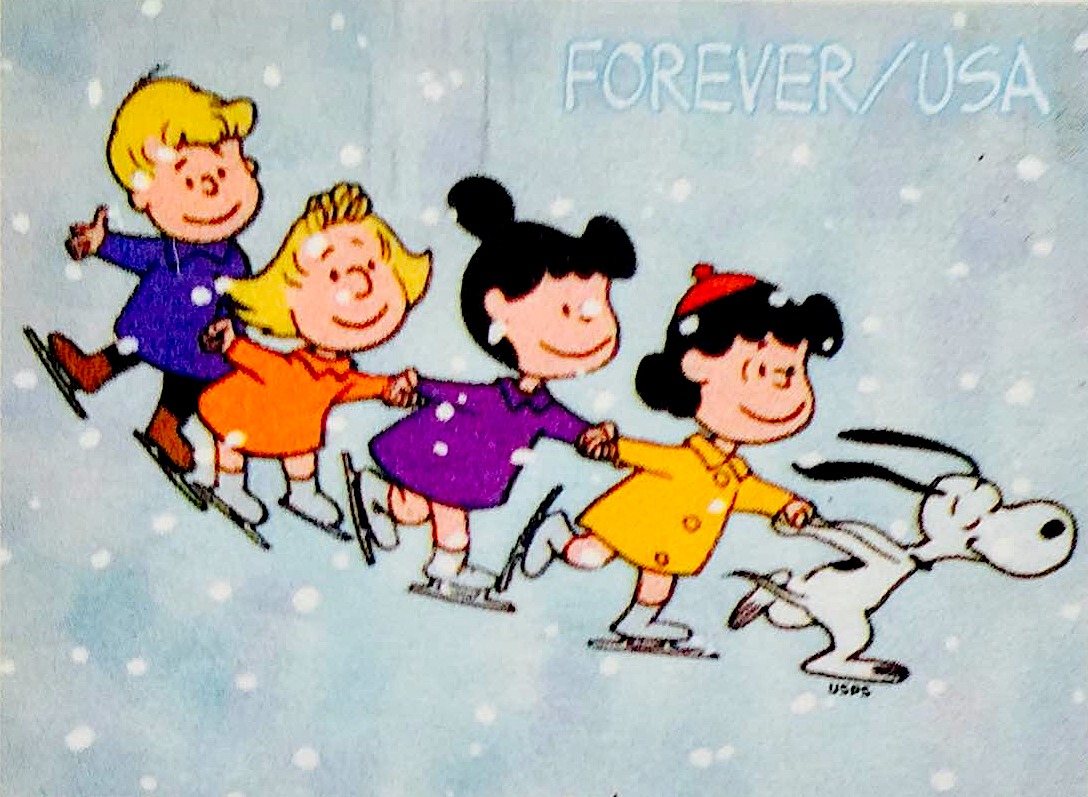
Finally, Christmas time is here, happiness and cheer, with “A Charlie Brown Christmas” (1965). We’ll hear the Vince Guaraldi Trio perform selections from this most beloved of Christmas classics.
For once, the snow has nothing to do with your television reception. I hope you’ll join me for a cookie plate full of classic Christmas specials, on “Picture Perfect,” now in syndication on KWAX, the radio station of the University of Oregon!
Remember, KWAX is on the West Coast, so there’s a three-hour difference for those of you listening in the East. Here are the respective air-times of my recorded shows (with East Coast conversions in parentheses):
PICTURE PERFECT, the movie music show – Friday on KWAX at 5:00 PM PACIFIC TIME (8:00 PM EST)
THE LOST CHORD, unusual and neglected rep – Saturday on KWAX at 4:00 PM PACIFIC TIME (7:00 PM EST)
Also, a reminder that tomorrow morning I’LL BE ADDING A THIRD SHOW to the mix: SWEETNESS AND LIGHT will debut at 8:00 AM PACIFIC TIME (11:00 AM EST) with a seasonal playlist calculated to charm and to cheer. I hope you’ll be able to join me then.
Stream all three shows, at the times indicated, at the link!
This week on “Picture Perfect,” get ready to take flight, with music from movies about airports and airplanes.
In the original “Airport” (1970), producer Irwin Allen established the prototype for disaster movies of all stripes by placing an all-star, aging cast in spectacular peril. Burt Lancaster! Dean Martin! George Kennedy! Jean Seberg! Jacqueline Bisset! Helen Hayes! The list goes on and on, longer than the longest runway. The bongo-laden theme is by veteran film composer Alfred Newman,” from the last of his over 200 scores.
Another movie with something of the same feel is “The V.I.P.s” (1963), allegedly inspired by the real-life love-triangle of Vivien Leigh, Laurence Olivier, and Peter Finch. The story is set at London Heathrow Airport, where flights are delayed because of a dense fog. The film was written by Terrence Rattigan and the parts cast from another laundry list of stars, including Elizabeth Taylor, Richard Burton, Louis Jourdan, Maggie Smith, Rod Taylor, and Orson Welles, with Margaret Rutherford in an Academy Award-winning performance. The music is by Miklós Rózsa.
By contrast, Steven Spielberg’s “The Terminal” (2004) is an (intentionally) comic take on the predicament of a hapless Eastern European who finds himself in a kind limbo, trapped in an international arrivals terminal in New York, after his country erupts into civil war, so that his passport and other documentation are no longer valid. His plight mirrors that of real-life Mehran Karimi Nasseri, an Iranian who lived for 17 years in a terminal at Charles de Gaulle Airport.
Tom Hanks plays the unfortunate traveler, who makes the terminal his home, and Catherine Zeta-Jones the airline attendant with whom he strikes up a relationship. The music is by regular Spielberg collaborator John Williams, and I think you’ll find it quite different from the Williams known for his work on “Star Wars” and “Indiana Jones.”
Finally, we’ll turn to the Alfred Hitchcock thriller “North by Northwest” (1959), a film in which Cary Grant encounters love and danger in, on, and from a variety of planes, trains, and automobiles. Planes are particularly significant. During the course of the film, it’s revealed that the title is in reference to a Northwest Airlines flight; Eve Kendall (Eva Marie Saint) must do all she can to avoid getting on a plane with Phillip Vandamm (James Mason); and of course, Roger Thornhill (Grant) flees from a strafing crop duster. Bernard Herrmann’s opening fandango propels us into the adventure.
Rush more to Rushmore. Departure time below, for “Picture Perfect,” music for the movies, now in syndication on KWAX, the radio station of the University of Oregon!
Remember, KWAX is on the West Coast, so there’s a three-hour difference for the Trenton-Princeton area. Here are the respective air-times of my recorded shows (with East Coast conversions in parentheses):
PICTURE PERFECT, the movie music show – Friday on KWAX at 5:00 PACIFIC TIME (8:00 PM EDT)
THE LOST CHORD, unusual and neglected rep – Saturday on KWAX at 4:00 PACIFIC TIME (7:00 PM EDT)
It’s interesting that Gustav Holst and Ralph Vaughan Williams were born only three weeks apart, albeit separated by two years. Uncle Ralph’s birthday looms on October 12 – but for today, we celebrate Holst!
“Gustav” may be a strange name for one of England’s greatest composers. Even stranger, he was actually christened Gustavus. Also, there was a “von” in his name – Gustavus Theodore von Holst. Holst’s father was of Swedish, Latvian, and German descent. His great-grandfather had also been a composer, who taught harp at the Imperial Russian Court in St. Petersburg. Continuing in the family trade, his grandfather set up shop in England. In doing so, he added the “von,” thinking it lent a little gravitas and might help to drum up business. Sensibly, Gustav dropped the prefix with the outbreak of war with Germany in 1914.
Like Vaughan Williams, Holst was born in Gloucestershire. Both were students at the Royal College of Music, who studied with Sir Charles Villiers Stanford. Significantly, they were also linked by a common destiny, spearheading a movement to establish a distinctly “English” national sound in music. They accomplished this by getting their hands dirty, tying on their boots and striking out for the fields and fens, to collect songs of the countryside, already endangered by encroaching industrialization. In some of their best original music, both composers assimilate English folk inflections into their respective styles.
Holst himself was an exacting teacher, who took his duties very seriously. However, in common with the best of his profession, he never imposed his will on his students, but rather shepherded them in finding their own solutions. Holst served as director of music at St. Paul’s Girls’ School, Hammersmith, and at Morley College.
Of course his masterpiece would be “The Planets,” composed between 1914 and 1916. Hard to believe, in a world of composers schooled on the piano, that Holst’s principal instrument was the trombone! I recall listening to this music for the first time in my teens and thinking “Jupiter,” in particular, positively exuded “England.” Its roistering, galumphing, perhaps even Falstaffian antics give way to a stately, processional theme, later adapted into the patriotic hymn “I Vow to Thee, My Country.” But with the passage of time, and longer familiarity, “The Planets’” English identity, detectable in every note, has become increasingly evident.
Even so, Holst was never of a provincial mindset. On the contrary, he was a much more adventurous – and frequently modernist – composer than he is frequently given credit for having been. His literary inspirations were far-ranging, from Thomas Hardy to Walt Whitman to Sanskrit. His music is often less emotive than Vaughan Williams’. I’ve always detected more of an objective detachment in his works. Remarked Vaughan Williams, “He was not afraid of being obvious when the occasion demanded, nor did he hesitate to be remote when remoteness expressed his purpose.”
The two were one another’s most constructive critics. When Holst died, comparatively young, at the age of 59, Vaughan Williams felt his friend’s passing keenly. Aside from the personal loss, from a professional and artist standpoint, suddenly he was bereft of his most valued confidante and advisor.
Holst’s legacy can be detected best in those composers who reacted against Vaughan Williams and the pastoral school. His economy and restraint appealed to the generation of Walton, Britten, and Tippett. Also – and I never see this remarked upon – I detect his spirit often in the film and concert music of Bernard Herrmann. (Herrmann was a great anglophile, who championed Holst.) There is a certain aloofness, perhaps even a chill, in the work of both artists, but also great sensitivity.
Happy birthday, Gustav Holst (1874-1934)! You may be regarded by some as a one-hit wonder, but it is an assessment made in ignorance. May the inertia of your greatest success carry listeners far beyond “The Planets.”
The composer’s most famous music, “Mars, the Bringer of War” (1914)
“Jupiter, the Bringer of Jollity” (1914)
“Beni Mora” (1910)
Vaughan Williams’ setting of “Seventeen Come Sunday” from his “English Folk Song Suite” (1923)
Listen for the tune in Holst’s “Somerset Rhapsody” (1906), about three minutes in
“Choral Hymns from the Rig Veda” (1911), anticipating Britten?
First Choral Symphony (1923-24); RVW expressed only “cold admiration” for it
12 Welsh Folk Songs (1930-31): “My sweetheart’s like Venus”
Finally, a collaborative work, “Pan’s Anniversary,” a masque written by Ben Jonson, circa 1620, revived in 1905 for a production at Stratford-upon-Avon. Vaughan Williams composed most of the incidental music, with Holst stepping up to arrange some dance tunes under considerable time pressure. The piece was released for the first time on Albion Records, the recording branch of the Ralph Vaughan Williams Society, with some colorful bonuses.
You can sample the entire album, including an arrangement of the “Fantasia on a Theme by Thomas Tallis” for voices and strong octet, here:
The Albion catalogue sports much unusual and intriguing RVW fare, often in world premiere recordings. You’ll find some great gift ideas for the musical anglophile who “has everything.”
This was shared yesterday on the Bernard Herrmann Society page. At the link, you’ll find a couple of letters written by special effects legend Ray Harryhausen, in which he comments on the various composers he had the privilege to work with. He has especially high praise for Herrmann and Miklós Rózsa.
Interestingly, on his last film, “Clash of the Titans,” Harryhausen apparently rejected a score-in-progress by Academy Award winning composer John Barry (composer of “Born Free,” “Out of Africa,” “Dances with Wolves,” and the James Bond franchise). In a later interview, Barry, who had been hired because Harryhausen was impressed by his score for “The Lion in Winter,” claimed not to remember much about the experience, beyond the fact that he had provided a few demos.
Some of the music can actually be heard in this installment of the Ray Harryhausen Podcast.
The composer’s fragmentary contributions begin at the following times:
• 6:48, “Heroic 1”
• 1:27:10, “Andromeda”
• 1:28:43, “Persius Growing Up”
• 1:30:49, “Scorpion”
Barry was replaced by Laurence Rosenthal (composer of “A Raisin in the Sun,” “The Miracle Worker,” “Becket,” “The Return of a Man Called Horse,” “The Island of Dr. Moreau,” and “The Young Indiana Jones Chronicles”).
But don’t shed any tears for Barry. He wound up doing just fine.