Into each life some rain must fall.
For James Stewart in “The Man Who Knew Too Much” (1956), he races to foil an assassination attempt against the backdrop of a literal “Storm Clouds Cantata,” at a concert in Royal Albert Hall, no less. The conductor in the pit? None other than Alfred Hitchcock house composer Bernard Herrmann.
At long last, Herrmann’s complete score to the Hitchcock classic has been released on the Intrada label. And I have to say, it’s probably the film music release of the year. All newly-recorded in state-of-the-art digital sound, the presentation is glorious, and the performances are perfection. William T. Stromberg, who for decades has specialized in recording classic film scores (often in partnership with Jeff Morgan), has never been better. I have not been so eager to remove the shrink wrap from a new film music release in some time. That I do not at all feel let down by what followed speaks to the overall excellence of the production.
Alas, at the time of the CD’s release, on April 28, a little rain was falling in my life as well, as it was only nine days after WWFM notified me that, after 13 years, they would be “sunsetting” my film music show, “Picture Perfect,” at the end of the month. The timing was especially frustrating, as this is precisely the kind of event-release I would have built an entire show around.
Fortunately, “Picture Perfect” continues in syndication and hopefully soon I’ll be expanding into other markets. By then, I will have begun recording new episodes, so watch this page for an announcement of the CD’s inclusion on an upcoming episode sometime this fall.
As to its contents: the disc contains not only “The Man Who Knew Too Much,” but also the complete score to “On Dangerous Ground” (1951). More about that below.
What it does not contain is a cover of the Academy Award winning song “Que Sera, Sera” – introduced in “The Man Who Knew Too Much” by Doris Day – which, after all, is not by Herrmann, but rather by Jay Livingston & Ray Evans, and probably would have required an additional licensing fee .
Nor does it contain the “Storm Clouds Cantata,” composed by Arthur Benjamin for Hitchcock’s earlier take on the same material, released in 1934, with Peter Lorre as the villain.
Herrmann resurrected the music for the climactic sequence in a version he re-orchestrated himself. Its omission from the new recording is unfortunate – the cantata is only nine minutes long – but if something had to go, in order to fit the rest of the music onto a single disc and to keep the budget down by not employing a chorus, then I’m all right with it.
The cantata is available on an earlier album, “Bernard Herrmann Film Scores: From Citizen Kane to Taxi Driver,” recorded by Elmer Bernstein, the Royal Philharmonic Orchestra, and the Ambrosian Singers for the Milan label in 1993.
Back to the disc under consideration: for as enticing as “The Man Who Knew Too Much” is, the real draw for me personally is the companion piece: music for the lesser-known Nicholas Ray film noir “On Dangerous Ground.” I’ve always liked the film, and the score is terrific (also one of Herrmann’s favorites), especially the knockout cue, “Death Hunt,” replete with hammer blows and eight braying French horns.
Gritty city gives way to sinister snowscapes as no-fuse detective Robert Ryan teams up with country bumpkin Ward Bond to bring a killer a justice. Along the way, there are some stirrings of humanity in the unexpected tenderness between Ryan and Ida Lupino, the suspect’s sister, who happens to be blind.
I remember my excitement when I snapped up an earlier release of the score on FSM (Film Score Monthly) back in 2003, but in that instance, it was the original recording. The tracks were all in mono and the master tapes long gone, with the cues rescued and restored from acetate discs that had been in the possession of the composer himself. For somebody like me, who doesn’t mind listening past any aural imperfections, it’s a rewarding release, even if the sound quality is a little rough at times.
Sadly, this is especially evident in the love music, so beautiful performed on the viola d’amore by Virginia Majewski. Herrmann was so taken with her playing that he insisted she be listed in the film’s opening credits. On the new release, Huw Daniel again plays beautifully, but in pristine sound. I have included the older release on my film show in the past, but this one is much more listener-friendly.
Until now, the most thrilling performance of any of the music was the “Death Hunt” cue on the album “Citizen Kane: The Classic Film Scores of Bernard Herrmann,” part of the legendary Classic Film Scores series, with Charles Gerhardt and the National Philharmonic, released on RCA back in the 1970s, still stunningly visceral in its effect. But now we get to hear the entire score.
Keep in mind, the music is NOT presented in the form of perhaps more structurally-satisfying concert suites, but rather note-complete, meaning it is especially wonderful from a documentary standpoint and guaranteed to delight any hardcore Herrmann fan, but perhaps less optimal for those unaccustomed to the inclusion of all the shorter cues, some of them less than a minute in length. I guarantee you, though, it is very much worth having.
There are a couple of very short bonuses, notably an alternative finale for “The Man Who Knew Too Much.” It’s only about 20 seconds long, but it’s a great little cue! And the disc opens with Van Cleave’s evocative music for the VistaVision logo, so vibrantly recreated that it sets the tone for all the great things to come.
Interestingly, the project was financed largely with funds raised through Kickstarter, the third time Intrada has had success employing the tactic. “The Man Who Knew Too Much” was preceded by campaigns for new recordings of Dimitri Tiomkin’s “Dial M for Murder” and Jerry Goldsmith’s “Blue Patch” and “The Man.” If this is the new paradigm, I am down with it, especially if it yields such satisfying results.
As time passes and the population ages, these movies become more and more the province of classic movie buffs. There are only a handful of Golden Age film composers or scores that would merit an enterprise of this expense and magnitude. If you care about this kind of music, then please support it, and snap it up while you can!
https://store.intrada.com/s.nl/it.A/id.12676/.f
I direct your attention to it now for Bernard Herrmann’s birthday. Happy birthday, Maestro!
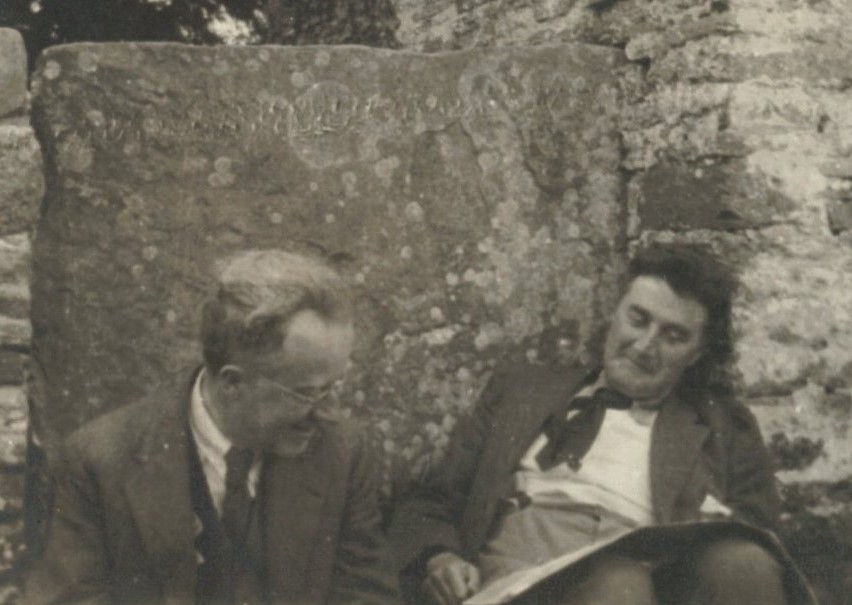
PHOTOS: (left) Hitchcock and Herrmann horsing around; (top) the cover of the new CD booklet; and (bottom) the flip-side, with “On Dangerous Ground.” In between? That’s me introducing a showing of “The Man Who Knew Too Much,” talking about Herrmann at Princeton Garden Theatre. Note the WWFM logo. But what have I done for them lately?