Tag: Bernard Herrmann

  • Remembering War Memorial Day Music

    Remembering War Memorial Day Music

    To a great many, Memorial Day is the unofficial start of summer, a time for picnics and trips to the shore, for Hollywood to flood the multiplexes with soulless blockbusters, a signifier of the end of school, and the beginning of three long, lazy months of way too much daylight.

    But it didn’t always bear those associations. The precursor of Memorial Day was Decoration Day, first widely observed in 1868, to honor and remember those who died in the Civil War. It was a time for decorating graves, making solemn speeches, and marching in parades. These customs metamorphosed to the point where, after World War I, Memorial Day was seen as an occasion to honor those who died in ALL American wars.

    Regardless of how one may perceive armed conflict, of whether any given war may be called just or unjust, it is not war itself or conflict in general that is being celebrated. Rather, it is the sacrifice of those who died in defense of a larger cause, and ostensibly that cause has been for the common good.

    One would think, were one an idealist, that by this stage of our collective development, when any disruption in the global fabric obviously effects all of us, that wars would be considered obsolete. But sadly, human nature being what it is, there will probably always be reasons to remember.

    This week on “The Lost Chord,” we’ll salute those who made the ultimate sacrifice, by listening to three works commemorating the dead of World War II, including “For the Fallen,” a berceuse for orchestra by Bernard Herrmann; Aaron Copland’s Violin Sonata, dedicated to Lt. Larry H. Dunham, who was killed in the Pacific in 1943; and the peace cantata “A Time for Remembrance,” by John Duffy.

    Duffy himself was a World War II veteran, who lied about his age when enlisting. He became part of the Amphibious Scouts and Raiders, forerunners to the Navy SEALs, before deploying on the USS Hopping, a destroyer escort in the Pacific. His duties included detonating Japanese mines by shooting them from ship deck. When his ship took fire from shore batteries at Okinawa, the sailor standing next to him was killed. Duffy had to stand guard over the dead man’s body until burial at sea in the morning. That night watch determined the course of his life. “Since our time is so fleeting and unpredictable,” he later commented, “I knew I had to dedicate my life to music.”

    War is no picnic. I hope you’ll join me for “Requiescat in pace,” on “The Lost Chord,” now in syndication on KWAX, the radio station of the University of Oregon.


    Here, for your convenience, are the start times for all three of my recorded shows:

    PICTURE PERFECT, the movie music show – Friday at 8:00 PM EDT/5:00 PM PDT

    SWEETNESS AND LIGHT, the light music program – ALL NEW! – Saturday at 11:00 AM EDT/8:00 AM PDT

    THE LOST CHORD, unusual and neglected rep – Saturday at 7:00 PM EDT/4:00 PM PDT

    Stream them, wherever you are, at the link:

    https://kwax.uoregon.edu/


    John Duffy on his war experiences and his decision to become a composer:

  • Rejected Film Scores: Herrmann & Hitchcock

    Rejected Film Scores: Herrmann & Hitchcock

    Rejection! Any film composer of reasonable experience has, at one time or another, had his or her music replaced. It’s an occupational hazard. Poor test screenings, creative differences, interpersonal difficulties, and producer panic have all contributed to the rejection of original film scores. Since music is usually the last ingredient in the creation of a film, it is also the most vulnerable to change. This week on “Picture Perfect,” we’ll work through the pain to lavish some belated respect on the efforts of four eminently- (perhaps over-) qualified composers.

    A strong argument could be made that there was no greater film composer than Bernard Herrmann. Of the eight films he worked on with Alfred Hitchcock, three are indisputable masterpieces: “Vertigo,” “North by Northwest,” and “Psycho” (Hitch’s biggest box office success).

    However, things began to change within the studio system, and Hitchcock became increasingly insecure. The emphasis shifted more and more to the bottom line, and the mounting pressure extended to every aspect of his subsequent films.

    After “Marnie,” only a moderate success with audiences, Hitchcock became desperate for another hit. It was the studio’s thinking that its music scores should forthwith be attuned to a younger sensibility. In particular, the suits were interested in a hit single that they could use to help promote the film. All of a sudden, Herrmann’s reliance on a symphony orchestra was perceived as terribly old fashioned.

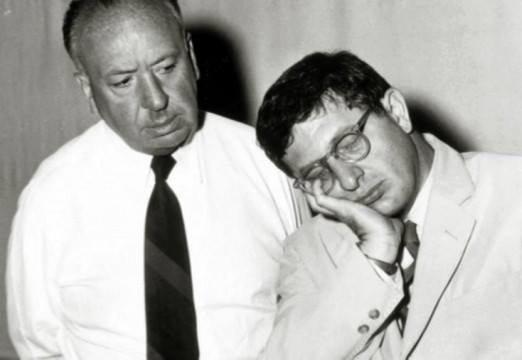
    By the time Hitchcock and Herrmann began work on “Torn Curtain,” in 1966, the tension between director and composer neared the breaking point. When Hitch learned Herrmann hadn’t produce what he had requested, the composer was fired halfway through the first day’s recording sessions. Of course, Herrmann had defied Hitch before – when the director instructed him that the shower scene in “Psycho” should play without music!

    Herrmann’s replacement was John Addison, who was a hot commodity at the time, having won the Academy Award in 1963 for his music for Tony Richardson’s freewheeling adaptation of “Tom Jones.” Ironically, instead of going “popular,” as the studio wanted, save for one incongruous, Mancini-esque song at the end, Addison did what all of Hitch’s subsequent composers did – he emulated Herrmann. “Torn Curtain” failed to gain traction with younger audiences, and the film was not a success.

    Herrmann and Hitchcock would never work together again. The “Torn Curtain” debacle spelled the end of one of the greatest artistic partnerships in all of cinema. Chalk it up to another boneheaded decision by management.

    I hope you’ll join me for selections from Herrmann’s original, rejected score, alongside jettisoned music for “2001: A Space Odyssey” (by Alex North), “Edge of Darkness” (John Corigliano), and “The Battle of Britain” (Sir William Walton).

    Take it from a guy who knows a thing or two about rejection. We’ll show some belated appreciation for these talented, seasoned professionals who got the shaft, when we savor an hour of their rejected scores, on “Picture Perfect,” music for the movies, now in syndication on KWAX, the radio station of the University of Oregon!


    Remember, KWAX is on the West Coast, so there’s a three-hour difference for those of you listening in the East. Here are the respective air-times for all three of my recorded shows (with East Coast conversions in parentheses):

    PICTURE PERFECT, the movie music show – Friday on KWAX at 5:00 PM PACIFIC TIME (8:00 PM EASTERN)

    SWEETNESS AND LIGHT, the light music program – ALL NEW! – Saturday on KWAX at 8:00 AM PACIFIC TIME (11:00 AM EASTERN)

    THE LOST CHORD, unusual and neglected rep – Saturday on KWAX at 4:00 PM PACIFIC TIME (7:00 PM EASTERN)

    Stream all three, at the times indicated, by following the link!

    https://kwax.uoregon.edu/


    PHOTO: Hitch and Herrmann – who’d have predicted anything could have gone wrong?

  • Jules Verne Movie Music on KWAX Picture Perfect

    Jules Verne Movie Music on KWAX Picture Perfect

    This week on “Picture Perfect,” with the New Year only days away, we’ll greet the future with music from movies inspired by Jules Verne’s novels of science, progress, and adventure.

    We’ll hear selections from “20,000 Leagues Under the Sea,” composed by Paul J. Smith; “In Search of the Castaways,” by William Alwyn; “Journey to the Center of the Earth,” by Bernard Herrmann; and “Around the World in 80 Days,” by Victor Young.

    Of course, science and technology are all well and good for what they are, but there are times when the best solution is an expertly-wielded harpoon!

    Your grit and resourcefulness are always welcome on “Picture Perfect,” music for the movies, now in syndication on KWAX, the radio station of the University of Oregon!


    Remember, KWAX is on the West Coast, so there’s a three-hour difference for those of you listening in the East. Here are the respective air-times for all three of my recorded shows (with East Coast conversions in parentheses):

    PICTURE PERFECT, the movie music show – Friday on KWAX at 5:00 PM PACIFIC TIME (8:00 PM EST)

    SWEETNESS AND LIGHT, the light music program – ALL NEW! – Saturday on KWAX at 8:00 AM PACIFIC TIME (11:00 AM EST)

    THE LOST CHORD, unusual and neglected rep – Saturday on KWAX at 4:00 PM PACIFIC TIME (7:00 PM EST)

    Stream all three, at the times indicated, by following the link!

    https://kwax.uoregon.edu/

  • Classic Christmas TV Specials Music

    Classic Christmas TV Specials Music

    This week on “Picture Perfect,” we’ll think inside the box, with music from classic Christmas television specials.

    “The Snowman” (1982), based on the picture book by Raymond Briggs, is about a boy whose snowman comes to life and whisks him away on a journey to the North Pole. The show became enormously popular in the UK and through occasional showings on U.S. television. It was nominated for an Academy Award for Best Animated Short. Like the book, the film is wordless, using animation and music to tell its story, with the exception of an enchanting interlude, known as “Walking in the Air,” which employs a boy treble. “Walking in the Air” is easily the best-known music by Howard Blake. Blake turned 85 in October. Happy belated birthday!

    The television film “The Homecoming” (1971) stars Patricia Neal and Richard Thomas in a heart-warming story about a rural family Christmas in 1933. Written by Earl Hamner, the film’s success spawned the television series “The Waltons.” Jerry Goldsmith wrote the music. He would return to work on “The Waltons” – though as of “The Homecoming,” he had yet to write the show’s indelible theme.

    An adaptation of Charles Dickens’ “A Christmas Carol” (1954) was the subject of a special episode of the anthology series “Shower of Stars.” Fredric March plays Ebenezer Scrooge, and Basil Rathbone is Jacob Marley’s ghost. But it is Ray Middleton, who appears as both Scrooge’s nephew and the Spirit of Christmas Present, who is given arguably the show’s most memorable tune, “A Very Merry Christmas.” The teleplay and lyrics are by Maxwell Anderson, and the music is by Bernard Herrmann!

    Finally, Christmas time is here, happiness and cheer, with “A Charlie Brown Christmas” (1965). We’ll hear the Vince Guaraldi Trio perform selections from this most beloved of Christmas classics.

    For once, the snow has nothing to do with your television reception. I hope you’ll join me for a cookie plate full of classic Christmas specials, on “Picture Perfect,” now in syndication on KWAX, the radio station of the University of Oregon!


    Remember, KWAX is on the West Coast, so there’s a three-hour difference for those of you listening in the East. Here are the respective air-times of my recorded shows (with East Coast conversions in parentheses):

    PICTURE PERFECT, the movie music show – Friday on KWAX at 5:00 PM PACIFIC TIME (8:00 PM EST)

    THE LOST CHORD, unusual and neglected rep – Saturday on KWAX at 4:00 PM PACIFIC TIME (7:00 PM EST)

    Also, a reminder that tomorrow morning I’LL BE ADDING A THIRD SHOW to the mix: SWEETNESS AND LIGHT will debut at 8:00 AM PACIFIC TIME (11:00 AM EST) with a seasonal playlist calculated to charm and to cheer. I hope you’ll be able to join me then.

    Stream all three shows, at the times indicated, at the link!

    https://kwax.uoregon.edu/

  • Airport Movie Music on “Picture Perfect” Radio

    Airport Movie Music on “Picture Perfect” Radio

    This week on “Picture Perfect,” get ready to take flight, with music from movies about airports and airplanes.

    In the original “Airport” (1970), producer Irwin Allen established the prototype for disaster movies of all stripes by placing an all-star, aging cast in spectacular peril. Burt Lancaster! Dean Martin! George Kennedy! Jean Seberg! Jacqueline Bisset! Helen Hayes! The list goes on and on, longer than the longest runway. The bongo-laden theme is by veteran film composer Alfred Newman,” from the last of his over 200 scores.

    Another movie with something of the same feel is “The V.I.P.s” (1963), allegedly inspired by the real-life love-triangle of Vivien Leigh, Laurence Olivier, and Peter Finch. The story is set at London Heathrow Airport, where flights are delayed because of a dense fog. The film was written by Terrence Rattigan and the parts cast from another laundry list of stars, including Elizabeth Taylor, Richard Burton, Louis Jourdan, Maggie Smith, Rod Taylor, and Orson Welles, with Margaret Rutherford in an Academy Award-winning performance. The music is by Miklós Rózsa.

    By contrast, Steven Spielberg’s “The Terminal” (2004) is an (intentionally) comic take on the predicament of a hapless Eastern European who finds himself in a kind limbo, trapped in an international arrivals terminal in New York, after his country erupts into civil war, so that his passport and other documentation are no longer valid. His plight mirrors that of real-life Mehran Karimi Nasseri, an Iranian who lived for 17 years in a terminal at Charles de Gaulle Airport.

    Tom Hanks plays the unfortunate traveler, who makes the terminal his home, and Catherine Zeta-Jones the airline attendant with whom he strikes up a relationship. The music is by regular Spielberg collaborator John Williams, and I think you’ll find it quite different from the Williams known for his work on “Star Wars” and “Indiana Jones.”

    Finally, we’ll turn to the Alfred Hitchcock thriller “North by Northwest” (1959), a film in which Cary Grant encounters love and danger in, on, and from a variety of planes, trains, and automobiles. Planes are particularly significant. During the course of the film, it’s revealed that the title is in reference to a Northwest Airlines flight; Eve Kendall (Eva Marie Saint) must do all she can to avoid getting on a plane with Phillip Vandamm (James Mason); and of course, Roger Thornhill (Grant) flees from a strafing crop duster. Bernard Herrmann’s opening fandango propels us into the adventure.

    Rush more to Rushmore. Departure time below, for “Picture Perfect,” music for the movies, now in syndication on KWAX, the radio station of the University of Oregon!


    Remember, KWAX is on the West Coast, so there’s a three-hour difference for the Trenton-Princeton area. Here are the respective air-times of my recorded shows (with East Coast conversions in parentheses):

    PICTURE PERFECT, the movie music show – Friday on KWAX at 5:00 PACIFIC TIME (8:00 PM EDT)

    THE LOST CHORD, unusual and neglected rep – Saturday on KWAX at 4:00 PACIFIC TIME (7:00 PM EDT)

    Stream them here!

    https://kwax.uoregon.edu/

Tag Cloud

Aaron Copland (92) Beethoven (95) Composer (114) Film Music (123) Film Score (143) Film Scores (255) Halloween (94) John Williams (187) KWAX (229) Leonard Bernstein (101) Marlboro Music Festival (125) Movie Music (138) Opera (202) Philadelphia Orchestra (89) Picture Perfect (174) Princeton Symphony Orchestra (106) Radio (87) Ralph Vaughan Williams (85) Ross Amico (244) Roy's Tie-Dye Sci-Fi Corner (290) The Classical Network (101) The Lost Chord (268) Vaughan Williams (103) WPRB (396) WWFM (881)

DON’T MISS A BEAT

Receive a weekly digest every Sunday at noon by signing up here


RECENT POSTS