Tag: Film Scores

  • Dragon Movie Soundtracks Picture Perfect

    Dragon Movie Soundtracks Picture Perfect

    I don’t want to set the world on fire, goes the old Ink Spots classic; I just want to start a flame in your heart.

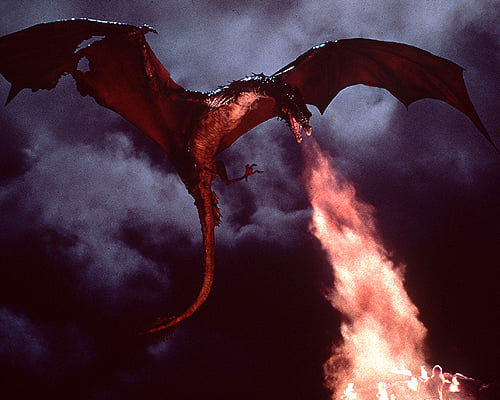
    This week on “Picture Perfect,” there be dragons!

    Who doesn’t enjoy a good dragon movie? Unfortunately, there are so few of them. Inevitably, the stories fail to live up to the production design, the special effects, and, yes, often the music.

    One score that Universal Pictures definitely took to, like a dragon to its hoard, was that for “Dragonheart,” from 1996. The film starred Dennis Quaid, with Sean Connery supplying the voice of the film’s dragon, Draco. The studio loved the music so much that it was used in its movie trailers for years, so don’t be surprised if you recognize it, even if you never saw the film. The composer was Randy Edelman.

    Alex North wrote one of the finest dragon scores for “Dragonslayer,” from 1981. “Dragonslayer” caused a bit of stir on its release, since it was an early foray by Disney into more mature territory. The film featured shocking (for the time) onscreen immolations and dismemberment.

    The story is a fairly generic sorcerer’s apprentice tale. However, the dragon, Vermithrax Pejorative, easily carries the movie, which also features a late performance by Sir Ralph Richardson as the master wizard. The composer reused portions of his rejected score for Stanley Kubrick’s “2001: A Space Odyssey.” A number of critics, including Pauline Kael, praised the result.

    The film was nominated for an Academy Award for its outstanding visual effects, but lost out to “Raiders of the Lost Ark.” George Lucas’ Industrial Light and Magic provided the effects for both films. In my humble assessment, Phil Tippett’s “go motion” dragon has yet to be surpassed.

    In 2010, Disney competitor Dreamworks released “How to Train Your Dragon,” a wholly computer-animated film. The story is one of forbidden friendship between a young Viking and a scaly representative of his tribe’s hereditary foes. Despite the Viking characters and setting, the score has an overt Celtic flavor and the actors speak with a Scottish bur(!). The music was by John Powell.

    Purely animated films are often more successful in creating an organic, believable world than those supposedly “live action” films that place actors in front of green screens and surround them with video game pyrotechnics. Only director Peter Jackson could have devised a way to pad J.R.R. Tolkien’s classic bedtime story, “The Hobbit,” into three bloated installments, darkening the tone, tying it in with lore from Tolkien’s “The Silmarillion,” and self-consciously anticipating the events in the equally self-indulgent film versions of “The Lord of the Rings.”

    Howard Shore supplied the music for all of the Middle Earth movies. He was recognized with three Academy Awards – one for “The Fellowship of the Ring,” in 2001, and two for “The Return of the King” in 2003, for which he also provided the Best Original Song. We’ll hear a selection of his music for the second of the films inspired by “The Hobbit,” subtitled “The Desolation of Smaug,” from 2013. The part of the dragon, by the way, was voiced by Benedict Cumberbatch.

    Feel the burn! Rekindle your affection for dragon movies, this Friday evening at 6:00 EDT, on WWFM – The Classical Network and wwfm.org.

  • Howard’s Barbarians Great Movie Music

    Howard’s Barbarians Great Movie Music

    In “Conan the Destroyer” (1984), one of Conan’s companions speculates, “I suppose nothing hurts you.”

    To which Conan replies, “Only pain.”

    Discriminating viewers may feel a little pain themselves watching these silly, cheesy, violent films, all of which were inspired by the writings of pulp master Robert E. Howard. Howard created the warrior Conan in 1932. The character became the center of a series of lucrative stories first published in “Weird Tales” magazine.

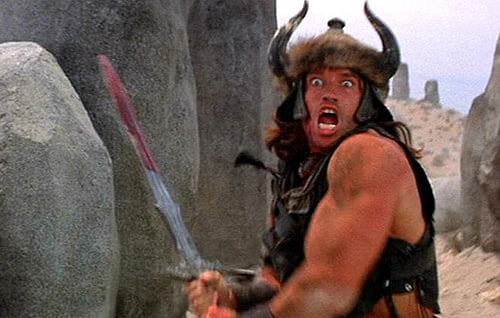
    It would be a half century before Conan made the leap to the big screen, under the direction of John Milius. “Conan the Barbarian” (1982) propelled Arnold Schwarzenegger, already a legend in the field of bodybuilding, to international superstardom. While “Conan” isn’t exactly “Citizen Kane,” it does have its pleasures. The intensity of the violence can be a little disturbing, but the ponderous tone is a blast. “Conan” is a film that takes itself just seriously enough to make it occasionally hilarious.

    Another thing “Conan” has going for it is the fact that it was made on a blockbuster budget. The first-rate production values extend to the music by Basil Poledouris, who employs a full symphony orchestra to impressive ends. In fact, the “Conan” score was one of the strongest of the decade. It’s amazing that anyone would find so much inspiration in such a mediocre film, but Poledouris’ music intersperses Borodin-style Central Asia lyricism with brawny, thrilling action music.

    Sadly, the sequel, “Conan the Destroyer,” betrays signs of penny-pinching, so that it often winds up feeling like a direct-to-video effort. Poledouris was forced to make do with a smaller orchestra, which sounds a bit too much like a television ensemble. Still, he gave it his all, and there’s something to be said for the fact that it is an original score, rather than a mere retread of the original.

    Another one of Howard’s creations, Kull of Atlantis, was given the big screen treatment as “Kull the Conqueror” (1997). Kevin Sorbo, TV’s Hercules, plays the title role. The composer, Joel Goldsmith (son of Jerry Goldsmith), was asked to incorporate heavy metal riffs into his orchestral underscore. I haven’t actually seen this one, but for some reason I don’t feel like I’m missing anything.

    The astoundingly prolific Ennio Morricone – who has more than 500 motion picture and television scores to his name – has an uncanny knack for spinning garbage into gold. His music for “Red Sonja” (1985) lends the film an aura of ‘80s cheese ball fun, perhaps more so than it deserves. This is the film that introduced Brigitte Nielsen as the chain-mailed barbarian beauty. Schwarzenegger appears in the supporting role of Lord Kalidor.

    In the ‘80s, even bad films had great scores. I hope you’ll give “Conan the Barbarian” a chance this week, on “Picture Perfect” – music for movies inspired by the writings of Robert E. Howard – this Friday evening at 6:00 EDT, on WWFM – The Classical Network and wwfm.org.

    BONUS! Tune in a little early (before 6) to hear selections from a virtuoso organ transcription of “Conan the Barbarian” by Philipp Pelster!

  • Labor Day Movie Music on Picture Perfect

    Labor Day Movie Music on Picture Perfect

    It’s nice to be able to look forward to a three-day weekend, when nobody expects you to get your butt in gear. Unless you’re Charlie Chaplin, that is.

    This week on “Picture Perfect,” we’ll have music from films about the working stiff, for Labor Day.

    “The Molly Maguires” (1970), set in and around the anthracite mines of Pennsylvania, illustrates the unfair labor practices imposed on immigrant workers there, which led to violent strikes and acts of sabotage. Sean Connery is the ringleader and Richard Harris the Pinkerton detective brought on to infiltrate the gang.

    The film was directed by Martin Ritt, a number of whose projects deal with labor, intimidation, and corruption, and his own experiences living through the era of the Hollywood blacklist – among these, “Edge of the City,” “The Front,” and “Norma Rae.”

    The music is by Henry Mancini, a far cry from his work on “The Pink Panther,” “Peter Gunn,” and “Breakfast at Tiffany’s,” with a decidedly Celtic lilt.

    Charlie Chaplin was a brilliant comedian, of course, but his perfectionism could manifest itself in uncomfortably close supervision over every aspect of his films. The young David Raksin found this out the hard way, when he accepted the job of assisting Chaplin in the writing of the score to “Modern Times” (1936).

    Chaplin, a violinist and cellist himself, would whistle tunes and then stand over Raksin’s shoulder as he figured out how to make them fit the action. Alfred Newman, a much more seasoned hand, stormed out of the recording sessions. Raksin was actually fired once, after only a week and a half, though he was quickly rehired. Despite the creative friction, the two men became friends, and Raksin recollected his work on “Modern Times” as some of the happiest days of his life.

    The film begins with an iconic factory scene, with Chaplin working an assembly line at an increasingly hectic pace, finally being put through the gears of the machinery. He suffers a breakdown, goes berserk, and throws the entire mechanized dystopia into chaos.

    Speaking of dystopias, few can match the OSHA-flouting nightmare of Fritz Lang’s “Metropolis” (1927). One of the landmarks of silent cinema, “Metropolis,” unfortunately, is eerily prescient of a world divided between the haves and the have-nots. Once seen, the subterranean hell of the workers’ hive is not soon to be forgotten.

    Lang’s vision continues to resonate in more ways than one, with its iconography shamelessly recycled by dew-eyed fans and film students down the generations. Similarly, Gottfried Huppertz’s influential, Straussian score led the way for the opulent symphonic canvases of Max Steiner, Erich Wolfgang Korngold, and John Williams.

    Finally, we’ll accept a helping hand – as well as claw, tail, beak, and tongue – from the benevolent woodland creatures of “Snow White and the Seven Dwarfs” (1937). Frank Churchill and Larry Morey’s songs are justifiably immortal.

    Whistle while you work, even as you look forward to a long weekend, on “Picture Perfect” – music for the movies – this Friday evening at 6:00 EDT, on WWFM – The Classical Network and wwfm.org.

  • Artist Biopics Soundtracks Picture Perfect

    Artist Biopics Soundtracks Picture Perfect

    How to translate visual art to the big screen? Generally, by focusing on the drama in the artists’ lives, that’s how.

    And what drama!

    This week on “Picture Perfect,” expand your palette with music from movies about the great artists.

    “The Agony and the Ecstasy” (1965), based on the novel of Irving Stone, dramatizes the friction between Michelangelo (Charlton Heston) and his benefactor, Pope Julius II (Rex Harrison), over the painting of the ceiling of the Sistine Chapel. For his part, Michelangelo would have been perfectly content to stick to sculpture. Alex North’s score is an Early Music banquet, with allusions to – and sometimes outright quotations of – music of the Renaissance.

    Stone had another bestseller in “Lust for Life” (1956), about the tormented Vincent van Gogh. This time Kirk Douglas plays one of his most sympathetic roles – and looks remarkably like the artist. Anthony Quinn turns up as his “frenemy,” the painter Paul Gaugin, and earns an Academy Award for Best Supporting Actor. The great Miklós Rózsa wrote the music, softening up the edges of his brawny Hungarian sound with the softer palette of the French Impressionists.

    John Huston brought Pierre La Mure’s novel about Henri de Toulouse-Lautrec to the big screen as “Moulin Rouge” (1952) – not to be confused with the more recent Baz Luhrmann spectacle starring Nicole Kidman and Ewan McGregor, which relegated the artist to a supporting role. José Ferrer dominates the earlier version, spending most of the film walking through off-camera trenches and shuffling along on his knees. Georges Auric, one of the composers of Les Six (which also included Francis Poulenc and Darius Milhaud), captures the spirit of the titular cabaret. The score became one of Auric’s best-known, thanks to the waltz becoming a popular hit, “Where is Your Heart.”

    “The Picasso Summer” (1969) is a departure from the usual formula of focusing on the artist himself. Instead, a young couple (Albert Finney and Yvette Mimieux), admirers of Picasso’s work, take off on a European adventure in an attempt to track him down. Originally Picasso himself had agreed to appear, but some off-screen drama involving a matador friend and Yul Brynner’s wife drove him off. The film was based on a short story by Ray Bradbury. Bradbury hated the adaptation, as did the studio, and “The Picasso Summer,” after being heavily cut and patched with new footage, was never released theatrically in the United States. The film is striking for its extended animation sequences inspired by Picasso’s paintings, and for its score by Michel Legrand.

    Join me for a brush with greatness – music from movies about the great artists – on “Picture Perfect,” this Friday evening at 6:00 EDT, on WWFM – The Classical Network and wwfm.org.

  • Summer Film Scores A European Vacation Soundtrack

    Summer Film Scores A European Vacation Soundtrack

    With two weeks left in August, there’s still time for a quick European vacation. This week on “Picture Perfect,” we glance across the pond for an hour of music from foreign films with summer settings.

    “A Summer Story” (1988), based on a tale of John Galsworthy, tells of a young London lawyer and a farm girl who fall profoundly in love at the turn of last century. Georges Delerue provides the poignant score.

    The juxtaposition of “Igmar Bergman” and “comedy” may seem like something of an oxymoron, but the dour Swede’s “Smiles of a Summer Night” (1955) proves to be a witty examination of the folly of the human heart. Frequent Bergman collaborator Erik Nordgren wrote the music.

    Director Yves Robert adapted the memoirs of Marcel Pagnol, who spent his childhood summers in the south of France, into two lovely films, “My Father’s Glory” and “My Mother’s Castle” (1990). We’ll hear music composed for both by Vladimir Cosma. Pagnol’s experiences in Provence marked him for life, informing the films and writings of his maturity, including “The Baker’s Wife,” and “Jean de Florette.”

    Finally, we’ll have a generous sampling from one of Ennio Morricone’s most beloved scores, that for “Cinema Paradiso” (1988). “Cinema Paradiso,” set in a post-war Sicily where it seems always to be summer, is a nostalgic paean to the shared experience of film and the significance it holds in our lives. It won a special jury prize at the Cannes Film Festival and was honored with an Academy Award for Best Foreign Film.

    Music is the universal language. Join me for summer overseas on “Picture Perfect,” this Friday evening at 6:00 EDT, on WWFM – The Classical NetworkWWFM and wwfm.org.

Tag Cloud

Aaron Copland (92) Beethoven (95) Composer (114) Film Music (123) Film Score (143) Film Scores (255) Halloween (94) John Williams (187) KWAX (229) Leonard Bernstein (101) Marlboro Music Festival (125) Movie Music (138) Opera (202) Philadelphia Orchestra (89) Picture Perfect (174) Princeton Symphony Orchestra (106) Radio (87) Ralph Vaughan Williams (85) Ross Amico (244) Roy's Tie-Dye Sci-Fi Corner (290) The Classical Network (101) The Lost Chord (268) Vaughan Williams (103) WPRB (396) WWFM (881)

DON’T MISS A BEAT

Receive a weekly digest every Sunday at noon by signing up here


RECENT POSTS